
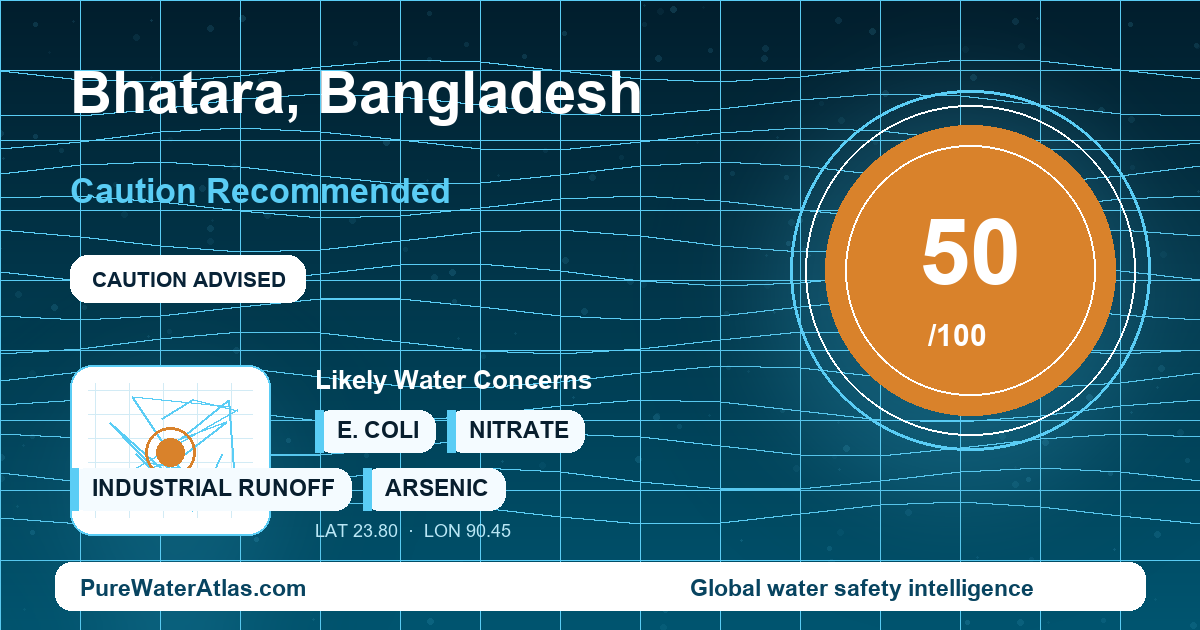
Bhatara, Bangladesh: Dhaka WASA network water, building storage tanks, and why point-of-use treatment is recommended before drinking.
Quick Answer
| Overall safety status | Caution recommended. Bhatara is an area of northeastern Dhaka, not a separate municipal water system. Tap water should not be assumed safe at the kitchen tap unless it has been treated or verified at the point of use. |
|---|---|
| Water safety score | 50 / 100 — risk level: Caution Recommended. |
| Traveler advice | Visitors should avoid untreated tap water in Bhatara. Use sealed bottled water, or water that has been properly boiled, filtered, or UV-treated by a reliable provider. |
| Resident advice | Residents should treat drinking and cooking water at home and pay close attention to rooftop tanks, underground reservoirs, internal plumbing, and water changes after repairs or outages. |
| Main water source context | Bhatara is served within the Dhaka WASA metropolitan system, which uses a combination of deep groundwater production wells and treated surface-water sources such as the Saidabad and Padma/Jashaldia systems. The exact source blend for an individual Bhatara building is not publicly reported at neighborhood level. |
| Responsible authority | Dhaka Water Supply and Sewerage Authority, commonly called Dhaka WASA. |
| Filter recommendation | A home treatment barrier is recommended: sediment filtration plus activated carbon, with UV, ultrafiltration, or reverse osmosis selected according to test results. Boiling helps with microbial risk but does not remove arsenic, lead, nitrate, salts, or many chemical contaminants. |
Why Bhatara Is Different
Bhatara’s drinking-water question is different from a typical city profile because Bhatara is not a standalone water utility area. It is a northeastern Dhaka area within the Dhaka North City Corporation urban growth corridor, near Gulshan, Baridhara, Bashundhara, Natun Bazar, and the low-lying eastern fringe of the city. Its tap water is best understood as part of the wider Dhaka WASA supply and distribution context, followed by a highly local building-level system of pumps, underground reservoirs, rooftop tanks, and internal plumbing.
That last part matters. For many households in Bhatara, the water a person drinks has usually passed through an underground storage tank, a rooftop tank, and apartment or building plumbing before it reaches the kitchen tap. Even if incoming utility water has been treated, building reservoirs and rooftop tanks can become the practical point of recontamination if they are dirty, uncovered, cracked, poorly screened, or cleaned infrequently. In Bhatara, building maintenance records and kitchen-point treatment can be as important as the broader Dhaka WASA source-water system.
The most defensible advice is therefore cautious: do not drink untreated tap water in Bhatara unless the water has been verified at the point of use. The confidence level for this profile is medium because Dhaka-wide utility and source-water information is available, along with Bangladesh-wide public-health water-quality evidence, but recent Bhatara-specific official tap sampling results are not available in a consistent public dataset.
Where Does Bhatara’s Tap Water Come From?
Bhatara is within the Dhaka metropolitan piped-water service context supplied by Dhaka Water Supply and Sewerage Authority. Dhaka’s raw-water system combines deep groundwater production wells with treated surface-water sources. Important surface-water infrastructure includes the Saidabad Water Treatment Plant, which treats water drawn from the Shitalakhya River system, and the Padma/Jashaldia surface-water treatment and transmission system, which was developed to reduce reliance on groundwater. However, the exact source blend reaching a specific apartment, office, or house in Bhatara is not publicly reported at neighborhood level.
Historically, Dhaka relied heavily on groundwater from deep tube wells. Official and development-bank project documents describe a long-term shift toward more treated surface water because of pressure on aquifers, falling groundwater levels, and the need for a more sustainable citywide supply. This is relevant to Bhatara because the area is part of the wider Dhaka network rather than an independent local source. A building in Bhatara may receive water that reflects Dhaka-wide production, treatment, transmission, and distribution conditions, then experience additional changes inside the property.
Key infrastructure affecting Bhatara includes Dhaka WASA production wells, transmission and distribution mains, the Saidabad Water Treatment Plant, the Padma/Jashaldia surface-water treatment and transmission infrastructure, local distribution mains, service connections, booster pumping, underground reservoirs, rooftop tanks, and internal building plumbing. The main water-safety issue is not a unique Bhatara river intake; it is the combination of Dhaka-wide source-water stress, distribution-network pressure, dense urban construction, and property-level storage.
Who Manages Drinking Water in Bhatara?
Dhaka Water Supply and Sewerage Authority, commonly called Dhaka WASA, is the responsible urban water utility for Dhaka, including areas such as Bhatara that are inside the Dhaka city service context. Dhaka WASA manages the citywide supply infrastructure, while water quality inside an individual building can also depend on local reservoirs, rooftop tanks, pumps, plumbing materials, and maintenance practices.
Urban piped water in Dhaka is supplied under Bangladesh’s water-supply governance framework, with national drinking-water standards and public-health responsibilities involving government bodies such as the Ministry of Local Government, Rural Development and Cooperatives, the Department of Public Health Engineering, and environmental-health regulators. For a Bhatara household, the important practical limitation is that publicly accessible compliance reporting is not available at the neighborhood or building level in a consistent way. Point-of-use safety should not be assumed from citywide infrastructure information alone.
This is especially important in fast-growing areas on the Bhatara-Bashundhara-Baridhara side of Dhaka, where rapid urbanization has increased water demand and dependence on pumps, storage tanks, and local distribution extensions. Those conditions can create more opportunities for pressure fluctuations, repairs, sediment disturbance, and inconsistent building-level hygiene.
Main Local Water Concerns
The most important Bhatara-specific concern is microbial risk at the point of use. Underground reservoirs and rooftop tanks can introduce or amplify contamination if they are not covered, screened, cleaned, and disinfected on a routine schedule. In practical terms, E. coli and total coliform testing at the kitchen tap is more useful for a resident than relying on assumptions about the city network.
Turbidity and sediment are also relevant in Bhatara. Roadworks, construction, pipe repairs, pressure changes, pump problems, or tank disturbance can produce visible particles, cloudy water, color changes, or odor changes. These changes should trigger flushing, tank inspection, and, where appropriate, microbial testing.
Low or inconsistent chlorine residual can be a concern by the time water reaches rooftop tanks or household taps. A disinfectant residual can decline during storage, especially when tanks are dirty or water is stagnant. Taste, odor, iron, and manganese complaints can occur in groundwater-influenced supplies or old internal plumbing, but these issues require site-specific testing rather than neighborhood-wide assumptions.
Lead risk in Bhatara should be treated mainly as a building-plumbing issue, not as a proven Bhatara-wide source-water problem. Older fittings, solder, fixtures, and service connections should be assessed in older properties, especially where children or pregnant residents are present. Arsenic is a major Bangladesh groundwater concern nationally, but risk for a Dhaka WASA-connected building cannot be inferred without testing. Any private tube well or supplemental groundwater source used by a building should be tested specifically for arsenic.
Seasonal conditions can change risk. Monsoon rainfall can increase turbidity, drainage overflow, flooding, and contamination pathways around broken pipes, low-pressure sections, and building reservoirs. During the dry season, lower river flows can concentrate pollution in urban river sources, increasing treatment difficulty and potential taste or odor concerns if treatment processes are disrupted. Power outages, pump failures, pressure drops, roadworks, and local construction can all increase intrusion or sediment risks in vulnerable sections.
For Travelers
Short-stay visitors in Bhatara should not drink untreated tap water. The safest default is sealed bottled water with an intact cap, or water that has been properly boiled, filtered, or UV-treated by a trustworthy provider. This advice applies even if the water looks clear or has a chlorinated smell, because appearance alone does not verify microbial safety at the tap.
For brushing teeth, visitors should use bottled or boiled water, especially if they are immunocompromised, pregnant, traveling with young children, or prone to stomach illness. Long-term residents may be accustomed to using household-treated water, but that does not mean untreated tap water is a good choice for travelers.
Ice is a common risk pathway. Avoid ice unless a hotel, serviced apartment, or restaurant can confirm that it was made from purified water. Higher-end hotels, serviced apartments, and established restaurants in the Gulshan-Baridhara-Bashundhara area may use filtration systems or bottled water, but this should be verified rather than assumed.
If using a filter bottle, choose one rated for bacteria and protozoa. For more conservative protection in a residence or extended stay, use a maintained multi-stage system. Travelers who are highly risk-averse should also avoid raw foods washed in unknown water. The CDC Travelers’ Health guidance for Bangladesh supports cautious food and water practices for visitors.
For Residents
Residents in Bhatara should use a treatment barrier for drinking and cooking water. A practical household setup is sediment filtration plus activated carbon, followed by UV, ultrafiltration, or reverse osmosis depending on laboratory results and the building’s water characteristics. Boiling is useful when microbial safety is the immediate concern, and PureWaterAtlas explains the method in the Boiling Water Purification: Complete Guide. However, boiling does not remove arsenic, lead, nitrate, salts, or many chemical contaminants.
Routine testing should be based on the building, not just the neighborhood. Test kitchen-tap water for E. coli and total coliform, especially after tank cleaning, pipe repair, flooding, odor changes, or long water interruptions. If the building uses any private tube well or supplemental groundwater source, test for arsenic, iron, manganese, electrical conductivity or TDS, and nitrate. If the building is older or has unknown pipe materials, metallic taste, brass fixtures of uncertain quality, or children and pregnant residents in the household, test for lead using appropriate sampling.
Older buildings and buildings with poorly documented plumbing can add risk through corroded pipes, old fixtures, stagnant lines, and possible lead-bearing components. If lead is a concern, flush stagnant water before use and consider both first-draw and flushed samples. PureWaterAtlas has dedicated guides on lead testing and arsenic testing.
Storage tanks deserve special attention in Bhatara. Underground reservoirs and rooftop tanks should be covered, screened, cleaned, and disinfected on a routine schedule. Dirty tanks can introduce E. coli, turbidity, insects, biofilm, and loss of chlorine residual even when the incoming utility water was treated. Sudden visible sediment, color, odor, or taste changes should trigger tank inspection, flushing, and testing rather than continued untreated use.
Relevant Contaminants and Water-Quality Issues
The most relevant water-quality issues for Bhatara are those that can arise from the combined Dhaka supply network and building-level storage. Microbial indicators such as E. coli are especially important because they indicate fecal contamination risk at the point where water is actually consumed. Turbidity and sediment matter because cloudy or particle-laden water can signal disturbance, tank contamination, or treatment challenges.
Chlorine is relevant because residual disinfectant may decline before water reaches rooftop tanks or household taps. Iron and manganese can affect taste, color, staining, and acceptability, especially where groundwater influence or old plumbing is involved. Arsenic and lead require direct testing: arsenic is nationally important in Bangladesh groundwater, while lead is mainly a plumbing-material concern for individual buildings.
How to Verify Your Water Quality
The best way to verify drinking water safety in Bhatara is to test the water that actually comes from the kitchen tap after it has passed through the building’s tanks and plumbing. For health-critical contaminants such as bacteria, arsenic, lead, and nitrate, use an accredited laboratory where possible rather than relying only on simple home strips. Test again after plumbing work, tank cleaning, flooding, long service interruptions, pump failures, or unexplained odor, color, or sediment changes.
For a broader framework, see PureWaterAtlas resources on water testing, drinking water safety, water microbiology, and water treatment systems. You can also compare risks using the Global Water Quality Checker and look up specific substances in the Contaminants Search Engine. Related category pages include Drinking Water Safety, Global Water Quality, Water Testing, and Water Microbiology.
Official and Technical Sources
- Dhaka Water Supply and Sewerage Authority — official utility responsible for Dhaka’s piped water supply and water-sector projects, including the system serving Bhatara.
- Asian Development Bank: Dhaka Environmentally Sustainable Water Supply Project — describes Dhaka’s shift toward treated surface water and reduced reliance on groundwater.
- Asian Development Bank: Dhaka Water Supply Network Improvement Project — documents network-improvement needs relevant to pressure, leakage, and service reliability concerns.
- World Bank: Dhaka Water Supply and Sanitation Project — provides citywide water-supply and sanitation infrastructure context.
- WHO and UNICEF Joint Monitoring Programme: Bangladesh 2019 MICS Water Quality Thematic Report — provides Bangladesh public-health water-quality evidence, including microbial risk context at household drinking-water points.
- CDC Travelers’ Health: Bangladesh — supports conservative traveler guidance on safe food and water practices.
- UNICEF Bangladesh: Water, Sanitation and Hygiene — background on Bangladesh water, sanitation, hygiene, arsenic, and microbial water-safety challenges.
Bottom Line
Bhatara’s tap water should be approached with caution. The area is part of northeastern Dhaka and is served within the Dhaka WASA network, but the final water quality at a kitchen tap can depend heavily on building reservoirs, rooftop tanks, pumps, and internal plumbing. Visitors should avoid untreated tap water and use sealed bottled, boiled, filtered, or reliably UV-treated water. Residents should use a maintained home treatment system, clean and disinfect storage tanks routinely, and test kitchen-tap water for microbial contamination after repairs, flooding, outages, or tank disturbance. Because recent Bhatara-specific official tap-water data is not available in a consistent public dataset, point-of-use treatment and periodic testing are the most reliable safeguards.
Read the full guide: Global Water Quality Guide
Explore more in this category: Global Water Quality Articles