
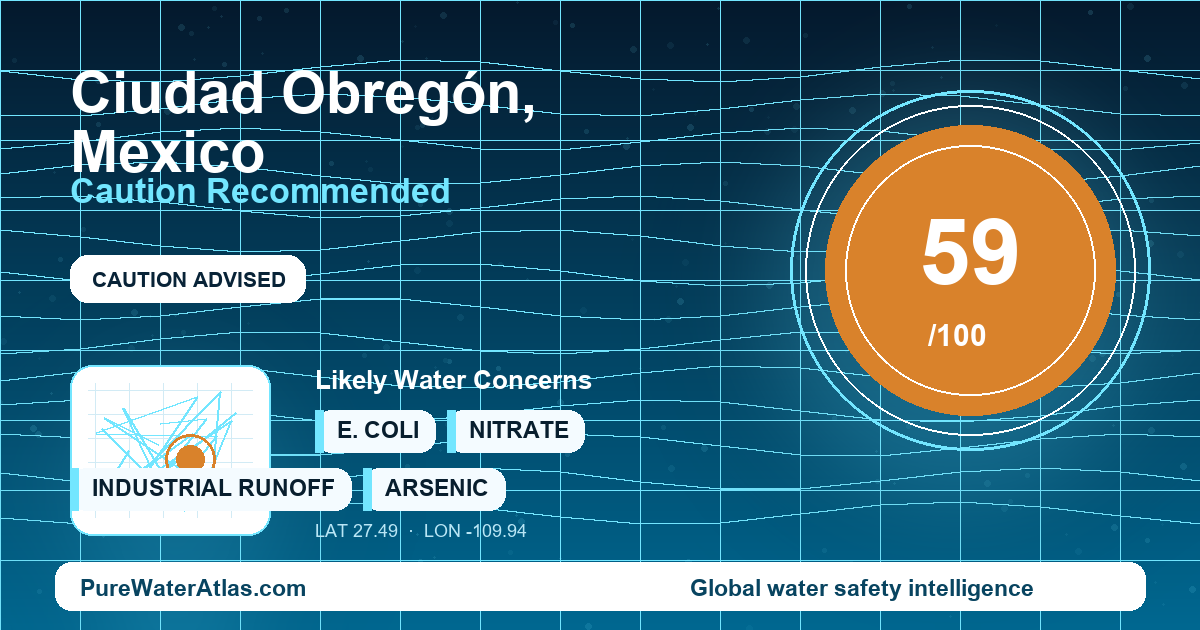
Ciudad Obregón, Sonora: treated municipal water in the Yaqui Valley, with caution recommended for drinking because of limited public compliance data, source-water stress, distribution conditions, and household storage risks.
Quick Answer
| Overall safety status | Caution Recommended — Water safety score: 59/100. Ciudad Obregón has a formal municipal water utility and treated public supply, but the public evidence is not strong enough to recommend untreated tap water as a default drinking source for visitors or new residents. |
|---|---|
| Can tourists drink the tap water? | Short-term visitors should use sealed bottled water, commercial garrafón water, or properly filtered water for drinking. Tap water is generally more reasonable for bathing and handwashing. |
| Resident advice | Treat safety as a household-level question. Storage tanks, rooftop tinacos, old plumbing, pressure interruptions, and private or supplemental wells can change water quality at the tap. |
| Main water source context | Ciudad Obregón is tied to the Yaqui River reservoir and irrigation-canal system, including Presa Álvaro Obregón, also known as Oviáchic. Some wider Cajeme areas may also use wells or supplemental groundwater. |
| Water authority | Organismo Operador Municipal de Agua Potable, Alcantarillado y Saneamiento de Cajeme, commonly OOMAPAS de Cajeme. |
| Filter recommendation | For many homes, a sediment prefilter plus activated carbon is a practical baseline. Reverse osmosis is more appropriate when testing shows high dissolved solids, nitrate, arsenic, fluoride, or other dissolved contaminants. UV can help with microbial risk only when paired with good prefiltration and maintenance. |
Why Ciudad Obregón Is Different
Ciudad Obregón is not a coastal resort city where the main drinking-water question is usually framed around tourism infrastructure. It is an inland city in the arid-to-semiarid Yaqui Valley of southern Sonora, one of Mexico’s major agricultural districts. That setting matters for water safety because the local water picture is shaped by Yaqui River storage, irrigation-canal operations, drought, heat, and agricultural watershed pressure.
The city’s modern identity grew around the irrigated Yaqui Valley. The region is closely associated with the Yaqui River dam system and large-scale agricultural irrigation rather than a single protected spring or mountain aqueduct. Presa Álvaro Obregón, commonly called Oviáchic, is one of the best-known storage features linked to the region. As a result, water reliability in Ciudad Obregón is connected not only to municipal treatment but also to reservoir levels, canal management, seasonal runoff, and drought conditions in Sonora.
For a traveler, the most practical sign of caution is local behavior: bottled water and garrafón water are commonly used even in homes connected to the municipal network. That does not prove that every municipal tap is unsafe. It does show that many residents prefer a secondary drinking-water barrier because of taste, household plumbing, storage tanks, and intermittent-service concerns.
Where Does Ciudad Obregón’s Tap Water Come From?
Ciudad Obregón’s urban supply is commonly associated with the Yaqui River reservoir and irrigation-canal system. Surface water stored in the Yaqui River dam network, including Presa Álvaro Obregón/Oviáchic, is conveyed through canals before municipal treatment. Publicly available information also indicates that parts of the wider municipality of Cajeme may use wells or supplemental groundwater, although the exact neighborhood-by-neighborhood source split is not readily available in a single public source.
The key infrastructure includes the Yaqui River reservoir network, irrigation-canal conveyance serving the Yaqui Valley, municipal potable-water treatment and distribution infrastructure, pumping and storage systems, and pressure zones across Ciudad Obregón and Cajeme. The final step to the tap often includes private building plumbing and storage, such as cisterns, rooftop tanks, tinacos, and household garrafón systems.
This last step is important. Even when water is treated before entering the distribution network, quality at a hotel room, apartment, older house, school, or business can be affected by local pressure events, pipe repairs, sediment resuspension, stagnant plumbing, and the cleanliness of private tanks. In Ciudad Obregón, as in many Mexican cities, the condition of the building can be just as important as the condition of the municipal source.
Who Manages Drinking Water in Ciudad Obregón?
Municipal water and sewer service in Ciudad Obregón is handled by OOMAPAS de Cajeme, the Organismo Operador Municipal de Agua Potable, Alcantarillado y Saneamiento de Cajeme. The Gobierno Municipal de Cajeme is also relevant for local public-service context and municipal announcements.
At the national level, drinking water in Mexico is governed by federal health standards, principally NOM-127-SSA1-2021, the Mexican standard for water for human use and consumption. Federal public-health oversight involves the Secretaría de Salud and COFEPRIS, while state sanitary authorities such as Secretaría de Salud Sonora participate in health surveillance. CONAGUA’s Sistema Nacional de Información del Agua provides hydrologic and water-infrastructure context, and the CONAGUA drought monitor is relevant because drought in Sonora can affect reliability and source-water conditions.
Data availability is a key limitation. City-level institutional information is available, but recent, easily downloadable tap-by-tap or neighborhood-level laboratory results for Ciudad Obregón are limited in public sources. This profile does not claim that every neighborhood currently meets or fails specific limits. The recommendation is therefore cautious and based on source-water context, infrastructure risk pathways, regulatory structure, traveler-health guidance, and practical household risk factors.
Main Local Water Concerns
The most important concern for Ciudad Obregón is not a single proven contaminant exceedance across the city. It is the combination of treated surface-water supply, arid agricultural watershed context, distribution-system interruptions, and household storage. Microbial risk can increase after low-pressure events, pipe repairs, flooding, contaminated cisterns or tinacos, or loss of disinfectant residual. This is a risk pathway, not a claim that E. coli is currently present in the municipal supply.
Turbidity and sediment are plausible short-term concerns after monsoon storms, canal disturbances, main breaks, flushing, or repair work. If water is cloudy, gritty, or visibly discolored, do not use it for drinking until it clears and, if needed, is filtered and boiled for microbial protection. Learn more about turbidity in drinking water and sediment in drinking water.
Chlorine taste or odor may be noticeable because residual disinfectant is used to help protect water in the distribution system. A mild chlorine smell is not automatically dangerous. A sudden strong odor, or no detectable residual after an outage, can justify caution and testing. PureWaterAtlas has a dedicated guide to chlorine in drinking water.
Because Ciudad Obregón sits in an intensive agricultural valley, nitrate and pesticide-related source-water screening are relevant testing priorities, especially for private wells or unclear sources. This does not mean city tap water is being claimed to exceed nitrate limits. It means nitrate is a sensible contaminant to include in testing for wells, infants, pregnant residents, or homes near agricultural influence. Salinity, hardness, total dissolved solids, chloride, sulfate, and conductivity are also relevant in arid Sonora, particularly where groundwater influence is possible.
For Travelers
For short stays in Ciudad Obregón, do not rely on untreated tap water as your main drinking source. Use sealed bottled water, commercial garrafón water, or water that has passed through a well-maintained purifier. This is especially important for children, pregnant travelers, older adults, and immunocompromised people.
Brushing teeth with tap water in established hotels is usually lower risk than drinking full glasses of tap water, but cautious travelers should use bottled or purified water. Always switch to bottled water if the tap is cloudy, has sediment, smells unusual, or if there has been a recent outage or repair in the area.
For ice, ask whether it is made from purified water. Locally, purified ice may be described as hielo purificado. Ice in established hotels and restaurants is generally lower risk than ice from informal or unknown sources, but sensitive travelers should ask rather than assume.
Many hotels, restaurants, and cafes in Ciudad Obregón use garrafón water, filtered water, or commercial purified ice for customer service. Do not assume the bathroom tap water is the same water used for drinking service. During hot weather, carry bottled water, avoid outdoor taps or unknown refill containers, and treat post-outage or visibly turbid water as suspect. Boiling can reduce microbial risk, but it does not remove salts, metals, nitrate, pesticides, or many industrial chemicals. See the PureWaterAtlas boiling water purification guide for when boiling helps and when it does not.
For Residents
Residents should treat Ciudad Obregón tap-water safety as a building-level and household-level question. A maintained point-of-use system, a clean cistern or rooftop tank, and periodic lab testing are advisable, especially in older homes, rentals, homes with low pressure, properties with storage tanks, or any residence using a private or supplemental well.
A practical home setup often starts with a sediment prefilter and activated carbon to improve taste, chlorine, and particulates. Reverse osmosis is more appropriate when testing shows elevated total dissolved solids, nitrate, arsenic, fluoride, or other dissolved contaminants. UV can be useful for microbial protection after tank storage or well use, but only after sediment filtration and only if the lamp, sleeve, flow rate, and maintenance schedule are correct. For system selection, see Water Treatment Systems and the UV Water Purification guide.
Recommended testing for Ciudad Obregón households includes total coliform and E. coli at least annually if you use a cistern, rooftop tank, private well, or experience frequent pressure interruptions. Test nitrate if the home is near agricultural areas, uses a well, or serves infants or pregnant residents. Test total dissolved solids, hardness, chloride, sulfate, and conductivity if the water tastes salty, leaves heavy scale, or varies seasonally. If groundwater is used or source information is unclear, test arsenic and fluoride because these are regional concerns in parts of northern and northwestern Mexico.
Older buildings can contribute lead, copper, metals, or sediment independently of the municipal source. Flush stagnant water in the morning, avoid using hot tap water for cooking or infant formula, and test both first-draw and flushed samples if lead is a concern. Cisterns and rooftop tanks should be kept sealed, inspected, cleaned, disinfected, and retested after any contamination event.
Relevant Contaminants and Water-Quality Issues
For Ciudad Obregón, the most relevant PureWaterAtlas contaminant profiles are practical rather than alarmist. Start with E. coli for microbial risk after pressure loss, contaminated tanks, or inadequate disinfection. Review turbidity and sediment for storm runoff, canal-source changes, old plumbing, and main disturbances. Read chlorine to understand disinfectant residual and taste issues.
Residents using wells or living with agricultural-source uncertainty should review nitrate in drinking water and the detailed guide to nitrate testing and detection methods. Where groundwater influence is possible, arsenic and the arsenic testing guide are also relevant. For older homes, rentals, schools, and buildings with old fixtures, review lead in drinking water and lead testing methods.
Because the city is located in the Yaqui Valley, the PureWaterAtlas article on agricultural runoff in drinking water is especially relevant for understanding why nitrate and pesticide-related screening can be prudent without assuming a confirmed citywide violation.
How to Verify Your Water Quality
The best way to answer “is my tap water safe?” in Ciudad Obregón is to test the water actually coming from your tap, especially if your home uses a cistern, rooftop tank, private well, or older plumbing. Use an accredited or reliable laboratory where possible, and choose tests based on the local risk pathways: microbial indicators, nitrate, dissolved minerals, arsenic and fluoride when groundwater is possible, and lead or copper in older buildings.
PureWaterAtlas resources that can help include the Water Testing guide, the Contaminants Search Engine, and the Global Water Quality Checker. For broader context, see Drinking Water Safety, Global Water Quality, and Water Microbiology.
Official and Technical Sources
- OOMAPAS de Cajeme — municipal water and sewer utility for Cajeme, including Ciudad Obregón.
- Gobierno Municipal de Cajeme — official municipal portal.
- CONAGUA Sistema Nacional de Información del Agua — hydrologic and water-infrastructure context.
- CONAGUA Monitor de Sequía en México — official drought-monitoring source.
- NOM-127-SSA1-2021 — Mexico’s drinking-water quality standard for water for human use and consumption.
- COFEPRIS — federal sanitary-risk authority.
- Secretaría de Salud Sonora — state health authority.
- CDC Travelers’ Health: Mexico — conservative travel-health guidance.
- WHO Guidelines for Drinking-water Quality — international drinking-water risk-management reference.
Bottom Line
Caution is recommended for drinking tap water in Ciudad Obregón. The city has a formal municipal utility and treated supply connected to the Yaqui River reservoir and canal system, but recent neighborhood-level public compliance data are limited. For travelers, sealed bottled water, garrafón water, or verified purified water is the safer default for drinking and ice. For residents, the main question is often the condition of the building: cisterns, rooftop tanks, old plumbing, pressure interruptions, and possible groundwater influence can all affect tap quality. A maintained filter system, clean storage tanks, and periodic testing for microbial indicators, nitrate, dissolved minerals, metals, and relevant groundwater contaminants provide the best practical protection.
Read the full guide: Global Water Quality Guide
Explore more in this category: Global Water Quality Articles