
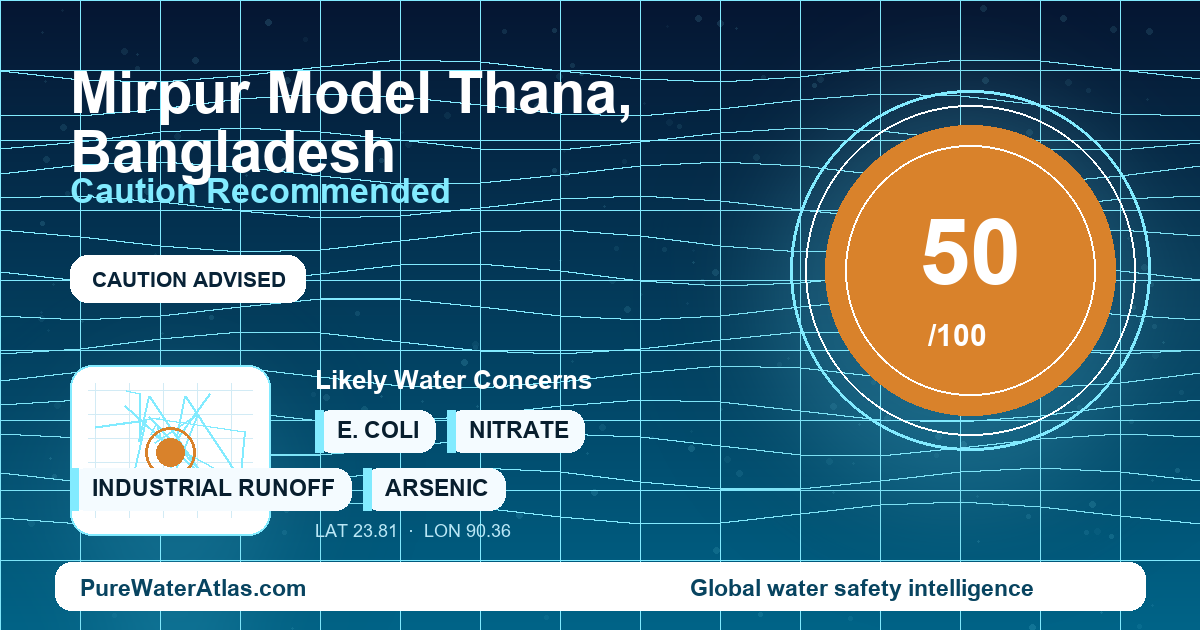
Mirpur Model Thana, Bangladesh: tap water safety score 50/100 — caution recommended because Dhaka WASA supply quality can change after treatment in distribution pipes, building reservoirs, rooftop tanks, and older internal plumbing.
Quick Answer
| Overall status | Caution recommended. Mirpur Model Thana is inside the Dhaka WASA metropolitan water system, not a separate municipal water utility. Untreated tap water should not be assumed safe at every tap. |
|---|---|
| Water safety score | 50/100 — variable-quality urban supply with important distribution, pressure, storage-tank, and household-plumbing risks. |
| Traveler advice | Short-term visitors should use sealed bottled water or water that has been properly boiled, filtered, or treated by a reliable hotel or restaurant system. |
| Resident advice | Use a multi-barrier approach based on your building: sediment filtration, carbon if needed for taste or chlorine, and a disinfection step such as boiling, UV, ultrafiltration, or reverse osmosis when testing supports it. |
| Main source identity | Dhaka WASA network water: historically deep groundwater production wells, with treated surface-water supply from major facilities such as Sayedabad Water Treatment Plant and newer bulk-water projects. |
| Water authority | Dhaka Water Supply and Sewerage Authority, commonly Dhaka WASA. |
| Filter recommendation | Often advisable. At minimum, consider sediment filtration plus reliable microbial control. Choose reverse osmosis, UV, ultrafiltration, or other systems only after considering tap testing and building-tank conditions. |
Why Mirpur Model Thana Is Different
Mirpur Model Thana is a dense urban area in northern Dhaka, and its drinking-water risk is best understood as part of the wider Dhaka metropolitan system. The question is not simply whether water leaves a treatment plant meeting a target. For many Mirpur households, the more practical question is what happens after water enters the local distribution network, reaches a building reservoir, is pumped to a rooftop tank, and finally sits in internal plumbing before reaching the kitchen tap.
The local risk profile is shaped by Dhaka’s combination of high demand, long-running groundwater dependence, surface-water expansion, distribution-network rehabilitation, and common building-level storage. A Mirpur apartment tap may be affected by low pressure, pipe repairs, old internal fittings, tank sediment, tank lids, pump maintenance, and whether water has stagnated overnight. For that reason, two nearby homes can have different practical water quality even when both are supplied through Dhaka WASA.
Public Dhaka-wide infrastructure information is available, but current, routine, Mirpur-specific tap-by-tap compliance data is limited. This is an important data limitation: the available sources support a cautious approach, but they do not prove that every tap in Mirpur Model Thana is unsafe or safe. Household and building-level testing remains the most reliable way to judge your own water.
Where Does Mirpur Model Thana’s Tap Water Come From?
Mirpur Model Thana receives piped water through the Dhaka WASA metropolitan distribution network. Dhaka’s public water supply has historically relied heavily on deep groundwater production wells and pumping stations. This helped reduce dependence on visibly polluted local rivers in earlier periods, but it also contributed to long-term stress on Dhaka’s aquifers.
Dhaka is also served by treated surface-water infrastructure. A major example is Sayedabad Water Treatment Plant, which draws from the Shitalakhya River system. Dhaka has also developed bulk surface-water projects, including Padma/Jashaldia-related supply expansion, to reduce pressure on overdrawn groundwater sources. These projects are part of a wider transition from a groundwater-dominated system toward larger treated surface-water sources.
For a Mirpur resident, the exact source at a specific tap may vary by distribution zone, pumping conditions, pressure, and network operation. This means it is not valid to assume that all taps in Mirpur have the same raw-water origin at all times. A tap may reflect a mix of citywide source management and highly local factors such as nearby mains, service connections, building pumps, underground reservoirs, rooftop tanks, and internal piping.
Key infrastructure relevant to Mirpur includes the Dhaka WASA distribution network, deep production wells, pumping stations, surface-water treatment capacity, district metered area work, network-rehabilitation programs, and the private building storage systems commonly used in Dhaka apartment and commercial buildings. Those storage systems are not a minor detail; in Mirpur, they can be one of the most important control points between utility water and drinkable household water.
Who Manages Drinking Water in Mirpur Model Thana?
Drinking water supply in Mirpur Model Thana is managed as part of the Dhaka metropolitan system by Dhaka Water Supply and Sewerage Authority. Dhaka WASA is the main utility responsible for piped water supply in Dhaka, including Mirpur areas.
The utility operates within Bangladesh’s national urban water and sewerage institutional framework, with policy oversight linked to the Ministry of Local Government, Rural Development and Cooperatives. National drinking-water quality is guided by Bangladesh standards and public-health institutions, while international benchmarking often references the World Health Organization Guidelines for drinking-water quality.
Development and technical sources also show why the distribution system matters. The Asian Development Bank Dhaka Water Supply Network Improvement Project focuses on network improvement, pressure management, and nonrevenue-water reduction. The ADB Dhaka Environmentally Sustainable Water Supply Project supports the wider shift toward larger surface-water sources. The World Bank Dhaka Water Supply and Sanitation Project provides additional context on Dhaka water-supply and sanitation infrastructure challenges.
Main Local Water Concerns
Microbial contamination after treatment is the highest practical concern for many Mirpur taps. Indicators such as E. coli and total coliform can appear when treated water is affected by leaking pipes, low-pressure conditions, poorly sealed tanks, or contaminated building plumbing. This does not mean every tap contains fecal contamination, but it does mean that untreated tap water should not be treated as reliably safe without testing.
Intermittent pressure and leakage are important because low or unstable pressure can allow contaminated water from soil, drains, or sewage-affected surroundings to enter damaged or poorly connected pipes. Dhaka network-improvement work is directly relevant to this concern because pressure management and leakage reduction can reduce the chance of intrusion.
Turbidity, sediment, odor, and taste changes can occur when mains are disturbed, when tank deposits accumulate, or when source-water treatment conditions become more demanding. Turbidity is not just a cosmetic issue: suspended particles can interfere with disinfection and may signal recent disturbance in pipes or tanks. Taste and odor may also shift when chlorine residual, organic matter, algae, or tank conditions vary.
Building storage tanks are a major Mirpur-specific practical concern. Many buildings store water in underground reservoirs and roof tanks before it reaches taps. Dirty tanks, broken lids, insects, sediment, biofilm, or flood-affected reservoirs can contaminate water even if it entered the building in better condition.
Arsenic, iron, and manganese deserve careful but precise interpretation. Bangladesh has a major groundwater arsenic history, and groundwater-related supplies should be periodically monitored. However, deep urban production wells are not the same as shallow private wells, so it is not accurate to assume every Mirpur tap has arsenic. Iron and manganese can affect taste, staining, color, and acceptability. Testing is needed for a specific building or tap.
Lead is usually a building-specific risk. It may come from old plumbing, solder, brass fixtures, or stagnant water in pipes. Mirpur source-water information alone cannot confirm or rule out lead at a household tap, especially in older buildings or homes serving infants, children, or pregnant people.
For Travelers
Short-term visitors should not drink untreated tap water in Mirpur Model Thana. Use sealed bottled water, or water that has been boiled or treated by a reliable filtration and disinfection system. This is especially important for travelers with sensitive stomachs, children, pregnant travelers, older adults, and immunocompromised people.
For brushing teeth, bottled or treated water is the safer choice if you are staying in a building where tank hygiene is uncertain. Do not rely on clear appearance or acceptable taste as proof of microbiological safety. For oral medicines and infant formula, use sealed bottled water or properly boiled and cooled water stored in a clean, covered container.
Avoid ice from street vendors or small shops unless you can confirm it was made from purified water. In higher-end hotels and restaurants, ask whether ice is made from filtered or commercially purified water. In small restaurants, assume tap water and ice may be untreated unless bottled or clearly purified.
In hotels, ask practical questions: Does the building use reverse osmosis, UV, or another disinfection barrier? Are filters maintained? Are storage tanks cleaned regularly? A hotel’s treatment system is only as reliable as its maintenance, tank hygiene, and plumbing.
For Residents
Residents should treat Mirpur tap water as a variable-quality supply and build protection around the actual household situation. A practical approach often begins with a sediment prefilter to reduce particles, followed by an appropriate microbial barrier such as boiling, UV, or ultrafiltration. Activated carbon can help where taste, odor, or chlorine are concerns, but carbon alone should not be treated as a complete microbial safety solution.
Reverse osmosis may be useful where testing shows dissolved minerals, arsenic, nitrate, some metals, or taste problems, but it should not be selected blindly. RO systems require maintenance, correct installation, and post-treatment hygiene. For many Mirpur homes, the first priority is not a more expensive device; it is understanding the building’s tank condition and testing the kitchen tap.
Test for E. coli and total coliform after monsoon flooding, water outages, sewer work, or repeated stomach-illness concerns. Measure turbidity, color, odor, pH, and residual chlorine to understand whether disinfection is likely to persist at the tap. Test iron and manganese if the water stains fixtures, tastes metallic, or appears yellow, brown, or black after storage. Test arsenic if the building uses any private well, mixed source, or if residents want confirmation of groundwater-related risk. Test lead in older buildings, after long stagnation, or where infants, children, or pregnant people drink the water.
Older Mirpur buildings can carry higher risk from internal plumbing, corroded pipes, old valves, low-quality fittings, stagnant water, or rooftop tanks that have not been maintained. Letting water run briefly after long stagnation can reduce some stagnant-water issues, but flushing is not a substitute for testing when lead or microbial contamination is suspected.
Storage tanks are a critical control point. Keep underground reservoirs and roof tanks covered, screened, and physically clean. Arrange cleaning and disinfection at least once or twice a year, and more often if sediment, odor, insects, leaks, flooding, or visible contamination are observed.
Relevant Contaminants and Water-Quality Issues
The most relevant Mirpur water-quality issues connect directly to distribution, storage, and building plumbing. E. coli is the key fecal-contamination indicator for post-treatment intrusion and dirty tanks. Turbidity matters because sediment and particles can reduce disinfection reliability and signal pipe or tank disturbance. Chlorine residual helps protect water in distribution, but it can vary with distance, organic load, and storage conditions.
For groundwater-related concerns, review arsenic, iron, and manganese. For older buildings and unknown plumbing, review lead. These issues cannot be confirmed from city identity alone; they require building-specific or tap-specific testing.
How to Verify Your Water Quality
The best way to verify drinking-water safety in Mirpur Model Thana is to test the water actually used for drinking, preferably from the kitchen tap after it has passed through the building reservoir, roof tank, pump, and internal plumbing. This is especially important because Mirpur does not have an easily accessible public dashboard showing current routine test results for every block, building, or distribution main.
Use the PureWaterAtlas Water Testing guide to plan a basic test panel. For microbial risk, review the Water Microbiology guide. For choosing household barriers, compare options in Water Treatment Systems, including boiling, UV, ultrafiltration, activated carbon, and reverse osmosis.
For immediate microbial-risk control during outages, flooding, or uncertain tank hygiene, see Boiling Water Purification: Complete Guide. For installed disinfection systems, see UV Water Purification: Complete Guide. If your building is old or plumbing is unknown, review Lead in Drinking Water: Testing and Detection Methods. For groundwater-related confirmation, review Arsenic in Drinking Water: Testing and Detection Methods.
You can also compare this location with other profiles using the Global Water Quality Checker, or look up individual substances in the Contaminants Search Engine. For broader context, see PureWaterAtlas resources on Drinking Water Safety, Water Testing, Water Microbiology, and Water Treatment Systems.
Official and Technical Sources
- Dhaka Water Supply and Sewerage Authority official website — identifies Dhaka WASA as the metropolitan water and sewerage authority serving Dhaka areas including Mirpur.
- Asian Development Bank: Dhaka Water Supply Network Improvement Project — documents network improvement, pressure management, and nonrevenue-water reduction work.
- Asian Development Bank: Dhaka Environmentally Sustainable Water Supply Project — supports Dhaka’s shift toward larger surface-water sources to reduce groundwater dependence.
- World Bank: Dhaka Water Supply and Sanitation Project — provides context on Dhaka water-supply and sanitation infrastructure challenges.
- WHO/UNICEF Joint Monitoring Programme: Bangladesh data — national drinking-water and sanitation access context, not a Mirpur tap-level compliance dataset.
- UNICEF Bangladesh: Bangladesh National Drinking Water Quality Survey — Bangladesh drinking-water quality context, including microbial and chemical concerns.
- Department of Public Health Engineering, Bangladesh — national institutional context for water quality and groundwater concerns.
- CDC Travelers Health: Bangladesh — supports cautious traveler advice on food, water, and ice safety.
- WHO Guidelines for drinking-water quality — international public-health framework for microbial and chemical drinking-water safety.
Bottom Line
Tap water in Mirpur Model Thana should be approached with caution. The area is served by Dhaka WASA’s metropolitan system, which includes deep groundwater production and treated surface-water infrastructure, but the main household risk is often what happens after treatment: low or intermittent pressure, leaking pipes, local repairs, building reservoirs, rooftop tanks, and older plumbing. Visitors should drink sealed bottled water or reliably boiled or treated water, and should avoid uncertain ice. Residents should test kitchen tap water, maintain storage tanks, and use a multi-barrier treatment approach matched to actual results. Because public Mirpur-specific tap-by-tap data is limited, building-level testing is the most dependable way to confirm safety.
Read the full guide: Global Water Quality Guide
Explore more in this category: Global Water Quality Articles