
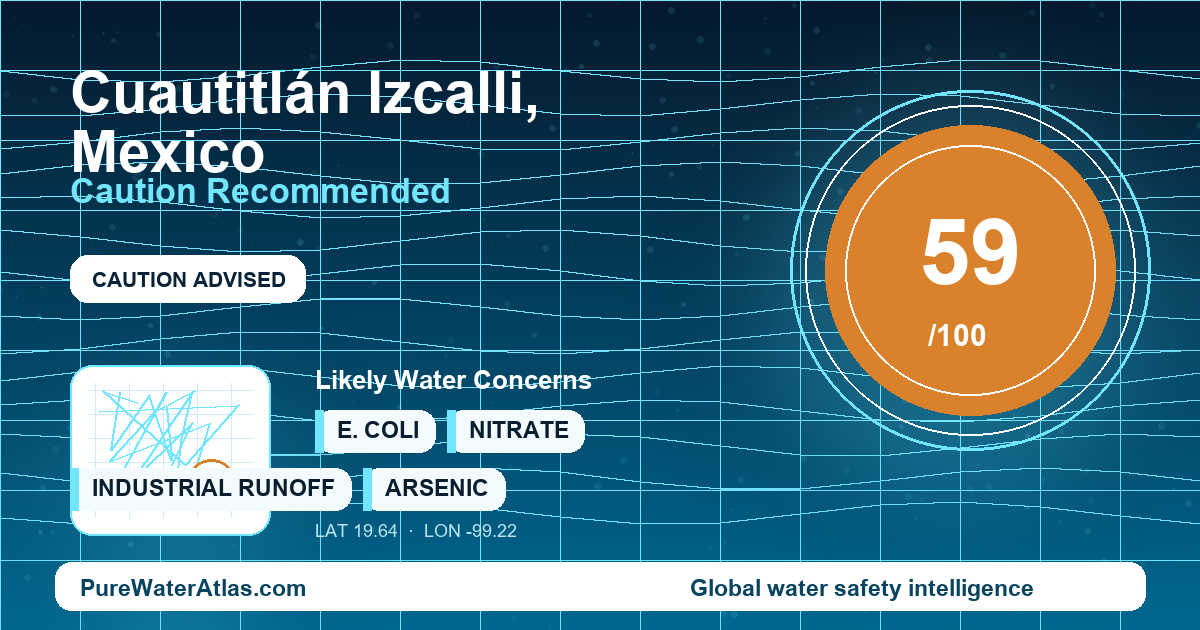
Cuautitlán Izcalli tap water is treated and supplied through a formal municipal system, but limited public tap-level reporting, intermittent service, household storage tanks, and mixed metropolitan sources mean caution is recommended for drinking.
Quick Answer
| Water safety score | 59 / 100 |
|---|---|
| Risk level | Caution Recommended |
| Can visitors drink the tap water? | Most short-term visitors should not drink untreated tap water in Cuautitlán Izcalli. Use sealed bottled water, professionally purified water, or water confirmed by a reputable hotel or restaurant to be from a purified source. |
| Resident guidance | Residents should treat tap water as a managed utility supply that may need household filtration, tank maintenance, and occasional testing before being used as routine drinking water. |
| Main supply identity | Mixed northern Valley of Mexico supply: municipal groundwater wells, especially within the Cuautitlán-Pachuca aquifer context, plus imported bulk water through Estado de México and federal metropolitan infrastructure, including Cutzamala allocations where applicable. |
| Local authority | OPERAGUA Izcalli, with state-level coordination involving the Comisión del Agua del Estado de México and federal water-resource oversight by CONAGUA. |
| Filter recommendation | At minimum, use a maintained sediment prefilter plus activated carbon for drinking water. Higher-risk households should consider certified reverse osmosis and lab testing. |
Overall verdict: caution recommended. The city has a formal water operator and receives treated supply, but public city-level water-quality reporting is limited, supply interruptions occur, and cisterns or rooftop tinacos can become the weak point between the utility system and the kitchen tap.
Why Cuautitlán Izcalli Is Different
Cuautitlán Izcalli is not a small isolated water system. It sits in the northern part of the Valley of Mexico in Estado de México, inside an urban-industrial corridor that is hydrologically and operationally tied to the broader Mexico City metropolitan water network. That matters because the city’s drinking-water risk is not defined by one simple source. Instead, it reflects a combination of local groundwater, imported metropolitan water, pumping, storage, distribution pressure, and building-level storage practices.
The municipality was developed as a planned urban and industrial city in the 1970s, in a region already dependent on heavily used Mexico Valley groundwater. Rapid urbanization and industrial development increased demand on wells and distribution infrastructure. CONAGUA identifies the Cuautitlán-Pachuca aquifer as a managed groundwater unit with availability constraints, which is important for long-term supply reliability even when water entering the network is disinfected.
A practical local issue is that many homes, apartment buildings, and businesses store municipal water in cisterns or rooftop tinacos before it reaches the tap. In Cuautitlán Izcalli, the water that leaves the public system may not be identical to the water you drink from a kitchen faucet after it has passed through old plumbing or sat in a warm, poorly covered storage tank.
Where Does Cuautitlán Izcalli’s Tap Water Come From?
Cuautitlán Izcalli receives a mixed supply typical of the northern Mexico City metropolitan area. Publicly available evidence identifies municipal groundwater wells drawing from the Mexico Valley aquifer system, especially the Cuautitlán-Pachuca aquifer area, along with imported bulk water delivered through state and federal infrastructure. Where allocated through the Estado de México network, imported water can include treated Cutzamala system water.
The exact proportions are not fixed for every neighborhood or every season. They can vary with operating conditions, maintenance outages, drought, pressure zones, and allocation changes. That variability is one reason this profile does not claim that all tap water in every colonia has the same quality or the same risk.
Key infrastructure includes local production wells and pumping equipment, state and metropolitan bulk-water connections, storage tanks, pressure-regulating zones, distribution mains, service lines, household cisterns, rooftop tinacos, and water trucks used during low-pressure periods or interruptions. Regional drainage, wastewater, and stormwater infrastructure also matters because heavy rains, flooding, pipe breaks, and pressure drops can increase the importance of maintaining disinfectant residual and protecting storage systems from contamination.
Presa Guadalupe is a prominent local reservoir and watershed feature, but the available public evidence does not support treating it as the main direct drinking-water source for household taps in Cuautitlán Izcalli.
Who Manages Drinking Water in Cuautitlán Izcalli?
The local water operator is OPERAGUA Izcalli, formally the Organismo Público Descentralizado Municipal para la Prestación de los Servicios de Agua Potable, Drenaje, Alcantarillado, Tratamiento y Disposición de Aguas Residuales de Cuautitlán Izcalli. The Gobierno Municipal de Cuautitlán Izcalli provides local municipal context and links to public services.
At the state level, the Comisión del Agua del Estado de México is relevant for bulk water, hydraulic infrastructure, and coordination among Estado de México municipalities. At the federal level, CONAGUA’s Sistema Cutzamala information documents one of the major imported water systems serving the Valley of Mexico and Estado de México service areas, while CONAGUA’s groundwater availability platform documents aquifer units such as Cuautitlán-Pachuca.
Drinking-water quality in Mexico is governed by NOM-127-SSA1-2021, the national standard for water for human use and consumption. Public-health surveillance also involves health authorities such as COFEPRIS and state health services. However, recent comprehensive Cuautitlán Izcalli tap-water results with sampling dates, locations, disinfectant residuals, microbiology, metals, and inorganic chemistry were not found in a single easily verifiable public dataset. That limitation is central to this caution-based assessment.
Main Local Water Concerns
- Intermittent supply and low pressure: Outages or pressure drops can increase reliance on cisterns, tinacos, and water trucks. These conditions create more opportunities for microbial contamination if storage is poorly maintained.
- Household storage: A dirty, cracked, uncovered, or warm tank can undermine water quality after municipal disinfection. This is one of the most important practical risks for Cuautitlán Izcalli households.
- Groundwater stress and mineral changes: Dependence on a managed aquifer system can be associated with changing mineral content, hardness, taste, and possible localized naturally occurring or urban contaminants. Neighborhood-specific contaminant levels should not be assumed without testing.
- Imported surface-water variability: Cutzamala-related water can face seasonal turbidity and treatment challenges during heavy rains, while drought can reduce allocations or trigger operating changes.
- Old plumbing and fixtures: Older service lines, solder, brass fixtures, galvanized pipe, and long internal plumbing runs can contribute metals or sediment even if water leaves the utility system adequately treated.
- Industrial and urban land use: Cuautitlán Izcalli’s urban-industrial setting makes source protection and groundwater monitoring important, but public tap-level datasets are not transparent enough to make block-by-block safety claims.
Season also matters. Dry periods and drought can reduce regional reservoir storage and contribute to cuts or low pressure. Rainy-season storms can increase source-water turbidity and stress drainage systems. After repairs, outages, or pressure changes, residents may see cloudy water, sediment, chlorine odor changes, or discoloration; flushing and temporary use of purified water is prudent until water clears.
For Travelers
For visitors, the practical answer is: do not rely on untreated tap water for routine drinking in Cuautitlán Izcalli. Use sealed bottled water, garrafón water from a reputable source, boiled water, or water treated with a reliable purifier. The municipal system is treated, but traveler tolerance, building storage, and limited public reporting make untreated tap water a preventable gastrointestinal risk.
Use bottled or purified water for brushing teeth if you have a sensitive stomach, are immunocompromised, pregnant, traveling with young children, or staying in a rental or budget lodging where tank maintenance is unknown. If you do use tap water for brushing, avoid swallowing it.
Avoid ice from informal vendors or unknown sources. Ice in established restaurants, hotels, and chains is often made from purified water, but ask whether it is from agua purificada when in doubt. Higher-end hotels and established restaurants commonly use garrafón water, in-house purification, or commercial ice, but it is still reasonable to confirm the arrangement.
Buy sealed bottled water from reputable stores and check that caps and seals are intact. Use purified water for baby formula. Keep a small reserve during announced or suspected service cuts. If gastrointestinal symptoms develop, switch strictly to sealed water and seek medical advice if symptoms are severe or persistent. The CDC’s Mexico traveler-health guidance supports a conservative approach to drinking water, ice, and food hygiene.
For Residents
Residents should manage Cuautitlán Izcalli tap water as a utility supply that may need household barriers before drinking. At minimum, a sediment prefilter and activated carbon filter can help with particles, taste, odor, and chlorine-related issues if maintained on schedule. For infants, pregnancy, immunocompromised people, older buildings, unknown storage conditions, or concerns about metals, salts, arsenic, nitrate, or PFAS, a certified reverse osmosis system for the drinking tap is a more protective option.
Testing should be done at the kitchen tap, not only at the street connection, because many homes use cisterns, rooftop tanks, or older internal plumbing. Basic checks include free chlorine residual, pH, conductivity or total dissolved solids, turbidity, hardness, and visible sediment after outages or repairs. Use a certified laboratory for total coliforms and E. coli if water is stored in a cistern or tinaco, if odors are present, or if household members report repeated gastrointestinal illness.
Older buildings should consider testing for lead, copper, iron, and manganese, especially where there is staining, metallic taste, discolored water after stagnation, metal plumbing, brass fixtures, or children and pregnant residents in the home. If a private or condominium well is involved, or if the source is unclear, consider nitrate, arsenic, fluoride, and other inorganic tests relevant to groundwater in Mexico.
Cisterns and rooftop tinacos should be covered, screened, cleaned, and disinfected periodically by a competent provider. Do not assume chlorinated municipal water remains microbiologically safe after sitting in a dirty or uncovered tank. Retest after major plumbing work, tank cleaning, flooding, long vacancies, or recurring low-pressure events.
Relevant Contaminants and Water-Quality Issues
Chlorine is central because residual disinfection is a key safety barrier in Mexican municipal distribution systems, but it can decline during long storage or after operational disruptions. Turbidity is relevant for imported surface-water treatment, rainy-season conditions, and cloudy water after repairs. Sediment matters when residents see particles, discoloration, or disturbed deposits after low-pressure events.
For microbial risk, E. coli is the critical indicator to understand when evaluating storage-tank contamination or illness risk. For older homes, lead can be a plumbing-related concern even when the utility supply is treated. Because groundwater is part of the regional supply identity, arsenic and nitrate are reasonable parameters to consider in targeted testing, especially where the source is unclear or a private or condominium well is involved.
For broader background, PureWaterAtlas guides on Drinking Water Safety, Water Microbiology, and Water Purification explain how source protection, treatment, distribution integrity, and household storage combine to determine real tap safety.
How to Verify Your Water Quality
Because public Cuautitlán Izcalli tap-level data is limited, the most reliable answer for a specific home is direct testing. Start with a visual and operational check: recent outages, pressure drops, dirty tinacos, unusual odor, sediment, cloudy water, or discoloration are reasons to use purified water temporarily and investigate.
For a structured testing plan, use the PureWaterAtlas Water Testing guide. If an older building is involved, see Lead in Drinking Water: Testing and Detection Methods. For groundwater-related screening, review Arsenic in Drinking Water: Testing and Detection Methods and Nitrate Contamination in Drinking Water: Testing and Detection Methods.
During outages or suspected microbial contamination, boiling can be a short-term barrier when done correctly; see Boiling Water Purification: Complete Guide. To research additional substances, use the Contaminants Search Engine. For comparison with other destinations, use the Global Water Quality Checker. Related PureWaterAtlas categories include Drinking Water Safety, Global Water Quality, Water Testing, and Water Treatment Systems.
Official and Technical Sources
- OPERAGUA Izcalli official website — identifies the municipal water, drainage, sewerage, treatment, and wastewater-disposal operator serving Cuautitlán Izcalli.
- Gobierno Municipal de Cuautitlán Izcalli — municipal context and public-service links.
- Comisión del Agua del Estado de México — state water authority relevant to bulk water and hydraulic coordination.
- CONAGUA, Sistema Cutzamala — federal information on the major imported water system serving the Valley of Mexico and Estado de México areas.
- CONAGUA groundwater availability publications — official aquifer availability platform, including aquifer units such as Cuautitlán-Pachuca.
- Diario Oficial de la Federación, NOM-127-SSA1-2021 — national Mexican drinking-water quality standard.
- COFEPRIS, Agua de Calidad Bacteriológica — bacteriological surveillance and chlorination context.
- CDC Travelers’ Health, Mexico — traveler guidance supporting conservative drinking-water precautions.
- WHO Guidelines for Drinking-water Quality — international reference for risk-based water safety, treatment, distribution, and household storage.
Bottom Line
Cuautitlán Izcalli has a formal municipal water utility and receives treated water from a mixed northern Valley of Mexico system, including local groundwater and metropolitan bulk supply. That does not make every household tap automatically drink-ready. The city’s main uncertainties are limited public tap-level reporting, intermittent pressure or outages, stressed groundwater context, older plumbing, and widespread use of cisterns and rooftop tinacos. Visitors should use sealed bottled or verified purified water for drinking and preferably for brushing teeth. Residents should maintain storage tanks, use at least sediment plus carbon filtration, consider reverse osmosis for higher-risk households, and test at the kitchen tap when water quality is uncertain.
Read the full guide: Global Water Quality Guide
Explore more in this category: Global Water Quality Articles