
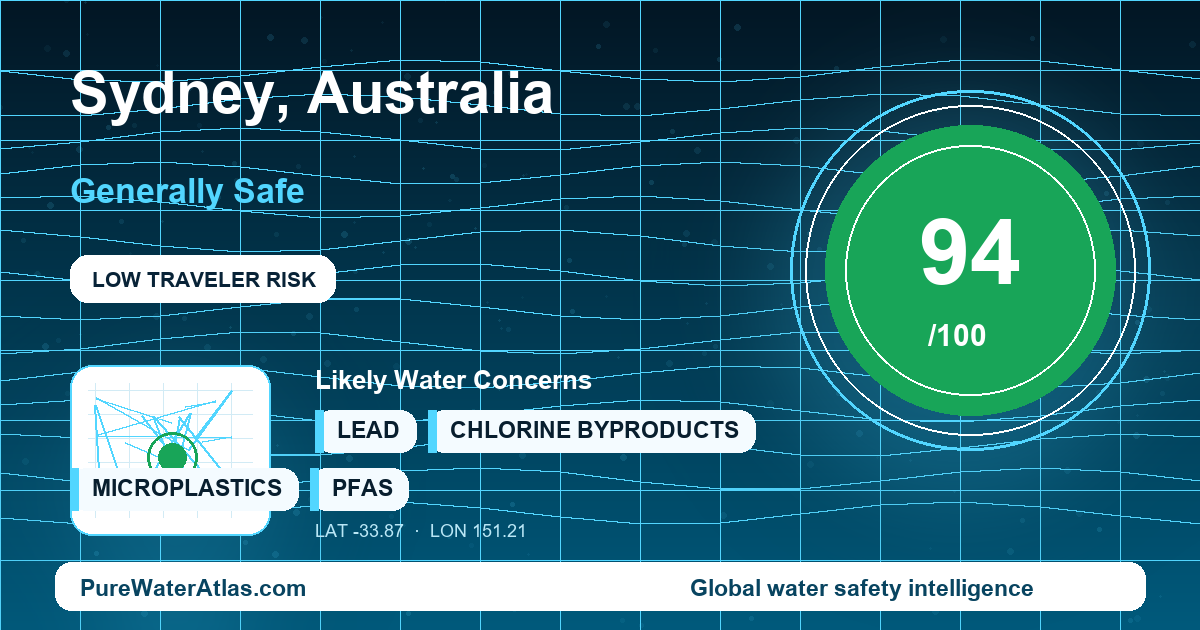
Sydney tap water is generally safe to drink from the regulated metropolitan public supply, with most at-tap concerns linked to building plumbing, stagnant water, private tanks, or temporary local service events rather than the city’s protected source-water system.
Quick Answer
| Water safety score | 94 / 100 |
|---|---|
| Risk level | Generally Safe |
| Can you drink Sydney tap water? | Yes. Sydney tap water is normally safe to drink in homes, hotels, airports, cafes, and restaurants connected to the public supply. |
| Traveler advice | Visitors can normally drink tap water, brush teeth with it, and use ice from regulated venues. Use bottled water only by preference, during an official boil-water notice, or if a clinician advises it for a specific condition. |
| Resident advice | Most residents do not need a filter for safety. Investigate old internal plumbing, stagnant water, private building tanks, or persistent discoloration after local works. |
| Main water source | Greater Sydney’s protected catchments and dams, with Warragamba Dam as the dominant storage, supported by the Upper Nepean, Woronora, Blue Mountains, and Shoalhaven-linked systems. The Kurnell desalination plant can supplement supply. |
| Water authorities | Sydney Water supplies customers; WaterNSW manages much of the raw-water catchment, dams, and bulk supply; NSW Health provides public-health oversight. |
| Filter recommendation | A filter is not generally needed for safety. A certified activated-carbon filter may improve chlorine taste and odour; contaminant-specific filters should be chosen only for confirmed or plausible premise-specific risks. |
Why Sydney Is Different
Sydney’s drinking-water story is not centred on Sydney Harbour, urban creeks, or the rivers visible in the city. The metropolitan supply is mostly drawn from protected upland catchments west, southwest, and south of the city, then treated before it enters the distribution network. That matters because the main safety question for most Sydney users is not whether the city is drawing drinking water from an urban harbour environment; it is whether the treated public supply remains protected and whether the water changes after it enters private plumbing.
The overall verdict for Sydney is strong: the public tap-water supply is generally safe to drink. The city benefits from a large raw-water catchment system, modern filtration and disinfection, routine monitoring, and oversight under New South Wales public-health requirements and the Australian Drinking Water Guidelines. Confidence is high for the metropolitan public supply, but only moderate for individual premises because official monitoring cannot verify every apartment tank, old pipe, tap, fitting, private tank, or building pump system.
For a visitor staying in central Sydney, the eastern suburbs, the Inner West, the North Shore, or western Sydney, tap water will typically come from the same regulated metropolitan supply system. Taste may vary slightly because of source mix, residual disinfectant, local pipe conditions, and building plumbing, but those variations do not by themselves mean the water is unsafe.
Where Does Sydney’s Tap Water Come From?
Sydney is supplied by the Greater Sydney water supply system. Raw water is managed primarily by WaterNSW and comes from a network of protected catchments and dams. Warragamba Dam is the best-known and dominant storage, but it is only one part of a broader interconnected system. The system also includes the Upper Nepean dams, including Cataract, Cordeaux, Avon, and Nepean; Woronora Dam, which serves southern parts of the system; Blue Mountains dams and associated supply infrastructure; and Shoalhaven system transfers used to support Greater Sydney storages.
This network developed because Sydney outgrew local water sources. Historically, the city moved from local streams and early urban reservoirs to larger protected catchments outside the urban area. The Upper Nepean Scheme and later Warragamba Dam became central to securing water for a rapidly growing population.
After raw water is collected, it is treated before distribution. Key infrastructure includes Prospect water filtration infrastructure and other treatment plants serving the Sydney Water network, along with disinfection, fluoridation, and distribution reservoirs across the metropolitan area. The Sydney Desalination Plant at Kurnell is also part of the supply-resilience system and can supplement dam supplies during drought or low-storage conditions. When desalinated water contributes to supply, some customers may notice subtle taste or mineral-character differences, but this is a supply-planning and resilience issue rather than a routine reason to avoid tap water.
Who Manages Drinking Water in Sydney?
Sydney’s drinking-water responsibilities are split across several official bodies. Sydney Water supplies drinking water to customers across Greater Sydney, the Blue Mountains, and the Illawarra. WaterNSW manages much of the raw-water catchment, dams, and bulk supply. NSW Health provides public-health oversight for drinking-water safety in New South Wales.
The regulatory framework is based on NSW public-health requirements and the risk-management approach of the Australian Drinking Water Guidelines. Sydney Water publishes drinking-water quality information and operates under licensing and regulatory obligations. For residents, an important practical boundary is that water quality can change after water leaves the public main. Sydney Water is generally responsible for water to the property connection, while internal plumbing, fixtures, building tanks, pumps, and many premise-side systems are the owner’s responsibility.
This distinction explains why a citywide supply can be compliant while a particular apartment, older terrace, hotel tank, or unused tap may still deserve investigation. Official system data is highly useful, but it cannot prove the quality at every individual tap at every moment.
Main Local Water Concerns
The most common Sydney tap-water concerns are localized or aesthetic rather than evidence of a broad unsafe supply. Chlorine or chloramine taste and smell can be noticeable, especially in warm weather or in buildings with low water turnover. This is usually an aesthetic issue rather than a safety issue, and chilling water in a clean covered container can improve taste.
Heavy rain, floods, drought, algal growth, or bushfire impacts in catchments can place pressure on raw-water quality by increasing turbidity, organic matter, ash, or taste-and-odour compounds. Sydney’s system manages these pressures through source selection, treatment, and monitoring, but short-term changes in taste, odour, or appearance can still occur.
Discoloured water or sediment may occur locally after water-main breaks, hydrant use, pipe scouring, or plumbing work. If water is brown, cloudy, or contains visible sediment, flush the cold tap. If it does not clear after normal flushing, avoid using it for drinking, report it, and check for local service information.
Lead and other metals are not expected to be a system-wide Sydney source-water problem. The more relevant issue is at-tap exposure from older plumbing, brass fittings, lead-containing solder, taps, and stagnant water in individual buildings. Large apartment buildings, hotels, hospitals, and commercial premises may also have private storage tanks, booster systems, and backflow-prevention devices. Poor maintenance of those private systems can create localized water-quality problems even when the street main is compliant.
For Travelers
Travelers in Sydney can normally drink tap water from hotels, homes, airports, cafes, restaurants, and public-supply taps. Brushing teeth with Sydney tap water is considered safe under normal conditions. Ice from regulated hotels, bars, restaurants, and cafes is normally safe if it is made from the public supply and handled hygienically.
If hotel tap water tastes strongly of chlorine, chill it in a clean covered bottle or jug. Taste is not the same as contamination, especially in a disinfected public system. Carrying a refillable bottle is practical in Sydney and avoids unnecessary bottled-water use. Use bottled water only if you prefer it, if an official boil-water notice applies to your location, or if you have medical advice to avoid ordinary tap water.
Do not drink untreated creek, river, lake, or rain-tank water unless it has been properly treated. During unusual events such as floods, major mains breaks, or boil-water advisories, check Sydney Water or NSW Health notices rather than relying on general travel advice.
For Residents
Most Sydney residents connected to the public supply do not need a home water-treatment device for safety. A certified activated-carbon filter can be useful if the main complaint is chlorine taste or odour. If there is a specific concern involving old plumbing, lead-risk fittings, infant feeding, pregnancy, or another contaminant, choose a certified filter matched to that contaminant and confirm the issue with appropriate testing where possible.
Older houses, renovated terraces, heritage buildings, and some older apartment blocks may have plumbing or fittings that contribute lead, copper, nickel, or other metals to first-draw water. Practical controls are simple: use the cold tap for drinking and cooking, flush water that has been sitting in pipes for several hours or days, maintain old plumbing, and test when risk factors exist.
High-rise apartments and large buildings need extra attention because water may pass through privately maintained roof tanks, break tanks, pumps, and internal pipework before it reaches the tap. Owners corporations and building managers should maintain tank lids, vents, backflow protection, cleaning schedules, and booster systems. Sydney public-supply monitoring does not verify conditions inside every private tank or internal pipe system.
Residents should investigate if water is persistently brown, cloudy, metallic-tasting, fuel-like, sewage-like, or unusual after normal flushing. If using a rainwater tank, bore, private tank, or private treatment system, treat it as a separate supply and test it independently; Sydney public-supply results do not verify private sources.
Relevant Contaminants and Water-Quality Issues
Several water-quality topics are especially relevant to Sydney even though they do not imply a citywide unsafe supply. Chlorine in drinking water is the most practical topic for taste and residual disinfectant questions. Chlorine or chloramine smell can be noticeable in warm weather or low-turnover buildings, but this is usually an aesthetic concern.
Turbidity in drinking water and sediment in drinking water are relevant after storms, catchment disturbance, mains repairs, hydrant use, pipe scouring, or plumbing work. If water appearance changes and does not clear after flushing, treat it as a local issue that needs reporting or investigation.
Lead in drinking water is most relevant at the property level in Sydney, not as a claimed system-wide source-water problem. Older plumbing, brass fittings, solder, taps, and stagnant water can affect first-draw samples. E. coli in drinking water is most relevant to boil-water notices, private tanks, and untreated sources. Readers researching emerging contaminants can also review PFAS in drinking water, while avoiding unsupported neighbourhood-level claims unless official location-specific evidence is available.
How to Verify Your Water Quality
Start with official Sydney Water drinking-water quality information and local service alerts before assuming a citywide problem. If your concern is old plumbing, metals, private tanks, or a persistent unusual taste, odour, or appearance, at-tap testing is more useful than general city averages.
For lead and copper concerns, use a qualified laboratory such as a NATA-accredited service where appropriate, rather than relying only on colour-strip tests for health decisions. PureWaterAtlas has a practical guide to lead in drinking water testing and detection methods and a guide to lead filters and solutions if a premise-specific risk is confirmed or strongly suspected.
If an official boil-water advisory applies, or if you are using a private source, see the boiling water purification guide. For broader decision-making, use the PureWaterAtlas guide to drinking water safety, the complete guide to how to test drinking water, and the guide to choosing water treatment systems. You can also compare destinations with the Global Water Quality Checker or look up specific substances in the Contaminants Search Engine. For emerging-contaminant testing, see PFAS testing and detection methods.
Official and Technical Sources
- Sydney Water: Drinking water quality
- Sydney Water: Water filtration
- WaterNSW: Greater Sydney water supply
- WaterNSW: Greater Sydney dam levels
- Sydney Desalination Plant
- NSW Health: Drinking water
- NHMRC: Australian Drinking Water Guidelines
- NSW Health: Water fluoridation
- Australian Government Department of Health: enHealth guidance statement on lead in drinking water from some plumbing products
- NSW Health: Rainwater tanks
Bottom Line
Sydney tap water is generally safe to drink from the public metropolitan supply. The city’s water comes mainly from protected Greater Sydney catchments and dams, with treatment, disinfection, fluoridation, monitoring, and public-health oversight before distribution. Travelers can normally drink tap water, brush teeth with it, and use ice from regulated venues. Residents usually do not need a filter for safety, though carbon filtration can improve chlorine taste. The main risks to check are premise-specific: old plumbing and fittings, stagnant first-draw water, private tanks in large buildings, persistent discoloration after works, or private rainwater and other non-public supplies. Official data is strong at system level, but it cannot prove the condition of every tap inside every Sydney property.
Read the full guide: Global Water Quality Guide
Explore more in this category: Global Water Quality Articles