
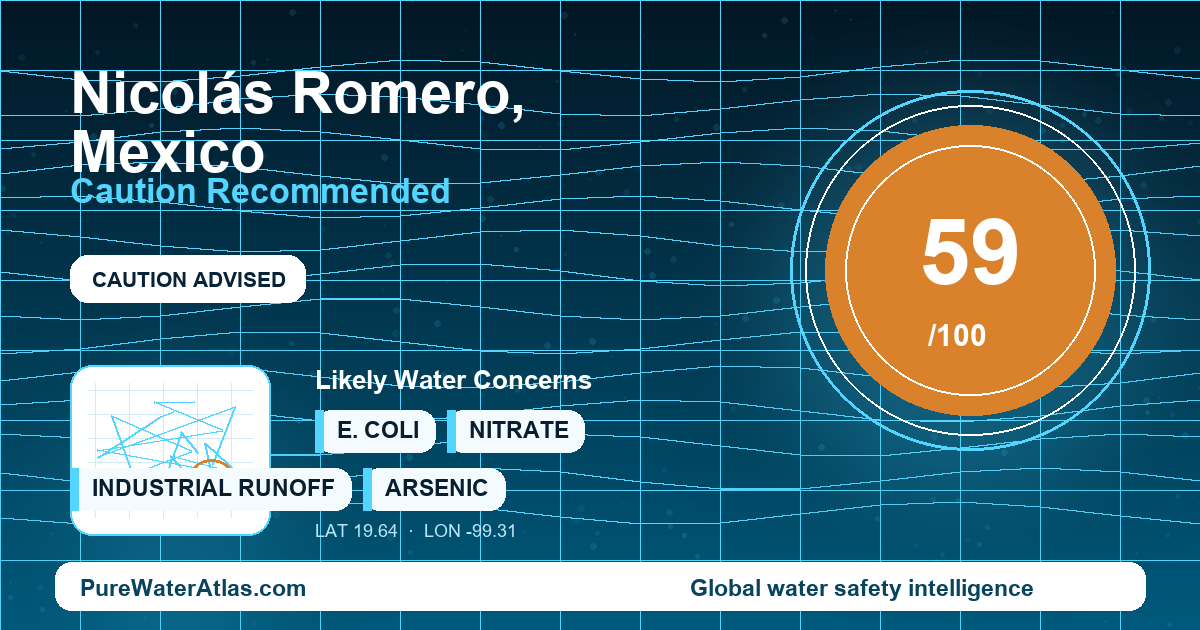
Nicolás Romero, State of Mexico: a northwestern Mexico City metropolitan municipality where tap-water safety depends heavily on mixed regional supply, pressure reliability, cisterns, tinacos, and building plumbing.
Quick Answer
| Overall status | Caution recommended. PureWaterAtlas water safety score: 59/100. Nicolás Romero tap water should not be treated as reliably drinkable without knowing the building, storage, recent outage history, and point-of-use quality. |
|---|---|
| Can visitors drink it? | Not recommended for most visitors. Use sealed bottled water, verified purified garrafón water, or water treated with a reliable purifier. |
| Resident approach | Manage municipal tap water as a utility supply that may be disinfected but can be affected by intermittent service, pressure drops, storage tanks, and internal plumbing. |
| Main supply identity | Mixed metropolitan supply: local groundwater wells and pumping infrastructure plus regional bulk water linked to State of Mexico and Cutzamala infrastructure. |
| Local authority | SAPASNIR, the Organismo Público Descentralizado Servicios de Agua Potable, Alcantarillado y Saneamiento de Nicolás Romero, with regional roles involving the Comisión del Agua del Estado de México and CONAGUA. |
| Filter recommendation | For drinking and cooking, consider sediment prefiltration, activated carbon, and a microbial barrier such as UV or ultrafiltration. Reverse osmosis is appropriate when testing shows dissolved contaminants such as nitrate, arsenic, fluoride, or high salinity. |
Why Nicolás Romero Is Different
Nicolás Romero is not a simple single-source water system. It sits on the northwestern edge of the Mexico City metropolitan area, in the State of Mexico, with urbanized neighborhoods, rural and mountain communities, and significant elevation changes. Those conditions matter for drinking-water safety because water quality at the kitchen tap can be shaped as much by distribution reliability as by the source water itself.
The city appears to rely on a mixed supply: local groundwater sources operated through municipal infrastructure and regional bulk water connected to State of Mexico distribution works and the wider Cutzamala-linked metropolitan system. That means local water reliability can be affected by municipal pumping, pressure-zone management, regional drought, Cutzamala reductions, pipe repairs, and household storage practices.
The most practical risk in Nicolás Romero is not a single confirmed contaminant unique to the municipality. The more important issue is variability: pressure interruptions, low-pressure events, leaks, sediment disturbance, cisterns, rooftop tinacos, old internal plumbing, and limited public access to recent tap-level lab results. Even if water is disinfected before or within the network, the final water consumed in a home may have passed through a cistern, a rooftop tank, a pump, and older building pipes before reaching the glass.
Where Does Nicolás Romero’s Tap Water Come From?
Nicolás Romero is part of the Valley of Mexico water setting. Its supply context includes local groundwater wells and pumping infrastructure, plus regional bulk-water systems serving metropolitan municipalities in the State of Mexico. Groundwater in this broader area is associated with the Cuautitlán-Pachuca and Valley of Mexico aquifer setting, while Cutzamala water originates in surface reservoirs west of the Valley of Mexico and is treated before entering metropolitan distribution systems.
Key infrastructure for Nicolás Romero includes the municipal distribution network operated by SAPASNIR, local wells and pumps serving zones where direct regional supply is insufficient or intermittent, storage tanks, booster pumping, and pressure zones required by the municipality’s steep topography. State-level bulk-water infrastructure managed by the Comisión del Agua del Estado de México also supports metropolitan supply, while the regional Cutzamala system includes reservoirs, conveyance works, and the Los Berros treatment plant upstream of the distribution network.
Household infrastructure is also part of the real water system in Nicolás Romero. Many homes and buildings rely on cisterns, rooftop tinacos, pumps, and garrafón water because supply can be intermittent. This means the “tap water” that residents encounter is often not just municipal water; it is municipal or regional water plus the condition of private storage and internal plumbing.
Who Manages Drinking Water in Nicolás Romero?
The local water and sanitation operator is SAPASNIR, commonly identified as the Organismo Público Descentralizado Servicios de Agua Potable, Alcantarillado y Saneamiento de Nicolás Romero. Regional bulk-water and infrastructure responsibilities also involve the Comisión del Agua del Estado de México, while federal water-resource and Cutzamala responsibilities involve CONAGUA and the Sistema Cutzamala.
Drinking-water quality in Mexico is governed nationally by health standards including NOM-127-SSA1-2021, which covers water for human use and consumption. Local and state operators are expected to provide disinfected water meeting applicable microbiological, physical, chemical, and radiological criteria, while health surveillance involves Mexican health authorities such as COFEPRIS and state health agencies.
A key limitation for this Nicolás Romero profile is data access. The water-operator identity and regional supply context are identifiable, but recent public tap-level laboratory results for Nicolás Romero were not found in a consolidated, easily accessible official dataset. This assessment therefore does not claim exact compliance status, exact contaminant concentrations, or neighborhood-by-neighborhood safety. Actual household safety can vary by pressure zone, recent outages, storage condition, plumbing age, and point-of-use treatment.
Main Local Water Concerns
The main concerns in Nicolás Romero are distribution-side and building-side vulnerabilities. Low pressure, intermittent service, leaks, pumping interruptions, and domestic storage can allow sediment movement or microbial intrusion if disinfectant residual is inadequate. These concerns are especially relevant after outages, pipe repairs, pressure restoration, Cutzamala reductions, rainy-season events, or heavy use of household reserve water.
- Intermittent supply and pressure changes: Pressure drops can disturb sediment in mains and tanks and can reduce confidence in microbial safety at the tap.
- Cisterns and tinacos: Unsealed, cracked, uncovered, or rarely cleaned tanks can contaminate otherwise disinfected water before it reaches the kitchen.
- Brown or turbid water: Visible color, cloudiness, or sediment may occur after repairs, main breaks, heavy rains, or pressure restoration.
- Regional supply stress: Drought, Cutzamala storage shortages, and maintenance can reduce supply continuity in metropolitan State of Mexico municipalities.
- Older building plumbing: Old galvanized lines, solder, brass fixtures, stagnant internal pipes, and roof tanks can create local water-quality problems even when incoming water is treated.
- Groundwater uncertainty: Recent well-by-well public data for Nicolás Romero was not found in an easily accessible city dataset, so dissolved-contaminant assumptions should be confirmed by testing rather than guessed.
- Post-outage microbial risk: If chlorine residual is low or stored water is not protected, microbial regrowth becomes a practical concern.
Season also matters. Rainy season can increase runoff, pipe-infiltration risk during low pressure, and visible turbidity after repairs or pressure changes. Dry-season and drought periods can increase rationing, trucking, storage, and use of household reserve water. Warm weather can also worsen microbial growth in poorly maintained cisterns and rooftop tanks.
For Travelers
Visitors should not treat Nicolás Romero tap water as reliably safe for drinking. The safer choice is sealed bottled water, verified purified garrafón water, or water treated with a properly maintained purifier. The reason is practical: a traveler usually cannot verify the building’s cistern, rooftop tank, pressure history, residual chlorine, or plumbing condition.
For brushing teeth, purified or bottled water is the safest option, especially for short-stay travelers, children, pregnant travelers, and anyone with a sensitive stomach. Some travelers may use tap water for brushing if it is clear, has no unusual odor, and there has been no recent outage, but purified water is the lower-risk choice.
Use ice only where restaurants, hotels, or vendors state that it is made with purified water. Avoid informal ice if the source is unclear. Many hotels, restaurants, and households in the region use garrafón or purified water for drinking and cooking, but visitors should ask directly. Do not assume that water from a hotel bathroom sink is drinking-quality.
If tap water is cloudy, brown, contains sediment, smells unusual, or appears after a service interruption, do not drink it untreated. During suspected microbial contamination, boiling can be an emergency option; see the PureWaterAtlas Boiling Water Purification Guide for method details.
For Residents
Residents in Nicolás Romero should think in layers: municipal supply, street distribution, household storage, internal plumbing, and point-of-use treatment. A household treatment barrier is advisable for water used for drinking and cooking. A practical configuration is sediment prefiltration for visible particles, activated carbon for taste and chlorine-related issues, and either UV or ultrafiltration when microbial protection is a priority. Reverse osmosis is best reserved for cases where testing shows elevated dissolved contaminants such as nitrate, arsenic, fluoride, or high salinity.
Testing should be done at the point of use, not only at the street connection, because cisterns, tinacos, and internal plumbing can change water quality. Prioritize total coliform and E. coli testing if the home has a cistern, rooftop tank, intermittent service, recent flooding, or recurring stomach-illness concerns. Check free chlorine residual after first flush and after storage; very low residual can indicate inadequate protection against microbial regrowth.
If water is brown, metallic, cloudy, or leaves sediment, test turbidity, color, iron, manganese, and total dissolved solids. For older homes, schools, clinics, and daycare settings, test first-draw and flushed samples for lead when old plumbing, brass fixtures, solder, or long stagnation are possible. If a home uses a private well, water truck delivery, or informal supply, include nitrate, arsenic, fluoride, hardness, and basic microbiology in the test panel.
Cisterns and tinacos should be covered, screened, watertight, periodically cleaned and disinfected, and protected from insects, roof runoff, animals, and cross-connections. A dirty or uncovered storage tank can make otherwise disinfected water unsafe at the tap.
Relevant Contaminants and Water-Quality Issues
The most relevant Nicolás Romero issues are microbial risk, sediment, turbidity, disinfectant residual, and building plumbing. E. coli in drinking water is important because intermittent pressure, cisterns, rooftop tanks, and post-outage conditions can create microbial risk if protection is inadequate. Turbidity and sediment are relevant when water turns cloudy, brown, or visibly particulate after repairs, heavy rain, or pressure restoration.
Chlorine is also important in Nicolás Romero because disinfectant residual helps protect water as it moves through distribution and household storage. Too little residual can allow microbial regrowth; excessive taste or odor can also affect user confidence. Lead is not identified here as a proven citywide source-water problem, but it is relevant to old building plumbing, solder, brass fixtures, and stagnant lines. Nitrate is relevant when evaluating private wells, trucked water, or other nonstandard sources where source-specific laboratory data is unavailable.
How to Verify Your Water Quality
The most reliable way to know whether a specific Nicolás Romero tap is safe is to test the water actually being consumed. Start with the PureWaterAtlas Water Testing Guide to choose a panel based on your home’s source, storage, plumbing age, and symptoms such as odor, color, sediment, or stomach illness concerns.
For treatment choices, use the PureWaterAtlas Water Purification Methods Guide. Homes with cisterns or tinacos may also benefit from understanding UV water purification, while older properties should review lead testing and detection methods. If wells, trucked water, or informal sources are used, the nitrate testing guide is also relevant.
For broader research, use the PureWaterAtlas Contaminants Search Engine, the Global Water Quality Checker, and the background guide on how to know if tap water is safe to drink. For microbial risk, see the PureWaterAtlas guide to water microbiology.
Official and Technical Sources
- Sistema Cutzamala — Comisión Nacional del Agua, Gobierno de México. Official background on the regional imported surface-water system serving the Valley of Mexico and parts of the State of Mexico.
- Comisión del Agua del Estado de México — State water authority involved in bulk-water infrastructure and support for State of Mexico municipalities.
- SAPASNIR transparency portal — Información Pública de Oficio Mexiquense reference identifying the Nicolás Romero water and sanitation organism.
- Nicolás Romero municipal government — Municipal source for local public administration and service notices.
- México en Cifras: Nicolás Romero, Estado de México — INEGI geographic and demographic context for the municipality.
- Sistema Nacional de Información del Agua — CONAGUA national water-information system for aquifers, water resources, and hydrologic context.
- NOM-127-SSA1-2021 — Diario Oficial de la Federación drinking-water quality standard for water for human use and consumption.
- Mexico Traveler View — U.S. Centers for Disease Control and Prevention traveler health guidance for Mexico.
Bottom Line
Nicolás Romero tap water deserves caution, not panic. The municipality is tied to a mixed Valley of Mexico supply that can include local groundwater and regional bulk water linked to State of Mexico and Cutzamala infrastructure. The most important local risks are variable pressure, intermittent service, sediment after disruptions, household cisterns and tinacos, and older internal plumbing. Visitors should use bottled, purified garrafón, or properly treated water for drinking and preferably for brushing teeth. Residents should keep storage tanks sealed and clean, test at the point of use, and use a treatment barrier suited to actual test results. Because recent Nicolás Romero-specific tap-level laboratory data is not publicly consolidated, household-level verification is the most dependable safety step.
Read the full guide: Global Water Quality Guide
Explore more in this category: Global Water Quality Articles