
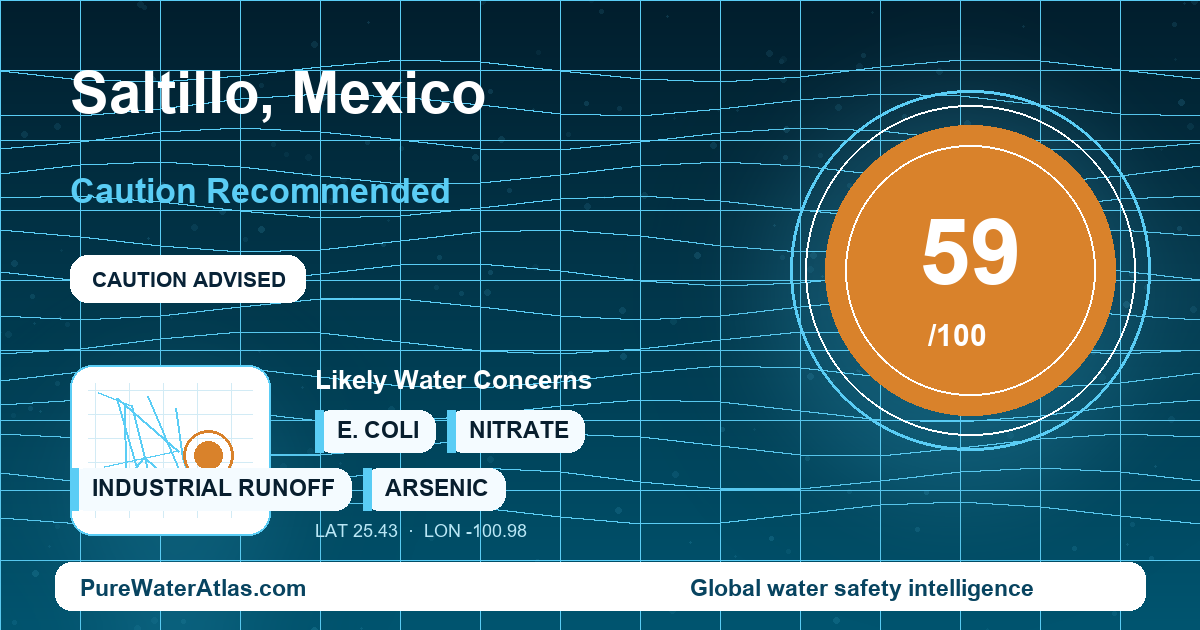
Saltillo, Coahuila has an organized municipal water operator and a primarily disinfected groundwater supply, but household tap safety depends heavily on local plumbing, storage tanks, pressure conditions, and verified test results.
Quick Answer
| Water safety score | 59 / 100 |
|---|---|
| Risk level | Caution Recommended |
| Can you drink the tap water? | Use caution. Saltillo’s municipal supply is organized and primarily disinfected groundwater, but current public, citywide tap-level test results are not easy to verify. For drinking, especially for visitors, bottled or verified purified water is the safer default. |
| Traveler advice | Use sealed bottled water, commercially purified water, or a verified hotel or restaurant purification system. Avoid assuming bathroom taps, rental-property tanks, or homemade ice are safe. |
| Resident advice | Use municipal water for many domestic purposes, but test the kitchen tap before relying on it untreated for daily drinking. Maintain cisterns and tinacos carefully. |
| Main water source | Predominantly groundwater from deep wells and wellfields in the Saltillo-Ramos Arizpe regional aquifer context and nearby recharge zones. |
| Water authority | Aguas de Saltillo, S.A. de C.V. is the local potable-water and sewerage operator; CONAGUA oversees national water-resource concessions and aquifer availability. |
| Filter recommendation | A point-of-use system is advisable for drinking, but the correct system should be chosen from actual test results. Carbon, lead-certified filters, reverse osmosis, and UV solve different problems. |
Why Saltillo Is Different
Saltillo is not a city where the main drinking-water question is a large river, lake, or conventional surface-water treatment plant. It sits in a semi-arid highland zone of southeast Coahuila, near the Sierra de Zapaliname and the wider Saltillo-Ramos Arizpe urban-industrial corridor. That geography makes groundwater recharge, drought stress, pumping depth, distribution pressure, and mineral content central to the local drinking-water picture.
The practical verdict for Saltillo is therefore cautious rather than alarmist. The city is served by an identifiable operator, Aguas de Saltillo, and the municipal supply is expected to be disinfected before and within distribution. However, the available public information does not provide a simple, current, neighborhood-by-neighborhood answer for every household tap, hotel, apartment, cistern, or roof tank. A clean supply at the utility level can become less reliable after it passes through aging internal pipes, poorly sealed storage tanks, stagnant building lines, or plumbing repairs that disturb sediment.
Saltillo also has a local water culture shaped by dryness and groundwater dependence. Many households and businesses are accustomed to using bottled garrafón water or point-of-use purification for drinking even when municipal water is available for bathing, cleaning, and cooking. That practice is consistent with the city’s main risk profile: not one confirmed citywide contaminant, but a combination of source-water pressure, mineralized groundwater, distribution conditions, and building-level uncertainty.
Where Does Saltillo’s Tap Water Come From?
Saltillo’s drinking-water supply is predominantly groundwater. The supply system relies on deep municipal production wells, pumping stations, wellfields associated with the Saltillo-Ramos Arizpe regional aquifer context, storage tanks, disinfection points, and distribution-sector management. The city does not depend on a large conventional surface-water reservoir in the way many wetter cities do.
Historically, Saltillo developed in a semi-arid highland setting where springs, local wells, and mountain-front recharge from the Sierra de Zapaliname area were important. With urban growth, industry, and regional development, the practical system shifted toward multiple deep wells, pumping, chlorination, storage, and pressure management. This kind of groundwater-based system can deliver treated water, but it also makes long-term aquifer availability and drought vulnerability important public issues.
For consumers, the infrastructure chain matters. Water may leave the utility’s system with disinfectant, but household experience can differ depending on the condition of the distribution main, local pressure, private cisterns, roof tanks, internal plumbing, and fixture materials. After outages, construction, repairs, or pressure changes, residents may notice turbidity, sediment, or discoloration. In those situations, it is prudent to flush taps and avoid drinking visibly cloudy, rusty, or sediment-laden water untreated.
Who Manages Drinking Water in Saltillo?
Saltillo’s potable-water and sewerage operator is Aguas de Saltillo, S.A. de C.V., commonly known as Agsal or Aguas de Saltillo. The utility is notable in Mexico because Saltillo has operated under a dedicated local water-utility model with public-private characteristics since the early 2000s, rather than relying only on a traditional municipal department.
At the national level, Mexico’s potable-water health standard is NOM-127-SSA1-2021, which defines requirements for water for human use and consumption. Water-resource concessions, aquifer availability, and official hydrologic information fall under CONAGUA’s national water information system and CONAGUA’s aquifer-availability framework. Public-health oversight also involves federal and state health authorities, including COFEPRIS-linked sanitary control for water for human consumption.
This regulatory structure is important, but it does not prove that every individual tap in Saltillo is safe at all times. The main data limitation is that recent, public, point-of-use laboratory results by neighborhood are not consistently available. Utility-level treatment or compliance information should not be treated as proof that every building’s cistern, tinaco, old fixture, or rarely used line is safe.
Main Local Water Concerns
The most important concerns in Saltillo are local and practical. First, the city depends heavily on groundwater in an arid region. That raises long-term source-water pressure and drought vulnerability. Hot-season demand and dry periods can increase stress on wells, pumps, and pressure management infrastructure.
Second, groundwater in northern Mexico can be mineralized. Saltillo residents may encounter hardness, salinity, total dissolved solids, or taste issues. These are not the same as a confirmed acute health emergency, but they affect household acceptability and can determine whether reverse osmosis or another treatment system is appropriate.
Third, distribution and building conditions matter. Turbidity, sediment, or discoloration can occur after pipe repairs, pressure changes, stagnant internal plumbing, or tank disturbance. Microbial risk is especially relevant when private cisterns or tinacos are dirty, poorly sealed, exposed to insects or dust, or allowed to lose disinfectant residual.
Fourth, older buildings require caution. Lead should not be claimed as a confirmed citywide Saltillo contaminant without local test data, but older fixtures, solder, brass parts, galvanized lines, and service connections can influence water after it leaves the public main. In older homes and apartments, both first-draw and flushed samples are useful for understanding whether premise plumbing is contributing metals or sediment.
For Travelers
Short-term visitors should use sealed bottled water, commercially purified water, or water from a verified hotel or restaurant purification system for drinking. Tap water in Saltillo may be treated at the municipal-system level, but travelers usually cannot verify building plumbing, roof tanks, recent service interruptions, or internal maintenance practices. That uncertainty is the main reason for a conservative recommendation.
For brushing teeth, many healthy travelers in reputable hotels may use tap water if there is no local boil-water notice and the water is clear with a normal chlorinated odor. More cautious travelers should use bottled or purified water. This includes infants, pregnant travelers, immunocompromised people, people with sensitive stomachs, and anyone staying in older or poorly maintained lodging.
Ice should be treated as a separate risk. Use ice only if it is commercially produced or provided by a reputable restaurant or hotel that uses purified water. Avoid homemade ice in rentals, street settings, or places where the water source is unclear. When eating out, ask whether drinking water and ice come from garrafón, reverse osmosis, UV, or another maintained purification system.
Practical travel habits in Saltillo are simple: carry bottled water, choose sealed containers, avoid bathroom taps in rentals, use purified water for infant formula, and do not drink water that is cloudy, rusty, sediment-laden, or recently affected by a service interruption. For broader travel precautions, the U.S. CDC Mexico Traveler View supports conservative food and water practices for visitors.
For Residents
Residents can reasonably use Saltillo municipal water for many household uses, but drinking it untreated every day should be a verified decision, not an assumption. The most practical resident approach is to test the kitchen tap, maintain private storage, and choose treatment based on actual results.
A home filter is advisable if the goal is daily drinking from the tap. Activated carbon can improve chlorine taste and may reduce some organic compounds. A certified lead-reduction filter is relevant where older plumbing, solder, brass fixtures, or stagnant lines are present. Reverse osmosis is more appropriate when lab results show high dissolved solids, salinity, nitrate, arsenic, or other dissolved ions. UV can help with microbial control only when the water is clear, prefiltered, and the unit is correctly maintained.
Testing should be done at the kitchen tap, not only at the building entrance, because internal plumbing and storage can change water quality. A useful certified laboratory panel for Saltillo should include total coliform and E. coli, free chlorine residual, turbidity, pH, conductivity or total dissolved solids, hardness, nitrate, arsenic, iron, manganese, and lead. Homes with infants, pregnant residents, elderly residents, or immunocompromised residents should prioritize microbial indicators, nitrate, arsenic, and lead.
Retest after plumbing work, recurring discoloration, roof-tank contamination, well-field interruptions, or any major change in taste or odor. Residents should also ask Aguas de Saltillo’s transparency portal or customer channels for the most recent water-quality information for their supply sector and compare that with household tap results.
Private cisterns and tinacos are one of the most important household risk points in Saltillo. Keep tanks covered, screened, and cleaned on a routine schedule. Disinfect after cleaning, check for insects, birds, dust entry, and verify that stored water is not sitting without adequate residual protection. A safe municipal supply can become unsafe if stored in a dirty or uncovered tank.
Relevant Contaminants and Water-Quality Issues
Saltillo’s profile makes several water-quality issues especially relevant. Chlorine in drinking water matters because municipal groundwater supplies rely on disinfection, and chlorine taste or residual can be a practical household indicator. Low or absent residual in stored water can increase concern, especially after intermittent service or long tank storage.
Turbidity and sediment are relevant after pipe repairs, pressure changes, storms, stagnant building lines, or cistern disturbance. They are not automatically proof of a toxic contaminant, but cloudy or dirty water is a warning sign and can interfere with disinfection and UV performance.
E. coli is the key microbial indicator to include in household testing, especially where private storage tanks are present. For older buildings, lead should be considered a premise-plumbing concern rather than a confirmed citywide Saltillo finding. In a groundwater-dependent region, residents may also want to screen for nitrate and arsenic, while recognizing that Saltillo-specific levels must be verified by laboratory testing rather than assumed.
How to Verify Your Water Quality
The most reliable way to answer “is my Saltillo tap water safe?” is to combine official utility information with household tap testing. Start by checking notices and service information from Aguas de Saltillo and municipal public-service channels such as the Gobierno Municipal de Saltillo. For source-water context, CONAGUA’s annual aquifer availability information helps place Saltillo’s groundwater dependence in the correct official framework.
For household decisions, use a certified lab and test the water actually used for drinking. PureWaterAtlas resources can help interpret the results: read the complete water testing guide, the drinking water safety framework, and the guide to choosing water treatment systems. If microbes are a concern, review water microbiology risks and the boiling water purification guide.
If a test report shows specific contaminants, use the PureWaterAtlas Contaminants Search Engine. For comparison with other destinations, use the Global Water Quality Checker. Residents evaluating older plumbing may also want the guide to lead testing and detection; groundwater-focused households can consult the guides for arsenic testing and nitrate testing. Where microbial control is needed, review UV water purification, but remember that UV requires clear, prefiltered water and proper maintenance.
Official and Technical Sources
- Aguas de Saltillo — local potable-water and sewerage operator for Saltillo.
- Aguas de Saltillo Transparencia — local transparency and public-information portal.
- CONAGUA Sistema Nacional de Información del Agua — official national water-resource information system.
- CONAGUA aquifer availability information — federal aquifer-availability and groundwater context.
- NOM-127-SSA1-2021 in the Diario Oficial de la Federación — Mexico’s potable-water health standard.
- COFEPRIS: Agua de uso y consumo humano — Mexican public-health oversight context.
- Gobierno Municipal de Saltillo — municipal context and local public-service information.
- World Health Organization Guidelines for Drinking-water Quality — international public-health guidance on microbial safety, storage hygiene, and household-level risk.
- U.S. CDC Mexico Traveler View — travel medicine guidance supporting conservative food and water precautions.
Bottom Line
Saltillo’s tap water deserves a cautious, evidence-based answer. The city has an organized operator, Aguas de Saltillo, and relies mainly on disinfected groundwater from deep wells and regional aquifer sources rather than a major surface-water reservoir. That does not automatically mean every household or hotel tap is safe to drink. The biggest practical uncertainties are groundwater stress, mineralized water, pressure changes, sediment, old internal plumbing, and private cisterns or tinacos. Visitors should use sealed bottled or verified purified water. Residents should test the kitchen tap, maintain storage tanks, and choose filtration based on results. Because current neighborhood-level tap data are limited, Saltillo’s safest classification is: caution recommended.
Read the full guide: Global Water Quality Guide
Explore more in this category: Global Water Quality Articles