
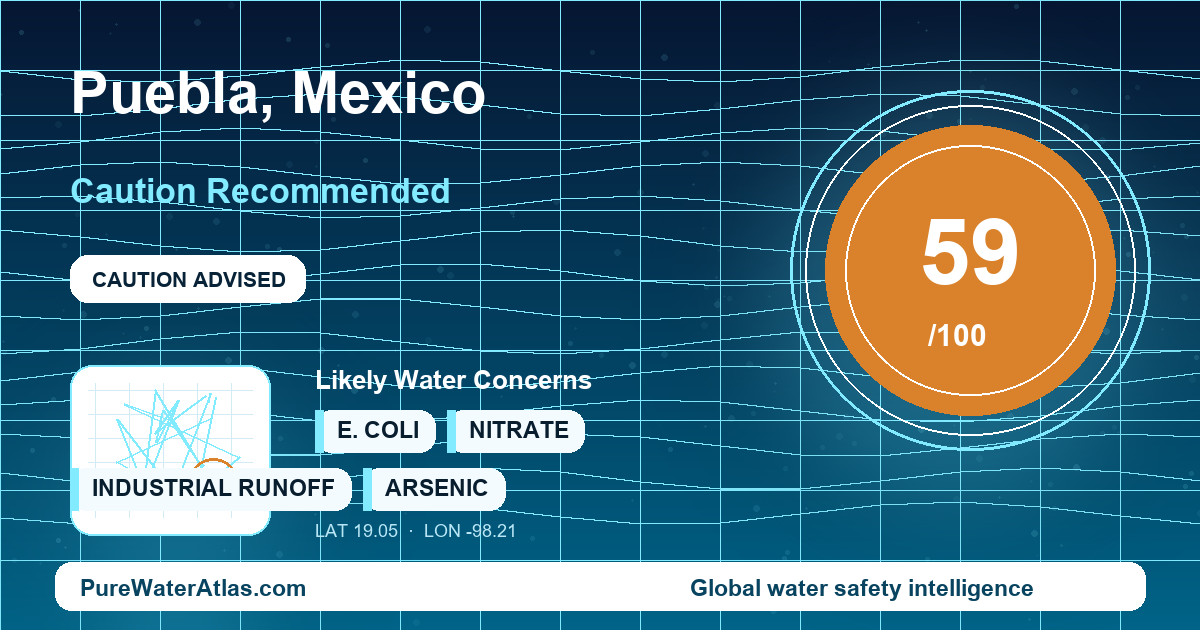
Puebla, Mexico has a treated municipal water system built largely around groundwater from the Puebla Valley, but tap-to-glass safety can vary by building plumbing, cisterns, rooftop tinacos, pressure interruptions, and maintenance practices.
Quick Answer
| Water safety score | 59 / 100 |
|---|---|
| Risk level | Caution Recommended |
| Can tourists drink the tap water? | Not recommended as a routine choice. Most travelers should use sealed bottled water, reputable dispenser water, or water from a maintained purifier. |
| Resident guidance | Puebla tap water is generally usable for washing and household purposes, but residents should use point-of-use treatment and periodic testing for drinking water, especially in older buildings or homes with cisterns and tinacos. |
| Main water source | Primarily groundwater from wells in the Puebla Valley aquifer system, including the Valle de Puebla aquifer area regulated by CONAGUA. |
| Local authority and operator | SOAPAP is the public water-service authority, with service operation and concession functions associated with Agua de Puebla para Todos, also known as Concesiones Integrales. |
| Filter recommendation | Sediment prefiltration plus activated carbon is a practical baseline. Reverse osmosis, UV, or other certified treatment may be appropriate depending on tap-specific testing and storage-tank conditions. |
Overall verdict: Caution is recommended. Puebla’s formal municipal supply is treated and disinfected, but drinking directly from the tap is not the default safe choice for visitors because conditions after water leaves the utility system can change quality. Intermittent supply, household storage tanks, old internal plumbing, low pressure, and limited easy access to recent neighborhood-level finished-water results all add uncertainty.
Why Puebla Is Different
Puebla is a high-altitude inland city in the Atoyac basin, east of Mexico City and near the Popocatépetl, Iztaccíhuatl, and La Malinche volcanic landscapes. This geography makes groundwater recharge and aquifer management central to the city’s drinking-water security. Unlike cities where the public can easily identify a dominant lake or river intake, Puebla’s urban drinking-water supply is largely groundwater-based and depends on production wells, pumping, distribution mains, storage, and disinfection.
The practical safety question in Puebla is often not simply whether the utility treats water. The more important household question is what happens after treated water enters a building. In many homes and apartment buildings, water may pass through cisterns, rooftop tanks known locally as tinacos, old internal pipes, fixtures, or private filters. If tanks are not cleaned, if lids are cracked, if sediment accumulates, or if chlorine residual drops during storage, microbial risk can increase even when water originally entered the building disinfected.
Puebla also sits within a broader regional watershed that has documented environmental pressures. The Alto Atoyac watershed, including the Atoyac and Xochiac river system, has been the subject of official human-rights and environmental concern due to municipal and industrial wastewater pollution. That does not mean the Atoyac River should be assumed to be the city’s main direct drinking-water source; the city supply is primarily groundwater-based. It does mean that regional source-water vulnerability and aquifer protection are important local context.
Where Does Puebla’s Tap Water Come From?
Puebla’s urban tap water comes mainly from groundwater drawn from wells in the Puebla Valley system, especially the Valle de Puebla aquifer area administered within Mexico’s federal water-resources framework. Surface waters such as the Atoyac River are important to the regional basin, but they should not be treated as the primary direct source of Puebla’s municipal drinking water without site-specific confirmation from the local utility.
The main infrastructure includes municipal and metropolitan production wells, pumping stations, distribution mains, storage reservoirs, cisterns, household rooftop tanks, and disinfection equipment. Chlorination is the principal disinfection barrier in the formal potable-water system. After that, many residents and businesses rely on bottled-water delivery, garrafón water, refill stations, or private building-level filters for water intended for drinking.
Because the system is groundwater-dependent, local concerns include urban growth pressure on the Valle de Puebla aquifer system and the need for careful aquifer management. Groundwater may also have mineral taste or hardness characteristics typical of many well-based supplies. Hardness and mineral taste can affect consumer acceptance even when they do not automatically indicate a health violation.
Who Manages Drinking Water in Puebla?
The local public water-service authority is SOAPAP, Sistema Operador de los Servicios de Agua Potable y Alcantarillado del Municipio de Puebla. Customer-facing service operation in the Puebla concession area is associated with Agua de Puebla para Todos, also known as Concesiones Integrales.
At the federal level, water resources are administered by CONAGUA, which publishes groundwater and aquifer information. The CONAGUA Valle de Puebla aquifer availability document is a key technical source for understanding the groundwater context most relevant to Puebla’s urban water supply.
Drinking-water health quality in Mexico is governed through the Secretaría de Salud framework, including NOM-127-SSA1-2021, the official health standard for water for human use and consumption. Surveillance and enforcement involve federal and state health authorities, while local service delivery is handled through SOAPAP and the concessionaire.
Main Local Water Concerns
Puebla’s main drinking-water concerns are practical and building-specific as much as they are source-water-related. The city depends heavily on pumped groundwater and a large distribution network. During intermittent service or low-pressure periods, buildings may rely more heavily on stored water. Low pressure and service interruptions can increase vulnerability to intrusion, sediment disturbance, and water-quality changes after repairs or pressure shifts.
- Groundwater dependence: Puebla relies on the Valle de Puebla aquifer system, which faces pressure from urban growth and requires careful management.
- Regional watershed pollution: The Atoyac and Xochiac river system has documented municipal and industrial wastewater pollution concerns, relevant to the broader environmental-health setting.
- Storage tanks: Cisterns and rooftop tinacos can become microbial risk points if they contain sediment, biofilm, insects, cracked lids, or low disinfectant residual.
- Discoloration and turbidity: Sediment, cloudiness, or discoloration may occur after pipe work, outages, pressure changes, or tank disturbance.
- Older internal plumbing: Lead or other metals are more likely to be associated with legacy plumbing materials, brass fixtures, solder, or stagnant water inside buildings than with the aquifer itself.
- Mineral taste and hardness: Groundwater can have mineral character that affects taste and scaling, even where it is not necessarily a health-based exceedance.
Season also matters. Rainy-season runoff can increase contamination pressure in the wider watershed, especially where drainage and wastewater infrastructure are stressed. Dry-season demand can make intermittent service more noticeable in some buildings. After local flooding, pipe repairs, service interruptions, or sudden changes in odor or sediment, Puebla residents should be more cautious with first-draw water and tank hygiene.
For Travelers
For visitors to Puebla, the practical answer is simple: do not make untreated tap water your routine drinking water. Use sealed bottled water, water from a reputable dispenser, or water that has passed through a maintained purifier designed for microbial and chemical concerns. This is especially important for short stays, sensitive stomachs, children, immunocompromised travelers, and anyone staying in basic accommodation or a rental with unknown storage tanks.
For brushing teeth, bottled or filtered water is the lower-risk choice. Some travelers brush with tap water and avoid swallowing it, but that is not the most conservative recommendation. Showering is generally acceptable, and tap water is usually acceptable for basic hygiene if it is not swallowed and there are no visible or odor changes suggesting a local problem.
Use ice only in established hotels, restaurants, and cafés that use purified water or commercial ice. Avoid unknown ice from street vendors or informal sources. In better hotels and restaurants, water is commonly supplied through garrafón water, commercial ice, or installed purification systems, but it is still reasonable to ask whether drinking water and ice are purified. Do not assume bathroom tap water is drinking water.
If staying in an apartment, ask the host whether the unit uses garrafón water, a maintained filter, UV, reverse osmosis, or another treatment system. Avoid drinking from taps connected to unknown cisterns or rooftop tanks unless the system is maintained and the water has been tested or properly treated.
For Residents
Residents should treat Puebla tap water as a variable-quality municipal supply: useful for washing, cleaning, bathing, and many household purposes, but best treated before drinking. A practical home barrier often starts with sediment prefiltration followed by activated carbon for taste, chlorine, and some organic compounds. If testing shows metals, nitrate, high dissolved solids, or other chemical concerns, reverse osmosis or another certified system may be appropriate. UV can help control microbial risk only when water is already low in turbidity and the UV unit is maintained correctly.
Testing should be done at the kitchen tap, not only at the building entry, because building plumbing and storage can change the water. At minimum, homes with cisterns or tinacos should consider testing for total coliform and E. coli, particularly after flooding, long interruptions, cleaning failures, or obvious tank problems. Older buildings, recently changed fixtures, unknown plumbing materials, or water that sits overnight should be evaluated for lead using both first-draw and flushed sampling where appropriate.
Additional useful screening may include turbidity, residual chlorine, pH, hardness, total dissolved solids, nitrate, arsenic, iron, and manganese when taste, staining, scale, or local groundwater concerns are present. Cisterns and rooftop tanks should be cleaned and disinfected on a regular schedule. Retesting after tank cleaning is advisable if that stored water is used for drinking.
Relevant Contaminants and Water-Quality Issues
Chlorine in drinking water is relevant in Puebla because the formal municipal supply uses disinfection, and chlorine residual helps protect against microbial contamination while also influencing taste and odor. If water is stored in cisterns or tinacos for long periods, chlorine residual can decline.
Turbidity matters after outages, pressure changes, pipe work, or tank sediment disturbance. Cloudy or sediment-laden water can interfere with disinfection and is a warning sign that water should not be consumed without further treatment or confirmation.
E. coli is a key microbial indicator for homes using cisterns or rooftop tanks. A positive result suggests fecal contamination risk and requires corrective action. Lead is most relevant in Puebla as a building-plumbing issue, especially in older properties or where fixtures, solder, or stagnant internal pipes are unknown. Nitrate is worth screening in groundwater contexts where wastewater or agricultural influence is possible.
How to Verify Your Water Quality
The most reliable way to answer the Puebla tap-water question for a specific home, hotel, or business is to test the water that actually comes from the tap used for drinking. City-level information can identify the utility, groundwater source context, and regulatory framework, but it cannot prove that every individual tap is safe. Puebla conditions can change after water enters a building because of cisterns, rooftop tanks, internal plumbing, intermittent service, and filter maintenance.
PureWaterAtlas resources that are especially useful for Puebla include the complete guide to water testing, the drinking water safety guide, the water microbiology guide, and the water treatment systems guide.
For targeted questions, use the Global Water Quality Checker and the Contaminants Search Engine. Puebla residents concerned about plumbing can also review lead testing and detection methods. For groundwater screening, see nitrate testing and detection methods. For household treatment decisions, the UV water purification guide and boiling water purification guide are useful, remembering that boiling is mainly a microbial emergency measure and does not remove metals or dissolved chemicals.
Official and Technical Sources
- SOAPAP, Sistema Operador de los Servicios de Agua Potable y Alcantarillado del Municipio de Puebla — local public water-service authority.
- Agua de Puebla para Todos — customer-facing service operator for the Puebla concession area.
- CONAGUA national groundwater and aquifer information system — official federal aquifer and groundwater information.
- CONAGUA Valle de Puebla aquifer availability document — technical document for the aquifer most relevant to Puebla’s supply context.
- NOM-127-SSA1-2021 — Mexico’s official drinking-water health standard for water for human use and consumption.
- CNDH Recomendación 10/2017 on contamination of the Atoyac, Xochiac, and tributaries — official environmental and public-health concern for the regional watershed.
- CDC Travelers’ Health: Mexico — traveler health guidance supporting cautious food and water practices.
- Secretaría de Salud — national health authority involved in Mexico’s drinking-water health protection framework.
Data limitation: Recent finished-water monitoring results by Puebla neighborhood, building, or individual tap are not consistently available in a simple public format. This profile does not claim that every tap in Puebla is safe or unsafe, and it does not assign contaminant levels to specific neighborhoods without published evidence.
Bottom Line
Puebla’s tap water should be approached with caution for drinking. The city’s supply is mainly groundwater from the Puebla Valley system and is treated through the formal municipal network, but household safety can change after distribution because of intermittent service, low pressure, cisterns, rooftop tinacos, old plumbing, and filter maintenance. Tourists should use sealed bottled water, reputable dispenser water, or verified purified water, including for brushing teeth when risk tolerance is low. Residents should use a maintained point-of-use treatment system, clean storage tanks regularly, and test kitchen-tap water for microbes, lead, nitrate, turbidity, chlorine residual, and other parameters when conditions warrant. Puebla’s water is not a simple “safe” or “unsafe” case; it is a building-specific risk-management question.
Read the full guide: Global Water Quality Guide
Explore more in this category: Global Water Quality Articles