
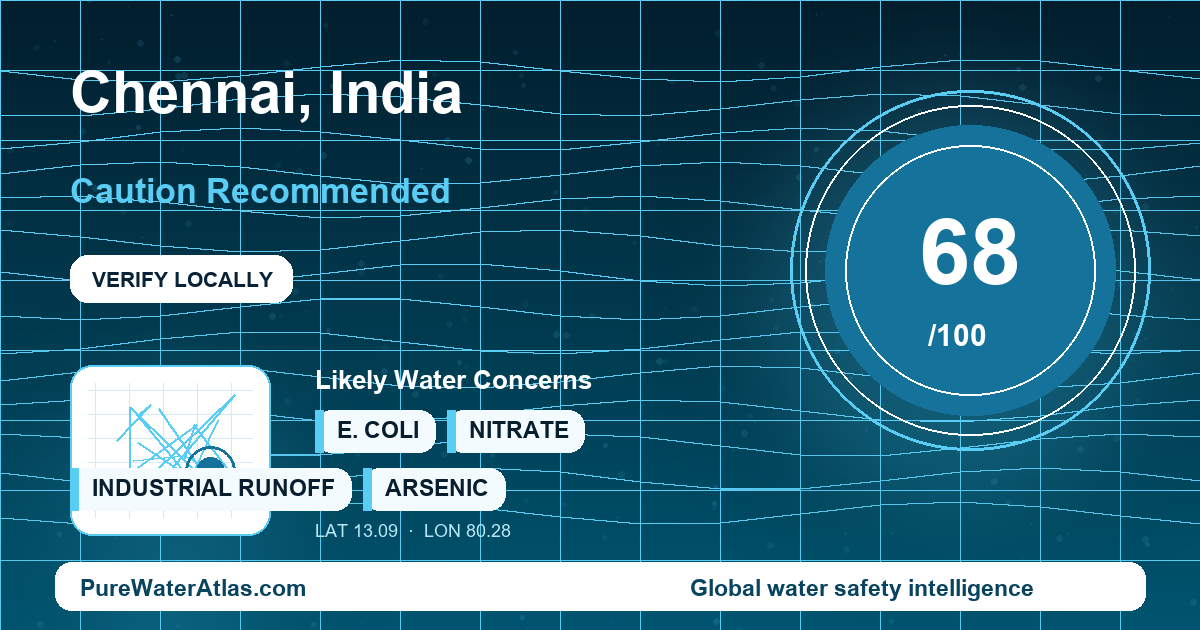
Chennai’s municipal water is treated and chlorinated, but point-of-use safety depends heavily on storage tanks, intermittent supply, monsoon conditions, private borewells, tanker water, and building plumbing.
Quick Answer
| Overall status | Caution recommended. Chennai’s treated municipal supply is not automatically unsafe, but drinking straight from the tap is not the safest default. |
|---|---|
| Water safety score | 68 / 100 |
| For visitors | Avoid untreated tap water. Use sealed bottled water, hotel-provided treated water, boiled water, or water from a well-maintained purifier. |
| For residents | Use household-level risk management: maintain sumps and overhead tanks, check water after flooding or repairs, and use testing or purification where needed. |
| Main water sources | Rain-fed reservoirs, Krishna water via the Telugu Ganga system, Veeranam Lake supply, desalination at Minjur and Nemmeli, and limited groundwater support during stress periods. |
| Water authority | Chennai Metropolitan Water Supply and Sewerage Board, commonly known as Chennai Metrowater or CMWSSB. |
| Filter recommendation | Most drinking households should consider a purifier. Sediment plus carbon and UV may be enough for clear, low-TDS water; RO is best reserved for confirmed high TDS, salinity, nitrate, or other dissolved contaminant issues. |
Why Chennai Is Different
Chennai is a low-lying coastal metropolis on the Bay of Bengal, and its drinking-water risk profile is shaped by both climate and infrastructure. Unlike cities that rely mainly on a large perennial river, Chennai depends on a mixed water system: monsoon-fed reservoirs, imported water, lake supply, desalination, and limited groundwater or well-field support during stress periods. This makes the city’s water situation unusually seasonal and location-dependent.
The practical question is not simply whether Chennai Metrowater treats its water. It does. The more important question is what happens between the treatment system and the glass. Chennai commonly uses scheduled or intermittent water delivery, and many homes, apartments, and commercial buildings store water in underground sumps and overhead tanks. Those tanks can become the final control point for water quality. A clean, covered, disinfected tank can preserve treated water quality; a cracked, dirty, uncovered, or sewage-vulnerable tank can undermine it.
Chennai’s 2019 water crisis is also relevant. The crisis, widely reported internationally, involved reservoir depletion, tanker dependence, and pressure on groundwater sources. It accelerated the importance of desalination, transferred water, tanker supply, and demand management. For drinking-water safety, this history matters because drought periods can increase dependence on alternate sources, private borewells, stored water, and building-level decisions.
Where Does Chennai’s Tap Water Come From?
Chennai uses a blended raw-water system. The major surface reservoirs commonly associated with the city include Poondi, Cholavaram, Red Hills, and Chembarambakkam. These reservoirs are rain-fed and are strongly influenced by seasonal rainfall. Chennai also receives water through inter-basin transfer systems, including Krishna water through the Telugu Ganga system, and from the Veeranam water supply system.
Desalination is another major part of Chennai’s water identity. The city uses seawater desalination facilities at Minjur and Nemmeli, helping reduce dependence on rainfall alone. During stress periods, limited groundwater or well-field support may also contribute. At the household level, however, the water reaching a tap may not always be only one source. A Chennai household may receive treated Metrowater, tanker water, borewell water, desalinated water blended into the network, packaged water, or some combination depending on location, season, and building arrangements.
Key infrastructure includes the Chennai Metropolitan Water Supply and Sewerage Board distribution network, reservoir-linked treatment systems, the Krishna transfer system, the Veeranam supply system, desalination plants, and city water treatment plants. Just as important in everyday use are the underground sumps and overhead tanks in homes and apartments. These building storage systems are not a minor detail in Chennai; they are often the final stage before water reaches a kitchen tap.
Who Manages Drinking Water in Chennai?
The local drinking water utility is the Chennai Metropolitan Water Supply and Sewerage Board, commonly known as Chennai Metrowater or CMWSSB. The official Government of Tamil Nadu CMWSSB service portal also identifies the board as the metropolitan water and sewerage provider.
Drinking water quality in Chennai sits within Indian and Tamil Nadu public-sector frameworks. Indian drinking-water benchmarks commonly reference Bureau of Indian Standards IS 10500 specifications. Source-water pollution and environmental water-quality issues also intersect with the Tamil Nadu Pollution Control Board and the Central Pollution Control Board.
There is good public information on the identity of the utility, major sources, and infrastructure. There is less consistent public access to current, neighborhood-level, point-of-use tap-water results. That limitation matters. Water leaving a treatment plant may differ from water inside a private sump, overhead tank, old plumbing line, or building that mixes municipal, tanker, and borewell sources.
Main Local Water Concerns
The main short-term health concern in Chennai is microbial contamination at vulnerable points in the distribution and storage chain. Risk can rise after pipe breaks, sewage cross-connections, low-pressure events, flooding, or poorly maintained building tanks. Northeast monsoon months can bring heavy rainfall, flooding, sewer overflows, turbidity changes, and higher short-term microbial risk where the network or storage systems are vulnerable.
Storage is a city-specific concern. Underground sumps and overhead tanks can accumulate sediment, become contaminated by insects or debris, or be affected by cracks, poor covers, or nearby sewage intrusion. Even when incoming municipal water is treated and chlorinated, long storage and poor tank hygiene can change water quality before use.
Chennai also has concerns related to turbidity, sediment, color, and odor, especially after heavy rain, reservoir disturbance, pipeline repair, or stagnant storage. Taste and odor complaints may also be related to residual chlorine or stored water conditions. In private borewells and coastal aquifers, salinity and high total dissolved solids can be a problem, especially where groundwater is overdrawn. Private wells, borewells, and tanker sources can also carry nitrate or microbial risks where source control and testing are uncertain.
Older internal plumbing may contribute metals in some buildings, but available Chennai-specific public evidence is not strong enough to claim a citywide lead problem. For older apartments, unknown plumbing materials, or first-draw water that has been sitting overnight, targeted testing is more appropriate than assumption.
For Travelers
Visitors should not treat untreated Chennai tap water as the safe default. Municipal water is treated, but traveler risk comes from the final mile: building tanks, intermittent distribution, local plumbing, and unfamiliar microbes. Use sealed bottled water, hotel-provided treated water, boiled water, or water from a clearly maintained purifier.
For brushing teeth, tap water is commonly tolerated by many travelers in higher-standard hotels, but cautious travelers should use bottled or treated water. This is especially sensible for children, pregnant travelers, immunocompromised people, and anyone with a sensitive stomach.
Avoid ice from street vendors and small informal outlets unless you know it was made from treated water. In reputable hotels and restaurants, ice is generally lower risk, but it still depends on their internal water treatment and hygiene. At restaurants, ask whether drinking water is RO-treated, UV-treated, boiled, or packaged. Avoid drinks diluted with unknown water if you are vulnerable to stomach illness.
In Chennai’s hot weather, carry sealed bottled water and check the seal before opening. Use treated water for oral rehydration salts and infant formula. Avoid drinking from taps in public toilets, railway stations, small lodges, or buildings where storage hygiene looks poor. For broader travel-risk context, see the Global Water Quality Checker and the CDC’s Travelers’ Health guidance for India.
For Residents
Most Chennai residents who drink tap or stored building water should consider a household purifier, but the right system depends on the actual water. If the water is clear and low in dissolved salts, and the main concern is microbiological safety, a sediment prefilter plus activated carbon and UV may be sufficient. UV works best when water is not turbid; cloudy water should be clarified first. See PureWaterAtlas guides to UV water purification and boiling water purification for practical treatment choices.
RO can be useful in Chennai homes using high-TDS borewell water, saline water, nitrate-affected water, or mixed sources with confirmed dissolved contaminants. It should not be installed blindly. Unnecessary RO wastes water and removes minerals, so testing should guide the decision. If using private well, borewell, or tanker water, test TDS, electrical conductivity, chloride, hardness, and taste-related parameters. Test nitrate if the source could be affected by sewage or septic influence, especially where infants, pregnant people, or medically vulnerable residents are present.
Microbial testing is important after flooding, sewage backflow, plumbing repairs, tank contamination, or household gastrointestinal illness clusters. Test for total coliform and E. coli when stored water safety is uncertain. If water appears cloudy or contains particles, test turbidity and consider sediment control. Residual chlorine checks can help identify whether water has lost disinfectant protection after long storage.
Older buildings deserve extra caution. Corroded pipes, old fixtures, dead legs, and unknown plumbing materials can affect first-draw water after overnight stagnation. Flush stagnant lines before drinking and test metals where building age or plumbing history raises concern. Storage tanks should be covered, insect-proof, protected from sewage ingress, cleaned on a schedule, and disinfected after flooding, repair work, or suspected contamination. A purifier cannot fully compensate for a filthy or leaking sump or overhead tank.
Relevant Contaminants and Water-Quality Issues
For Chennai, the most important practical contaminant category is microbial risk from storage tanks, flooding, sewage intrusion, and intermittent distribution. Start with E. coli in drinking water, because E. coli is a key indicator of fecal contamination and a high-priority reason to boil, disinfect, or stop using water for drinking until corrected.
Turbidity and sediment are also relevant in Chennai during monsoon runoff, reservoir disturbance, pipe repair, and stagnant storage. Cloudy or particle-filled water can interfere with disinfection and may signal a distribution or storage problem.
Chlorine is central to municipal disinfection and can affect taste and odor. A mild chlorine smell does not automatically mean the water is unsafe; loss of disinfectant after long storage may be more concerning. Nitrate is most relevant for private wells, borewells, and tanker sources where sewage or septic influence is possible. Lead is not established here as a citywide Chennai issue, but it is worth considering in older buildings or where first-draw water sits in old plumbing.
How to Verify Your Water Quality
Because Chennai tap safety can vary by building and source mix, verification should happen at the point of use. Use the PureWaterAtlas complete guide to water testing to choose tests based on your source: municipal-only, stored apartment water, borewell, tanker, or blended supply. The broader drinking water safety guide explains how to judge whether tap water is safe to drink at the household level.
If your test report lists unfamiliar parameters, use the Contaminants Search Engine. For microbial risk, the Water Microbiology guide explains bacteria, viruses, and practical contamination pathways. For treatment decisions, compare sediment filtration, carbon, UV, RO, and boiling in the Water Treatment Systems guide.
Use certified laboratory testing when results will guide RO installation, infant feeding decisions, medical-risk decisions, or apartment-association action. For nitrate-specific concerns, see nitrate testing and detection methods. For older-building plumbing concerns, see lead testing and detection methods.
Official and Technical Sources
- Chennai Metropolitan Water Supply and Sewerage Board — official local utility for Chennai water supply and sewerage information.
- Government of Tamil Nadu CMWSSB service portal — official government utility portal.
- Central Ground Water Board Chennai District groundwater profile — technical context on groundwater, coastal aquifers, salinity, and groundwater quality concerns.
- Bureau of Indian Standards — national standards body; Indian drinking-water benchmarks commonly reference BIS IS 10500.
- Central Pollution Control Board — national environmental water-quality and pollution oversight framework.
- Tamil Nadu Pollution Control Board — state environmental regulator relevant to source-water pollution and discharge issues.
- World Bank analysis of Chennai’s 2019 water crisis — background on urban water stress and supply resilience.
- CDC Travelers’ Health: India — food and water safety guidance for travelers.
- WHO Guidelines for Drinking-water Quality — global health-based framework for microbial and chemical drinking-water risk.
Bottom Line
Chennai’s tap water should be treated as caution recommended, not as universally unsafe or universally safe. The municipal system is treated and chlorinated, and the city uses a complex mix of reservoirs, transferred water, Veeranam supply, desalination, and limited groundwater support. The main risk is what happens after treatment: intermittent supply, local pipe events, monsoon flooding, apartment sumps, overhead tanks, tanker or borewell blending, and older plumbing can all affect the water at the tap. Visitors should use bottled, boiled, or reliably purified water. Residents should maintain storage tanks, test when conditions change, and choose filtration based on actual water quality rather than assumptions.
Read the full guide: Global Water Quality Guide
Explore more in this category: Global Water Quality Articles