
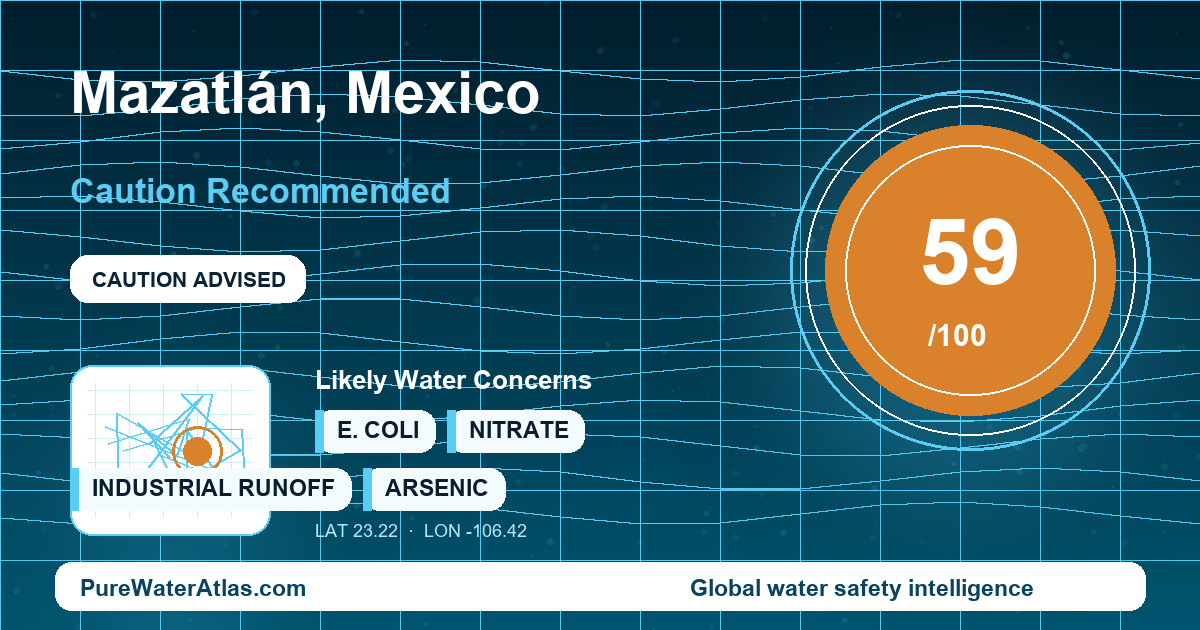
Mazatlán, Mexico: treated municipal supply from the Presidio River/Picachos system, but tap-level safety depends on distribution pressure, storage tanks, building plumbing, and verified treatment at the point of use.
Quick Answer
| Water safety score | 59 / 100 |
|---|---|
| Risk level | Caution Recommended |
| Is Mazatlán tap water safe to drink? | Caution recommended. Mazatlán has a formal municipal water utility and treated public supply, but public, city-specific finished-water test reporting is limited, distribution interruptions occur, and cisterns or rooftop tanks can change water quality after it leaves the utility system. |
| Traveler advice | Short-term visitors should not rely on unfiltered tap water for routine drinking. Use sealed bottled water, hotel-provided purified water, or a verified purifier. Tap water is generally acceptable for showering and handwashing. |
| Resident advice | Residents connected to JUMAPAM should treat the municipal supply as utility-treated, but use a point-of-use barrier for drinking and cooking, especially in older buildings or properties with cisterns or tinacos. |
| Main water source | Presidio River basin and Picachos Dam system, conveyed through the Picachos-Mazatlán aqueduct toward municipal treatment and distribution infrastructure. |
| Water authority | JUMAPAM, Junta Municipal de Agua Potable y Alcantarillado de Mazatlán. |
| Practical filter recommendation | Sediment prefilter plus NSF/ANSI-certified activated carbon; add UV disinfection or reverse osmosis when microbial risk, tank storage, salinity taste, or dissolved contaminants are concerns. |
Why Mazatlán Is Different
Mazatlán is not just another coastal tourism city with a simple local well system. Its modern public water security is closely tied to large regional infrastructure in the Presidio River basin, especially the Picachos Dam, the Picachos-Mazatlán aqueduct, and the Miravalles treatment system. These projects matter because Mazatlán is a growing Pacific coastal city in southern Sinaloa with seasonal demand, dry-season water stress, and exposure to summer and early-autumn tropical rain events.
The practical drinking-water issue in Mazatlán is not only whether water is treated at a plant. A traveler or resident may receive water after it has moved through long distribution lines, pressure zones, pumps, storage tanks, building cisterns, rooftop tinacos, and internal plumbing. In this city, the final tap can be influenced by pressure interruptions, tank maintenance, sediment after repairs, or building-level storage conditions.
PureWaterAtlas rates Mazatlán as Caution Recommended because the city has an identifiable municipal utility and treated supply, but recent, comprehensive, neighborhood-level and tap-level public test results are not easy to verify. This guide therefore avoids claiming that every tap, hotel, rental, well, cistern, or neighborhood is safe. Conditions can vary by building and by recent operational events.
Where Does Mazatlán’s Tap Water Come From?
Mazatlán’s current public supply is closely connected to the Presidio River basin and the Picachos Dam system. Local reporting and government project descriptions identify the Picachos reservoir, its aqueduct, and associated treatment works as strategic infrastructure for Mazatlán’s urban water security. Water is conveyed through the Acueducto Picachos-Mazatlán toward municipal treatment and distribution infrastructure, including the Planta Potabilizadora Miravalles.
This newer supply context is important because Mazatlán historically relied more heavily on wells, galleries, and intake infrastructure associated with the Presidio River area, including the Los Horcones system. That older groundwater and riverbank-source context still matters when discussing drought, aquifer stress, continuity of service, and raw-water quality pressures in a coastal, lower-basin city.
The main pieces of the Mazatlán water system include Presa Picachos, the Picachos-Mazatlán aqueduct, the Miravalles treatment plant, JUMAPAM’s distribution network, pumps, storage tanks, service lines, neighborhood-level pipes, and private or building-level cisterns and rooftop tanks. For household drinking-water risk, that last category is critical: even treated municipal water can deteriorate if it is stored in a dirty, uncovered, cracked, warm, or poorly disinfected tank.
Who Manages Drinking Water in Mazatlán?
Mazatlán’s municipal water and sewer utility is JUMAPAM, Junta Municipal de Agua Potable y Alcantarillado de Mazatlán. JUMAPAM is responsible for local public water service and distribution. The Gobierno Municipal de Mazatlán provides municipal government context for services and the local utility structure.
Mexico’s drinking-water quality requirements are set federally. The key standard is NOM-127-SSA1-2021, which covers water for human use and consumption, including microbiological, physical, chemical, and treatment-related requirements. COFEPRIS and state health authorities have sanitary surveillance roles, while CONAGUA regulates national waters and major water infrastructure. Hydrologic and basin context can also be checked through the CONAGUA Sistema Nacional de Información del Agua.
The limitation for consumers is that identifying the authority and the infrastructure is easier than verifying current tap-level quality at a specific apartment, hotel, restaurant, rental, or neighborhood. For Mazatlán, PureWaterAtlas confidence is medium: the utility and infrastructure are identifiable, but routinely published city-specific results for microbiology, turbidity, metals, disinfection residual, and household-level conditions are limited in public sources.
Main Local Water Concerns
The main Mazatlán concerns are linked to continuity, distribution, storage, and seasonal source-water pressures rather than a single confirmed citywide contaminant. Intermittent service or low pressure can increase the chance of intrusion if pipes, valves, or connections are compromised. This is especially relevant after repairs, pressure changes, or localized service interruptions.
Turbidity and sediment may appear after pipe repairs, flushing, pressure shifts, or heavy-rain runoff into surface-water sources. Summer monsoon rains and Pacific tropical storms can raise raw-water turbidity and increase the chance of sediment pulses, drainage impacts, or localized flooding. Dry-season and drought periods can stress reservoir levels, pumping operations, pressure, and continuity.
Microbial risk is the most important practical concern after distribution breaks, flooding, tank contamination, inadequate disinfection residual, or poorly maintained cisterns and tinacos. Chlorine taste and odor may be noticeable because chlorination is a normal barrier against microbial contamination. A chlorine smell does not automatically mean the water is unsafe, but the absence of a disinfectant residual in stored water can be a warning sign.
Coastal and lower-basin settings can make salinity or mineral taste a concern in some regional groundwater contexts, but available public evidence is insufficient to claim a uniform citywide salinity problem in Mazatlán’s treated tap water. Lead risk is also not identified here as a citywide source-water issue; it is mainly a premise-plumbing concern in older buildings, older fixtures, solder, valves, and unknown internal plumbing.
For Travelers
Short-term visitors to Mazatlán should not use ordinary tap water for routine drinking unless the specific tap is backed by a verified purifier or the hotel explicitly provides purified drinking water. The issue is not that every tap in Mazatlán is unsafe; the issue is that a traveler cannot easily verify treatment performance, distribution conditions, tank maintenance, residual disinfectant, and plumbing quality at the exact tap being used.
For drinking, choose sealed bottled water, hotel-supplied purified water, or water treated by a reliable purifier. Carry bottled or purified water during beach days, excursions, and long walks in hot weather. Avoid drinking from bathroom taps, marina taps, outdoor hoses, or unverified refill stations.
Many visitors brush their teeth with tap water without incident, but cautious travelers should use bottled or purified water for tooth brushing. This is especially sensible for families with young children, pregnant travelers, older adults, immunocompromised people, and anyone with a sensitive stomach.
Ice in established hotels, resorts, and restaurants in Mazatlán is commonly made from purified water, but do not assume this at informal stands or small venues. Ask whether the ice is made from purified water, or choose drinks without ice if uncertain. In hotels and restaurants, ask specifically whether drinking water and ice are purified, not merely whether the building is connected to city water. If there is flooding, pressure loss, visible discoloration, or a boil-water notice, use bottled water until the issue has clearly been resolved.
Travelers can also review the CDC Travelers’ Health guidance for Mexico for broader food and water precautions.
For Residents
Residents connected to JUMAPAM can treat the municipal supply as a utility-treated source, but household safety depends strongly on local pressure, pipe condition, internal plumbing, and storage tank maintenance. For drinking and cooking, a point-of-use treatment barrier is prudent in many Mazatlán homes, rentals, and apartments.
A practical resident setup is a sediment prefilter plus activated carbon to reduce particles, chlorine taste, and odor. If microbial risk is a concern because of cisterns, rooftop tinacos, long storage times, service interruptions, or uncertain maintenance, add UV disinfection or use reverse osmosis where appropriate. Reverse osmosis may also be considered if salinity taste, mineral-heavy water, or dissolved contaminants are a concern. Where possible, choose certified systems and replace cartridges and lamps on schedule.
Testing is especially important after interruptions, flooding, plumbing work, sewage backup nearby, or recurring illness concerns. Test for total coliform and E. coli if water passes through a cistern, rooftop tank, or private storage system. Measure free chlorine residual at the tap if water has sat in storage or if there are concerns about microbial protection. Test turbidity and basic physical parameters if water is cloudy, sandy, rusty, or changes after storms or repairs.
If the water tastes salty or mineral-heavy, test total dissolved solids, chloride, sodium, hardness, and conductivity, especially in properties using wells or mixed sources. In older buildings, schools, rentals, and homes with unknown plumbing materials, test lead and copper. Let water run after long stagnation, and consider both first-draw and flushed samples when evaluating metals from premise plumbing.
Cisterns and rooftop tinacos in Mazatlán should be sealed, cleaned, and disinfected regularly. A clean municipal supply can become unsafe if stored in a dirty, cracked, uncovered, or warm tank with low disinfectant residual. This building-level step is one of the most important resident actions in the city.
Relevant Contaminants and Water-Quality Issues
The most relevant Mazatlán water-quality topics are linked to disinfection, suspended particles, microbial indicators, storage tanks, and premise plumbing. Learn more about chlorine, which is used as a microbial barrier but can affect taste and odor. Review turbidity and sediment if your tap water becomes cloudy, sandy, rusty, or changes after storms, repairs, or pressure shifts.
For microbial risk, especially after tank contamination, service interruptions, or flooding, review E. coli and the broader PureWaterAtlas guide to water microbiology. For older buildings and unknown plumbing, review lead and the guide to lead testing and detection methods. If you use a private or mixed source, or if fertilizer or sewage impacts are a concern in the broader area, review nitrate and nitrate testing methods.
How to Verify Your Water Quality
Because Mazatlán-specific public tap-level reporting is limited, verification should be local and practical. Start by checking announcements from JUMAPAM and local authorities after repairs, storms, low-pressure events, or service interruptions. If water is discolored, cloudy, or has unusual odor, do not use it for drinking until the situation is clarified and the plumbing has been flushed.
For health decisions, use an accredited laboratory rather than relying only on home strips. Home screening tools can be useful for quick checks, but they should not be treated as proof of microbiological safety. Residents with storage tanks should prioritize testing for total coliform, E. coli, chlorine residual, and turbidity. Older properties should include lead and copper when plumbing materials are uncertain.
PureWaterAtlas resources that can help include the complete guide to water testing, the drinking water safety guide, and the water treatment systems guide. You can also use the Global Water Quality Checker and the Contaminants Search Engine to compare water-quality issues and treatment options.
Official and Technical Sources
- JUMAPAM, Junta Municipal de Agua Potable y Alcantarillado de Mazatlán — municipal water and sewer authority for Mazatlán.
- Gobierno Municipal de Mazatlán — municipal government context for local services and utility structure.
- CONAGUA, Comisión Nacional del Agua — federal authority for national waters, hydrologic information, dams, and major water infrastructure.
- CONAGUA Sistema Nacional de Información del Agua — official hydrologic and water information system.
- Diario Oficial de la Federación, NOM-127-SSA1-2021 — Mexican federal drinking-water standard for water for human use and consumption.
- COFEPRIS, Agua para uso y consumo humano — public health and sanitary surveillance context.
- CDC Travelers’ Health, Mexico — travel health guidance for food and water precautions.
- World Health Organization, Guidelines for Drinking-water Quality — international reference for microbial barriers and household water safety principles.
Bottom Line
Mazatlán has a real municipal water system, a named utility, and major supply infrastructure tied to the Presidio River basin, Picachos Dam, the Picachos-Mazatlán aqueduct, and the Miravalles treatment system. Even so, PureWaterAtlas recommends caution because public tap-level reporting is limited and final water quality can change in the distribution network, cisterns, rooftop tinacos, hotel storage systems, and older plumbing. Visitors should use sealed bottled water, hotel-provided purified water, or verified purification for drinking, and cautious travelers should also use it for tooth brushing. Residents should maintain storage tanks, monitor pressure or discoloration events, test after interruptions or flooding, and use a point-of-use treatment barrier for drinking and cooking.
Read the full guide: Global Water Quality Guide
Explore more in this category: Global Water Quality Articles