
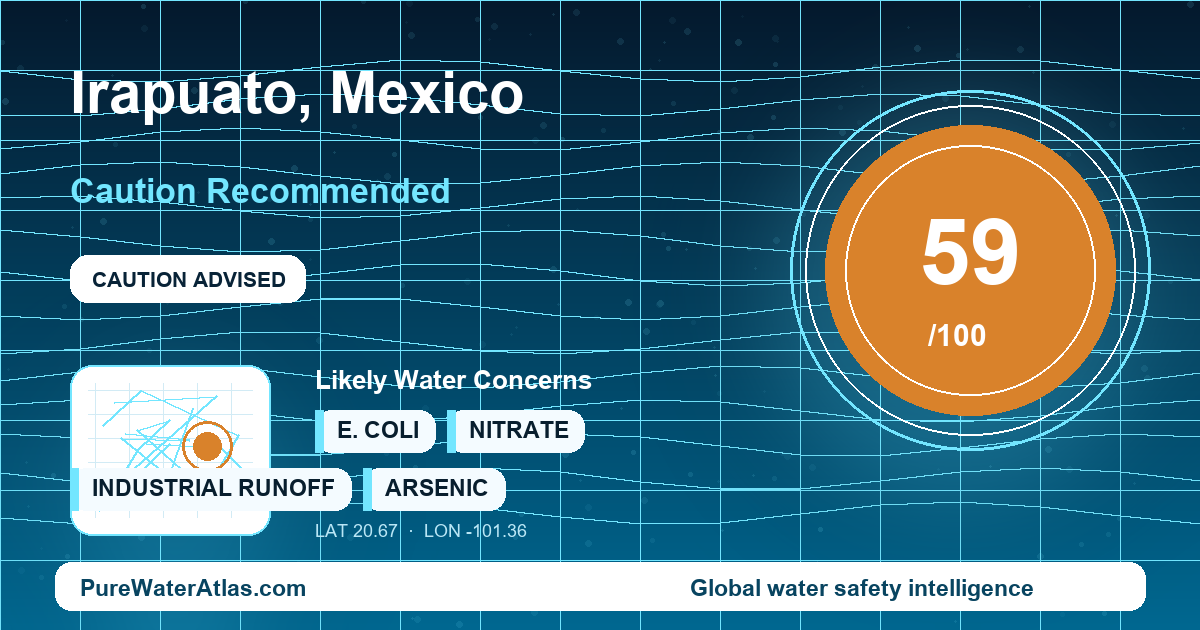
Irapuato, Guanajuato: a groundwater-dependent Bajío city where visitors should use bottled or verified purified water, and residents should verify household tap and storage-tank quality before drinking untreated tap water.
Quick Answer
| Overall safety status | Caution recommended. PureWaterAtlas assigns Irapuato a water safety score of 59/100. Untreated tap water is not recommended for short-term visitors. |
|---|---|
| Traveler advice | Use sealed bottled water, professionally filtered water, or water from a trusted hotel or restaurant purification system for drinking. Do not assume every tap, ice source, or refill container is safe. |
| Resident advice | Municipal water can generally be used for bathing, washing, and household use, but drinking water should be filtered or verified by testing, especially where cisterns, rooftop tanks, or older plumbing are present. |
| Main water source | Irapuato’s public supply is understood to rely predominantly on municipal groundwater wells within the Lerma-Chapala hydrologic region and the Irapuato-Valle groundwater system. |
| Water authority | JAPAMI, the Junta de Agua Potable, Drenaje, Alcantarillado y Saneamiento del Municipio de Irapuato. |
| Filter recommendation | A filter is advisable for routine drinking unless recent testing confirms safety at the kitchen tap and after household storage. Use treatment matched to results; reverse osmosis may be needed for dissolved contaminants such as arsenic, fluoride, nitrate, metals, or high TDS. |
Why Irapuato Is Different
Irapuato is not a generic “Mexico tap water” case. It is a central Guanajuato city in the Bajío, an intensively farmed and urbanizing valley area associated with the Lerma-Chapala basin. That location matters because the same regional groundwater resource supports municipal supply, agriculture, and urban growth. The practical question is not only whether water is disinfected when it enters the network, but what happens across a stressed groundwater system, the distribution grid, and the final building-level plumbing.
The most important local feature is Irapuato’s dependence on groundwater. Groundwater can be reliable, but in water-stressed settings it can also carry high hardness, elevated total dissolved solids, and site-specific geogenic contaminants. In parts of central and northern Mexico, groundwater-related arsenic and fluoride concerns are important enough that they should be tested rather than dismissed because water looks clear. Around Irapuato, agricultural pressure also makes nitrate screening relevant, especially for peri-urban properties and any private or semi-private well situation.
The PureWaterAtlas verdict for Irapuato is therefore cautious rather than alarmist: there is not enough open, current, neighborhood-level public monitoring data to declare every consumer tap safe, and there is also not enough verified evidence to claim a single contaminant is failing citywide. The realistic risk is variability: wells, disinfection, distribution lines, pressure events, repairs, household cisterns, rooftop tanks, and older in-building plumbing can all influence the water that actually reaches a glass.
Where Does Irapuato’s Tap Water Come From?
Irapuato’s public drinking-water supply is understood to rely predominantly on groundwater pumped from municipal wells serving the urban area. The city sits within the Lerma-Chapala hydrologic region and the Irapuato-Valle groundwater system. Rivers and canals in the area are important for regional hydrology, drainage, and agriculture, but they are not the typical direct treated surface-water source for ordinary city taps.
The urban system includes municipal groundwater production wells, disinfection points that are typically based on chlorination, storage and pressure infrastructure such as tanks, elevated reservoirs, and pumping stations, and the distribution network managed by JAPAMI. Sewerage, drainage, and wastewater treatment infrastructure are also part of the municipal water-management context. At the household level, cisterns and rooftop tanks are common practical control points: even if water leaves a utility disinfection point in acceptable condition, storage tanks can lose chlorine residual, collect sediment, or become contaminated if they are uncovered, cracked, dirty, or poorly maintained.
This groundwater identity also explains why taste, scale, hardness, and mineral content may be more noticeable than in some surface-water cities. These characteristics do not automatically prove unsafe water, but they are useful signals that testing should include hardness, conductivity, total dissolved solids, pH, turbidity, and contaminant-specific parameters rather than relying only on appearance or taste.
Who Manages Drinking Water in Irapuato?
Irapuato’s municipal water, sewer, drainage, and sanitation utility is JAPAMI. The full institutional name is Junta de Agua Potable, Drenaje, Alcantarillado y Saneamiento del Municipio de Irapuato. JAPAMI is the local operator most relevant to urban potable-water service and distribution.
The regulatory setting is broader than the city utility. Drinking water in Mexico is regulated under federal health standards, especially NOM-127-SSA1-2021, which defines sanitary quality requirements for water for human use and consumption. CONAGUA regulates national waters, groundwater concessions, and aquifer availability, with aquifer data available through the Sistema Nacional de Información del Agua. The Comisión Estatal del Agua de Guanajuato provides state-level water planning context, while health authorities such as COFEPRIS and state health services have sanitary surveillance roles.
The key data limitation is transparency at the consumer level. Official sources identify the utility, regulatory framework, and groundwater context, but recent, complete, public Irapuato distribution-zone tap-water results are limited. Without current sampling by zone and by building, it is not possible to verify that every tap is safe, or that a specific contaminant exceeds a legal limit citywide.
Main Local Water Concerns
Irapuato’s main drinking-water concerns are linked to groundwater dependence, aquifer stress, agricultural surroundings, and final-mile distribution and storage. Hardness, scale, taste, odor, and elevated total dissolved solids are plausible groundwater-related issues even where water is disinfected. These can affect acceptability and can indicate the need for more complete chemical testing.
Regional geogenic contaminants such as arsenic and fluoride are a concern in parts of central and northern Mexico. For Irapuato, the responsible position is to test for them rather than assume they are either present or absent. Agricultural activity around the city also makes nitrate screening relevant, particularly for private wells, peri-urban properties, and homes where water quality is not clearly documented through the municipal system.
Distribution-system and building-level issues are also important. Sediment, turbidity, or discoloration may appear after pipe repairs, pressure changes, low-pressure events, or intermittent supply conditions. Microbial risk can re-enter through household storage tanks, cisterns, rooftop tinacos, or poorly maintained internal plumbing even if municipal water was disinfected upstream. Older plumbing, solder, brass fixtures, stagnant first-draw water, and rarely used lines can create building-specific metals concerns, including possible lead risk.
Seasonal conditions can change practical risk. Rainy-season runoff may increase turbidity, sediment movement, sewer overflow potential, and local flooding risks that indirectly affect distribution and storage hygiene. Dry-season demand and groundwater drawdown can increase pressure on wells and operations. Hot weather can speed chlorine residual decay in stored water, making tank hygiene more important.
For Travelers
Visitors to Irapuato should not casually drink untreated tap water. The safer default is sealed bottled water, commercially supplied garrafón water, professionally filtered water, or water from a hotel or restaurant system that specifically confirms purification. This is consistent with conservative travel-health practice for Mexico and with the uncertainty around building-level water quality in Irapuato.
For brushing teeth, many healthy adults may choose bottled water to reduce the chance of stomach upset. In reputable hotels with confirmed filtered water, tap use for brushing is a lower-risk choice, but cautious travelers should still use bottled water. Infants, immunocompromised travelers, and anyone with a sensitive stomach should use bottled or verified purified water for drinking and oral hygiene.
Ice deserves special attention. Use ice only if it is commercially produced, made from purified water, or served by a reputable hotel or restaurant that confirms purified water. Avoid informal ice, uncertain refilled bottles, or containers where the source is unclear. In restaurants, ask whether drinking water and ice come from garrafón, sealed bottled supply, or an in-house purification system. Many hotels and restaurants in Mexican cities use purified water for guests, but that should be confirmed, not assumed.
Boiling is useful for bacteria, viruses, and protozoa, but it does not remove arsenic, fluoride, nitrate, salts, or metals. For a deeper explanation, see the PureWaterAtlas guide to boiling water purification.
For Residents
For Irapuato residents, the most practical strategy is verification followed by targeted treatment. A basic sediment plus activated-carbon system can improve taste, odor, particles, and some chlorine-related issues, but it will not reliably remove arsenic, fluoride, nitrate, high dissolved salts, or many metals. If testing shows elevated TDS, arsenic, fluoride, nitrate, or metals, a certified reverse-osmosis system or another contaminant-specific technology may be appropriate. The PureWaterAtlas guide to water purification methods explains how treatment choices differ by contaminant.
Testing should include both the kitchen tap and, where present, the cistern or rooftop tank after storage. Include microbiological indicators such as E. coli or total coliforms, especially after outages, flooding, tank-cleaning lapses, or repairs. Also measure residual chlorine, pH, turbidity, hardness, conductivity, and total dissolved solids to understand baseline system conditions.
Chemical screening should include nitrate because of the agricultural setting around Irapuato, and arsenic and fluoride because groundwater in parts of Guanajuato and central Mexico can contain geogenic contaminants. Older homes or buildings with unknown plumbing materials should test first-draw and flushed samples for lead and other metals. After installing any filter, retest treated water and follow cartridge or membrane replacement schedules.
Cisterns and rooftop tinacos should be tightly covered, protected from insects and dust, and cleaned and disinfected on a routine schedule. Stored water can lose disinfectant residual and become contaminated if tanks are cracked, uncovered, or poorly maintained. Older buildings can also create their own water-quality problems through stagnation, old valves, brass components, solder, or rarely used lines. Flush stagnant water before use and test where plumbing age is uncertain.
Relevant Contaminants and Water-Quality Issues
Several PureWaterAtlas contaminant profiles are especially relevant to Irapuato’s groundwater and building-level context. Chlorine matters because municipal systems generally rely on disinfectant residual, while taste and residual loss can become noticeable in storage tanks. Turbidity and sediment are relevant after pipe repairs, low-pressure events, rainy-season disturbance, or tank deposits.
For microbial risk, E. coli is a key indicator for contamination in stored water, private wells, and post-outage situations. The PureWaterAtlas water microbiology guide provides broader context for bacteria, viruses, and household storage risks.
For groundwater chemistry, Irapuato residents should understand arsenic and nitrate. Arsenic is important because it can occur naturally in groundwater in some regions and cannot be judged by taste or clarity. Nitrate is relevant because Irapuato is surrounded by intensive agriculture. Lead is different: it is mainly a building-specific risk from older plumbing, solder, brass fixtures, and stagnant first-draw water rather than a confirmed citywide source-water issue.
How to Verify Your Water Quality
The best next step in Irapuato is not guessing; it is testing. Start with the PureWaterAtlas complete guide to water testing and analysis. For contaminant-specific methods, see arsenic testing, nitrate testing, and lead testing.
Residents should sample the water they actually drink: first from the kitchen tap, and separately from any cistern or tinaco if storage is part of the home system. If a filter is installed, test both before and after treatment. If water has been off, pressure has dropped, repairs have occurred, or flooding has affected the area, flush taps until water is clear and consider using bottled or boiled water for microbial protection until normal service is restored. Remember that boiling does not solve dissolved chemical contamination.
To explore contaminants named in this Irapuato assessment, use the PureWaterAtlas Contaminants Search Engine. To compare Irapuato with other destinations, use the Global Water Quality Checker. For general decision-making, see Drinking Water Safety, plus the PureWaterAtlas categories on Global Water Quality, Water Testing, Water Contamination, and Water Purification.
Official and Technical Sources
- JAPAMI Irapuato official website — local municipal authority for potable water, drainage, sewerage, and sanitation services in Irapuato.
- Comisión Estatal del Agua de Guanajuato — state water-planning context for Guanajuato and the Bajío setting.
- CONAGUA aquifer information — official aquifer and groundwater availability context relevant to the Irapuato-Valle groundwater system.
- CONAGUA Sistema Nacional de Información del Agua — federal entry point for national water data.
- NOM-127-SSA1-2021 — Mexico’s federal sanitary quality standard for water for human use and consumption.
- COFEPRIS water for human use and consumption program — federal health surveillance context for drinking-water quality.
- CDC Travelers’ Health: Mexico — public-health travel guidance supporting conservative food and water precautions.
- INEGI — geographic and municipal context for Guanajuato and Irapuato.
Bottom Line
Irapuato’s tap water should be approached with caution. The city is served by JAPAMI and relies mainly on groundwater wells in a water-stressed Bajío setting, with federal standards applying under NOM-127-SSA1-2021. However, recent public neighborhood-level tap-water data are limited, and final water quality can change inside distribution lines, cisterns, rooftop tanks, and older plumbing. Visitors should use sealed bottled or verified purified water for drinking, brushing teeth if cautious, and ice. Residents should test kitchen tap and storage-tank water for microbiology, residual chlorine, hardness, TDS, nitrate, arsenic, fluoride, and metals where relevant, then select filtration based on results rather than assumptions.
Read the full guide: Global Water Quality Guide
Explore more in this category: Global Water Quality Articles