
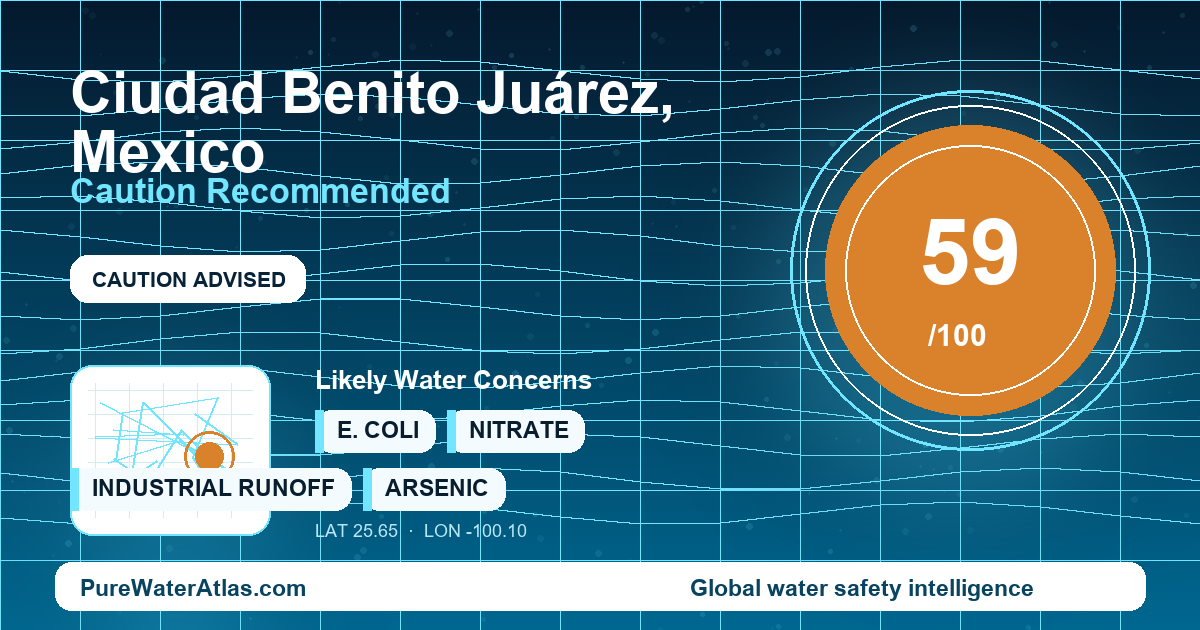
Ciudad Benito Juárez, Nuevo León, is part of the Monterrey metropolitan water system. The treated supply is regulated, but limited city-specific public testing data, drought-related pressure issues, and household storage tanks make direct tap drinking a caution case.
Quick Answer
| Water safety score | 59 / 100 |
|---|---|
| Risk level | Caution Recommended |
| Can visitors drink the tap water? | Not recommended as a default. Visitors should use sealed bottled water, reputable garrafón water, or verified purified water for drinking. |
| Resident advice | Use municipal water for washing and general household needs, but consider point-of-use treatment and periodic testing for drinking and cooking water. |
| Main supply identity | Servicios de Agua y Drenaje de Monterrey metropolitan system, blending major regional reservoirs, aqueducts, and groundwater sources depending on operating conditions. |
| Water authority | Servicios de Agua y Drenaje de Monterrey, I.P.D. within the Nuevo León metropolitan service area. |
| Filter recommendation | Sediment plus activated carbon is a practical baseline; reverse osmosis is more appropriate if testing shows high dissolved solids, nitrate, arsenic, or other dissolved contaminants. |
Overall verdict: caution recommended. Ciudad Benito Juárez is not understood here as a small isolated municipal well system. It is tied to the broader Monterrey metropolitan supply, operated by Servicios de Agua y Drenaje de Monterrey. The main issue is not proof that the official treated supply is unsafe; it is the limited public neighborhood-level data for Ciudad Benito Juárez and the practical risks created by drought, pressure management, intermittent service, storage tanks, and building plumbing.
Why Ciudad Benito Juárez Is Different
Ciudad Benito Juárez is in the eastern part of the Monterrey metropolitan area in Nuevo León. Its drinking-water profile is therefore regional as much as municipal. The city’s tap water is linked to the same broad metropolitan supply pressures that affect Monterrey-area municipalities: reservoir storage, aqueduct capacity, groundwater supplementation, distribution pressure, and demand from a rapidly growing urban region.
This matters because a water sample taken at a treatment facility does not always describe what reaches a kitchen tap in a particular house, rental, shop, or hotel in Ciudad Benito Juárez. The city is part of a fast-growing suburban corridor, where new subdivisions, pipe extensions, pressure zones, and building-level storage practices can affect final tap quality. A clean treated supply can still deteriorate after a pressure interruption, sediment disturbance, or storage in a poorly maintained tinaco or cistern.
The 2022 Nuevo León water-supply crisis is an important local context. During that drought crisis, reservoir levels, restrictions, pressure reductions, and intermittent service became major public issues across the Monterrey metropolitan area. That event does not prove that every tap in Ciudad Benito Juárez is unsafe today, but it does show why drought resilience, continuity of service, and household storage conditions are central to water-safety decisions in this city.
Public information identifies the regional utility and source system, but open, recent, neighborhood-specific laboratory results for Ciudad Benito Juárez are limited. Because of that data limitation, this profile uses a precautionary interpretation: the regulated SADM system is the relevant supplier, while real safety at the tap depends on the specific address, pressure history, tank maintenance, and plumbing condition.
Where Does Ciudad Benito Juárez’s Tap Water Come From?
Ciudad Benito Juárez is served within the Monterrey metropolitan system operated by Servicios de Agua y Drenaje de Monterrey. The broader system blends surface water from major regional reservoirs and aqueducts with groundwater wells and other metropolitan sources depending on reservoir storage, season, and operating conditions.
Key regional water infrastructure includes the El Cuchillo reservoir and aqueduct system, including the newer El Cuchillo II project for the Monterrey area; Cerro Prieto reservoir and conveyance infrastructure; La Boca reservoir and treatment infrastructure; metropolitan groundwater wells and pumping systems used as supplemental supply; and the SADM metropolitan distribution network that moves treated water across the urban area.
For Ciudad Benito Juárez residents, the final part of the system is often just as important as the regional source. Tinacos, cisterns, rooftop tanks, and internal building plumbing are common practical control points for final tap-water quality. If a household tank is unsealed, dusty, insect-accessible, rarely cleaned, or affected by long stagnation, the water at the tap may have a different risk profile than water leaving the utility system.
Seasonal conditions can also change risk. Late dry-season and drought periods can reduce reservoir storage and increase pressure-management measures. High summer heat raises demand and can worsen tank hygiene if tanks are not sealed and cleaned. Heavy rain and storm runoff can increase raw-water turbidity in reservoirs and canals, requiring treatment adjustments. Repairs, outages, and re-pressurization can temporarily mobilize sediment in mains and household lines.
Who Manages Drinking Water in Ciudad Benito Juárez?
The water and sewer utility relevant to Ciudad Benito Juárez is Servicios de Agua y Drenaje de Monterrey, commonly known as SADM. It is the state water and sewer utility serving the Monterrey metropolitan area, including municipalities in the metropolitan zone such as Juárez.
Drinking water quality in Mexico is governed nationally by Secretaría de Salud standards, including NOM-127-SSA1-2021 for water for human use and consumption. CONAGUA oversees national water resources, concessions, drought monitoring, and water information. SADM handles local treated-water operation and distribution for the metropolitan service area.
This authority structure is important because residents should look first to SADM and Nuevo León official notices for local service interruptions, supply updates, and utility water-quality information. However, because detailed open city-level test results for Ciudad Benito Juárez neighborhoods are limited, household verification remains especially useful for people who plan to drink tap water regularly.
Main Local Water Concerns
The main concerns for Ciudad Benito Juárez are practical, distribution-related, and data-related rather than a single confirmed citywide contaminant. The most important limitation is the lack of recent, publicly accessible, neighborhood-specific water-quality reporting for Ciudad Benito Juárez. This means a household should not assume that a regional statement automatically describes its own kitchen tap.
- Drought and source-water stress: Nuevo León’s 2022 water crisis showed that the Monterrey metropolitan system can be vulnerable during dry periods and high demand.
- Pressure interruptions: Intermittent pressure, low pressure, repairs, and re-pressurization can increase intrusion risk and stir up sediment in distribution lines.
- Turbidity and sediment: Brown, cloudy, or gritty water may occur after repairs, pipe flushing, storms, or pressure changes and should not be ignored.
- Chlorine taste and odor: Chlorine residual is expected in a large distribution network, but taste and odor can be noticeable at the tap.
- Variable mineral content: Hardness and total dissolved solids may vary because the regional system can blend reservoir water and groundwater.
- Storage tanks: Tinacos and cisterns can become microbial risk points if they are dirty, open, unsealed, or not disinfected.
- Building plumbing: Older plumbing, solder, brass fixtures, or long stagnation can contribute metals at the building level. This should not be treated as proof of citywide lead contamination without testing.
For Travelers
Short-term visitors to Ciudad Benito Juárez should not drink tap water as a default. Use sealed bottled water, reputable garrafón water, or water that has been filtered and disinfected. This recommendation is precautionary: the supply is part of a regulated metropolitan system, but final-tap conditions in a hotel, rental, restaurant, or private home may depend on storage-tank cleanliness and recent pressure history.
For brushing teeth, most healthy adults can usually use tap water if they avoid swallowing it. More cautious travelers should use bottled or purified water, especially in older buildings, small rentals, or any accommodation where cistern or tinaco maintenance is unknown. Infants, pregnant travelers, immunocompromised people, and visitors with sensitive stomachs should be more conservative.
Use ice only from hotels, restaurants, or stores that state they use purified water. Avoid informal ice or ice made in private accommodations unless you know the water source and the tank condition. Larger hotels and established restaurants often use purified water or commercial ice, but it is still reasonable to ask directly.
During hot weather, carry bottled water. Avoid outdoor taps. Be extra cautious after visible pipe repairs, pressure outages, brown water, unusual odor, or public service disruption notices. If a boil-water situation or suspected microbial event occurs, see the PureWaterAtlas Boiling Water Purification Guide for emergency treatment principles.
For Residents
Residents of Ciudad Benito Juárez should treat the municipal supply as usable for washing, bathing, cleaning, and general household use, while taking extra steps before relying on it as daily drinking water. A home filter is advisable unless recent testing confirms the kitchen tap is consistently safe at the point of use.
A sediment prefilter plus activated carbon can improve particles, chlorine taste, and some organic compounds. This is a practical baseline for many homes connected to a treated municipal supply. Reverse osmosis is a stronger option when laboratory tests show high total dissolved solids, nitrate, arsenic, or other dissolved contaminants. Filters must be maintained on schedule; neglected cartridges can become a microbial risk instead of a safety barrier.
Testing is especially important if the home uses a cistern or tinaco, has experienced low pressure, or has had changes in color, odor, or taste. At minimum, residents using tap water for drinking should consider annual kitchen-tap testing and additional testing after long outages, flooding, major plumbing work, or major service disruptions. Prioritize total coliforms and E. coli for microbial screening, residual free chlorine as a simple disinfectant indicator, and turbidity, total dissolved solids, hardness, nitrate, arsenic, iron, manganese, and basic metals when setting up a long-term drinking-water system.
Older homes and buildings need extra attention. If water sits overnight in older pipes, flush the cold tap before drinking and test for plumbing-related metals if children, pregnant people, or infants use the water. Tinacos and cisterns should be sealed, screened from insects and dust, cleaned and disinfected periodically, and inspected after outages. In Ciudad Benito Juárez, tank maintenance can be one of the most important differences between “treated water in the system” and “safe water at the tap.”
Relevant Contaminants and Water-Quality Issues
For Ciudad Benito Juárez, the most relevant water-quality topics are the ones that connect regional treatment, distribution stability, and household storage. Chlorine in drinking water is important because a measurable residual helps protect water as it moves through a large metropolitan network. If there is no chlorine residual at the tap, it may indicate loss of disinfectant protection in the building or distribution line.
Turbidity and sediment are relevant after storms, pipe repairs, pressure changes, or tank disturbance. Visible cloudiness, grit, or brown water should be treated as a warning sign until the cause is understood. Microbial indicators such as E. coli are especially important for homes with cisterns, tinacos, or recent low-pressure events.
Lead should be considered mainly as a building-plumbing risk, not as a confirmed citywide source-water issue. Homes with older plumbing, solder, brass fixtures, or long stagnation should test rather than assume. Arsenic and nitrate are also useful screening parameters where groundwater influence, private wells, or broader dissolved-contaminant concerns justify a lab panel.
How to Verify Your Water Quality
The best way to answer “is my tap water safe in Ciudad Benito Juárez?” is to test the water at the actual tap used for drinking. Utility treatment information is useful, but it does not replace a kitchen-tap sample from a home with its own plumbing, storage tank, and pressure history.
Start with the PureWaterAtlas Water Testing Guide for choosing field checks and laboratory panels. If you receive a laboratory report, use the Contaminants Search Engine to understand individual parameters. For general safety decision-making, see Drinking Water Safety, Water Microbiology, and Water Treatment Systems.
Residents comparing risk across cities can also use the Global Water Quality Checker. For households considering advanced treatment, PureWaterAtlas resources on UV purification, lead testing, arsenic testing, and nitrate testing can help match treatment to actual test results.
Official and Technical Sources
- Servicios de Agua y Drenaje de Monterrey — local utility for the Monterrey metropolitan water and sewer system.
- Servicios de Agua y Drenaje de Monterrey – Calidad del Agua — utility water-quality information page; availability and page structure may change.
- Gobierno de Nuevo León – Agua y Drenaje de Monterrey — state government entry for the public water utility.
- CONAGUA – Monitor de Sequía en México — national drought monitoring source relevant to Nuevo León water availability and pressure management.
- CONAGUA – Sistema Nacional de Información del Agua — national water-resource and infrastructure information.
- Secretaría de Salud – NOM-127-SSA1-2021 — official Mexican drinking-water standard for water for human use and consumption.
- INEGI – Juárez, Nuevo León municipal information — geographic and demographic reference for the municipality.
- Gobierno de Nuevo León — state information source for major water-infrastructure announcements, including El Cuchillo II project information when available through the site.
- World Health Organization – Guidelines for Drinking-water Quality — technical reference for microbial risk, disinfection, turbidity, and household water-safety principles.
Bottom Line
Tap water in Ciudad Benito Juárez should be treated as a caution case for drinking. The city is served by the regulated Servicios de Agua y Drenaje de Monterrey metropolitan system, drawing on regional reservoirs, aqueducts, groundwater wells, and distribution infrastructure. However, public neighborhood-level test data for Ciudad Benito Juárez are limited, and the Monterrey region has documented drought, pressure-management, and service-continuity challenges. For visitors, sealed bottled water or verified purified water is the safer default. For residents, municipal water is generally practical for household use, but drinking water should be filtered, periodically tested, and protected from storage-tank and plumbing risks. Clean tinacos, steady pressure, residual chlorine, and kitchen-tap testing matter as much as the regional source.
Read the full guide: Global Water Quality Guide
Explore more in this category: Global Water Quality Articles