
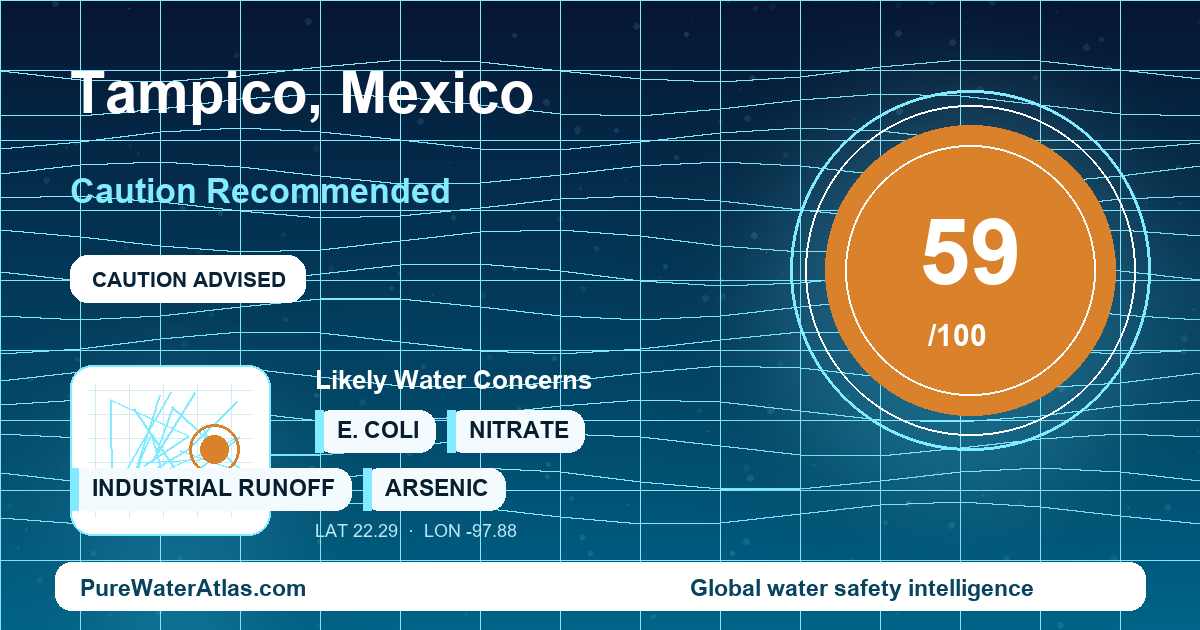
Tampico’s tap-water safety depends on a treated municipal surface-water system, a coastal lagoon supply, and local risks from salinity intrusion, storms, outages, and building storage tanks.
Quick Answer
| Overall safety status | Caution recommended. PureWaterAtlas water safety score: 59/100. Tampico has a real municipal treated-water system, but tap-level safety can vary with source-water conditions, pressure interruptions, storms, salinity events, and building plumbing. |
|---|---|
| Can tourists drink the tap water? | Not recommended for most travelers. Use sealed bottled water, reputable garrafón water, or water from a verified hotel or restaurant filtration and disinfection system. |
| Resident advice | Treat the municipal supply as water that often needs final household control before drinking. Use maintained point-of-use treatment and test at the kitchen tap if drinking it regularly. |
| Main water source | Surface water tied to the Laguna del Chairel and connected Tamesí-Guayalejo-Pánuco river-lagoon environment near the Gulf of Mexico. |
| Local authority | COMAPA Sur, the Comisión Municipal de Agua Potable y Alcantarillado de la Zona Conurbada serving Tampico and Ciudad Madero. |
| Filter recommendation | Sediment prefiltration plus activated carbon, with ultrafiltration or UV for microbial risk. Reverse osmosis is prudent where salinity, dissolved solids, nitrate, or certain metals are concerns. |
Why Tampico Is Different
Tampico is not a generic inland Mexican city drawing only from a protected deep aquifer. It sits at the mouth of the Pánuco River on the Gulf of Mexico, immediately adjacent to lagoon and wetland waters including Laguna del Chairel. That geography gives Tampico a distinctive coastal-estuary water profile: the city’s drinking-water supply is influenced by upstream watershed conditions, lagoon levels, storm runoff, drought, and downstream saltwater pressure from the Gulf-connected estuary.
The practical implication is that a simple yes-or-no answer is misleading. Tampico has municipal drinking-water infrastructure and treated water, but local conditions can materially affect what reaches a household tap. Low lagoon levels, drought stress, turbidity after storms, service interruptions, and old building storage tanks can all change the risk profile. The El Camalote hydraulic barrier or dike system is especially important because it helps protect the freshwater lagoon supply from saltwater intrusion from the Pánuco estuary. When low-water conditions or hydraulic-control problems occur, salty or highly mineralized taste should be treated as a warning sign.
Another Tampico-specific issue is the “last meter” problem: even if the utility treats water correctly, older internal plumbing, cisterns, rooftop tinacos, and poorly maintained building storage can recontaminate water before it reaches the glass. This matters in dense urban neighborhoods, older central areas, hotels, rentals, and commercial properties.
Where Does Tampico’s Tap Water Come From?
Tampico’s drinking-water supply is tied to the southern Tamaulipas surface-water system centered on Laguna del Chairel and the connected Tamesí-Guayalejo-Pánuco river-lagoon environment. This is a low-elevation coastal freshwater lagoon and river-estuary setting near the Gulf of Mexico, not a deep inland groundwater-only system.
Key infrastructure relevant to Tampico users includes the Laguna del Chairel and connected lagoon channels used as the practical raw-water reserve for the Tampico-Ciudad Madero urban area, surface-water intakes and municipal treatment facilities operated by COMAPA Sur, and the urban distribution network serving homes, hotels, commercial zones, and port-related districts. The El Camalote barrier is widely referenced in regional water management because it helps keep freshwater separated from brackish estuarine water.
This source identity explains several local risk patterns. Surface-water lagoon systems can carry suspended sediment, organic matter, algae, and runoff after rain. Coastal systems can also become more vulnerable to salinity intrusion during drought or when hydraulic controls are stressed. Boiling can reduce microbial risk in an emergency, but it does not remove salt, dissolved solids, metals, or many industrial chemicals. If Tampico tap water tastes salty, unusually mineralized, oily, chemically strong, or visibly muddy, bottled or properly treated water is the safer option until conditions are clarified.
Who Manages Drinking Water in Tampico?
The local drinking-water and sewer utility most directly relevant to Tampico users is COMAPA Sur, the Comisión Municipal de Agua Potable y Alcantarillado de la Zona Conurbada serving Tampico and Ciudad Madero. For regional and state context, the Comisión Estatal del Agua de Tamaulipas is relevant to hydraulic works and regional water planning, while CONAGUA’s Sistema Nacional de Información del Agua provides national water-resource information.
Mexico’s potable-water framework includes NOM-127-SSA1-2021, the official standard for water for human use and consumption. Sanitary oversight also involves health authorities such as COFEPRIS and state health agencies including the Secretaría de Salud de Tamaulipas.
A key limitation for consumers is transparency at the tap level. Public communication in Tampico does not provide the same easy-to-find, neighborhood-level consumer confidence report format used in some countries. The available information is enough to identify the water source, utility, regulatory framework, and coastal vulnerability, but it is not enough to claim that every neighborhood, hotel, school, or building tap is currently safe without direct testing.
Main Local Water Concerns
- Salinity, chloride, and total dissolved solids: Tampico’s source is a coastal lagoon and river-estuary system near the Gulf of Mexico. During drought, low river or lagoon levels, or hydraulic-control problems, saltwater intrusion pressure can increase. If water tastes salty or sharply mineralized, do not try to “fix” it by boiling. Use bottled water or reverse-osmosis-treated water for drinking, infant formula, coffee, cooking, and pets until the utility confirms normalization.
- Turbidity and organic matter: Laguna and river source waters can become cloudy after rain, runoff, sediment disturbance, or algal activity. Turbidity can make disinfection less effective and can quickly clog household cartridges. Sediment prefilters and timely filter changes matter in Tampico.
- Microbial risk after outages, low pressure, flooding, or tank contamination: Mexican standards require microbiological control, but pressure drops, storms, service interruptions, and poorly maintained storage tanks are practical failure points. After flooding or an outage, use bottled water. If no bottled water is available, boiling can reduce microbial risk, but only when the water is not salty, oily, chemically smelling, or heavily muddy.
- Old internal plumbing and building-level contamination: No public source confirms a Tampico-wide lead problem at the tap. However, older buildings can introduce metals, sediment, or microbial contamination through pipes, fixtures, solder, cisterns, and tinacos. Testing should be done at the actual kitchen tap.
- Urban, port, petrochemical, and industrial watershed pressures: Tampico is part of a major Gulf port and industrial corridor near Ciudad Madero and Altamira. Public consumer data does not allow a precise neighborhood-level claim about PFAS, solvents, petroleum compounds, or metals in finished tap water. Where these contaminants are a concern, use targeted certified treatment and laboratory testing.
For Travelers
Short-stay visitors should not assume Tampico tap water is safe to drink directly from the faucet. The safer default is sealed bottled water, reputable garrafón water, or water from a hotel or restaurant system that can clearly confirm filtration and disinfection. This is especially important after tropical rain, flooding, service interruptions, visible discoloration, or drought-related water notices.
For brushing teeth, bottled or filtered water is a low-cost precaution, especially for immunocompromised travelers, young children, and anyone staying in older lodging. Many travelers in Tampico use bottled water for brushing because it avoids unnecessary gastrointestinal risk.
Use caution with ice. Ice in established hotels and restaurants is often commercially produced or made from purified water, but street vendors and informal locations are harder to verify. If avoiding stomach illness is a priority, skip ice unless the source is clearly purified.
Higher-end hotels and restaurants may use private filtration, bottled water service, or purified ice, but ask directly. A statement that the water is purified is more useful than assuming the kitchen tap is safe. Travelers should also carry bottled water during hot weather and avoid refilling bottles from public bathroom taps. The CDC’s Mexico traveler health guidance supports treated or bottled water precautions for visitors.
For Residents
Residents should treat Tampico tap water as a municipal utility supply that may need final household management before drinking. A practical home setup is sediment prefiltration for turbidity, activated carbon for chlorine taste and some organic compounds, and either UV or ultrafiltration for microbial risk. Reverse osmosis is the stronger option where dissolved solids, salinity, nitrate, or some metals are concerns. However, reverse osmosis does not replace tank cleaning, plumbing maintenance, or periodic testing.
Testing should be done at the kitchen tap, not only at the street connection, because building plumbing and storage can change water quality. At minimum, consider total coliform and E. coli testing if drinking tap water directly, especially after a tank cleaning, outage, flood, or low-pressure event. If taste, cloudiness, or salinity changes occur, test turbidity, free chlorine residual, pH, conductivity, total dissolved solids, chloride, and hardness.
Older homes, rentals, schools, daycares, and buildings with unknown plumbing should consider first-draw and flushed sampling for lead and other metals where available. If a property uses a cistern or rooftop tinaco, test after cleaning and again if there is odor, slime, insects, sediment, or unexplained illness. Tinacos and cisterns should be sealed, screened, disinfected, and cleaned on a regular schedule. A dirty tank can recontaminate treated water even when the municipal supply leaving the plant is adequately chlorinated.
Relevant Contaminants and Water-Quality Issues
Several PureWaterAtlas contaminant guides are especially relevant to Tampico’s local conditions. Chlorine in drinking water matters because residual disinfectant helps control microbial risk in distribution systems and storage tanks, but it can be affected by outages, stagnation, and dirty tanks. Turbidity is important because Tampico relies on surface-water lagoon sources that can become cloudy after runoff, algae, or sediment disturbance. Sediment is relevant for brown water, pipe work, old internal plumbing, and tank deposits.
For microbial safety, residents should understand E. coli in drinking water, especially after low pressure, flooding, or storage-tank contamination. For older buildings, lead in drinking water is relevant as a building-plumbing issue, even though this profile does not claim a confirmed citywide lead problem in Tampico. Nitrate may be included in broader testing panels, particularly for households with infants or where runoff concerns exist.
For treatment planning, see PureWaterAtlas guides on boiling water purification, UV purification, and choosing water treatment systems. Boiling is useful for microbial emergencies, but it does not remove salinity, dissolved metals, or many industrial chemicals.
How to Verify Your Water Quality
The most reliable way to know whether Tampico tap water is safe in a specific home, hotel, or business is to verify the actual tap water. Start with local service notices from COMAPA Sur, especially during drought, storms, pipe repairs, pressure interruptions, or unusual taste events. For drought context, check the Monitor de Sequía en México from CONAGUA and the Servicio Meteorológico Nacional.
For household testing strategy, use the PureWaterAtlas Water Testing guide. If you receive laboratory results and need to understand the terms, use the PureWaterAtlas Contaminants Search Engine. Travelers comparing Tampico with other destinations can use the Global Water Quality Checker and the broader Global Water Quality resource.
Because neighborhood-level finished-water data for Tampico taps is limited in public consumer format, avoid broad claims such as “all tap water is safe” or “all tap water is unsafe.” The better standard is building-specific verification: test the tap, inspect tanks, maintain filters, and respond quickly to changes in taste, odor, color, pressure, or utility notices.
Official and Technical Sources
- COMAPA Sur official website — local utility reference for the Tampico-Ciudad Madero conurbation.
- Comisión Estatal del Agua de Tamaulipas — state-level water authority context.
- Sistema Nacional de Información del Agua, CONAGUA — national water-resource information.
- Monitor de Sequía en México — drought conditions relevant to lagoon levels and salinity vulnerability.
- NOM-127-SSA1-2021 — Mexico’s official drinking-water quality standard.
- COFEPRIS — federal sanitary authority context.
- Secretaría de Salud de Tamaulipas — state health authority context.
- CDC Travelers’ Health: Mexico — traveler water precautions.
- WHO Guidelines for Drinking-water Quality — public-health basis for microbial risk, treatment barriers, and safe water management.
- INEGI geographic information portal — geographic context for Tampico, Tamaulipas.
Bottom Line
Tampico tap water deserves caution, not panic. The city is served by a municipal treated-water system, but its supply is locally distinctive: a coastal lagoon and river-estuary system near the Gulf of Mexico, protected in part by hydraulic separation from brackish water. Drought, low lagoon levels, saltwater intrusion pressure, storms, turbidity, outages, and building storage tanks can all affect tap-level safety. Tourists should use sealed bottled or verified purified water for drinking, brushing teeth, and ice-sensitive situations. Residents who want to drink tap water should use maintained household treatment, clean tinacos and cisterns, and test at the kitchen tap. Because recent neighborhood-level public tap data is limited, building-specific verification is the most reliable approach.
Read the full guide: Global Water Quality Guide
Explore more in this category: Global Water Quality Articles