Hangzhou has one of China’s stronger urban water-supply profiles because the central city is served by treated municipal water and has strategic access to Qiandao Lake, also known as Xin’anjiang Reservoir, but tap-level safety still depends on building plumbing, high-rise storage tanks, and current local conditions.
Quick Answer
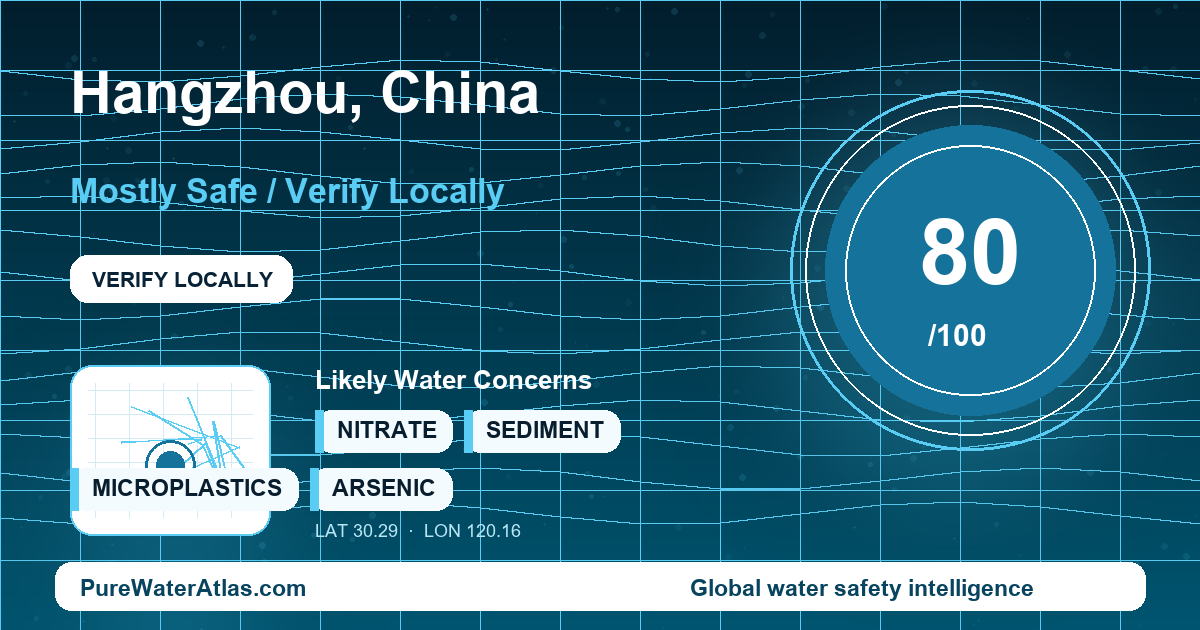
| Overall tap-water status | Mostly safe / verify locally. Hangzhou’s water safety score is 80. The city has treated municipal water and a major upland reservoir source, but point-of-use risk can vary by building. |
|---|---|
| Can visitors drink it? | For routine drinking, visitors should use bottled, boiled, or properly filtered water unless the hotel specifically confirms potable tap water and well-maintained building systems. Tap water is generally reasonable for washing and brushing teeth in modern central hotels. |
| Resident advice | Municipal-network water is a relatively strong baseline, especially in newer buildings. Residents should still check secondary water-supply maintenance, flush stagnant taps, and consider filtration in older apartments or high-rises. |
| Main water source | Hangzhou’s urban system uses treated surface water, with the Qiandao Lake / Xin’anjiang Reservoir diversion system serving as a major strategic raw-water source for the main urban area. |
| Water authority | Hangzhou Water Group / Hangzhou Water Affairs Group, with public-health oversight connected to the Hangzhou Municipal Health Commission and environmental oversight connected to Hangzhou and Zhejiang ecology and environment authorities. |
| Filter recommendation | A filter is not automatically required for every household, but activated carbon can improve chlorine taste, sediment filtration can help with particles, and reverse osmosis or equivalent systems may be appropriate when broader contaminant reduction is desired. |
Why Hangzhou Is Different
Hangzhou’s drinking-water profile is shaped by a city-specific contrast: it sits at the lower Qiantang River near a tidal estuary, yet its strategic newer raw-water supply draws from Qiandao Lake, a large reservoir in the upper Xin’an River system west of the city. That dual context matters. A lower estuarine river setting can face turbidity, sediment, storm runoff, tidal influence, and seasonal flow variability. An upland reservoir source can improve source-water security and reduce dependence on more variable lower-river water.
This does not mean every tap in Hangzhou is identical. The strongest part of Hangzhou’s profile is the combination of modern municipal treatment and the Qiandao Lake / Xin’anjiang Reservoir diversion system. The weaker and more variable part is what happens after water leaves the treatment plant: apartment-tower tanks, pumps, building pipework, older internal plumbing, stagnation, and local pipe maintenance. For practical purposes, a visitor in a central hotel and a resident in an older high-rise may face different tap-level risk even though both are within the same municipal water system.
The evidence base is also uneven. Hangzhou has official Chinese-language utility, health, environmental, and government sources, and the broad identity of the Qiandao Lake diversion system is well established. However, public neighborhood-level and building-level tap data are not consistently easy to search or compare in English. For that reason, this guide does not claim universal potability at every apartment tap or exact contaminant levels for specific districts.
Where Does Hangzhou’s Tap Water Come From?
Hangzhou’s urban drinking-water system uses treated surface water. A major city-specific feature is the Qiandao Lake / Xin’anjiang Reservoir raw-water diversion system, which was built to bring reservoir water from the upper Xin’an River system toward Hangzhou and strengthen the city’s urban water supply. This project materially changes Hangzhou’s risk profile by improving source-water security and reducing reliance on the more turbid and tidally influenced Qiantang River system.
Historically, Hangzhou relied heavily on local surface-water sources, including the Qiantang River system. The Qiantang River near Hangzhou is a tidal river and is more exposed to sediment load, estuarine influence, urban runoff, and seasonal flow variability than a protected upland reservoir source. The shift toward Qiandao Lake water should therefore be understood as a source-protection and supply-resilience measure, not merely a routine expansion of capacity.
Key infrastructure in the Hangzhou water system includes the Qiandao Lake / Xin’anjiang Reservoir diversion project, municipal water-treatment plants, Qiantang River-related legacy or backup source-water infrastructure, urban distribution mains and pressure zones, and household connections across the central districts. In high-rise buildings, one of the most important practical components is the secondary water supply system: rooftop tanks, underground tanks, pumps, building valves, and internal pipes. These systems can affect final tap quality even when water leaving the municipal plant is acceptable.
Who Manages Drinking Water in Hangzhou?
The principal municipal utility associated with Hangzhou’s urban water supply is Hangzhou Water Group / Hangzhou Water Affairs Group. City-level public-service and infrastructure information may also appear through the Hangzhou Municipal People’s Government.
Drinking-water sanitary oversight is connected to the Hangzhou Municipal Health Commission. Environmental oversight of centralized drinking-water sources is connected to the Hangzhou Ecology and Environment Bureau and the Zhejiang Provincial Department of Ecology and Environment. National environmental and health frameworks are associated with the Ministry of Ecology and Environment of the People’s Republic of China and the National Health Commission of the People’s Republic of China.
Hangzhou drinking water is governed by China’s national drinking-water standard framework, including GB 5749-2022 Standards for Drinking Water Quality. However, standards alone should not be treated as proof of what is coming out of every kitchen tap. Residents should look for current official Chinese-language notices, local monitoring information, and building-level records where available.
Main Local Water Concerns
Hangzhou’s main tap-water concerns are not a single confirmed contaminant problem across the city. They are a set of local risk points tied to source-water conditions, weather, distribution, and building infrastructure.
- Qiantang River vulnerability: Where lower-river sources are relevant, raw water can be more vulnerable to turbidity, sediment, storm runoff, tidal influence, and seasonal water-quality variation than protected reservoir water.
- Dry-season and estuarine pressure: During low-flow periods, tidal or estuarine influence can become more relevant for lower Qiantang River source-water management. Current risk depends on intake location, flow, and operational controls.
- Storm and typhoon effects: Plum-rain season, summer storms, and typhoon-related rainfall can increase raw-water turbidity and runoff pressure. Repair work or pressure changes can also disturb distribution sediment.
- Secondary water supply: High-rise apartment buildings commonly use storage tanks, pumps, and building-level pipe systems. If these are not cleaned, disinfected, sealed, and inspected, they can become a practical risk point.
- Older plumbing: Older apartments may have aging pipes, valves, fixtures, or stagnant branch lines that contribute yellow or brown water, sediment, metallic taste, or possible metal pickup.
- Chlorine taste and odor: Residual disinfectant is maintained for microbial control across the distribution network, so chlorine taste or smell may be noticeable.
For Travelers
For visitors, Hangzhou tap water should be treated as generally suitable for showering, handwashing, and brushing teeth in modern hotels and reputable central accommodations. For routine drinking, the safer default is sealed bottled water, boiled tap water, or water from a properly maintained filter. This aligns with common local practice in Chinese cities, where treated tap water is often boiled before drinking even when the municipal supply is considered acceptable.
Brushing teeth with tap water is generally reasonable in modern hotels. Travelers with very sensitive stomachs, infants, immunocompromised travelers, or anyone staying in older apartments may prefer bottled or boiled water for brushing as well.
Use normal caution with ice. Ice in higher-end hotels, international chains, and reputable restaurants is more likely to be made from treated water, but street vendors and small shops may not provide clear assurance. If you are avoiding gastrointestinal risk, skip ice and choose hot tea, boiled water, sealed bottled water, or factory-sealed drinks.
Most Hangzhou hotels provide kettles and often bottled water. If tap water appears cloudy after pipe work, contains visible particles, or smells unusual beyond normal chlorine, let it run briefly and switch to bottled or boiled water. Short-stay travelers do not need to spend time proving building-level water quality; use the lowest-risk option available.
For more detail on boiling as a practical travel method, see Boiling Water Purification: Complete Guide.
For Residents
For residents connected to Hangzhou’s municipal network, baseline risk is moderate to low, especially in newer buildings with well-maintained internal plumbing. The most important local question is often not whether Hangzhou has municipal treatment, but whether your building’s secondary supply system and internal pipes preserve that quality.
A home filter is not automatically required for every Hangzhou household. It can still be sensible for taste, chlorine reduction, sediment control, and added protection in older housing or high-rises with storage tanks. Match the device to the concern: activated carbon for chlorine taste and odor, sediment prefilters for visible particles, and reverse osmosis or equivalent systems for broader dissolved-contaminant reduction. Maintain cartridges on schedule because exhausted filters can become ineffective, and poorly maintained systems can create microbial risk.
Residents in older buildings should consider testing first-draw and flushed samples for lead and other metals if there are children, pregnant residents, unexplained metallic taste, or recurring discoloration. If water is yellow, brown, or contains visible particles, check iron, manganese, turbidity, and sediment, and ask the property manager about recent pipe work or tank cleaning.
If your building uses rooftop or underground storage tanks, ask for the latest cleaning and disinfection records and any sanitary inspection documents. Tanks should be sealed against pests, cleaned, disinfected, and inspected. After long absences, flush taps until water temperature stabilizes before using water for drinking or cooking.
Relevant Contaminants and Water-Quality Issues
Hangzhou’s city-specific concerns point to several water-quality topics worth understanding. Residual disinfectant can affect taste and odor, so see Chlorine in Drinking Water. Storm runoff, Qiantang River turbidity pressure, and visible cloudiness after maintenance are connected to Turbidity in Drinking Water. Particles from old pipes, disturbed mains, or building tanks are covered in Sediment in Drinking Water.
For older apartments, the most relevant tap-level concern is premise plumbing rather than the reservoir itself. Learn more from Lead in Drinking Water and Lead in Drinking Water: Testing and Detection Methods. For high-rise tank and microbial concerns, see E. coli in Drinking Water and the broader Water Microbiology guide.
Surface-water catchments can be affected by runoff, although this guide does not claim neighborhood-specific nitrate levels for Hangzhou. Residents who want to understand that issue can review Nitrate in Drinking Water and Nitrate Contamination in Drinking Water: Testing and Detection Methods. Advanced testing questions, including PFAS screening, are covered in PFAS in Drinking Water: Testing and Detection Methods; PFAS is not presented here as a confirmed Hangzhou tap-water problem without site-specific evidence.
How to Verify Your Water Quality
Because Hangzhou’s strongest public information is generally city-level, source-level, or utility-level, the best way to verify your actual risk is to focus on the point of use. Check official Chinese-language sources for current notices, treatment or service updates, public-health information, and source-water monitoring. Then verify your building conditions: tank-cleaning records, recent pipe work, and whether residents have reported discoloration, particles, odor, or intermittent pressure issues.
For household testing strategy, use the PureWaterAtlas Water Testing guide. For deciding what treatment method fits a specific concern, see Water Purification. For a general tap-water decision framework, read Drinking Water Safety.
You can also compare potential issues through the Contaminants Search Engine or compare Hangzhou with other destinations using the Global Water Quality Checker. Related PureWaterAtlas categories include Global Water Quality, Drinking Water Safety, Water Testing, and Water Treatment Systems.
Official and Technical Sources
- Hangzhou Water Group / Hangzhou Water Affairs Group — municipal water utility information, service notices, and urban water-supply context.
- Hangzhou Municipal People’s Government — official city portal for municipal infrastructure and public-service announcements.
- Hangzhou Municipal Health Commission — local public-health authority relevant to drinking-water sanitary supervision.
- Hangzhou Ecology and Environment Bureau — local environmental authority for source-water environment and pollution-control information.
- Zhejiang Provincial Department of Ecology and Environment — provincial source-water protection and surface-water quality context.
- Ministry of Ecology and Environment of the People’s Republic of China — national environmental policy and water-environment information.
- National Health Commission of the People’s Republic of China — national health authority associated with China’s drinking-water standards framework.
- World Health Organization drinking-water fact sheet — international reference for drinking-water health risks and household water-safety concepts.
Bottom Line
Hangzhou has a comparatively strong urban drinking-water profile for China because the central city is served by treated municipal water and benefits from the Qiandao Lake / Xin’anjiang Reservoir diversion system. The main caution is tap-level variability after treatment. Older internal plumbing, high-rise storage tanks, stagnant pipes, recent pipe work, and limited public building-level data mean residents and travelers should not assume every tap is identical. Visitors should use bottled, boiled, or filtered water for drinking, while tap water is generally reasonable for washing and brushing teeth in modern hotels. Residents should verify tank maintenance, flush after stagnation, test if discoloration or metal concerns appear, and consider filtration where building conditions warrant it.
Read the full guide: Global Water Quality Guide
Explore more in this category: Global Water Quality Articles