
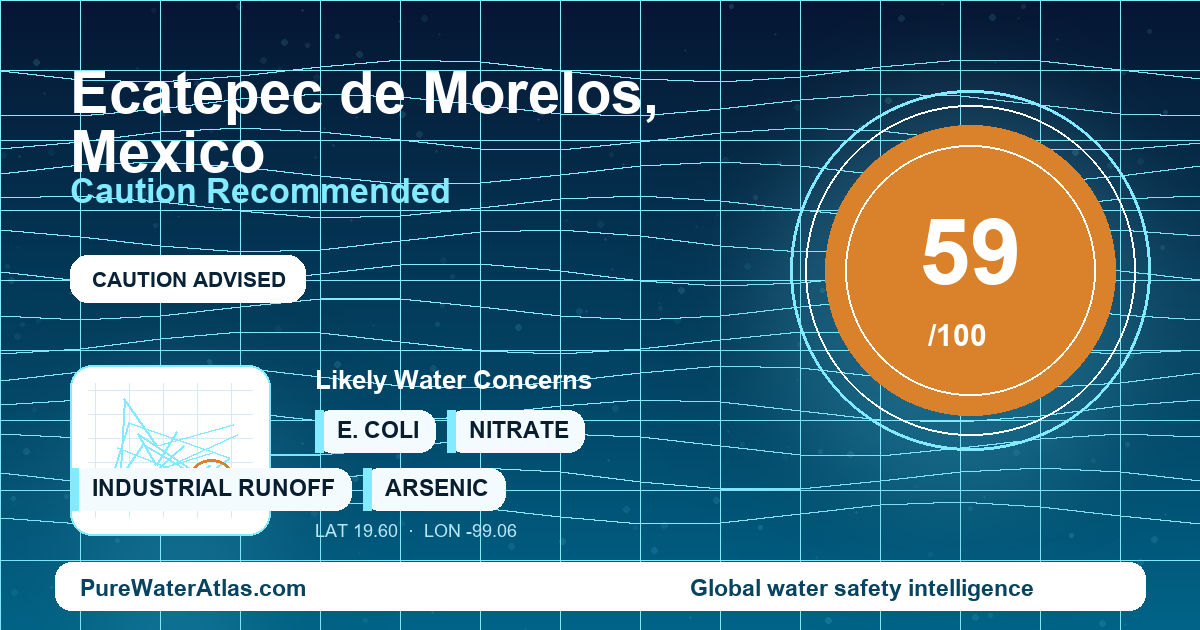
Ecatepec de Morelos, State of Mexico: mixed groundwater and metropolitan bulk-water supply, intermittent service risk, household storage concerns, and practical tap-water guidance for visitors and residents.
Quick Answer
| Overall safety status | Caution recommended. Ecatepec de Morelos has a formal municipal drinking-water system, but tap safety can vary by neighborhood, building, storage tank, and recent service conditions. The city’s water safety score is 59/100, with a risk level of Caution Recommended. |
|---|---|
| Can visitors drink the tap water? | Not recommended as a default. Short-stay visitors should use sealed bottled water, garrafón water, or reliably filtered water for drinking. |
| Resident advice | Treat tap water as variable-quality. For daily drinking and cooking, a maintained point-of-use system is prudent, especially where water is stored in cisterns or rooftop tinacos. |
| Main water sources | Municipal groundwater wells plus treated bulk water from regional Valley of Mexico systems, including supply associated with the Cutzamala System. |
| Water authority | Local operator: SAPASE Ecatepec de Morelos. State and regional support: CAEM and CONAGUA. |
| Filter recommendation | Sediment prefiltration plus activated carbon is useful for sediment, taste, and chlorine-related issues. Reverse osmosis is advisable where dissolved salts, arsenic, fluoride, nitrate, or metals are a concern. UV can help with microbial risk only after turbidity is controlled. |
Why Ecatepec de Morelos Is Different
Ecatepec de Morelos is not a simple “one source, one treatment plant, one answer” drinking-water city. It is a very large, dense municipality in the State of Mexico within the Mexico City metropolitan area. Its location at the foot of the Sierra de Guadalupe and near the former Lake Texcoco lowlands matters because the broader basin’s geology, groundwater extraction, urban expansion, and old distribution networks all influence water service reliability and potential contamination pathways.
The practical safety question in Ecatepec is shaped as much by distribution and storage as by water treatment. Even if water is disinfected before or during distribution, quality can change before it reaches a kitchen tap. Intermittent pressure, pipe repairs, leaks, household cisterns, rooftop tinacos, and tanker deliveries can create building-by-building differences. A modern hotel on a main avenue may provide bottled or filtered drinking water, while a household in a low-pressure neighborhood may depend on stored water. Those two situations can have very different microbial and sediment risks.
For this reason, the most defensible conclusion is cautious: Ecatepec tap water may be disinfected within the public system, but it should not be treated as reliably drinkable at every tap without local verification, storage-tank hygiene, and appropriate point-of-use treatment.
Where Does Ecatepec de Morelos’s Tap Water Come From?
Ecatepec’s supply is a combination of local and regional water. The local component comes from municipal groundwater wells tapping over-stressed Valley of Mexico aquifers in and around Ecatepec and neighboring municipalities. The regional component includes treated bulk water from metropolitan systems. One important regional source is the Cutzamala System, which captures surface water from reservoirs outside the Valley of Mexico, treats it at the Los Berros treatment plant, and conveys it to the metropolitan area through major hydraulic infrastructure.
Historically, Ecatepec developed on the northeastern edge of the Mexico City metropolitan basin, between mountain slopes and former lacustrine lowlands. Rapid urban growth made its water supply dependent on groundwater extraction, imported-water transfers, pumping, storage tanks, and local distribution networks rather than a single local river source.
Important water infrastructure for Ecatepec includes municipal wells and pumping stations operated or coordinated through SAPASE, bulk-water connections involving State of Mexico and federal metropolitan systems, storage tanks, cisterns, rooftop tinacos, pressure zones, and neighborhood distribution networks. The Cutzamala infrastructure also matters because reservoir storage, treatment, pumping, aqueducts, maintenance, and metropolitan distribution constraints can affect parts of the Valley of Mexico supply.
Seasonal and operational factors are important. Dry-season shortages and reduced Cutzamala reservoir storage can lead to cutbacks, pressure changes, or greater reliance on local wells and stored water. Scheduled Cutzamala maintenance can reduce supply temporarily to parts of the metropolitan area. Rainy-season runoff and storm-related pipe disturbances can increase turbidity, especially where leaks or cross-connections exist. Hot weather can also accelerate microbial growth in poorly maintained rooftop tanks or cisterns.
Who Manages Drinking Water in Ecatepec de Morelos?
The local water and sanitation operator is SAPASE, Sistema de Agua Potable, Alcantarillado y Saneamiento de Ecatepec de Morelos. At the state level, the Comisión del Agua del Estado de México participates in hydraulic infrastructure and bulk-water services. At the federal level, CONAGUA manages national water resources, aquifers, and major systems such as Cutzamala.
Health-related drinking-water quality in Mexico is regulated under NOM-127-SSA1-2021, the national standard for water for human use and consumption. Sanitary oversight involves federal and state health authorities, including COFEPRIS and state health services.
A key limitation for Ecatepec residents is public data granularity. There is enough official and high-authority information to identify the responsible utility, mixed supply structure, regional water-stress context, and practical risk factors. However, recent neighborhood-by-neighborhood tap-water laboratory results are not consistently published in an easy centralized public format. That means PureWaterAtlas does not claim that every tap in Ecatepec is safe or unsafe, and it does not assign exact contaminant concentrations by colonia without sampling. For household decisions, point-of-use testing is the strongest evidence.
Main Local Water Concerns
- Intermittent service and low pressure: Depressurized pipes can increase intrusion risk, especially where water and sewer lines are old, damaged, or repaired frequently.
- Cisterns and rooftop tinacos: Household storage is common and can become a microbial risk if tanks are not sealed, cleaned, and disinfected on a routine schedule.
- Turbidity and sediment: Discoloration, visible particles, or cloudy water may occur after pipe repairs, pressure changes, Cutzamala maintenance, well switching, or rainy-season disturbances.
- Groundwater chemistry: Valley of Mexico groundwater can vary in dissolved minerals, hardness, salinity, iron, manganese, and other geogenic characteristics depending on the well field. Testing is needed rather than assuming uniform quality.
- Older building plumbing: Pipes, valves, fittings, solder, or storage infrastructure can add building-specific metals or sediment risk even when the municipal supply is treated.
- Tanker water: Water-truck supply can be safe or unsafe depending on source, tank hygiene, and handling. Residents should verify supplier legitimacy and protect household storage.
For Travelers
Visitors to Ecatepec de Morelos should not drink tap water as a default. Use sealed bottled water, garrafón water, or water treated by a reliable filter or purification system. This advice is based on distribution and storage variability, not on a claim that all municipal water is untreated.
Brushing teeth with tap water is usually lower risk than drinking larger quantities, and many healthy adults may choose to brush with tap water while avoiding swallowing it. More cautious travelers, children, pregnant travelers, and immunocompromised people should use bottled or treated water, especially in private rentals, budget lodging, or buildings that rely on rooftop tanks.
Be careful with ice. Avoid ice from informal vendors or unknown sources. In established hotels and restaurants, ask whether ice is made from purified water. Many businesses in Mexico use purified bagged ice, but visitors should not assume this everywhere.
Hotels and restaurants that provide bottled water, garrafón water, or clearly filtered water are preferable. If staying in an apartment or short-term rental, ask whether drinking water comes from a sealed bottle, a maintained filter, or the building’s storage tank. Use bottled water for infant formula. If gastrointestinal symptoms develop, switch to sealed bottled water only and consider oral rehydration salts. Boiling can reduce microbial risk, but it does not remove dissolved salts, metals, or other chemical contaminants.
For Residents
Residents should manage Ecatepec tap water as a variable-quality supply. A home filter is strongly advisable for drinking water, especially where water is stored, tastes salty or metallic, appears turbid, or comes from an older building. A practical setup often starts with sediment prefiltration, followed by activated carbon for taste, chlorine-related issues, and some organic compounds. Reverse osmosis is appropriate where testing or local conditions raise concern about dissolved salts, arsenic, fluoride, nitrate, or metals. UV can support microbial control, but only after sediment and turbidity are controlled; UV does not remove chemicals.
Testing should be done at the point of use, not only at the street connection. Cisterns, tinacos, pumps, and building plumbing can change water quality after it enters the property. At minimum, residents should consider testing for total coliforms and E. coli, residual chlorine, turbidity, total dissolved solids, hardness, nitrate, iron, manganese, arsenic, fluoride, and lead where old plumbing is possible.
Retest after major plumbing work, repeated water outages, flooding, unusual color or odor, or a switch to tanker water. Use an accredited laboratory for health decisions. Home strips are useful for quick screening of chlorine, hardness, and TDS, but they are not enough for microbiological confirmation or metals decisions. If infants, pregnant people, elderly residents, or immunocompromised people live in the home, prioritize microbiological testing and use a reliable treated-water source until results are known.
Storage tanks require special attention. Cisterns and tinacos should be tightly covered, protected from insects and dust, and cleaned and disinfected routinely. A dirty storage tank can make otherwise disinfected municipal water unsafe at the tap. After outages, watch for turbidity and verify chlorine if possible, or use boiled or filtered water until water clears.
Relevant Contaminants and Water-Quality Issues
In Ecatepec, the most relevant water-quality issues are the ones connected to distribution, storage, groundwater influence, and old building plumbing. Chlorine in drinking water is important because residual chlorine helps indicate whether water remains disinfected after passing through pipes and household tanks. Low or absent residual chlorine at the tap can signal a need for additional caution.
Turbidity and sediment matter because cloudy or particle-filled water can follow pipe repairs, pressure changes, rainy-season disturbances, or tank problems. Turbid water can also reduce the effectiveness of UV treatment and may indicate conditions that require flushing, tank cleaning, filtration, or testing.
For microbial safety, E. coli testing is the key indicator of fecal contamination risk at the household tap. It is especially relevant after outages, flooding, storage-tank contamination, or suspected intrusion. For older buildings, lead risk is building-specific and can come from plumbing, fixtures, or fittings rather than the municipal source itself. Where groundwater influence is significant, residents should also understand arsenic as a contaminant that requires laboratory testing rather than taste or appearance checks.
How to Verify Your Water Quality
The best way to know whether a specific Ecatepec tap is safe is to test the water actually used for drinking and cooking. Start with the PureWaterAtlas guide to water testing, then use a certified or accredited laboratory for health-relevant results. If your building has a cistern or tinaco, test after the water has passed through that storage system.
For general decision-making, PureWaterAtlas also provides a broader framework for drinking water safety, an overview of water treatment systems, and a guide to water microbiology. For emergency or outage situations, see boiling water purification. For targeted testing, see lead testing methods and arsenic testing methods. If considering UV, review UV water purification and remember that UV requires clear water and does not remove chemicals.
You can compare broader city-level risk using the Global Water Quality Checker and look up specific substances in the Contaminants Search Engine. Related PureWaterAtlas sections include Drinking Water Safety, Water Testing, Water Purification, and Water Contamination.
Official and Technical Sources
- SAPASE Ecatepec de Morelos — official municipal water and sanitation operator.
- Comisión del Agua del Estado de México, CAEM — state water authority involved in infrastructure and bulk supply.
- CONAGUA, Sistema Cutzamala — official information on the regional Cutzamala System.
- CONAGUA, National Water Commission — federal authority for water resources and major hydraulic infrastructure.
- DOF, NOM-127-SSA1-2021 — Mexican drinking-water quality standard for human use and consumption.
- COFEPRIS — federal health-risk regulator involved in sanitary control.
- INEGI — municipal geography, population, housing, and urban context.
- World Bank — broader Mexico Valley water-security and infrastructure context.
- WHO Guidelines for Drinking-water Quality — international framework for microbial and chemical risk interpretation.
Bottom Line
Ecatepec de Morelos tap water should be approached with caution. The municipality has an official water system managed locally by SAPASE and connected to State of Mexico and federal metropolitan infrastructure, including groundwater wells and treated regional supply associated with Cutzamala. The main risk is not a single documented contaminant across the entire city; it is variability from intermittent pressure, old networks, storage in cisterns and tinacos, tanker use, and limited public neighborhood-level tap data. Visitors should drink sealed bottled or reliably filtered water. Residents should maintain storage tanks, consider sediment-carbon filtration plus reverse osmosis where testing supports it, and verify water at the point of use with laboratory testing for microbes, minerals, metals, and key chemical parameters.
Read the full guide: Global Water Quality Guide
Explore more in this category: Global Water Quality Articles