
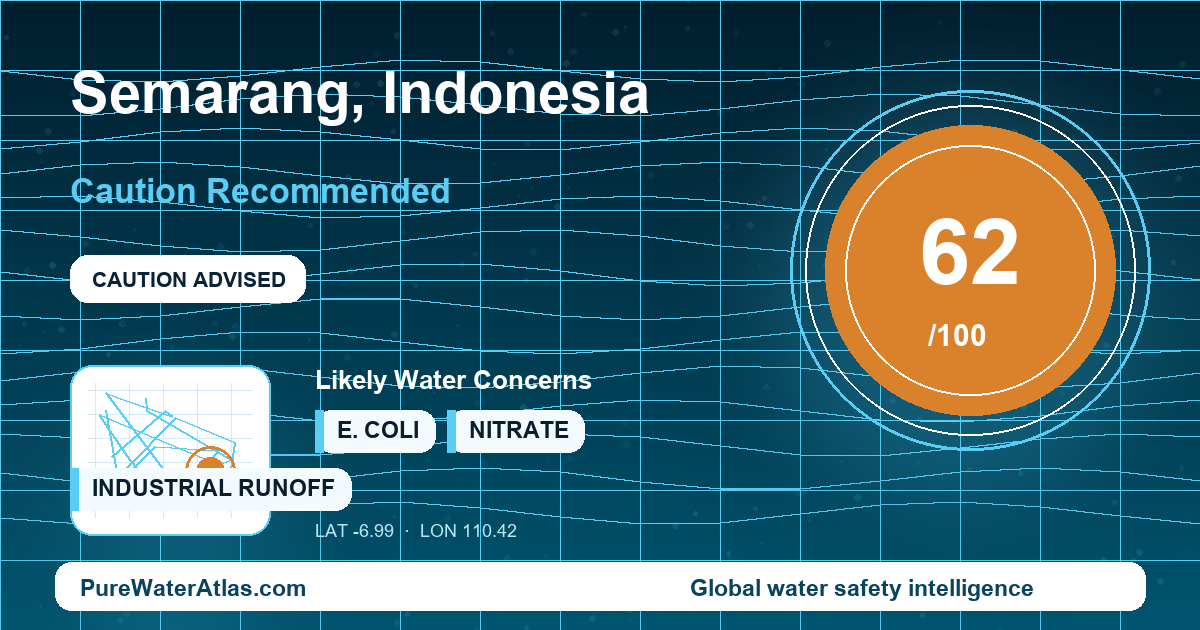
Semarang has a formal treated municipal water system, but coastal salinity pressure, rainy-season turbidity, flooding, storage tanks, wells, and building plumbing mean untreated tap water should be used with caution.
Quick Answer
| Water safety score | 62 / 100 |
|---|---|
| Risk level | Caution Recommended |
| Can visitors drink untreated tap water? | Not recommended for most short-term visitors. Use sealed bottled water, properly boiled water, trusted dispenser water, or a purifier rated for microorganisms. |
| Resident advice | Municipal water users are generally better positioned than households using shallow wells, especially in coastal or flood-prone areas. For daily drinking, use boiling plus safe storage or a maintained point-of-use system selected after testing. |
| Main water identity | Semarang uses a multi-source urban water system, including treated surface-water supplies associated with the Garang-Kreo-Jatibarang system, Kaligarang/Garang catchment, Kudu/Klambu raw-water supply, and local sources. |
| Water authority | Perumda Air Minum Tirta Moedal Kota Semarang. |
| Practical filter recommendation | For municipal water: sediment prefilter plus activated carbon, with UV or ultrafiltration if tank or low-pressure microbial risk is suspected. Reverse osmosis is most relevant where testing shows salinity, high TDS, nitrate, or other dissolved contaminants. |
Editorial verdict: Semarang has an organized municipal water utility and treated piped-water system, but untreated tap water should be approached carefully. The practical risks are not based on one confirmed citywide toxic contaminant; they relate more to source-water turbidity, coastal salinity pressure, intermittent distribution or low-pressure events, household storage tanks, old premise plumbing, private wells, flooding, and limited public access to recent neighborhood-level water-quality results.
Why Semarang Is Different
Semarang is not a simple “one source, one pipe, one risk” city. It is a north-coast Java city built across a low coastal plain and higher southern hills. That geography creates two different drinking-water risk profiles inside the same city. Coastal and northern lowland areas face tidal flooding, land subsidence, and saline groundwater pressure. Higher or river-fed areas are more exposed to rainy-season turbidity, watershed runoff, and source-water changes after heavy rain.
This matters because the water reaching a tap in Semarang can depend heavily on the connection type and the building. A traveler in a modern hotel connected to the municipal network may see clear, chlorinated water. A household using a shallow well in a flood-prone northern area may face a very different risk profile, including saltiness, turbidity, or microbial contamination after inundation. Many buildings also use roof tanks, ground tanks, pumps, or mixed supply arrangements, so water quality can change after it leaves the treatment system.
The confidence level for this profile is moderate. Semarang-specific information exists on the local utility, Jatibarang and West Semarang water-supply projects, flooding, land subsidence, and coastal groundwater pressure. However, recent sample-by-sample consumer tap-water results by neighborhood are not published in the same transparent format used in some countries’ annual household water-quality reports. This guide therefore avoids claiming that all Semarang tap water either meets or fails specific legal limits.
Where Does Semarang’s Tap Water Come From?
Semarang uses a multi-source urban water system rather than a single reservoir or single aquifer. Public materials identify Perumda Air Minum Tirta Moedal Kota Semarang as the municipal provider, with treated water supplied from surface-water intakes and treatment plants associated with the Garang-Kreo-Jatibarang system, Kaligarang/Garang catchment, Kudu/Klambu raw-water supply, and other local sources.
The Jatibarang Dam and Reservoir on the Kreo-Garang system is especially important in Semarang’s modern water identity. It is used in the broader city context for flood control and raw-water supply. The SPAM Semarang Barat, or West Semarang Water Supply system, was developed to supply western Semarang and reduce dependence on groundwater abstraction. That is significant because groundwater overuse in Semarang is linked with land subsidence and seawater intrusion in the coastal plain.
Historically, Semarang relied on a mixture of springs, groundwater, and local river sources. The modern direction is toward more treated surface water and regional raw-water infrastructure. Important infrastructure includes the Tirta Moedal distribution network and service reservoirs, Kaligarang/Garang intake and treatment infrastructure, Kudu/Klambu raw-water and treatment infrastructure referenced in water-supply planning, and household-level tanks and pumps that can materially affect water quality at the final tap.
Who Manages Drinking Water in Semarang?
The local municipal drinking-water utility is Perumda Air Minum Tirta Moedal Kota Semarang. City-level public service and governance context is provided by the Pemerintah Kota Semarang. Drinking-water quality standards fall under Indonesian national regulation, including Ministry of Health environmental-health rules such as Permenkes No. 2 Tahun 2023, available through the Kementerian Kesehatan Republik Indonesia JDIH.
Infrastructure planning and raw-water projects also involve national public works authorities. The Kementerian Pekerjaan Umum dan Perumahan Rakyat, Direktorat Jenderal Sumber Daya Air is relevant for dams, reservoirs, and water-resource infrastructure, while the Kementerian PUPR BPPSPAM archive is relevant to Indonesian SPAM water-supply development. The World Bank Private Participation in Infrastructure Database provides broader project context for water-supply public-private investment.
The key limitation for consumers is not the absence of formal regulation. It is the limited public availability of detailed, recent, neighborhood-level tap-water compliance data in an easy consumer-report format. For individual homes, boarding houses, schools, hotels, and wells, site-specific testing remains the most reliable way to verify actual drinking-water quality.
Main Local Water Concerns
- Coastal salinity and seawater intrusion: Northern Semarang is affected by land subsidence, tidal flooding, and groundwater pressure. Shallow wells in coastal zones may become brackish or show elevated salinity indicators such as TDS, chloride, or electrical conductivity.
- Turbidity in surface-water sources: River and reservoir sources can receive high sediment loads during heavy rain. Treatment plants are designed to manage turbidity, but spikes can stress treatment and may contribute to color, sediment, or taste complaints where distribution conditions are poor.
- Microbial risk from wells, tanks, and low-pressure plumbing: E. coli and total coliform risk is most relevant where water is stored in unclean tanks, wells are near sanitation sources, flooding occurs, or pressure is unreliable.
- Iron and manganese in groundwater: Private wells and some groundwater sources can show iron or manganese, causing brown staining, metallic taste, sediment, and filter fouling. These are often aesthetic issues, but they indicate the need for testing and appropriate treatment.
- Nitrate in private wells: Nitrate is plausible in shallow wells influenced by septic systems, dense settlement, livestock, or agriculture in the catchment. Infants and pregnant people should not rely on untested shallow well water.
- Old premise plumbing: The main lead concern is usually from a building’s own pipes, fittings, solder, brass fixtures, or storage equipment rather than from a confirmed citywide source-water issue. Older buildings should test both first-draw and flushed samples.
Season also matters. During the rainy season, higher river turbidity, runoff, drain overflows, localized flooding, and contamination risk for shallow wells or poorly sealed tanks become more important. During the dry season, lower raw-water flows may concentrate pollutants, and salinity can become more noticeable in some coastal groundwater settings. After tidal flood or rob events, drinking water should be boiled or replaced with sealed bottled water until systems are flushed, disinfected, or tested.
For Travelers
Short-term visitors should not routinely drink untreated tap water in Semarang. Use sealed bottled water, properly boiled water, reliable hotel-provided dispenser water, or a purifier rated for microorganisms. This is especially important for travelers with sensitive stomachs, children, older adults, pregnant people, and immunocompromised visitors.
For brushing teeth, many healthy travelers use tap water in reputable hotels when the water is clear and there are no advisories, but cautious travelers should use bottled or boiled water. If the tap water is cloudy, brown, salty, has an unusual smell, follows a flood, or comes after a service outage, do not use it for oral hygiene without treatment.
Ice should be treated as a source decision. Use ice only in established hotels, cafes, and restaurants that use commercial ice or treated water. Avoid uncertain street-side ice if minimizing gastrointestinal risk is a priority. Higher-end hotels and restaurants often use filtered or commercially supplied drinking water, but bathroom tap water should not automatically be assumed potable. Ask whether drinking water is filtered, boiled, or supplied from sealed gallon dispensers.
Semarang can be hot and traffic delays can be long, so carry drinking water. For longer stays, a refillable bottle filled from a trusted dispenser or filtered source is more practical than repeatedly relying on bathroom taps.
For Residents
Residents connected to Perumda Air Minum Tirta Moedal are generally in a better position than households relying on shallow wells, particularly in coastal, lowland, or flood-prone areas. However, municipal treatment does not guarantee that water remains unchanged inside every building. Storage tanks, booster pumps, intermittent pressure, old pipework, and stagnant plumbing can alter tap-water quality.
For municipal-water users, a practical home setup is a sediment prefilter plus activated carbon to reduce particles, taste, odor, and chlorine-related complaints. A UV system or ultrafiltration can be considered where microbial risk from storage tanks or low-pressure plumbing is suspected. Reverse osmosis is most useful where testing confirms salinity, high TDS, nitrate, or specific dissolved contaminants. It should not be chosen blindly as a substitute for testing.
Private wells should be tested before selecting treatment. At minimum, test for E. coli, total coliform, turbidity, pH, electrical conductivity, TDS, chloride, nitrate, iron, and manganese. In northern or coastal lowland areas, chloride, conductivity, and TDS are especially important if water tastes salty or brackish. After flooding, tidal inundation, pipe repairs, or long outages, use bottled or boiled water until the system is flushed and tested for E. coli and total coliform.
Old houses, schools, boarding houses, and renovated buildings with unknown plumbing should test for lead using both first-draw and flushed samples. Households using roof tanks or ground tanks should test incoming water and water after the tank to identify whether contamination is occurring inside the building. Tanks should be sealed, screened against insects and animals, cleaned periodically, protected from floodwater, and disinfected after contamination.
Relevant Contaminants and Water-Quality Issues
The most relevant Semarang water-quality issues are practical and location-dependent. Turbidity is important because river and reservoir sources can carry high sediment loads during heavy rainfall. Sediment becomes relevant when water looks brown, cloudy, or particle-laden after rain, outages, or pipe disturbance. Chlorine is relevant because municipal water is typically disinfected, and residual chlorine affects taste while also indicating ongoing disinfection.
For health protection, E. coli is one of the most important markers for wells, tanks, and flood-affected systems. Nitrate matters for shallow wells influenced by sanitation, dense settlement, livestock, or agricultural runoff, especially for infants and pregnant people. Iron and manganese are common groundwater-related concerns where staining, metallic taste, or black-brown particles appear. Lead should be treated as a building-plumbing question rather than a proven citywide source-water claim.
How to Verify Your Water Quality
The most reliable way to verify drinking-water safety in Semarang is to test the water actually used for drinking. For a complete testing strategy, see the PureWaterAtlas Water Testing guide. To compare likely contaminants and treatment choices, use the Contaminants Search Engine. For city and country comparisons, see the Global Water Quality Checker and the Global Water Quality resource.
If microbial risk is the immediate concern, boiling water is the most practical short-term intervention when done correctly and followed by safe storage. For households considering disinfection equipment, read the UV Water Purification guide. For older Semarang buildings, use lead testing guidance. For wells where nitrate is possible, review nitrate testing and, if confirmed, nitrate treatment options, because ordinary carbon filters do not reliably remove nitrate.
For broader background, see PureWaterAtlas resources on Drinking Water Safety, Water Microbiology, and Water Treatment Systems.
Official and Technical Sources
- Perumda Air Minum Tirta Moedal Kota Semarang — official municipal water provider for Semarang.
- Pemerintah Kota Semarang — city government source for public services, flood context, and municipal governance.
- Kementerian Kesehatan Republik Indonesia JDIH — official legal-document portal for Indonesian Ministry of Health regulations, including Permenkes No. 2 Tahun 2023.
- Kementerian PUPR, Direktorat Jenderal Sumber Daya Air — national source for dams, reservoirs, and raw-water infrastructure.
- Kementerian PUPR BPPSPAM archive — SPAM water-supply project and infrastructure context.
- World Bank Private Participation in Infrastructure Database — infrastructure project context for Indonesian water-supply investment.
- Badan Pusat Statistik Kota Semarang — city-level demographic and infrastructure statistics.
- World Health Organization Guidelines for Drinking-water Quality — international public-health reference for microbial risk, turbidity, disinfection, and contaminants.
- UNICEF and WHO Joint Monitoring Programme — national and regional WASH context.
- NASA Earth Observatory — earth-observation context relevant to coastal subsidence and flood exposure.
Bottom Line
Semarang’s tap-water safety depends strongly on source, building, and location. The city has a formal municipal utility, treated piped water, and important surface-water infrastructure including Jatibarang-related supply, but untreated tap water is not the safest routine choice for visitors. Residents on the municipal network should manage building-level risks with clean storage tanks, flushing, testing, and appropriate filtration. Private wells, especially in coastal or flood-prone areas, require testing for microbial contamination, salinity indicators, nitrate, iron, manganese, and turbidity. After flooding, tidal inundation, outages, or pipe work, use bottled or properly boiled water until conditions are verified.
Read the full guide: Global Water Quality Guide
Explore more in this category: Global Water Quality Articles