Dar es Salaam’s piped water is treated and is usually the best baseline source, but drinking safety depends heavily on distribution pressure, outages, building storage tanks, private boreholes, and recent local conditions.
Quick Answer
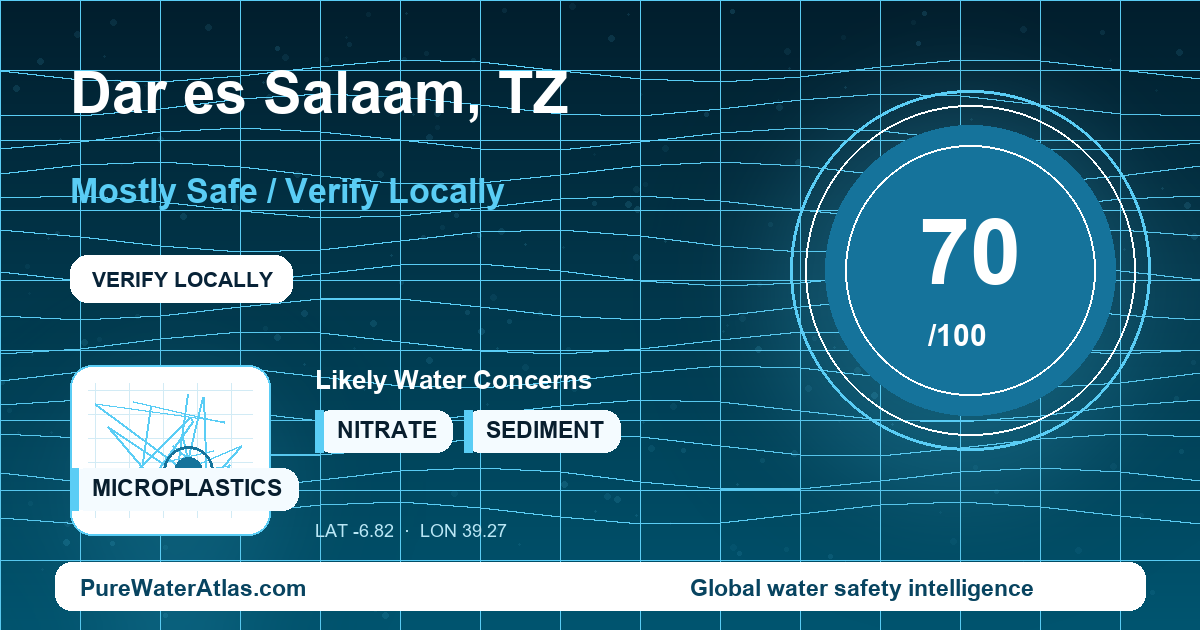
| Overall safety score | 70 / 100 |
|---|---|
| Risk level | Mostly Safe / Verify Locally |
| Can you drink the tap water? | Do not assume every tap is safe to drink directly. DAWASA-supplied municipal water is treated, but water quality at the tap can vary after outages, low pressure, pipe repairs, flooding, or storage in building tanks. |
| Traveler advice | Use sealed bottled water, boiled water, or a reliable purifier for drinking. Ask hotels whether water is filtered, boiled, or otherwise treated. Tap water is usually acceptable for showering and handwashing. |
| Resident advice | Use DAWASA supply as the preferred baseline source where available, but manage building-level risk: clean tanks, flush stagnant plumbing, treat water during uncertainty, and test private boreholes before drinking. |
| Main source | Primarily surface water from the Ruvu River system, treated through the Lower Ruvu and Upper Ruvu water treatment plants, with supplementary local works and groundwater in some areas. |
| Main authority | Dar es Salaam Water Supply and Sanitation Authority, commonly known as DAWASA. |
| Filter recommendation | A home filter is not automatically required for every DAWASA-connected household, but sediment filtration plus activated carbon is often practical. Use boiling, UV, or another microbiological barrier during outages, flooding, low pressure, or suspected contamination. |
Why Dar es Salaam Is Different
Dar es Salaam is a low-lying coastal city on the Indian Ocean, and that geography matters for drinking water safety. Coastal aquifers are vulnerable to salinity and seawater intrusion, while heavy rainfall and flooding can increase microbial contamination pressure in drains, shallow wells, poorly protected boreholes, and household storage systems. In this city, the safest water decision is often not just “municipal versus non-municipal,” but “what happened to the water between the treatment plant and this specific tap?”
The public supply is treated and is generally a better option than untreated wells, informal vendors, or surface water. However, Dar es Salaam has documented challenges that can affect tap-level safety: service interruptions, pressure variability, older distribution sections, rapid urban growth, and widespread household storage. Roof tanks, underground tanks, booster pumps, old internal pipes, and plumbing dead-ends can all change the quality of water after it has already left a treatment plant.
Because recent public neighborhood-level tap-water microbiology and chemistry results are not consistently available in a form that supports block-by-block conclusions, PureWaterAtlas classifies Dar es Salaam as “Mostly Safe / Verify Locally,” not as uniformly safe at every tap. The confidence level is medium: the main water system and institutions are identifiable, but last-mile conditions vary by area, building, season, and recent service history.
Where Does Dar es Salaam’s Tap Water Come From?
Dar es Salaam’s public water supply is primarily based on surface water from the Ruvu River system. The major treatment works are commonly described as the Lower Ruvu and Upper Ruvu water treatment plants. These works are part of the broader Wami/Ruvu basin context and supply a large share of the city’s demand through long-distance transmission infrastructure, storage reservoirs, pumping, transmission mains, and the urban distribution network.
The city also has older and supplementary source context. Dar es Salaam historically used smaller local sources and treatment works, including Mtoni, associated with the Kizinga catchment, as well as boreholes. As the metropolitan area expanded, the Ruvu River system became the dominant bulk source, and major investment focused on expanding intake, treatment, transmission, storage, and distribution capacity.
The key drinking-water infrastructure for the city includes the Lower Ruvu water treatment plant and transmission system, the Upper Ruvu water treatment plant and associated transmission infrastructure, Mtoni water treatment works, the DAWASA-operated distribution network, and supplementary boreholes or localized groundwater use in areas where piped service is intermittent or absent. This mix makes Dar es Salaam different from a city with a compact local source and short distribution network. Water may travel through a large system before reaching household tanks or building plumbing.
Season also matters. Long rains and intense storm events can raise turbidity in source waters and increase flooding-related contamination pressure in the urban environment. Dry-season low flows and high demand can stress supply reliability and increase reliance on stored water, vendors, or boreholes. After outages, water may initially run cloudy or discolored because sediment has been disturbed in mains or building plumbing.
Who Manages Drinking Water in Dar es Salaam?
The main public water and sanitation authority serving Dar es Salaam and parts of the surrounding Coast Region is the Dar es Salaam Water Supply and Sanitation Authority, commonly known as DAWASA. DAWASA is the primary local institution for public water supply and sanitation services in the city.
Water supply and sanitation services in Tanzania are regulated by the Energy and Water Utilities Regulatory Authority, or EWURA. National water policy and sector oversight sit with the Ministry of Water. Because Dar es Salaam’s main raw-water source is tied to the Ruvu River system, basin-level management also involves the Wami/Ruvu Basin Water Board.
Drinking-water quality expectations are influenced by Tanzania standards and public-health practice based on World Health Organization Guidelines for Drinking-water Quality. For this page, the most important limitation is that citywide authority and infrastructure information is available, but recent routine results at the neighborhood, building, and seasonal level are not consistently published in a way that allows a precise safety statement for every tap.
Main Local Water Concerns
The main water-quality concern in Dar es Salaam is not that all municipal water is untreated; it is that treated water can become less reliable by the time it reaches a specific tap. Low pressure, pipe breaks, illegal or poorly maintained connections, and intermittent supply can increase the chance of contamination entering pipes after water has left the treatment plant. This is especially important after outages, repairs, flooding, or sudden changes in water appearance.
- Microbial risk after treatment: Low distribution pressure, damaged pipes, unclean storage tanks, and flooding can increase the risk of organisms such as E. coli reaching tap water.
- Turbidity and sediment: Cloudiness, brown water, or visible particles may occur after pipe work, service restoration, heavy rain, or disturbance in building plumbing. Learn more about turbidity and sediment.
- Groundwater salinity: Some private boreholes and coastal groundwater sources may have salinity or high total dissolved solids, especially in the coastal aquifer environment.
- Nitrate and shallow-well risk: Shallow or poorly protected wells can be vulnerable where sanitation is close to water points. Nitrate testing is especially relevant for private sources.
- Chlorine residual changes: A chlorine taste or odor can be normal in treated water. However, a complete absence of disinfectant residual at the tap may be a warning sign after long storage or poor distribution conditions. See the PureWaterAtlas guide to chlorine.
- Old internal plumbing: Metals can come from old pipes, fittings, solder, or tanks inside buildings, even where the municipal supply itself is treated. Older plumbing can be relevant to lead exposure concerns.
For Travelers
For most short-stay travelers in Dar es Salaam, the safest practical answer is to avoid drinking untreated tap water directly unless a reputable hotel, host, or local authority confirms that the water is treated and that building plumbing is managed safely. Use sealed bottled water, boiled water, or a proven purifier for drinking. Check that bottled-water caps are intact, and use treated water for medications and infant formula.
Tap water is usually acceptable for showering and handwashing. Brushing teeth is more situation-dependent. In higher-standard hotels with filtered or treated water, brushing with tap water is commonly lower risk, but cautious travelers should use bottled or treated water, especially during short stays, after heavy rain, after an outage, or if the water is cloudy or has an unusual odor.
Be careful with ice. Avoid ice from informal vendors or unknown sources. In established hotels and restaurants, ask whether ice is made from filtered or purified water. If uncertain, skip ice. Reputable hotels, international restaurants, and higher-end venues often provide bottled, filtered, or boiled water, but it is still worth asking specifically because building tanks and plumbing can matter.
Do not rely on clear appearance alone. If tap water has visible particles, brown color, sewage-like odor, or appears immediately after a service outage, do not drink it without treatment. If you need a simple emergency option, see Boiling Water Purification: Complete Guide.
For Residents
Residents connected to DAWASA supply can generally use the municipal system as the baseline source, but household and building management are central in Dar es Salaam. A home filter is not automatically required for every DAWASA-connected household, yet it is often sensible because of intermittent supply, storage tanks, and variable distribution conditions. A practical setup may include sediment prefiltration plus activated carbon for taste and chlorine-related concerns, with boiling, UV, or another microbiological barrier when microbial risk is suspected.
Use a more conservative approach during outages, low-pressure events, pipe repairs, flooding, unusual taste, visible sediment, or unexplained illness that may be linked to water. Flush stagnant plumbing after service returns or after long building vacancy. If water remains discolored or contains particles, avoid drinking it until it is treated or tested.
Private borehole users should not choose treatment blindly. Test before using borehole water for drinking, including E. coli or thermotolerant coliforms, electrical conductivity or total dissolved solids, chloride or other salinity indicators, nitrate, iron, manganese, pH, hardness, and other relevant parameters. Coastal groundwater salinity and sanitation-related contamination are both important local considerations.
Older buildings deserve special attention. Corroded internal pipes, unknown metal fittings, stagnant dead-end plumbing, and tanks that have not been cleaned regularly can add sediment, metals, taste problems, or microbial regrowth. Storage tanks are also a major control point. Keep roof tanks and underground tanks covered, screened against insects and animals, cleaned on a schedule, protected from roof runoff and floodwater, and designed so sediment can be drained. Water stored for long periods may lose disinfectant residual and become microbiologically unsafe.
Relevant Contaminants and Water-Quality Issues
The most relevant Dar es Salaam water-quality issues are microbial safety, turbidity, sediment, disinfectant residual, groundwater chemistry, and building-plumbing metals. The PureWaterAtlas contaminant profiles below are especially useful for interpreting local warning signs:
- E. coli — relevant to low pressure, flooding, unclean tanks, and unsafe private wells.
- Turbidity — relevant after heavy rain, pipe disturbance, or cloudy water episodes.
- Sediment — relevant to old building plumbing, storage tanks, discolored water, and repairs.
- Chlorine — relevant because disinfectant residual helps control microbial regrowth in treated municipal water.
- Nitrate — relevant for shallow wells and boreholes near sanitation or urban runoff influences.
- Lead — relevant to old internal plumbing and fittings, even if the municipal source is treated.
For treatment options, see Water Purification, Boiling Water Purification, and UV Water Purification. UV can be useful for microbial control when the water is already clear enough for UV treatment.
How to Verify Your Water Quality
Because Dar es Salaam’s tap-water safety can vary by area, building, and recent service events, verification should be local. If you are a resident, compare water at the incoming municipal point with water from roof tanks, underground tanks, kitchen taps, and boreholes when relevant. This helps separate municipal-supply issues from building-storage or plumbing issues.
For DAWASA-connected homes, test at the tap if water is repeatedly discolored, contains sediment, tastes salty, smells unusual, or if household members experience recurring gastrointestinal illness that appears linked to water use. After plumbing changes, tank replacement, or long building vacancy, flush the system and consider testing for microbial indicators and metals. Households with infants, pregnant people, immunocompromised residents, or elderly residents should use a more conservative safety margin: confirmed treated water, boiling during uncertainty, and periodic microbial testing.
For private boreholes, include microbiology and chemistry rather than testing only for taste or appearance. At minimum, the dataset points to E. coli or thermotolerant coliforms, electrical conductivity or total dissolved solids, chloride or salinity indicators, nitrate, iron, manganese, pH, and hardness. For broader guidance, use the PureWaterAtlas Water Testing guide, the Contaminants Search Engine, and the Global Water Quality Checker. Background resources include Drinking Water Safety, Global Water Quality, and Water Microbiology.
Official and Technical Sources
- Dar es Salaam Water Supply and Sanitation Authority — primary local authority for public water supply and sanitation services in Dar es Salaam.
- Energy and Water Utilities Regulatory Authority — national regulator for water and sanitation utilities in Tanzania.
- Ministry of Water, United Republic of Tanzania — national water-sector policy, planning, and infrastructure oversight.
- Wami/Ruvu Basin Water Board — basin authority relevant to the Ruvu River source system.
- Tanzania Second Water Sector Support Project — World Bank project information on Tanzania water-sector investments.
- Dar es Salaam Water Supply and Sanitation Project — World Bank historical project record for Dar es Salaam water supply and sanitation infrastructure.
- WHO Guidelines for Drinking-water Quality — international public-health reference for microbial risks, disinfectant residuals, turbidity, and chemical contaminants.
- CDC Tanzania travel health information — traveler-oriented health guidance supporting conservative drinking-water practices for visitors.
Bottom Line
Dar es Salaam’s treated DAWASA supply is generally the best baseline drinking-water source compared with untreated wells, vendors, or surface water, but it should not be treated as automatically safe at every tap. The city depends heavily on the Ruvu River system and a large distribution network where outages, low pressure, pipe disturbance, flooding, and building storage can affect final water quality. Travelers should use sealed bottled, boiled, or reliably purified water for drinking unless a reputable hotel confirms safe treatment and plumbing. Residents should keep tanks clean and covered, flush stagnant plumbing, treat water during uncertain events, and test private boreholes for microbiology, salinity, nitrate, and other chemistry before drinking.
Read the full guide: Global Water Quality Guide
Explore more in this category: Global Water Quality Articles