Bahawalnagar, Pakistan: groundwater-dependent municipal and private tubewell supplies in southern Punjab require caution, household-level verification, and appropriate treatment before drinking.
Quick Answer
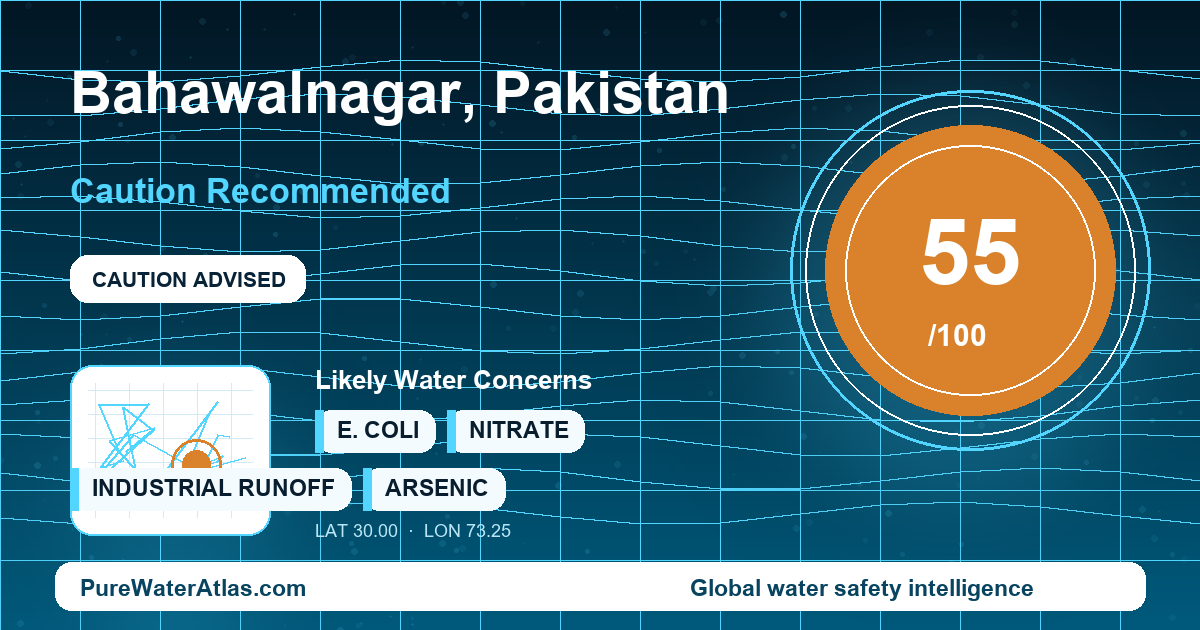
| Overall safety status | Caution recommended. Bahawalnagar tap water should not be assumed reliably drinkable without treatment or recent test results. PureWaterAtlas water safety score: 55/100. |
|---|---|
| Risk level | Caution Recommended because local quality can vary by tubewell, distribution line, household storage tank, and treatment maintenance. |
| Traveler advice | Use sealed bottled water from reputable shops, or water that has been boiled, disinfected, or passed through a reliable purifier. Do not make untreated tap water the default drinking source for short stays. |
| Resident advice | Treat water as source-specific. Municipal tubewell water, private bore water, and water after household tanks or filters can differ substantially, so testing and point-of-use treatment are advisable. |
| Main water source | Primarily groundwater abstraction through municipal and private tubewells in the Indus Basin and Sutlej canal-command area, influenced by canal irrigation and seepage. |
| Managing authority | Urban water services are mainly a local-government function through Municipal Committee or Municipal Corporation arrangements, with Punjab Public Health Engineering Department involvement in water-supply schemes. |
| Filter recommendation | At minimum, consider sediment prefiltration plus UV or chlorination for microbial control. If testing confirms high TDS, salinity, nitrate, arsenic, or hardness, a properly maintained RO system may be needed. |
Why Bahawalnagar Is Different
Bahawalnagar is a district headquarters in southeastern Punjab near the Sutlej River corridor and close to the Pakistan-India border. Its drinking-water picture is not the same as a city served by one large conventional surface-water treatment plant with daily published quality dashboards. The local pattern is more decentralized: municipal tubewells, private bores, local distribution pipes, storage tanks, and community filtration points where installed.
The city sits in a canal-irrigated agricultural district within an arid to semi-arid landscape. Canal irrigation shaped settlement and farming in the wider former Bahawalpur State region, but long-term irrigation in dry zones can also be associated with waterlogging, rising groundwater levels, salinity, and mobilization of naturally occurring minerals in some areas. That does not mean every tap in Bahawalnagar has the same problem. It means the safest assumption is variability.
The most important practical point is that Bahawalnagar water at the kitchen tap may be affected as much by the last-mile system as by the aquifer. Intermittent pumping, low pressure, pipe leakage near drains, unclean underground or rooftop tanks, dirty dispensers, and building plumbing can introduce microbial risk even when the original tubewell water is usable.
Where Does Bahawalnagar’s Tap Water Come From?
Bahawalnagar drinking water is understood to rely mainly on groundwater pumped through municipal and private tubewells in the Indus Basin and Sutlej canal-command area. Canal irrigation and seepage influence groundwater recharge, but city taps are generally associated with pumped groundwater rather than a single large surface-water treatment works.
Key local water infrastructure includes municipal tubewells and pumping points, local water-supply distribution pipelines, overhead reservoirs or storage components where present, public filtration plants or community drinking-water points where installed by provincial or local programs, and private household bores, handpumps, motor pumps, tanker or vendor water in some areas. Inside buildings, underground tanks, rooftop tanks, household plumbing, and small filters can significantly change the final water quality.
This source pattern matters because groundwater can be naturally mineralized and can vary sharply by depth and location. A private bore on one street may have different salinity, hardness, nitrate, or arsenic risk than a municipal tubewell or a deeper bore elsewhere. A household tank can also convert otherwise acceptable water into a microbial hazard if it is open, poorly cleaned, or exposed to sewage seepage, insects, roof runoff, or contaminated transfer hoses.
Who Manages Drinking Water in Bahawalnagar?
Bahawalnagar is not generally treated as a major WASA city like Lahore or Faisalabad. Urban water services are primarily a local-government responsibility through Municipal Committee or Municipal Corporation arrangements. The Local Government and Community Development Department Punjab provides institutional context for municipal service delivery, while the Punjab Public Health Engineering Department is relevant to planning and construction of water-supply and sanitation schemes in Punjab.
Other Punjab institutions also matter for context. The Punjab Municipal Development Fund Company provides municipal infrastructure and urban service context for smaller Punjab cities. Provincial safe-water initiatives, including the Punjab Saaf Pani Authority, are relevant where filtration plants or community safe-drinking-water points are installed.
Drinking-water quality in Pakistan is guided by the National Standards for Drinking Water Quality and public-health guidance from federal and provincial authorities. The Pakistan Council of Research in Water Resources is a key national body for water-quality monitoring, research, and laboratory context, and the Pakistan Environmental Protection Agency is associated with national environmental and drinking-water standards context. However, recent neighborhood-level Bahawalnagar tap-water results, continuous chlorine-residual data, and routine public compliance summaries are not available in a transparent official dashboard. This limits confidence and makes point-of-use verification important.
Main Local Water Concerns
- Microbial contamination, including E. coli risk: Intermittent supply, low pressure, pipe leakage near drains, and poorly cleaned household tanks can allow fecal contamination. This is the most urgent short-term health concern in many urban and peri-urban systems in Pakistan.
- Salinity, high TDS, hardness, and taste problems: Southern Punjab and canal-command aquifers commonly show variable salinity. Disinfection may reduce microbial risk, but it will not remove dissolved salts or hardness that affect taste and suitability.
- Arsenic as a regional groundwater concern: Arsenic has been documented in parts of Punjab groundwater. Bahawalnagar should not be labeled city-wide arsenic-contaminated without sampling, but arsenic should be included in baseline testing for municipal tubewell users and private bore users.
- Nitrate and agricultural influence: Bahawalnagar district is heavily agricultural. Fertilizer, animal waste, sanitation sources, and shallow groundwater vulnerability can make nitrate a relevant test parameter, especially for private wells and shallow bores.
- Turbidity, sediment, iron, and manganese: Tubewell systems can deliver sand, sediment, discoloration, metallic taste, or staining after pump maintenance, pipe disturbance, or stagnant storage. These signs do not prove a health violation, but they justify testing and filter inspection.
- Inconsistent chlorination or no effective residual: Where water is pumped through distribution and storage, disinfection protection can be uneven. A faint free-chlorine residual can help control microbes; no residual at the tap can indicate higher microbial vulnerability.
- Old plumbing and building-level contamination: Corroded fixtures, galvanized pipes, dead-end plumbing, illegal cross-connections, and unclean rooftop tanks may introduce sediment, metals, or bacteria after water leaves the municipal system.
Season also matters. During the monsoon and post-monsoon period, floodwater, drain turbidity, sewer overflow, and damaged pipes or tanks can increase contamination risk. In hot pre-monsoon summer, higher demand, longer storage, bacterial regrowth in tanks, and reliance on private pumps or vendor water can become more important. During canal closure or low-flow periods, local groundwater conditions and reliance on alternative bores may shift.
For Travelers
Most travelers should not drink untreated Bahawalnagar tap water. Use sealed bottled water from reputable shops, or water that has been boiled, disinfected, or treated by a reliable purifier. Check bottle seals and avoid bottles that appear refilled. In hot weather, carry oral rehydration salts, especially when traveling with children or older adults.
For brushing teeth, bottled, boiled, or filtered water is the safer choice if you have a sensitive stomach or are staying only briefly. If you use tap water for brushing, avoid swallowing it and prefer accommodation with a maintained filtration system.
Avoid ice unless you know it was made from bottled or treated water. This is especially important at roadside stalls, small restaurants, weddings, and event settings where ice handling and source water may be uncertain. In hotels and restaurants, ask whether drinking water is bottled, RO-treated, UV-treated, or simply cooled tap water. Sealed bottles opened in front of you are preferable. Hot tea and coffee made with water brought to a full boil are generally safer choices for microbial risk than untreated cold water.
For Residents
For Bahawalnagar residents, the best approach is not to ask whether “the city water” is safe in a general way. The better question is whether your specific source, building tank, filter, and drinking tap are safe today. Municipal tubewell water, private bore water, household tank water, and water after a local dispenser can all differ.
A practical treatment setup for many households is sediment prefiltration followed by UV or chlorination for microbial control. Learn the strengths and limits of UV in the PureWaterAtlas UV Water Purification Complete Guide, and use the Boiling Water Purification Complete Guide for emergency microbial risk reduction. If lab testing shows high TDS, salinity, nitrate, arsenic, or hardness, a reverse-osmosis system may be appropriate, but it must be maintained, and users should consider wastewater and remineralization.
Test both source water and the actual drinking tap after the household tank and filter. At minimum, test for E. coli or thermotolerant coliforms, total coliforms, turbidity, pH, electrical conductivity, total dissolved solids, hardness, chloride, and residual chlorine if the water is chlorinated. A baseline groundwater screen should include arsenic, nitrate, fluoride, iron, manganese, and lead where plumbing is old.
Repeat microbial testing after monsoon flooding, sewage overflows, pipe repair, pump replacement, or any change in taste, odor, or color. Private bore users should test annually and after nearby sanitation, drain, or construction changes. Shallow bores need closer scrutiny than well-constructed deeper tubewells. Use recognized laboratories where possible, including PCRWR facilities, Punjab government laboratories, university laboratories, or accredited private labs, and keep a written record of sample date, source, and whether the sample was first-draw or flushed.
Older houses and commercial buildings need special attention. Let stagnant water run before use, but do not rely on flushing alone if lead, rust, or chronic discoloration is suspected. Underground and rooftop tanks should be covered, screened from insects and rodents, cleaned and disinfected regularly, and protected from sewer seepage, roof runoff, and dirty transfer hoses.
Relevant Contaminants and Water-Quality Issues
The most important near-term issue to understand is E. coli in drinking water, because fecal contamination can occur through leaking pipes, low pressure, storage tanks, and unhygienic handling. Turbidity and sediment are also relevant in Bahawalnagar because cloudy, particle-laden, or tank-stored water can interfere with disinfection and signal operational problems.
For groundwater chemistry, residents should understand arsenic and use the PureWaterAtlas guide to arsenic testing and detection methods before assuming a bore is safe. If arsenic is confirmed, review arsenic filter and treatment options.
In an agricultural district, nitrate is another important parameter, particularly for shallow groundwater and infant health protection. PureWaterAtlas also provides guides to nitrate testing and nitrate treatment solutions. Where chlorination is used, residents should understand chlorine in drinking water and why residual disinfectant can be protective. In older buildings, lead and the guide to lead testing methods are relevant even if the source aquifer is not known to contain lead.
How to Verify Your Water Quality
Because recent public, neighborhood-level Bahawalnagar compliance data are limited, verification should happen at the point of use. Start with the PureWaterAtlas guide to water testing and analysis. Use the broader Drinking Water Safety framework to decide whether water is safe enough for drinking, cooking, infant formula, or only washing.
If you are comparing possible hazards, use the Contaminants Search Engine. For city and travel context beyond Bahawalnagar, consult the Global Water Quality Checker. Households choosing filters should review Water Treatment Systems, while users concerned about sewage intrusion, tanks, and pathogens should read Water Microbiology. For source, plumbing, agricultural, and storage risks, see Water Contamination.
Official and Technical Sources
- Punjab Public Health Engineering Department — provincial water-supply and sanitation scheme context.
- Local Government and Community Development Department Punjab — municipal service-delivery and local-government context.
- Punjab Municipal Development Fund Company — Punjab municipal infrastructure and smaller-city service context.
- Pakistan Council of Research in Water Resources — water-quality monitoring, research, and laboratory context.
- Pakistan Environmental Protection Agency — national environmental and drinking-water standards context.
- Punjab Saaf Pani Authority — provincial safe-drinking-water and filtration-plant context.
- UNICEF Pakistan: Water, Sanitation and Hygiene — public-health context for WASH risks in Pakistan.
- World Health Organization Guidelines for Drinking-water Quality — international drinking-water risk-management reference.
- Pakistan Bureau of Statistics — official demographic and administrative context for Bahawalnagar district.
Bottom Line
Bahawalnagar tap water deserves a cautious, source-specific approach. The city is understood to rely mainly on groundwater from municipal and private tubewells in a canal-irrigated part of southern Punjab, not on a single large surface-water treatment plant with transparent daily compliance reporting. The main practical risks are microbial contamination from intermittent supply, leaks, and storage tanks; variable salinity, TDS, hardness, and taste; and regional groundwater concerns such as arsenic and nitrate that require testing rather than assumptions. Travelers should use sealed bottled or properly treated water. Residents should test their own source and drinking tap, maintain tanks and filters, and choose treatment based on results.
Read the full guide: Global Water Quality Guide
Explore more in this category: Global Water Quality Articles