Harbin, Heilongjiang: treated municipal water from the Mopanshan Reservoir system, with point-of-use caution for older buildings, storage tanks, and short-term visitors.
Quick Answer
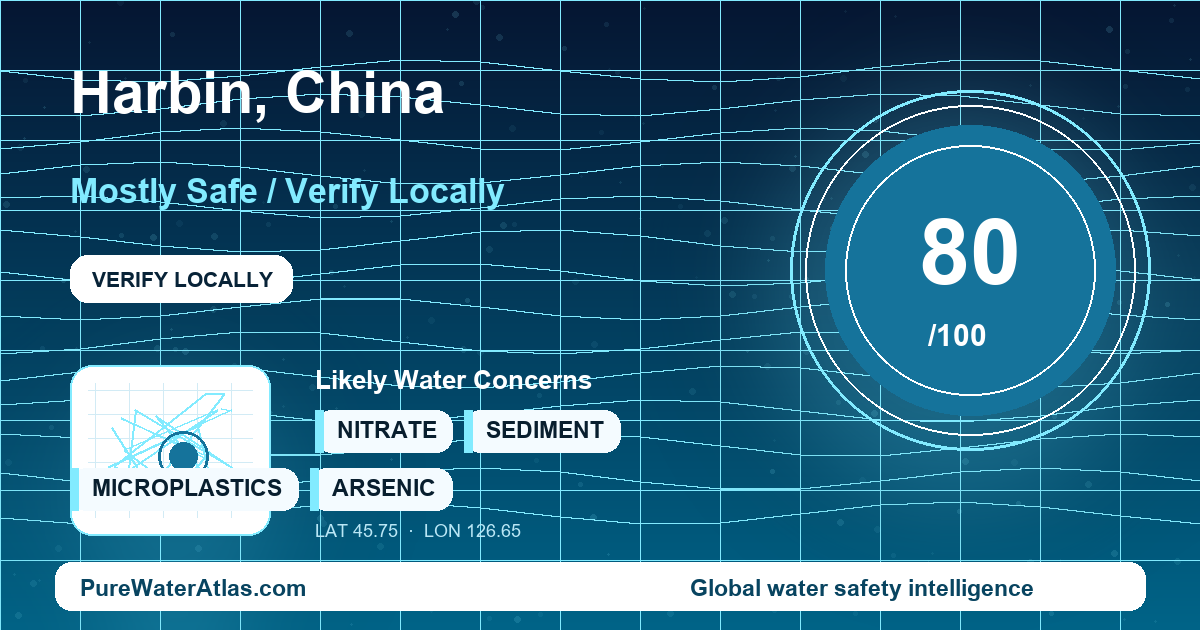
| Overall safety status | Mostly Safe / Verify Locally. Harbin’s municipal tap water is generally treated surface water and is considered suitable for normal domestic use, but drinking it straight from the tap is not the best default choice without local confirmation. |
|---|---|
| Water safety score | 80 / 100 |
| Best advice for travelers | Use tap water for washing, showering, and usually brushing teeth if it is clear. For drinking, use boiled water, sealed bottled water, or verified filtered water unless your hotel confirms potable tap water and the building plumbing is reliable. |
| Best advice for residents | Municipal-network households can generally use tap water after boiling for routine drinking and cooking. Older apartments, high-rises with secondary tanks, and homes with infants, pregnant people, or immunocompromised residents should consider testing and point-of-use filtration. |
| Main source identity | Harbin’s central urban supply is strongly associated with the Mopanshan Reservoir system in Wuchang, southeast of the urban core, rather than simply untreated urban Songhua River water. |
| Water authority context | Municipal supply is associated with Harbin Water Supply Group Co., Ltd. and local bodies such as the Harbin Water Affairs Bureau, with health and environmental oversight under China’s national drinking-water framework. |
| Filter recommendation | A filter is not automatically required for every household, but activated carbon, reverse osmosis, or other maintained point-of-use systems can help with chlorine taste, sediment, and building-level risks. |
Why Harbin Is Different
Harbin’s drinking-water story is unusually city-specific. The city sits on the Songhua River in Heilongjiang Province and is often associated with river water because the Songhua defines much of Harbin’s geography and water history. However, modern Harbin should not be treated as a generic “river-water city.” Its central urban drinking-water supply is strongly linked to the Mopanshan Reservoir water-supply system in Wuchang, southeast of the urban core. That protected reservoir source and long-distance conveyance system are central to understanding Harbin tap water today.
The city’s water-safety memory is also shaped by the 2005 Songhua River chemical pollution incident, caused by an upstream petrochemical accident in Jilin Province. That event led to a major temporary water-supply disruption in Harbin and remains a practical reason why many residents take drinking-water source safety seriously. It does not mean Harbin’s current municipal tap water is unsafe, but it explains why source protection, emergency response, and verification at the tap matter more here than in a generic city profile.
Harbin’s cold continental climate adds another local factor. Long freezing winters, spring thaw, and summer rainfall patterns can affect runoff, turbidity, pipe stress, and distribution-system operations. Even if water leaving the treatment plant is acceptable, the quality at an apartment tap can be influenced by old internal plumbing, high-rise booster systems, rooftop or basement storage tanks, and sediment disturbed after pipe repairs or pressure changes.
Where Does Harbin’s Tap Water Come From?
Harbin’s central urban drinking-water supply is associated with the Mopanshan Reservoir system in Wuchang, within Harbin jurisdiction and southeast of the city center. The system was developed to provide a protected reservoir source and convey raw water over a long distance toward the urban treatment and distribution network. This is the key source-water distinction for Harbin.
Historically, Harbin drew heavily from the Songhua River. The river remains central to the city’s geography and water history, and the 2005 pollution incident showed the vulnerability of a river-dependent urban supply. The shift toward the Mopanshan Reservoir system is therefore not just an infrastructure detail; it is a major part of Harbin’s modern drinking-water identity.
Key infrastructure includes the Mopanshan Reservoir raw-water source area, long-distance raw-water transmission works, municipal treatment plants, urban distribution mains, pressure zones serving districts such as Daoli, Daowai, Nangang, Xiangfang, and Songbei, and building-level secondary supply systems. For residents and visitors, that final building-level layer is often the practical difference between treated municipal water and the water that actually reaches a glass, kettle, or bathroom tap.
Who Manages Drinking Water in Harbin?
Municipal water supply in Harbin is associated with Harbin Water Supply Group Co., Ltd. and local water-administration bodies such as the Harbin Water Affairs Bureau. Source-water environmental protection also involves ecological-environment authorities. Exact responsibilities can vary across raw-water protection, treatment operation, distribution, public-health supervision, and environmental regulation.
Harbin’s drinking water is regulated within China’s national drinking-water quality framework, including GB 5749-2022. Implementation and supervision involve health, housing and urban-rural development, water affairs, market regulation, and ecological-environment agencies. In practical terms, treated municipal water is expected to meet national potable-water requirements at the treatment and distribution-system level. However, users should not assume every individual building tap has the same quality as water leaving the plant. Internal plumbing, stagnant water, tank cleaning, booster systems, and repair-related sediment can change conditions at the point of use.
Public data limitations are important. Harbin has identifiable city-specific source and infrastructure information, especially the Mopanshan Reservoir context, but recent neighborhood-level tap sampling, English-language consumer reports, building tank inspection records, and independent point-of-use datasets are not consistently easy to access. This guide therefore avoids claiming exact current contaminant levels or district-by-district compliance rates.
Main Local Water Concerns
The main Harbin water concerns are not based on a claim that the entire municipal system is unsafe. They are point-of-use and operating-condition concerns that fit the city’s infrastructure, climate, and public-data limitations.
- Residual chlorine taste or odor: Treated municipal water can have a noticeable disinfection taste, especially for visitors not used to Chinese tap water. See the PureWaterAtlas guide to chlorine for more detail.
- Turbidity and sediment: Spring thaw, summer storms, pipe repairs, main flushing, freeze-thaw stress, and pressure changes can temporarily stir up particles. Cloudy, yellow, or brown water should not be ignored. Relevant background: turbidity and sediment.
- Secondary water-supply tanks: High-rise buildings may use rooftop, basement, or pressure tanks. Poor cleaning, weak covers, or stagnant conditions can increase microbial risk at the building level.
- Older internal plumbing: Old pipes, brass fittings, stagnant water, or corrosion can affect tap quality even when the city supply is properly treated. This is why testing for lead and other metals can be sensible in older apartments, without implying a citywide lead problem.
- Source-water vulnerability: Reservoir and watershed protection remain important because storm runoff, algal or organic-matter changes, upstream activities, and emergency pollution events can place pressure on surface-water systems.
- Limited public neighborhood data: Travelers and foreign residents may not find easy-to-read, current local test results for a specific hotel, apartment block, or district.
For Travelers
Short-term visitors should use a cautious but practical approach. In most standard Harbin hotels and urban apartments, tap water is acceptable for washing, showering, and brushing teeth if it is clear and has no unusual odor. Cautious travelers can use bottled or boiled water for brushing teeth, especially in older hotels, hostels, or short-term rentals.
For drinking, do not make unboiled tap water your default. Use boiled water, sealed bottled water, or water from a verified filtration system. Most hotels in China provide kettles and often bottled water because boiled water is the normal safe-drinking practice. Restaurants commonly serve boiled hot water or tea, which is generally a safer choice than drinking unboiled tap water.
Avoid ice unless it is made from purified or boiled water and served by a reputable hotel, restaurant, or chain business. Small vendors and informal venues may not provide enough assurance about the water source or ice handling.
Practical travel steps in Harbin: carry sealed bottled water for your first day, use the hotel kettle, let cold tap water run briefly if it has been sitting in the pipes, and avoid water that is visibly cloudy, discolored, metallic-smelling, or affected by a local repair notice. After flooding, pipe repairs, pressure interruptions, or unusual water-supply announcements, switch to bottled or boiled water until conditions are normal. For boiling details, see Boiling Water Purification: Complete Guide.
For Residents
For Harbin residents connected to the municipal network, tap water can usually be used after boiling for routine drinking and cooking. A home filter is not mandatory for every household, but it can be useful for taste, residual chlorine, sediment, and added protection at the building tap. Many households combine boiling with activated carbon or reverse osmosis. If using reverse osmosis, maintain cartridges on schedule and pay attention to the storage tank, because old or neglected equipment can create its own quality problems.
Residents in older apartments should treat building plumbing as a separate risk layer from municipal treatment. Stagnant water, older metal fittings, corrosion, and unmaintained internal pipes may affect first-draw water. If you live in an older building, recently renovated plumbing, or a household with infants or pregnant people, consider testing first-draw and flushed samples for lead and other metals. The PureWaterAtlas article Lead in Drinking Water: Testing and Detection Methods explains how to approach confirmation, and Lead in Drinking Water: Best Filters, Systems and Solutions is useful if testing identifies a problem.
High-rise residents should ask property management about secondary water-supply tanks: cleaning records, disinfection practices, cover integrity, and inspection frequency. If water has slime, particles, odor, intermittent pressure, or recurring discoloration, tank hygiene and internal plumbing deserve attention. Test for total coliform and E. coli when tank hygiene is uncertain, especially if vulnerable residents live in the home. See Water Microbiology and UV Water Purification: Complete Guide for microbial-risk context.
After major pipe repairs or pressure interruptions, run cold water until clear and consider boiling drinking water until normal service is confirmed. Frequent yellow, brown, metallic-tasting, or sediment-laden water justifies testing for turbidity, color, odor, iron, manganese, and plumbing-related metals.
Relevant Contaminants and Water-Quality Issues
The most relevant Harbin water-quality issues are linked to treatment, seasonal conditions, distribution, and building-level plumbing rather than a single confirmed citywide contaminant. Disinfection can create a noticeable chlorine taste or odor. Spring thaw, storm runoff, pipe work, and pressure changes can affect turbidity and visible sediment. Older plumbing can justify checking for lead, while yellow or brown water may point toward aesthetic issues involving iron or manganese. Secondary storage tanks and poor building hygiene make microbial indicators such as E. coli important when contamination is suspected.
For broader decision-making, PureWaterAtlas also maintains the Drinking Water Safety guide and the Water Treatment Systems guide.
How to Verify Your Water Quality
The most reliable answer for a specific Harbin apartment, hotel, or office is point-of-use verification. Start with simple observations: water should be clear, without unusual odor, persistent particles, oily appearance, or strong discoloration. Run cold water after stagnation, especially first thing in the morning or after returning from travel. If water remains cloudy or colored, avoid drinking it unboiled and ask building management or the supplier about recent pipe work, flushing, or pressure interruptions.
For households, use targeted testing rather than random broad claims. Test first-draw and flushed samples for metals in older buildings. Test for total coliform and E. coli where storage tanks or booster systems are questionable. Test turbidity, iron, manganese, color, and odor when water is repeatedly yellow, brown, metallic, or sediment-laden. PureWaterAtlas resources that support this process include Water Testing, the Contaminants Search Engine, and the Global Water Quality Checker.
Official and Technical Sources
- Asian Development Bank – PRC: Harbin Water Supply Project — project documentation relevant to Harbin’s major water-supply infrastructure context.
- Harbin Municipal People’s Government — municipal portal for local notices and department information.
- Harbin Water Affairs Bureau — local water-administration authority relevant to water resources and water-management information.
- Harbin Ecological Environment Bureau — relevant to source-water environmental protection and pollution-control information.
- National Health Commission of the People’s Republic of China — national health authority connected to drinking-water standards and public-health supervision.
- Ministry of Ecology and Environment of the People’s Republic of China — national environmental authority for water-pollution control and drinking-water source protection policy.
- UN Environment Programme – Songhua River Spill China 2005 field mission report collection — high-authority context for the 2005 Songhua River chemical pollution incident.
- CDC Travelers’ Health – China — conservative food and water precautions for travelers.
- World Health Organization – Drinking-water fact sheet — global public-health background on safe drinking water, microbial risks, protected sources, and distribution safety.
Bottom Line
Harbin’s tap water is best classified as mostly safe for domestic use, with local verification recommended before drinking it directly. The key Harbin-specific fact is that the modern central urban supply is strongly associated with the Mopanshan Reservoir system, not simply the urban Songhua River. Treated municipal water should be expected to meet China’s national drinking-water framework at the system level, but the building tap can be affected by old pipes, high-rise storage tanks, sediment after repairs, and seasonal operating conditions. Travelers should drink boiled, bottled, or verified filtered water. Residents can usually boil municipal tap water for routine use, but older apartments and secondary tank systems justify testing and maintained point-of-use filtration.
Read the full guide: Global Water Quality Guide
Explore more in this category: Global Water Quality Articles