
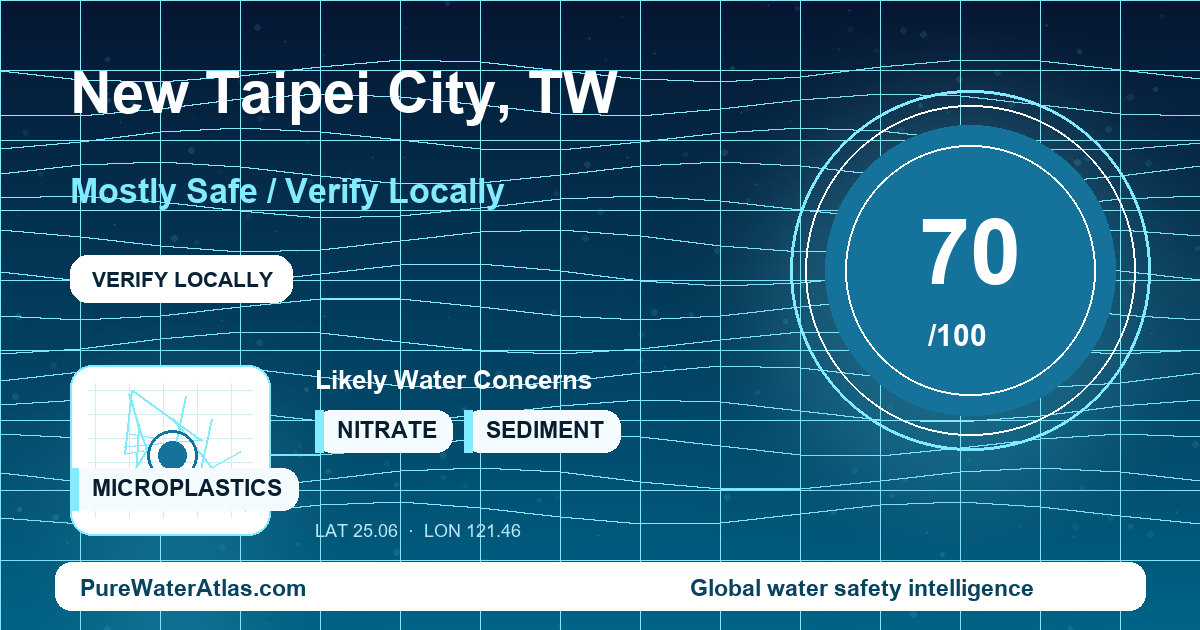
New Taipei City municipal tap water is generally treated and chlorinated, but safety at the faucet depends heavily on district supplier, building plumbing, storage tanks, and temporary conditions after storms or outages.
Quick Answer
| Overall status | Mostly Safe / Verify Locally — PureWaterAtlas score: 70/100. Municipal water is generally treated under Taiwan drinking-water regulation, but New Taipei City is not one uniform water-supply zone. |
|---|---|
| Can you drink the tap water? | Usually acceptable in modern urban accommodations when building plumbing and tanks are well maintained. Conservative visitors may prefer boiled, filtered, or bottled water for drinking, especially during typhoons, outages, or in outer districts. |
| Traveler advice | Generally fine for brushing teeth in urban hotels and apartments. Drink boiled, filtered, or bottled water if the property is older, rural, mountainous, coastal, or if water is cloudy, brown, or affected by a service notice. |
| Resident advice | Identify your supplier, check district-specific notices, maintain building tanks, flush after outages, and consider testing if you live in an older building or have discolored, odorous, or particle-containing water. |
| Main source context | The urban core is strongly tied to the Xindian River watershed and Feitsui Reservoir, while many districts use Taiwan Water Corporation systems, including Banxin and other local systems. |
| Water authority | Service may come from Taipei Water Department or Taiwan Water Corporation, depending on district and service connection. |
| Filter recommendation | Not automatically required for all municipal users, but useful for chlorine taste, sediment, old-building plumbing concerns, and added protection where tank maintenance is uncertain. |
Why New Taipei City Is Different
New Taipei City cannot be evaluated like a single compact water network. It surrounds Taipei City and extends from dense Taipei Basin districts to mountain watersheds, river corridors, hot-spring and rural areas, and northern coastal districts. That geography matters because a person in Banqiao, Xindian, Yonghe, Zhonghe, Tamsui, Ruifang, Wulai, or another district may not be receiving water from the same utility, the same treatment system, or the same local operating conditions.
The overall verdict is that New Taipei City municipal tap water is generally treated, disinfected with chlorine, and managed within Taiwan’s national drinking-water framework. However, the most practical risk for many users is not necessarily the water leaving a treatment plant. It is the water’s final path through district distribution pipes, building receiving tanks, booster pumps, rooftop tanks, internal plumbing, faucet aerators, and stagnant sections of old pipework.
This is especially important in high-rise residential and commercial buildings, where underground and rooftop storage tanks are common. A utility report can describe treated water or distribution-zone monitoring, but it does not prove that every kitchen tap in every apartment building has the same condition. New Taipei City’s safety question is therefore best answered locally: identify the utility, check current notices, and evaluate the building-side system.
Where Does New Taipei City’s Tap Water Come From?
New Taipei City is served by a mixed Greater Taipei water-supply system. The most important raw-water source for the urban core is the Xindian River watershed, strongly supported by Feitsui Reservoir in the upper Beishi Creek and Xindian River system. Feitsui Reservoir is a critical protected reservoir for the Greater Taipei supply system and has been central to drinking-water security since its completion in the 1980s.
Key infrastructure includes Feitsui Reservoir, Qingtan Weir and related Xindian River intake works, Taipei Water Department treatment and distribution facilities, Taiwan Water Corporation systems, and the Banxin water-supply system serving important western New Taipei urban districts. Expansion of Feitsui-linked supply to the Banxin area reduced dependence in parts of metropolitan New Taipei on more stressed or variable downstream river sources.
Outer districts can rely on Taiwan Water Corporation local surface-water and groundwater systems rather than the same arrangement used in the dense urban core. This is why a citywide statement such as “New Taipei tap water is always safe everywhere” would be too broad. The appropriate question is: which district, which utility, which building, and what are the current operating conditions?
Who Manages Drinking Water in New Taipei City?
New Taipei City has split water service. Some districts are within the Greater Taipei service area of Taipei Water Department, while many others are served by Taiwan Water Corporation. Residents should confirm the supplier from the water bill, district service office, or building manager. Visitors can ask hotels, serviced apartments, or guesthouses whether the property is connected to municipal water and whether drinking water is filtered or boiled before service.
Taiwan’s drinking water is regulated under national drinking-water quality standards administered by the Ministry of Environment, Taiwan. The official legal framework can be reviewed in the Taiwan Drinking Water Quality Standards. For source-water and reservoir context, the Taipei Feitsui Reservoir Administration and the Water Resources Agency provide relevant official information. Local emergency and district notices may also be issued through New Taipei City Government.
The limitation is important: official utility information is essential, but it usually does not inspect every private building tank or every final faucet. For New Taipei City, household-level safety can differ from utility-level compliance because of premise plumbing and storage systems after the meter.
Main Local Water Concerns
The main documented concerns in New Taipei City are practical and local rather than a single confirmed citywide contaminant problem. The most common issue is building-side vulnerability: rooftop storage tanks, underground receiving tanks, booster systems, and internal plumbing can affect water after it leaves the regulated distribution network. Tanks should be sealed, cleaned, inspected, and protected from insects, birds, dust, and backflow.
Storm-related turbidity is another key issue. Typhoon season and plum-rain events can increase turbidity in mountain-fed rivers and reservoirs, especially after intense rainfall or landslides. Utilities may manage treatment, pressure, source blending, or advisories, but consumers should be cautious if tap water is cloudy, brown, particle-filled, or appears soon after an outage or repair.
Other local concerns include chlorine taste or odor from normal disinfection, sediment or rust after pipe repairs and pressure changes, possible premise-plumbing metal exposure in older buildings, and microbiological risk where storage tanks are poorly maintained. Rural, mountain, hot-spring, or coastal accommodations may not have the same supply arrangement as central urban districts, so untreated spring, well, river, or unclear local supplies should not be assumed safe for drinking.
For Travelers
For short-term visitors staying in modern New Taipei City hotels or eating in established restaurants, tap water is usually low-risk for brushing teeth and incidental consumption. Many travelers still choose boiled, filtered, or bottled water for drinking because chlorine taste is noticeable to some people and because building storage tanks are common. This is a reasonable conservative approach, especially if you are unfamiliar with the property’s plumbing.
In hotels and serviced apartments, ask whether the tap water is intended for direct drinking, whether drinking water is filtered or boiled, and whether rooftop tanks are maintained. Many accommodations provide bottled water, filtered dispensers, or electric kettles because local residents often boil water for taste and extra assurance.
Brushing teeth is generally acceptable in urban hotels and apartments connected to municipal supply. Use bottled or boiled water if the water is rusty, cloudy, has visible particles, follows an outage, or if you are staying in an older building, rural guesthouse, mountain area, or coastal accommodation where the supply arrangement is unclear.
Ice from established restaurants, cafés, hotels, and convenience stores is usually low-risk because it is commonly made from treated or filtered water. Avoid informal ice if the water source is unclear, particularly after storms or in remote areas. If tap water smells strongly of chlorine, chilling it or letting it stand briefly may improve taste. If water is brown, cloudy, or particle-laden, do not drink it until it has been flushed and clarified and current utility notices have been checked.
For Residents
Residents connected to New Taipei municipal systems can generally treat the supply as usable, but the right approach is district-specific. First identify whether your home is supplied by Taipei Water Department or Taiwan Water Corporation. Then check official service-zone water-quality information and outage notices rather than relying on a broad citywide assumption.
A home filter is not automatically required for every municipal user in New Taipei City. It can be sensible for taste, chlorine reduction, sediment control, and added protection in older buildings or buildings with uncertain tank maintenance. Use the problem to choose the treatment: activated carbon for chlorine taste, sediment prefilters for particles, NSF-certified lead-reduction filtration if old plumbing is suspected, and reverse osmosis only where dissolved contaminants are confirmed or a high level of precaution is desired.
Older buildings deserve extra attention. Corroded internal pipes, solder, brass fixtures, pipe deposits, and stagnant water can affect the final tap. Do not assume that water leaving the treatment plant is identical to first-draw water from an old kitchen faucet. If children, pregnant residents, or vulnerable people use the water, consider testing first-draw and flushed samples for lead and other metals.
Storage tanks are a major practical issue. Rooftop and underground tanks should be sealed, cleaned, and inspected. If maintenance records are unavailable, if water has odor, or if flooding has occurred, microbiological testing for total coliform and E. coli is prudent. If water is repeatedly yellow, brown, cloudy, or particle-filled, test turbidity, iron, manganese, and basic aesthetic parameters, and clean faucet aerators after flushing.
Relevant Contaminants and Water-Quality Issues
Chlorine in drinking water is relevant because New Taipei’s municipal supply is disinfected, and some users notice chlorine taste or odor. This does not automatically mean the water is unsafe, but it often drives residents and travelers toward carbon filtration or boiling for taste.
Turbidity is important because typhoons, plum-rain events, landslides, and intense rainfall can affect mountain-fed source waters. Sediment is also relevant when water becomes discolored after repairs, pressure changes, or outages.
Lead should be treated as a building-specific plumbing concern in older premises, not as a proven citywide source-water claim. Residents who suspect old plumbing can use the PureWaterAtlas guide to lead testing and detection methods. For microbial concerns from poorly maintained tanks or non-municipal supplies, see E. coli in drinking water and the broader guide to water microbiology.
How to Verify Your Water Quality
Verification in New Taipei City should start with your exact service area. Check whether the supplier is Taipei Water Department or Taiwan Water Corporation, then review current water-quality reports and service notices. During typhoons, major rain events, drought conditions, maintenance, or pressure changes, current notices matter more than general background information.
At the household level, use testing when the building is old, tank maintenance is uncertain, or tap water is repeatedly cloudy, yellow, brown, odorous, or particle-filled. PureWaterAtlas provides a practical overview of how to test drinking water, a broader framework for drinking water safety, and guidance on choosing water treatment systems.
If a utility report mentions a contaminant or parameter you do not recognize, use the PureWaterAtlas Contaminants Search Engine. Travelers comparing New Taipei City with other destinations can also use the Global Water Quality Checker. During advisories or uncertain tank conditions, the guide to boiling water purification is relevant; for special microbiological precaution, review UV water purification.
Official and Technical Sources
- Taipei Water Department — official utility for Taipei City and parts of New Taipei City, with information on Greater Taipei water supply, treatment, service notices, and water quality.
- Taiwan Water Corporation — state-owned utility serving many New Taipei districts outside the Taipei Water Department service area.
- Taipei Feitsui Reservoir Administration — official source for Feitsui Reservoir, a key protected raw-water reservoir for Greater Taipei.
- Ministry of Environment, Taiwan — national environmental authority responsible for drinking-water quality policy and regulatory oversight.
- Taiwan Drinking Water Quality Standards — official legal text for Taiwan drinking-water quality standards.
- Water Resources Agency, Ministry of Economic Affairs — official water-resource and reservoir context for drought, rainfall, and source-water management.
- New Taipei City Government — local government source for district-level public notices and emergency information.
Bottom Line
New Taipei City tap water is generally treated, chlorinated, and regulated, but it should not be treated as one uniform citywide supply. Central urban districts are strongly linked to the Greater Taipei and Feitsui/Xindian River system, while other districts may be served by Taiwan Water Corporation systems or local arrangements. For travelers, tap water is usually acceptable for brushing teeth in modern urban accommodations, but boiled, filtered, or bottled water is a sensible drinking choice when plumbing is uncertain. For residents, the main safeguards are identifying the supplier, checking current notices, maintaining rooftop or underground tanks, flushing after outages, and testing older-building taps when metals, microbes, turbidity, or sediment are plausible concerns.
Read the full guide: Global Water Quality Guide
Explore more in this category: Global Water Quality Articles