
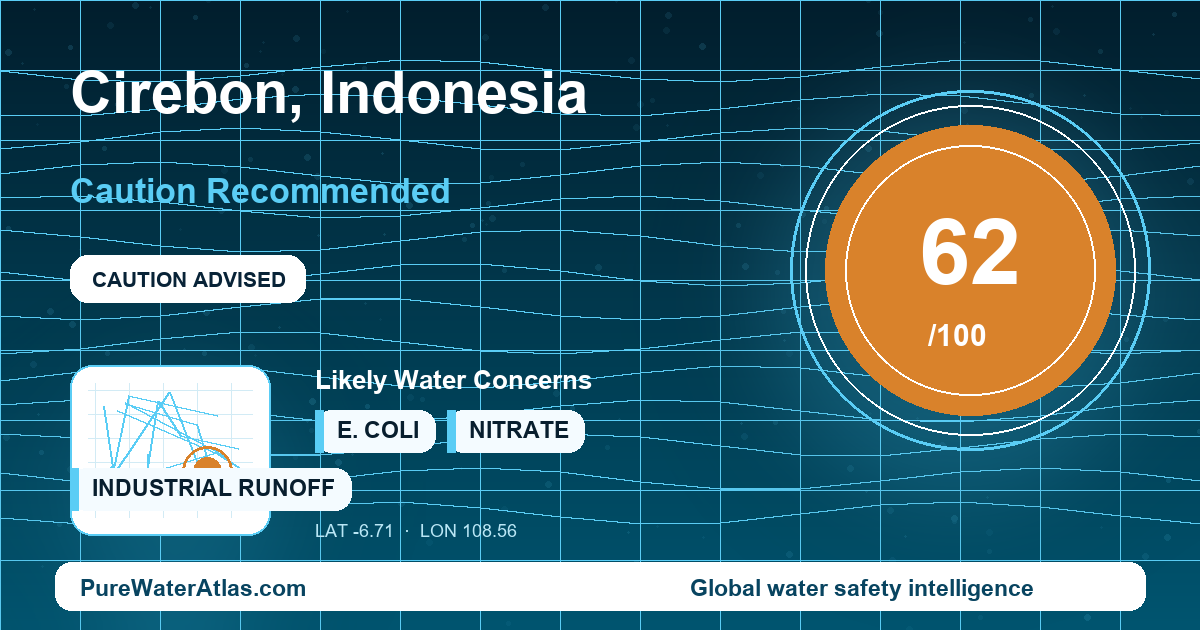
Cirebon, Indonesia: municipal spring-supplied water from the Kuningan/Ciremai uplands gives the city a better raw-water starting point than many shallow coastal wells, but untreated tap water should still be treated with caution at the point of use.
Quick Answer
| Water safety score | 62 / 100 |
|---|---|
| Risk level | Caution Recommended |
| Can visitors drink the tap water? | No for normal tourist use unless it has been boiled, disinfected, or passed through a verified purifier. Use sealed bottled water, trusted refill water, hotel-provided purified water, or boiled water. |
| Resident guidance | Municipal water from Perumda Air Minum Tirta Giri Nata can be used for household purposes, but direct drinking should rely on boiling, UV, or a maintained point-of-use system. Private wells require separate testing. |
| Main water identity | Cirebon’s municipal system is strongly associated with upland spring water from the Kuningan/Ciremai area, especially the Cipaniis or Paniis spring source, carried by transmission mains toward the coastal city. |
| Water authority | Perumda Air Minum Tirta Giri Nata Kota Cirebon, with public-health oversight linked to local health authorities and national standards set by Indonesia’s Ministry of Health. |
| Filter recommendation | For municipal water: sediment prefiltration plus activated carbon for taste, followed by boiling or UV when microbial assurance is needed. For wells with salinity, nitrate, arsenic, or high dissolved solids, test first; reverse osmosis may be needed only if testing confirms the issue. |
Editorial verdict: Caution is recommended. Cirebon has an identifiable municipal utility and a relatively favorable upland spring-water supply compared with local coastal groundwater, but tap water should not be assumed potable at the point of use without boiling, verified filtration, or recent local test results.
Why Cirebon Is Different
Cirebon is not a generic Indonesian tap-water case. The city sits on the low-lying north coast of Java along the Java Sea, where shallow groundwater can be more vulnerable to salinity intrusion, sanitation impacts, and urban land-use pressures. At the same time, Cirebon’s municipal piped-water identity is closely tied to upland spring water from outside the city, especially the Cipaniis or Paniis source in the Kuningan/Ciremai area.
That combination creates a distinctive risk profile. A central Cirebon hotel may receive municipal spring-supplied water that then passes into a building tank, while a small household or business near the coast using a private well may be dealing with a completely different water source and higher risk of salinity, iron, manganese, or microbial contamination. The source, the distribution system, and the condition of building storage all matter.
The advantage is that Cirebon’s piped supply has historically relied on upland spring water rather than primarily on local coastal groundwater. The vulnerability is that the city depends on a source and transmission corridor located in another regency. Dry-season flow, catchment protection, pipeline reliability, pressure changes, and inter-regency source allocation are therefore practical water-security issues for Cirebon, not just abstract infrastructure concerns.
Where Does Cirebon’s Tap Water Come From?
Cirebon’s municipal tap water is associated with upland spring water from the Kuningan/Ciremai area, commonly referenced locally as Cipaniis or Paniis. This spring-water source is conveyed through long transmission pipelines toward the urban distribution network in Cirebon. The system then depends on reservoirs, distribution pipes, valves, service connections, and finally household, hotel, or building plumbing.
The key point for users is that “Cirebon tap water” is not one uniform exposure. Municipal customers may be receiving spring-supplied water through the city system, while other users may rely on private wells or small non-network supplies. These private sources should not be treated as equivalent to municipal spring-supplied water. In a coastal alluvial setting, shallow wells can have higher total dissolved solids, chloride, sodium, hardness, iron, manganese, nitrate, or microbial risk depending on location and nearby sanitation conditions.
The final stage is often the weakest link. Even if water entering a building is acceptable for household use, roof tanks and ground tanks can become the last water-quality control point. Open, dirty, poorly screened, or rarely cleaned tanks can allow insects, animals, sediment, and microbial contamination to affect water before it reaches a bathroom or kitchen tap.
Who Manages Drinking Water in Cirebon?
The municipal water utility serving Cirebon is Perumda Air Minum Tirta Giri Nata Kota Cirebon. Local government context and public notices are associated with the Government of Cirebon City. Broader city geography and demographic context are available from Badan Pusat Statistik Kota Cirebon.
Indonesia’s drinking-water and environmental-health framework is set nationally, including Ministry of Health Regulation No. 2 of 2023. In practice, safety at the tap still depends on source protection, treatment, disinfectant maintenance, pressure in the distribution system, pipe integrity, local health-office monitoring, building plumbing, and whether stored water is protected inside the premises.
PureWaterAtlas rates the confidence for Cirebon as medium. The local utility and source-water context are clear, but a comprehensive, continuously updated public dashboard of neighborhood-level results for E. coli, residual chlorine, turbidity, nitrate, metals, salinity, pipe-break incidents, and building-tank conditions was not identified in the dataset. For that reason, this profile gives a cautious point-of-use recommendation rather than claiming verified potability at every tap.
Main Local Water Concerns
- Microbial risk at the tap: Intermittent pressure, pipe repairs, leaks, ingress during distribution disturbances, or poorly maintained building tanks can introduce microbial risk even where the source water is comparatively favorable.
- Dry-season pressure on the source: Cirebon’s system depends heavily on upland spring discharge, so dry-season flow and source protection in the Kuningan/Ciremai area are important local water-security issues.
- Turbidity and discoloration: Sediment, cloudy water, or taste changes may occur after pipe maintenance, pressure surges, repairs, or distribution disturbances.
- Coastal private-well salinity: Shallow wells closer to the Java Sea may face salinity and high total dissolved solids risk. Brackish taste should be treated as a testing trigger, not just an aesthetic problem.
- Iron and manganese in wells: These are plausible private-well concerns in coastal alluvial settings, especially where reddish-brown staining, black staining, or metallic taste appears. Public citywide lab evidence is limited, so testing is needed.
- Nitrate and sanitation influence: Unprotected wells near septic systems, drainage canals, agricultural land uses, or poor sanitation conditions can be affected by nitrate or microbial contamination.
- Household-level lead risk: Lead is not documented in this dataset as a citywide Cirebon contaminant, but older building plumbing, brass fixtures, solder, galvanized plumbing, and long stagnation can create premise-level risk.
Season also matters. During the dry season, reduced spring discharge and lower distribution pressure can raise the practical risk of interruptions and pressure-related intrusion. During the rainy season, runoff, catchment turbidity, drainage problems, and contamination around wells or storage areas may worsen. After floods, pipe breaks, long outages, or brown-water events, households should flush taps, clean storage tanks when needed, and boil or treat water until clarity and safety are confirmed.
For Travelers
Visitors should not drink untreated tap water in Cirebon as a default. The municipal spring-source context is better than relying on many local shallow wells, but that does not remove distribution, building-tank, or premise-plumbing risks. Use sealed bottled water, a trusted refill station, hotel-provided purified water, or water that has been brought to a rolling boil.
For brushing teeth, the lowest-risk choice is bottled, boiled, or hotel-provided purified water, especially for short-term visitors, children, pregnant travelers, immunocompromised people, or anyone prone to stomach illness. Many local residents may brush with tap water, but that does not make it the safest travel practice for people without local exposure history.
Ice should be treated selectively. Ice from reputable hotels, chain restaurants, or venues using commercial purified ice is generally lower risk. Avoid ice from informal street stalls when the water source or handling is unclear. In hotels and restaurants, ask whether drinking water comes from sealed bottles, a dispenser, or a maintained purification system. Do not assume bathroom tap water is potable, particularly where it passes through roof tanks.
If staying in an apartment or guesthouse, remember that a simple carbon taste filter is not enough for microbial safety. Use boiling or a purifier that combines fine filtration with UV or another reliable disinfection step. The PureWaterAtlas boiling water guide explains how boiling reduces microbial risk, while the UV water purification guide covers UV as a point-of-use barrier when installed and maintained correctly.
For Residents
Residents connected to Perumda Air Minum Tirta Giri Nata can generally treat municipal water as a household supply, but direct drinking should use an additional point-of-use barrier unless recent local results confirm safety at the tap. A practical municipal setup is sediment prefiltration, activated carbon for taste and chlorine-related aesthetics, and boiling or UV when microbial assurance is needed.
Private wells require a different approach. Before using any private well for drinking, test for E. coli or thermotolerant coliforms, total coliforms, nitrate, pH, conductivity or TDS, chloride, hardness, iron, and manganese. For brackish-tasting coastal wells, prioritize conductivity, TDS, chloride, sodium, hardness, and corrosion indicators. For infants, pregnancy, or immunocompromised residents, test microbial indicators and nitrate and do not rely on visual clarity as proof of safety.
Older houses, schools, clinics, and buildings with aging plumbing should consider first-draw and flushed lead testing, especially where children or pregnant people regularly consume tap water. Cirebon does not have a documented citywide lead finding in this dataset, but premise plumbing can still be the exposure source. Flush stagnant water, avoid using hot tap water for cooking, and test if risk is plausible.
Storage tanks deserve special attention. Roof tanks and ground tanks should be covered, screened against insects and animals, cleaned periodically, and protected from cross-connections. Even good utility water can become unsafe if stored in a dirty or open tank. After long outages, pipe repairs, tank cleaning, or brown-water events, flush plumbing and use boiled or treated water until water runs clear and safety is confirmed.
Relevant Contaminants and Water-Quality Issues
The most important Cirebon concern for travelers and many households is microbial contamination, especially when distribution pressure, storage tanks, wells, or sanitation conditions are uncertain. See E. coli in drinking water and the PureWaterAtlas guide to water microbiology for why clear water can still be unsafe.
Cloudiness, sediment, or discoloration after pipe work, tank disturbance, or pressure changes should be interpreted carefully. Relevant guides include turbidity in drinking water and sediment in drinking water. For piped water, residual disinfectant is also an important safety barrier; the chlorine in drinking water profile explains chlorine’s role and taste considerations.
For Cirebon private wells, especially in coastal or sanitation-influenced settings, users should understand nitrate, iron, and manganese. For older buildings, lead in drinking water is relevant as a household plumbing issue, not as a confirmed citywide Cirebon contaminant.
How to Verify Your Water Quality
The safest way to make a household decision in Cirebon is to identify your source first: municipal connection, roof-tank storage, ground-tank storage, private well, or mixed supply. Then match testing to the risk. Municipal users should pay attention to E. coli indicators, residual chlorine, turbidity, discoloration events, outages, tank condition, and old plumbing. Private-well users should add nitrate, conductivity or TDS, chloride, hardness, iron, manganese, and other locally indicated parameters.
For step-by-step testing strategy, use the PureWaterAtlas complete water testing guide. For private wells where nitrate is a concern, see nitrate testing and detection methods. For older buildings, see lead testing and detection methods.
To compare Cirebon with other locations, use the Global Water Quality Checker. To research specific substances mentioned in this Cirebon profile, use the PureWaterAtlas Contaminants Search Engine. For broader decision-making, see Drinking Water Safety and Water Treatment Systems.
Official and Technical Sources
- Perumda Air Minum Tirta Giri Nata Kota Cirebon — local municipal water utility responsible for piped water service in Cirebon.
- Pemerintah Kota Cirebon — official city government source for local institutions and public context.
- Badan Pusat Statistik Kota Cirebon — official statistics source for Cirebon’s geography and urban context.
- Balai Besar Wilayah Sungai Cimanuk Cisanggarung — regional water-resources authority for the wider basin setting around Cirebon.
- Permenkes No. 2 Tahun 2023 — national Indonesian environmental-health and drinking-water standards context.
- CDC Indonesia Traveler View — conservative food and water precautions for travelers to Indonesia.
- WHO Drinking-water Fact Sheet — public-health context for safe drinking water and contamination control.
Bottom Line
Cirebon’s tap-water situation is better understood as “caution recommended” rather than simply safe or unsafe. The municipal system’s reliance on upland spring water from the Kuningan/Ciremai area, especially the Cipaniis or Paniis source, is a meaningful advantage over shallow coastal wells. However, Cirebon’s coastal setting, dry-season source pressure, long transmission dependence, distribution disturbances, and building storage tanks all affect final tap safety. Travelers should avoid untreated tap water and use bottled, purified, or boiled water. Residents can use municipal water for household needs, but should treat water for direct drinking and test private wells separately for microbial indicators, salinity, nitrate, iron, manganese, and other locally relevant parameters. Without current neighborhood-level test results, verified point-of-use safety cannot be assumed.
Read the full guide: Global Water Quality Guide
Explore more in this category: Global Water Quality Articles