
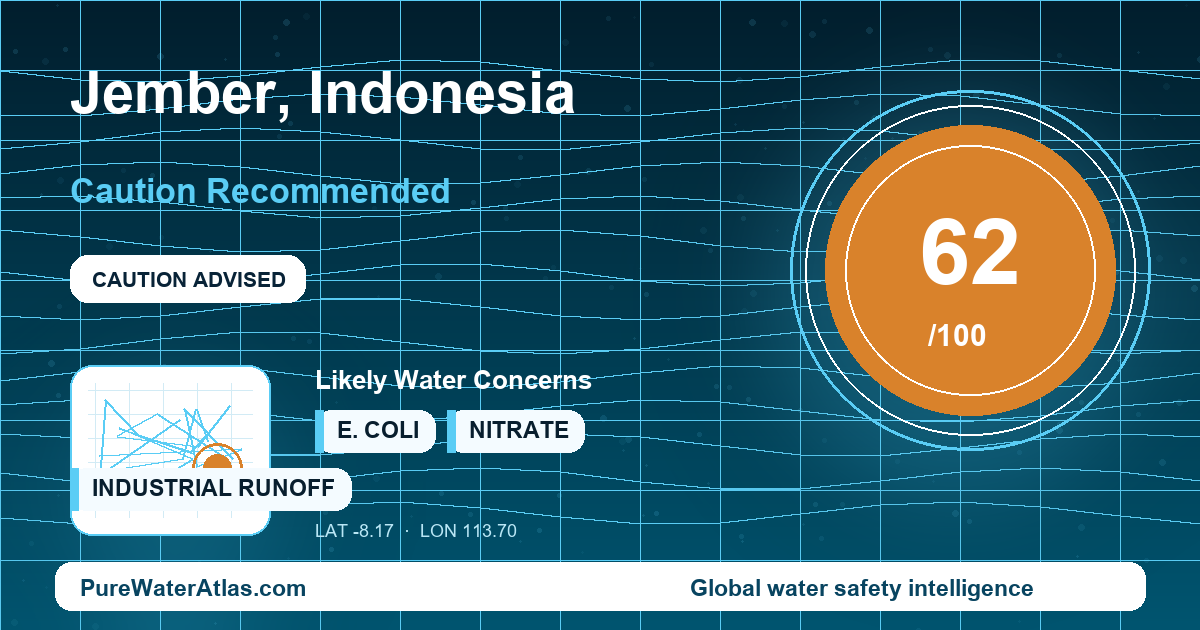
Jember, East Java: a mixed municipal, groundwater, spring, private-well, and refill-water setting where tap-water safety depends heavily on source, storage, plumbing, and treatment.
Quick Answer
| Water safety score | 62 / 100 |
|---|---|
| Risk level | Caution Recommended |
| Can tourists drink tap water? | No, not directly. Short-term visitors should use sealed bottled water, reputable refill water, or water that has been boiled, disinfected, and appropriately filtered. |
| Resident guidance | Residents should treat Jember water differently depending on whether it comes from Perumdam Tirta Pandalungan, a private well, a storage tank, or a refill-gallon depot. Testing and point-of-use treatment are advisable for drinking use. |
| Main water identity | Mixed urban and peri-urban supply: municipal distribution associated with upland springs and groundwater abstractions, plus private dug wells, bore wells, household tanks, and refill-gallon water. |
| Local authority | Perumdam Tirta Pandalungan Kabupaten Jember, formerly commonly referred to as PDAM Jember, with local-government and health-surveillance roles under Kabupaten Jember and national Indonesian standards. |
| Filter recommendation | A sediment prefilter and activated carbon can improve clarity and taste, but drinking safety may require boiling, UV, ultrafiltration, reverse osmosis, or another verified disinfection step, especially after outages, flooding, or tank storage. |
Overall verdict: caution is recommended. Jember has an identifiable municipal water utility and Indonesian drinking-water regulations apply, but recent public city-level compliance results are limited. The main practical risks are microbial contamination in wells and storage tanks, turbidity after heavy rain, ingress during low pressure or pipe disturbance, and quality differences between piped utility water, private wells, refill depots, and building plumbing.
Why Jember Is Different
Jember should not be treated as a simple one-source tap-water city. It is an inland East Java city in an agricultural basin connected hydrologically to the Bedadung catchment and surrounding tributaries. The wider raw-water environment includes volcanic and upland catchments around the Argopuro-Hyang and Raung-Ijen highlands. That setting matters because rainfall, sediment movement, land use, sanitation conditions, and groundwater protection can all influence local water quality.
The city developed as an inland agricultural center rather than a coastal desalination city or a city supplied by one large, closed reservoir system. Historically and practically, household water security in Jember has depended on local springs, shallow groundwater, dug wells, bore wells, and later municipal piped supply. As a result, the safety of water at the tap is often shaped as much by the last few meters of the system as by the original source: roof tanks, ground tanks, pumps, older pipes, fittings, refill containers, and whether the water is boiled or filtered before drinking.
Jember is also associated with tobacco, coffee, cocoa, rice, and other agriculture. This does not prove a specific contaminant level in any neighborhood, but it does make shallow groundwater and runoff-sensitive sources more relevant to evaluate for nitrate, sediment, microbial contamination, and agricultural influences. Central Jember should also be distinguished from coastal parts of Jember Regency such as Puger or Kencong. Salinity or seawater intrusion is a more plausible coastal issue; in central Jember, the more relevant concerns are microbial safety, turbidity, chlorine residual loss, well protection, storage-tank hygiene, and plumbing condition.
Where Does Jember’s Tap Water Come From?
Jember’s drinking-water supply is best understood as a mixed urban and peri-urban system. Publicly supplied premises are served through the Perumdam Tirta Pandalungan Kabupaten Jember municipal distribution network. The public supply is associated with upland spring intakes and groundwater abstraction points feeding local reservoirs, pumping units, and pressure zones. The available city-level information does not support describing Jember as a single-source system with one citywide raw-water reservoir.
Many households and small businesses, especially where piped utility service is absent, intermittent, or not used for drinking, rely on private dug wells, bore wells, or purchased refill-gallon water. Boarding houses, older shophouses, campuses, restaurants, hotels, and rural-edge homes can therefore have different water-quality realities even within the same city. A Perumdam-connected building with a clean tank and maintained plumbing is not the same risk profile as a shallow well near drains, livestock, septic influence, or floodwater exposure.
Household storage is especially important in Jember. Roof tanks, ground tanks, and dispensers can become the final quality-control point before drinking. Even if source water is acceptable, long storage times, uncovered tanks, insect or rodent access, sediment accumulation, biofilm, or loss of disinfectant residual can degrade water before it reaches a glass.
Who Manages Drinking Water in Jember?
The local drinking-water utility is Perumdam Tirta Pandalungan Kabupaten Jember, formerly known in public usage as PDAM Jember. Local government oversight is through Kabupaten Jember, while health surveillance functions are associated with the district health office. National technical and legal standards are set by Indonesian ministries and apply to drinking-water supply and environmental health.
Indonesia’s drinking-water quality framework includes Ministry of Health Regulation No. 2 of 2023, which covers environmental health and drinking-water quality parameters, and Government Regulation No. 122 of 2015 on drinking-water supply systems. These rules provide the national framework, but local safety still depends on utility operation, pressure stability, disinfection performance, district surveillance, household plumbing, well construction, and storage hygiene.
Data limitation: a recent public consumer-confidence-style report for Jember with routine results by service zone for E. coli, residual chlorine, turbidity, nitrate, metals, and pressure performance was not found in readily accessible official sources. This profile therefore does not claim universal compliance or non-compliance for all Jember tap water, and it does not assign contaminant concentrations by neighborhood.
Main Local Water Concerns
- Microbial contamination: the most important practical concern for shallow wells, household tanks, flood-exposed premises, and untreated water. Wells near septic systems, drains, livestock, or floodwater are higher concern.
- Turbidity and sediment: rainy-season runoff, source disturbance, pipe work, or dirty tanks can produce cloudy water or visible particles. Cloudy water can also make disinfection less reliable.
- Quality variation by source: Perumdam water, private wells, refill-gallon water, and building storage tanks should not be assumed to have the same risk profile.
- Nitrate vulnerability: in agricultural or densely settled areas using shallow groundwater, nitrate testing is prudent, especially where infants, pregnant people, or immunocompromised residents may consume the water.
- Iron and manganese: some groundwater settings can produce staining, metallic taste, discoloration, or black deposits, although site-specific testing is needed to confirm levels.
- Loss of disinfectant protection: water stored for long periods in tanks or containers can lose residual protection and become more vulnerable to regrowth or contamination.
- Ingress during low pressure: intermittent supply, pipe breaks, repairs, or pressure drops can allow contaminated water to enter distribution or building plumbing.
- Old plumbing and fixtures: older buildings, brass fittings, corroded pipes, rarely used taps, and dead-end plumbing can add metals or biofilm even when incoming water is acceptable.
Season matters. During the rainy season, Jember can face higher turbidity, drain overflow, runoff, and well contamination risk. During the dry season, shallow wells may produce less water, dissolved minerals may become more concentrated, and households may rely more heavily on stored or purchased water. After flooding, pipe repair, or service interruption, avoid drinking untreated tap water until it is clear and has been disinfected or boiled.
For Travelers
Short-term visitors should not drink Jember tap water directly unless it has been boiled, disinfected with a reliable method, or treated by a maintained purifier. This recommendation reflects limited public city-level water-quality data and the real variability of building storage, plumbing, roof tanks, and refill practices.
Use sealed bottled water on arrival, especially during the rainy season. Hot drinks are a better choice when they are made with fully boiled water. Reputable refill-gallon water may be acceptable when the establishment has good hygiene practices, but travelers should avoid assuming that all refill sources are equivalent.
For brushing teeth, many healthy adults may be comfortable using tap water in higher-standard hotels, but cautious travelers, children, immunocompromised people, and anyone with a sensitive stomach should use bottled, boiled, or treated water. In budget accommodation, do not assume the bathroom tap bypasses roof tanks or local storage.
Be careful with ice. Avoid ice from informal street vendors unless you can confirm it is factory-made or made from treated water. In restaurants and hotels, commercially produced clear tube ice is generally lower risk than homemade ice, but it is still reasonable to ask. Avoid drinking any water that is cloudy, has a sewage odor, or appears immediately after a pressure outage unless it has been treated.
For practical treatment, boiling is the simplest first-line method for microbial risk. See the PureWaterAtlas Boiling Water Purification: Complete Guide for method details.
For Residents
Residents should identify the actual source used for drinking: Perumdam Tirta Pandalungan water, a private dug well, a bore well, refill-gallon water, or a combination. The correct treatment depends on that answer.
For Perumdam-connected homes, a sediment prefilter can reduce particles and an activated carbon filter can improve taste and odor. However, these filters do not automatically guarantee microbiological safety. If water is stored in roof or ground tanks, or if there has been a pressure interruption, pipe repair, flooding, or unusual odor, add a verified disinfection step such as boiling, UV, ultrafiltration, or another appropriate process. UV is most effective when water is already clear; see UV Water Purification: Complete Guide.
For private wells, do not buy treatment equipment before testing. Test at least annually for E. coli or total coliform, nitrate, pH, TDS or conductivity, turbidity, iron, and manganese. Test immediately after flooding, well repair, nearby septic failure, sudden cloudiness, unusual odor, or a change in taste. For households with infants, pregnant people, elderly residents, or immunocompromised residents, prioritize microbiological and nitrate testing before using well water for drinking or formula.
Older houses, shophouses, boarding houses, and institutional buildings deserve extra attention. Corroded pipes, old brass fittings, dead-end plumbing, rooftop tanks, and long stagnation times can affect water at the tap. Flush stagnant taps before use, and if the water is used daily for infants, pregnancy, or other higher-risk situations, consider first-draw and flushed sampling for lead and other metals rather than assuming the municipal source is the only risk.
Storage tanks are a major practical risk point in Jember. Keep tanks covered, screened from insects and rodents, protected from roof runoff, and cleaned routinely. If a tank is visibly dirty or water has been sitting for long periods, do not drink it without boiling or disinfection.
Relevant Contaminants and Water-Quality Issues
The most relevant Jember issue to understand is E. coli, because microbial contamination is the primary concern for untreated wells, dirty tanks, flood exposure, and unverified drinking water. Turbidity and sediment are also important because rainy-season runoff, pipe disturbance, and tank debris can make water cloudy and reduce the effectiveness of disinfection.
In shallow groundwater areas influenced by agriculture, septic systems, or dense settlement, nitrate is an important testing priority. For municipal water and stored water, chlorine is relevant because disinfectant residual can decline during storage or long distribution times. In older buildings, lead should be considered a plumbing and fixture issue, not a proven citywide source-water claim. Groundwater users should also understand iron and manganese, which can cause taste, staining, or discoloration in some settings.
For Jember’s agricultural setting, the PureWaterAtlas guide to Agricultural Runoff in Drinking Water is also relevant, especially during the rainy season.
How to Verify Your Water Quality
The most reliable way to know whether your Jember water is safe is to test the water you actually drink, after it has passed through your building plumbing, storage tank, filter, dispenser, or refill container. Start with the PureWaterAtlas Water Testing Guide and the broader Drinking Water Safety resource.
Private-well users should prioritize microbiology and nitrate. If nitrate is a concern, see Nitrate Contamination in Drinking Water: Testing and Detection Methods. If the building is old or has unknown fixtures, review Lead in Drinking Water: Testing and Detection Methods.
For broader research, use the Contaminants Search Engine, the Global Water Quality Checker, and PureWaterAtlas pillar guides on Water Microbiology, Water Treatment Systems, and Global Water Quality. Related category pages include Drinking Water Safety, Water Testing, Water Microbiology, and Water Contamination.
Official and Technical Sources
- Kabupaten Jember official government website — local-government context for Jember and public-service responsibilities.
- BPS Kabupaten Jember — demographic, geographic, household, and infrastructure statistics for Jember Regency.
- Ministry of Health Regulation No. 2 of 2023 — national Indonesian reference for environmental health and drinking-water quality parameters.
- Government Regulation No. 122 of 2015 on Drinking Water Supply Systems — national SPAM governance framework.
- BMKG climate information — Indonesian rainfall and seasonal climate context relevant to turbidity, flooding, and runoff.
- WHO Guidelines for Drinking-water Quality — international reference for microbial safety, turbidity, disinfection, storage, and risk management.
- Directorate General of Human Settlements water supply information systems — public-works context for Indonesian drinking-water infrastructure planning.
Bottom Line
Jember tap water should be approached with caution, not panic. The city has a recognized municipal utility, Perumdam Tirta Pandalungan Kabupaten Jember, and Indonesian drinking-water regulations apply. However, public city-level compliance data are limited, and Jember’s real-world water quality can vary between piped supply, private wells, refill depots, storage tanks, and older building plumbing. Travelers should avoid drinking untreated tap water and use sealed bottled, boiled, or reliably treated water. Residents should test private wells, maintain tanks, flush stagnant plumbing, and use treatment suited to the actual contaminant risk. In central Jember, the leading practical concerns are microbial safety, turbidity after rain, well protection, chlorine residual loss, and storage hygiene.
Read the full guide: Global Water Quality Guide
Explore more in this category: Global Water Quality Articles