
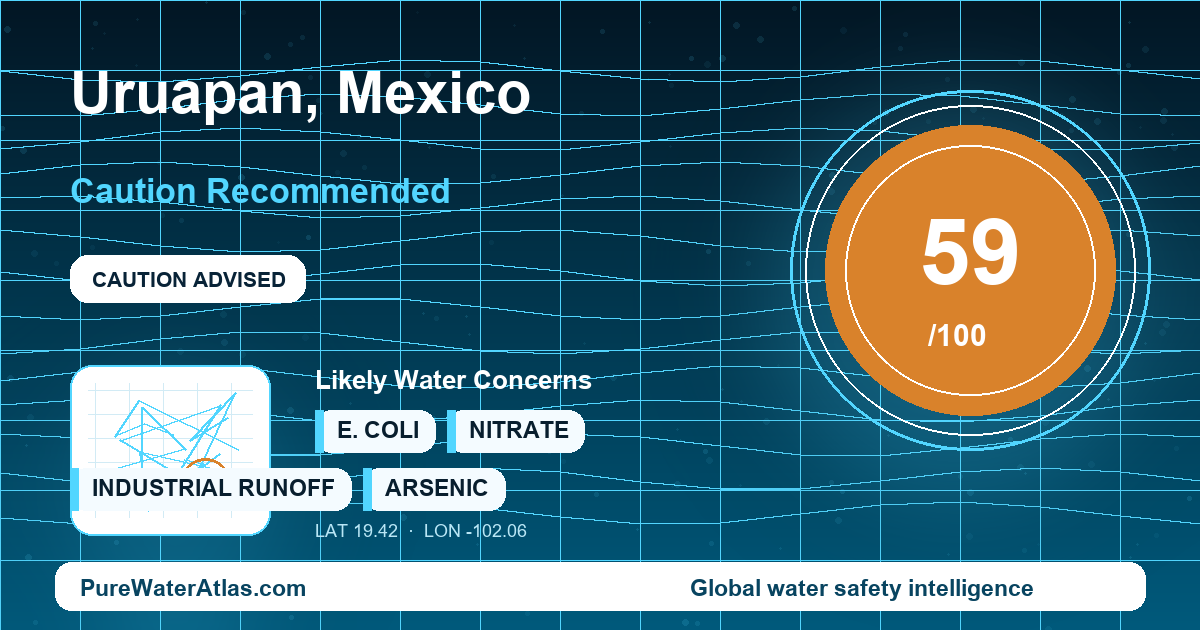
Uruapan, Michoacán has a spring-linked municipal water identity centered on the Cupatitzio system, but current public tap-by-tap drinking-water results are limited. Use caution before drinking untreated tap water.
Quick Answer
| Water safety score | 59 / 100 |
|---|---|
| Risk level | Caution Recommended |
| Is tap water safe to drink? | Caution recommended. Uruapan has a municipal operator and disinfected public supply, but recent citywide public test results are not easy to verify. Do not treat untreated tap water as reliably potable without a maintained household system or recent testing. |
| Traveler advice | Visitors should use sealed bottled water, reputable garrafón water, boiled water, or water treated by a reliable purifier. Untreated tap water is not recommended for short-stay drinking. |
| Resident advice | Residents should manage water at the household level: keep cisterns and tinacos clean, check chlorine residual when possible, and use a maintained point-of-use filter or purifier for drinking water. |
| Main water identity | Uruapan is closely associated with the Cupatitzio River headwaters and springs in the Barranca del Cupatitzio area, with municipal supply understood to use spring or surface-water captures plus supplemental groundwater wells. |
| Water authority | CAPASU, the Comisión de Agua Potable, Alcantarillado y Saneamiento de Uruapan. |
| Filter recommendation | Sediment prefiltration plus activated carbon and either UV or ultrafiltration is a practical household barrier. Reverse osmosis is best reserved for cases where testing shows dissolved contaminants such as nitrate, arsenic, fluoride, or high salinity. |
Why Uruapan Is Different
Uruapan is not a typical dry inland city that depends only on distant aquifers or long-distance transfers. Its local water identity is tied to Michoacán’s volcanic highland setting and to the Cupatitzio River, one of the best-known spring-fed urban water features in western Mexico. The Barranca del Cupatitzio National Park and the springs around the Rodilla del Diablo zone are part of the city’s historic and hydrologic character.
That spring-fed identity is important, but it does not automatically mean every household tap is safe for untreated drinking. Water quality at the tap depends on capture conditions, disinfection, distribution pressure, pipe integrity, household storage, and building plumbing. In Uruapan, as in many Mexican municipal systems, the final barrier is often inside the property: cisterns, rooftop tinacos, internal pipes, valves, and point-of-use treatment.
The city is also located in a major avocado-producing region. This does not prove that Uruapan’s municipal tap water contains agricultural contaminants, and this profile does not claim confirmed levels. It does mean that source-water protection, erosion control, nutrients, sediment, and pesticide runoff are reasonable watershed issues to watch around the city, especially during rainy-season runoff events.
Where Does Uruapan’s Tap Water Come From?
Uruapan’s public supply is understood to rely on a combination of spring or surface-water captures associated with the Cupatitzio system and groundwater wells operated through the local water system. Because a current public source-by-source production table was not identified, exact percentages by source should not be claimed. The safest description is that Uruapan has a locally influenced, spring-linked and groundwater-supplemented municipal supply.
Key infrastructure includes the CAPASU drinking-water, sewerage, and sanitation network; spring and surface-water capture areas associated with the Cupatitzio system; groundwater wells used to supplement supply; disinfection points that are most likely chlorination-based under Mexican potable-water practice; distribution mains; neighborhood storage; and household cisterns and rooftop tinacos. Drainage and wastewater infrastructure also matter because sewer leaks, cross-connections, storm events, or low-pressure periods can increase sanitary risk.
Season also matters. During the rainy season, typically late spring through early autumn, runoff can increase turbidity and sediment pulses in surface-influenced sources. After heavy rain, roadwork, pipe repairs, landslides, or pressure changes, residents should watch for cloudy, colored, or earthy-smelling water and avoid drinking it untreated until it clears and is disinfected or tested. During the dry season, lower spring or well yield and higher demand can contribute to pressure variability or greater reliance on supplemental sources.
Who Manages Drinking Water in Uruapan?
The local drinking-water, sewerage, and sanitation operator is CAPASU, the Comisión de Agua Potable, Alcantarillado y Saneamiento de Uruapan. Municipal public-service context is also available through the Gobierno Municipal de Uruapan.
At the national level, water-resource administration involves CONAGUA and the Sistema Nacional de Información del Agua. Drinking-water sanitary criteria are set under Mexico’s health authority framework, including Secretaría de Salud and COFEPRIS responsibilities. The main potable-water quality standard is NOM-127-SSA1-2021, Agua para uso y consumo humano.
The confidence level for this page is medium-low. Uruapan-specific utility, geography, and source-water context are available, but a recent, comprehensive, public, consumer-friendly finished-water quality report for the city was not found. This assessment therefore emphasizes verified local context, known system vulnerabilities, and conservative health-protective guidance rather than exact contaminant concentrations or neighborhood-level compliance claims.
Main Local Water Concerns
- Microbial risk: Risk can increase if disinfection residual is lost in the distribution system or if water is stored in dirty household cisterns or rooftop tanks. Learn more about E. coli and microbial warning signs.
- Turbidity and sediment: Cloudiness, grit, or colored water can appear after pipe repairs, pressure changes, heavy rain, or disturbance in surface- or spring-influenced systems. See PureWaterAtlas profiles on turbidity and sediment.
- Intermittent pressure: Localized outages or low-pressure events can allow intrusion through leaks or cross-connections, especially where drainage problems or old infrastructure are present.
- Household storage: Tinacos and cisterns are a major final-barrier issue in Uruapan. Even water that left the utility disinfected can become unsafe if stored in an uncovered, dirty, or poorly maintained tank.
- Agricultural watershed pressure: Uruapan’s surrounding avocado region makes nutrients, sediment, and pesticides reasonable source-water issues to monitor, although this profile does not claim confirmed finished-water contaminant levels.
- Premise plumbing: Older buildings may have plumbing materials, solder, valves, or fixtures that contribute metals at the tap. There is no public evidence that this is uniform across Uruapan, so building-specific testing is the right approach.
For Travelers
Short-term visitors should not rely on untreated tap water for drinking in Uruapan. Use sealed bottled water, garrafón water from a reputable supplier, boiled water, or water treated by a reliable purifier. This advice is especially important for children, pregnant travelers, older adults, immune-compromised travelers, and anyone with a sensitive stomach.
For brushing teeth, cautious travelers should use bottled or purified water. Healthy adults may tolerate small incidental exposure, but using purified water is an easy way to reduce avoidable gastrointestinal risk. For ice, use only ice that is clearly made from purified water. In hotels, restaurants, cafés, and juice stands, ask for hielo purificado if unsure.
Most hotels and tourist-facing restaurants are accustomed to serving purified water. Ask for agua purificada or bottled water rather than assuming a pitcher is safe. If staying in a rental, check whether the property uses a maintained filter, UV unit, or garrafón dispenser, and ask whether the tinaco or cistern is cleaned. For emergency or temporary treatment, see Boiling Water Purification: Complete Guide.
The CDC Travelers’ Health guidance for Mexico supports a cautious approach to food and water exposure for visitors.
For Residents
For Uruapan residents, the best approach is household-level water management rather than blind trust or blanket rejection of the municipal supply. A maintained point-of-use barrier is advisable for drinking and cooking water, especially if the home has a cistern, rooftop tank, older plumbing, infants, pregnant people, older adults, or immune-compromised residents.
A practical treatment train is sediment prefiltration, activated carbon, and either UV or ultrafiltration for microbial protection. UV can be effective, but it should not be used as the only barrier when water is cloudy because turbidity can interfere with disinfection. For details, see UV Water Purification: Complete Guide. Reverse osmosis can be useful when testing shows dissolved contaminants such as nitrate, arsenic, fluoride, or high salinity, but it should not be assumed necessary without data.
Residents with cisterns or tinacos should keep them covered, screened, and cleaned on a routine schedule, commonly every six months or after contamination events. Dirty tanks can defeat municipal chlorination and are one of the most important household water-safety risks in Uruapan. Periodic checks for free chlorine residual at the tap can help show whether a disinfectant barrier remains after distribution and storage.
Older buildings deserve extra caution. Corroded metal pipes, brass fixtures, galvanized plumbing, stagnant water in long internal lines, and older solder can affect water after it enters the property. Flush taps after overnight stagnation and consider first-draw and flushed testing for lead and copper. PureWaterAtlas also has a guide to lead testing and detection methods.
Relevant Contaminants and Water-Quality Issues
The most relevant Uruapan concerns are practical water-safety issues rather than confirmed citywide contaminant concentrations. Microbiology is the first priority when water pressure is intermittent, storage tanks are dirty, or chlorine residual is lost. The PureWaterAtlas Water Microbiology guide explains why bacteria, viruses, and sanitary barriers matter.
Turbidity and sediment matter because Uruapan’s water identity includes spring and surface-water influence, and because repairs, rainy-season runoff, and pipe disturbance can affect appearance and disinfection performance. Chlorine matters because it is the standard residual disinfectant barrier in many Mexican potable-water systems. Nitrate is worth testing where private wells, agricultural influence, or non-core supply conditions are involved; see Nitrate Contamination in Drinking Water: Testing and Detection Methods. Lead and copper should be evaluated at the building level in older premises rather than assumed from the municipal source alone.
How to Verify Your Water Quality
Because recent neighborhood-level public test data for Uruapan were not found in a consumer-friendly report, verification is especially important. Start with the basics: visual appearance, odor, chlorine residual, and whether your home stores water in a cistern or tinaco. If water is cloudy, colored, earthy-smelling, slimy, or changes after an outage or repair, do not drink it untreated until it is cleared, treated, or tested.
For household testing, prioritize total coliform and E. coli after flooding, long outages, tank contamination, or unexplained odor or taste. Add turbidity checks after rainy-season events or repairs. If you use a private well, live outside the core municipal network, or have uncertain plumbing, run a baseline lab panel for nitrate, arsenic, fluoride, iron, manganese, hardness, TDS, and basic metals. For a broader testing framework, use the PureWaterAtlas Water Testing guide.
You can also compare local risk factors using the Global Water Quality Checker, research specific contaminants in the Contaminants Search Engine, and review the broader Drinking Water Safety and Water Treatment Systems guides.
Official and Technical Sources
- CAPASU Uruapan — local drinking-water, sewerage, and sanitation operator.
- Gobierno Municipal de Uruapan — municipal public-service and administration context.
- CONANP SIMEC: Parque Nacional Barranca del Cupatitzio — official context for the protected area and spring-fed headwater environment.
- CONAGUA Sistema Nacional de Información del Agua — national water-resource reference context.
- NOM-127-SSA1-2021 — Mexico’s potable-water quality regulation for water for human use and consumption.
- CDC Travelers’ Health: Mexico — traveler-focused food and water safety guidance.
- INEGI Áreas Geográficas — geographic and administrative context for Uruapan within Michoacán.
Bottom Line
Uruapan’s tap water should be approached with caution, not panic. The city has a formal municipal operator, CAPASU, and a distinctive water identity tied to the Cupatitzio springs and volcanic highland setting. However, recent comprehensive public tap-water test results were not found in a consumer-friendly format, so untreated tap water should not be assumed reliably potable. Travelers should use bottled, garrafón, boiled, or properly purified water. Residents should focus on household controls: clean cisterns and tinacos, watch for turbidity after rain or repairs, verify chlorine residual when possible, and use maintained point-of-use treatment for drinking water. Testing is especially important for private wells, older buildings, unusual water changes, or homes with storage tanks.
Read the full guide: Global Water Quality Guide
Explore more in this category: Global Water Quality Articles