
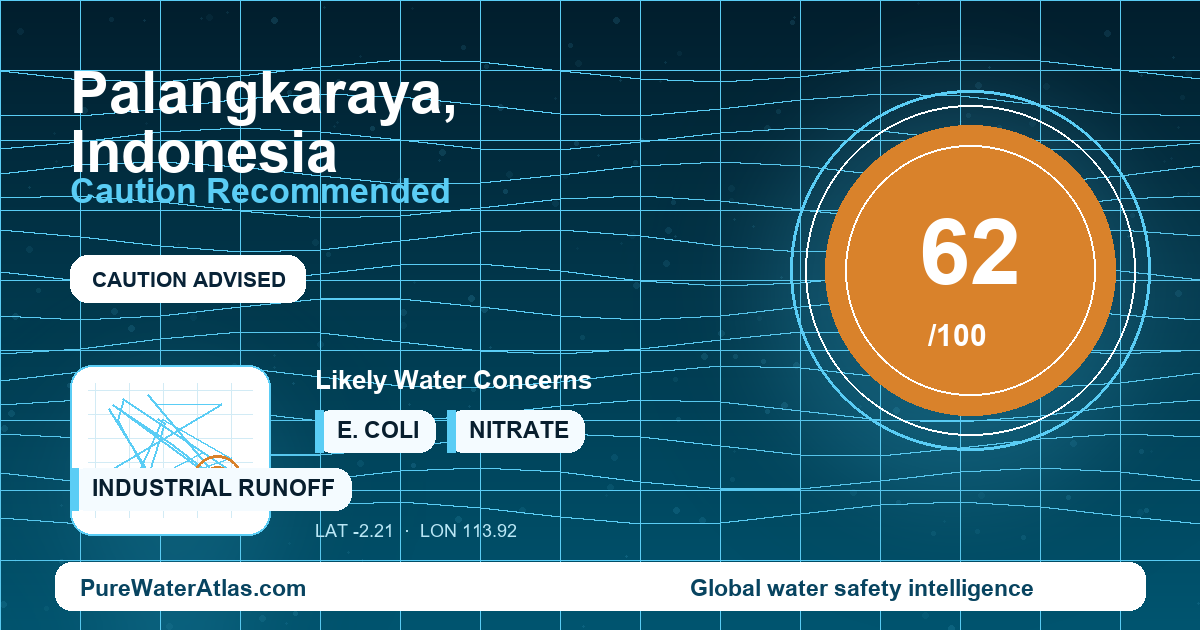
Palangkaraya is an inland Central Kalimantan city where tap-water safety is shaped by the Kahayan River system, peat-influenced surface water, seasonal turbidity, distribution reliability, and household storage conditions.
Quick Answer
| Water safety score | 62 / 100 |
|---|---|
| Risk level | Caution Recommended |
| Can tourists drink the tap water? | Not recommended untreated. Short-stay visitors should use sealed bottled water, reputable refill water, or water that has been boiled or properly filtered and disinfected. |
| Resident advice | Treat Palangkaraya tap water as a managed but locally variable supply. For drinking, use sediment prefiltration plus activated carbon and a final microbial barrier such as boiling, UV, or reverse osmosis depending on household risk tolerance and test results. |
| Main water source | Primarily surface water associated with the Kahayan River basin and local river reaches, not a coastal desalination or deep-aquifer system. |
| Water authority | PDAM Kota Palangka Raya / Perumdam Air Minum Kota Palangka Raya, with local health surveillance by Dinas Kesehatan Kota Palangka Raya and national standards set by Indonesia’s Ministry of Health. |
| Filter recommendation | Advisable for drinking water, especially where water is stored in tanks, pressure is inconsistent, outages occur, or water shows color, sediment, odor, or turbidity. |
Editorial verdict: caution recommended. Palangkaraya has a municipal piped-water utility and treated river-water supply, but easily accessible, recent, comprehensive city-level finished-water quality data are limited. The main local risk profile is peat-influenced river water, turbidity, microbial risk during distribution or storage problems, and variable household plumbing or tank conditions.
Why Palangkaraya Is Different
Palangkaraya is not a coastal salinity case. It is an inland lowland city in Central Kalimantan built around the Kahayan River system and surrounding peat-swamp landscapes. That geography matters because peat-influenced raw water can be naturally acidic, tea-colored, high in organic matter, and sensitive to changes in rainfall, runoff, flooding, and river conditions.
This means a glass of Palangkaraya tap water should not be judged by appearance alone. Slight color or an earthy character may reflect peat-derived natural organic matter, but the same raw-water conditions can increase treatment demand and make filtration and disinfection control more important. During heavy rain or flooding, river turbidity and suspended sediment can rise. During dry periods, lower flows may concentrate organic matter and contribute to taste, odor, or treatment-demand issues.
The practical safety of water at the tap also depends on what happens after municipal treatment. Distribution pressure, pipe condition, repairs, outages, household tanks, roof tanks, and internal plumbing can strongly affect what arrives at the kitchen tap. Two homes in the same city may have different risk profiles if one receives stable PDAM or Perumdam service while another relies on shallow wells, stored water, refill depots, or mixed sources.
Where Does Palangkaraya’s Tap Water Come From?
Palangkaraya is primarily a surface-water city. The municipal system is associated with the Kahayan River basin, with raw water drawn from the local river system or connected river reaches rather than from coastal desalination or a deep aquifer. In a peatland-influenced lowland environment, raw water can have high color, natural organic matter, acidity, and turbidity depending on season and river conditions.
The main water infrastructure includes municipal river intake infrastructure on the Kahayan river system or connected local reaches, water treatment plants operated by the local municipal water company, and a piped distribution network serving connected urban customers. Treatment is described at a general level as conventional treatment steps such as clarification or filtration and disinfection. These steps are important in Palangkaraya because peat color, suspended sediment, and microbial loading can vary with river and rainfall conditions.
Household-level infrastructure is also part of the real water system. Storage tanks, roof tanks, pumps, and containers can strongly affect water quality at the actual tap. Before and alongside expansion of piped supply, households in Palangkaraya and surrounding settlements have used a mix of river water, shallow wells, rainwater, refill-water depots, and stored water. These alternative sources remain relevant for households outside reliable piped coverage or during outages.
Who Manages Drinking Water in Palangkaraya?
The local piped-water provider is the municipal drinking-water company commonly referred to as PDAM Kota Palangka Raya or Perumdam Air Minum Kota Palangka Raya. Local health surveillance is associated with Dinas Kesehatan Kota Palangka Raya. Indonesia’s national drinking-water and environmental health requirements are set by the Ministry of Health, including Ministry of Health Regulation No. 2 of 2023.
For consumers, the key limitation is transparency at neighborhood scale. Official statistics, municipal information, national regulations, and watershed evidence help explain Palangkaraya’s water-access and source-water context. However, recent Palangkaraya-specific finished tap-water datasets, distribution-zone monitoring results, outage-linked advisories, and neighborhood-level contaminant trends are not consistently public in a way that allows independent verification at every tap. This profile therefore identifies documented and plausible local risk drivers rather than claiming that all taps comply or fail.
Main Local Water Concerns
- Peat-influenced raw water: River water affected by peat can be acidic, colored, and high in natural organic matter. That increases the importance of effective coagulation, filtration, and disinfection.
- Turbidity and sediment: Heavy rain, river flooding, and storm runoff can increase turbidity and suspended sediment. Turbidity can reduce treatment efficiency if it is not well managed.
- Microbial risk: The main immediate health concern is microbial contamination when water is inadequately disinfected, distribution pressure drops, pipes are repaired, or household storage tanks are dirty.
- Storage tanks and containers: Roof tanks and household containers can become a major risk point if lids are not sealed, tanks are not cleaned, animals or mosquitoes enter, or stored water is mixed with well or river water.
- Private wells: Shallow wells in peat and alluvial settings may have iron, manganese, color, odor, low pH, or microbial contamination. This risk is separate from treated PDAM water.
- Watershed mining concern: The broader Kahayan and Central Kalimantan river environment has documented concern from artisanal and small-scale gold mining, including mercury in the watershed. This is a source-water concern, but publicly available evidence is insufficient to claim a specific mercury level in Palangkaraya finished tap water.
- Chlorine taste or odor: Some users may notice chlorine where operators maintain a disinfectant residual, especially when peat-influenced raw water creates higher chlorine demand.
After pipe repairs, pressure loss, long outages, flooding, or dirty-tank events, residents should flush taps and boil or disinfect water until clarity and service stability return.
For Travelers
Tourists should not rely on untreated tap water as their primary drinking water in Palangkaraya. Use sealed bottled water, reputable refill water, or water that has been boiled or treated with a reliable purifier. This is especially important for short-stay visitors whose stomachs may be less adapted to local microbial exposures and who may not know whether a hotel bathroom tap is connected to treated municipal water, a storage tank, or another supply.
For brushing teeth, many healthy adults can use tap water if the hotel confirms it comes from a treated supply. More cautious travelers, children, pregnant travelers, elderly travelers, and immunocompromised visitors should use bottled or boiled water. Avoid swallowing shower water, and do not drink from bathroom taps unless the property explicitly says the water is intended for drinking.
Avoid ice from street stalls or unknown sources. Ice in higher-standard hotels and restaurants is lower risk if made from treated water or commercial ice, but travelers should ask if unsure. Better hotels and restaurants usually provide bottled or dispenser water for drinking. For tea or coffee, water that has reached a rolling boil is generally a safer choice; see the PureWaterAtlas guide to boiling water purification for practical treatment guidance.
Carry bottled water during outings, especially in hot weather. If tap water is visibly brown, muddy, has a strong odor, or appears after a service interruption, do not drink it without treatment.
For Residents
Residents connected to PDAM or Perumdam supply should treat the water as managed but locally variable. A household filter is advisable for drinking water, particularly where water is stored in tanks, service interruptions occur, distribution pressure is inconsistent, or the tap shows color, sediment, odor, or turbidity. A practical Palangkaraya setup is sediment filtration followed by activated carbon and a final microbial barrier such as boiling, UV, or reverse osmosis. For UV systems, pretreatment is important because turbid or colored water can reduce UV performance; see the PureWaterAtlas UV water purification guide.
For PDAM or Perumdam tap water, useful tests include E. coli or total coliform, turbidity, pH, residual chlorine, color, iron, and manganese where taste, odor, staining, or particles are present. For private wells or shallow groundwater, add nitrate, ammonia, conductivity or TDS, hardness, iron, manganese, pH, and microbial testing. Consider arsenic or other metals only where local geology, mining influence, or previous results suggest risk.
After flooding, pipe repair, long outages, or dirty-tank events, microbiology and turbidity testing are especially important before resuming untreated drinking. Babies, pregnant residents, elderly residents, and immunocompromised households should use boiled, UV-treated, or reverse-osmosis water for drinking unless recent tests confirm microbiological safety.
Lead service lines are not the dominant documented citywide issue in Palangkaraya, but older building plumbing, brass fittings, solder, pumps, and internal pipes can still contribute metals. If water has been standing overnight, flush first-use water and consider testing for lead and copper in older or renovated buildings. PureWaterAtlas has a detailed guide to lead testing and detection methods.
Storage tanks deserve special attention. Clean tanks regularly, keep lids sealed, prevent mosquito and animal entry, avoid cross-connections with well or river water, and disinfect or boil water after tank cleaning or suspected contamination. If relying on refill-water depots, choose depots with visible hygiene practices, clean handling of bottles and caps, sealed containers, and recent inspection documentation where available.
Relevant Contaminants and Water-Quality Issues
The most relevant Palangkaraya issues are not defined by a single contaminant; they are a source-water and distribution-risk pattern. Turbidity matters because river water can become more sediment-laden during rain, flooding, and runoff. Sediment is also relevant for households seeing particles after pipe work, floods, or tank disturbance.
E. coli and other microbial indicators are critical because microbial contamination is the main short-term illness risk when disinfection, distribution pressure, or storage fails. Chlorine is relevant because treated municipal water relies on disinfection, and peat-influenced raw water can increase chlorine demand and contribute to taste or odor concerns.
For private wells and shallow groundwater, iron and manganese may be relevant where water has staining, metallic taste, black particles, odor, or color. These issues should not be automatically attributed to treated PDAM water without testing, because source and plumbing conditions differ from home to home.
How to Verify Your Water Quality
Because public Palangkaraya finished-water data are limited, verification should happen at the household or building level when water will be used for drinking. Start by identifying the actual source: PDAM or Perumdam piped water, a private well, stored tank water, refill depot water, rainwater, or a mixed arrangement. Then test the water at the point where it is consumed, not only at the incoming pipe.
For a step-by-step testing framework, use the PureWaterAtlas complete guide to water testing and analysis. For broader risk interpretation, see Drinking Water Safety, Water Microbiology, and Water Treatment Systems.
You can compare city-level caution ratings using the Global Water Quality Checker and look up individual contaminants in the Contaminants Search Engine. Related PureWaterAtlas sections include Global Water Quality, Water Purification, and Water Testing.
Official and Technical Sources
- Badan Pusat Statistik Kota Palangka Raya — official city statistics source for geography, population, infrastructure, and household service context.
- Pemerintah Kota Palangka Raya — official municipal government source for city administration and public-service context.
- Peraturan BPK RI, Permenkes No. 2 Tahun 2023 — official legal database entry for Indonesia’s national drinking-water and environmental health requirements.
- Minamata Convention on Mercury, Indonesia Minamata Initial Assessment — high-authority source documenting mercury issues from artisanal and small-scale gold mining in Indonesia, relevant to Central Kalimantan river-basin source-water concerns.
- WHO Guidelines for Drinking-water Quality — international reference for microbial safety, disinfection, turbidity, and health-based water-quality assessment.
- CDC Travelers’ Health, Indonesia — travel-health guidance supporting cautious food and drinking-water practices for visitors.
- Badan Restorasi Gambut dan Mangrove Republik Indonesia — official peatland agency source relevant to Central Kalimantan peatland conditions affecting raw-water color, acidity, organic matter, and seasonal fire or runoff pressures.
Bottom Line
Palangkaraya’s tap water should be approached with caution, not because of coastal salinity, but because the city depends on peat-influenced river water and a distribution system where pressure, pipe work, outages, household tanks, and alternative sources can change water quality at the tap. Municipal treatment and PDAM or Perumdam supply provide a managed system, but public finished-water data are not detailed enough to verify every neighborhood or building. Tourists should use bottled, reputable refill, boiled, or properly purified water for drinking. Residents should consider sediment filtration, activated carbon, and a reliable microbial barrier, and should test water after floods, outages, pipe repairs, tank contamination, or when using private wells.
Read the full guide: Global Water Quality Guide
Explore more in this category: Global Water Quality Articles