
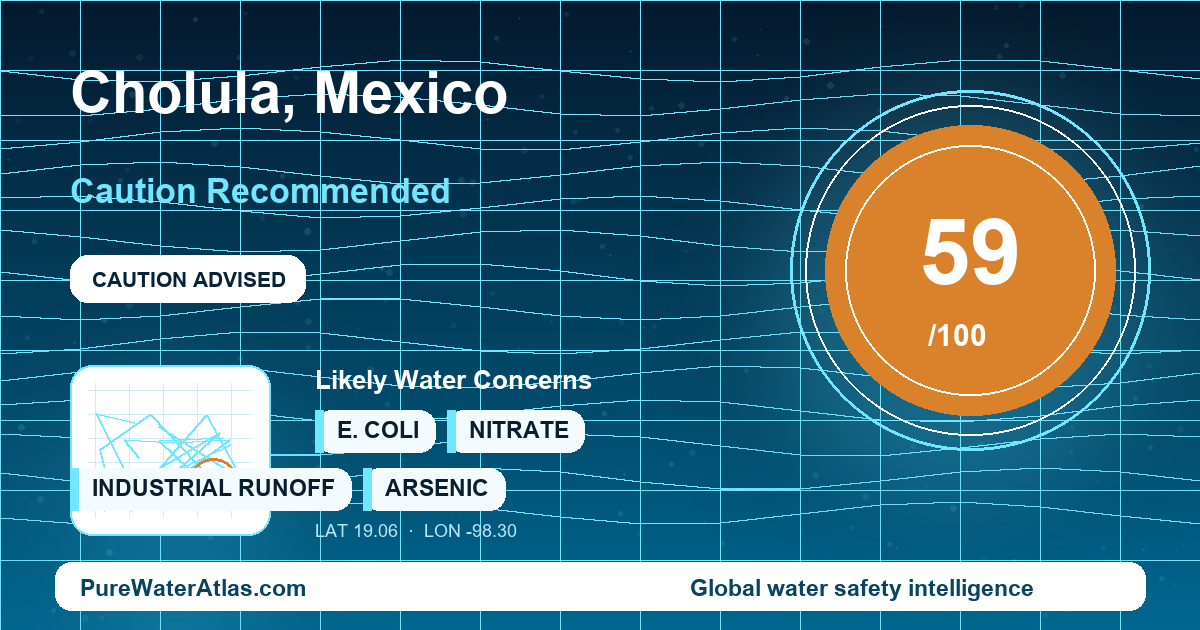
Cholula, Mexico: groundwater-based municipal supply, variable building storage, and traveler caution for tap water.
Quick Answer
| Water safety score | 59 / 100 |
|---|---|
| Risk level | Caution Recommended |
| Can visitors drink the tap water? | Not recommended as a default. Visitors should use sealed bottled water, verified filtered water, or boiled/disinfected water for drinking. |
| Resident guidance | Treat tap water as a utility supply that should be verified at the point of use, especially where cisterns, tinacos, older plumbing, or intermittent service are involved. |
| Main water source | Primarily pumped groundwater from the Puebla Valley aquifer system, distributed through municipal networks and building-level storage. |
| Local authority context | SOSAPACH for San Pedro Cholula and SOSAPAS for San Andrés Cholula, with oversight roles for municipal, Puebla state, CONAGUA, COFEPRIS, and health authorities. |
| Filter recommendation | A maintained point-of-use system is advisable for drinking and cooking unless recent kitchen-tap test results confirm potability. Sediment filtration plus activated carbon is a practical baseline; reverse osmosis, UV, or other certified treatment should be selected based on test results. |
Editorial verdict: caution is recommended. Cholula’s municipal water is generally understood to be groundwater-based and expected to be disinfected before distribution, but recent, public, city-specific finished-water results are limited. In practice, the safety question often depends less on the aquifer alone and more on the condition of local distribution pipes, pressure stability, household cisterns, rooftop tinacos, and building plumbing.
Why Cholula Is Different
Cholula is not a single simple water-service area. The urban area commonly described as Cholula includes both San Pedro Cholula and San Andrés Cholula, west of Puebla city in the Puebla Valley. That matters because the responsible water operator can change depending on the exact address. A hotel near the archaeological and religious center, a rental in an older central neighborhood, and a home in a peri-urban edge area may not share the same final plumbing, storage conditions, or maintenance history.
The city also sits in a volcanic and alluvial valley near Popocatépetl. This does not mean the volcano is the normal direct source of drinking water, but it does create a distinctive practical issue: ashfall. Volcanic ash can settle on roofs, enter uncovered containers, accumulate around tank lids, and contaminate gutters or rooftop storage if openings are not sealed. After ash events, residents should inspect cistern and tinaco covers, avoid using roof runoff for drinking, and rely on treated water until storage systems are confirmed clean.
The broader Puebla-Tlaxcala region is part of the Alto Atoyac basin, an area with documented pressure from urbanization, industry, wastewater, and agriculture. This profile does not claim that Cholula tap water is drawn from the Atoyac River. The relevance is different: groundwater protection, well integrity, wastewater control, nitrate screening, and microbial surveillance are important in a rapidly urbanizing valley.
Where Does Cholula’s Tap Water Come From?
Cholula is primarily supplied by pumped groundwater rather than by a large surface-water treatment plant. The relevant regional system is the Puebla Valley aquifer area. Municipal wells serve San Pedro Cholula and San Andrés Cholula depending on the exact location. In a typical local supply chain, groundwater is pumped, disinfected, stored, and distributed through municipal infrastructure before reaching building-level cisterns, rooftop tinacos, and internal plumbing.
Key infrastructure for Cholula includes municipal groundwater wells, pump stations, chlorination points, storage and pressure-regulating infrastructure, distribution pipes, and the final household or building storage system. The last part of that chain is especially important. A municipal supply can be disinfected, yet water quality at the kitchen tap can still be affected by a dirty cistern, an uncovered tinaco, old pipes, stagnant plumbing, pipe repairs, or low-pressure intrusion events.
Historically, the Cholula region relied on springs, shallow groundwater, wells, irrigation canals, and local surface flows. Modern public drinking water service is now largely groundwater-well based. Rivers and drainage channels in the broader basin are better understood as environmental and wastewater concerns than as the direct routine source of urban drinking water for Cholula.
Who Manages Drinking Water in Cholula?
For San Pedro Cholula, the local operator is the Sistema Operador de los Servicios de Agua Potable y Alcantarillado del Municipio de San Pedro Cholula, commonly referenced as SOSAPACH. For San Andrés Cholula, service is associated with its municipal water operator, commonly referenced as SOSAPAS. Because the Cholula urban area crosses municipal boundaries, residents should confirm which operator serves their exact address before requesting service information, test records, or maintenance support.
At the broader level, CONAGUA manages national water resources and aquifer information, including the regional aquifer context. Puebla state water and sanitation context is provided by the Comisión Estatal de Agua y Saneamiento del Estado de Puebla. Mexico’s potable-water sanitary framework includes NOM-127-SSA1-2021, which sets permissible limits for water for human use and consumption, while COFEPRIS provides federal health authority context for sanitary surveillance.
The limitation is important: this profile does not claim verified compliance for every tap in Cholula. Public sources identify the likely groundwater supply framework and responsible authorities, but they do not provide one recent, complete, easy-to-review Cholula tap-water report showing sample dates, sample locations, residual chlorine trends, microbiology, metals, nitrate, and consumer-facing interpretation for all neighborhoods and building types.
Main Local Water Concerns
- Limited public finished-water data: recent Cholula-specific laboratory results are not consistently available in a transparent consumer format.
- Groundwater dependence in an urbanizing valley: the Puebla Valley aquifer context makes well protection, wastewater control, and periodic chemical screening important.
- Distribution and pressure variability: intermittent service or low-pressure events can increase intrusion risk in weaker parts of a distribution network.
- Cisterns and rooftop tinacos: household storage may be the most important determinant of actual tap quality. Dirty, uncovered, or poorly disinfected tanks can introduce sediment, insects, animal contamination, and microbial risk.
- Taste, odor, chlorine, sediment, and turbidity: these may vary at the tap, especially after pipe work, tank disturbance, rainy-season events, or service interruptions.
- Older buildings: central-area and historic properties may have mixed plumbing materials, old fixtures, solder, galvanized pipes, corrosion products, or accumulated scale.
- Regional nitrate and microbial concerns: private wells, peri-urban locations, or homes with poorly protected storage should consider nitrate and microbiological testing.
- Popocatépetl ashfall: ash can affect exposed rooftop systems, tank lids, gutters, and open containers.
Season also matters. The rainy season, generally May through October, can increase runoff, localized flooding, turbidity, and sewer or stormwater intrusion risk where infrastructure is weak. Dry-season demand can make storage dependence and pressure interruptions more noticeable. Tourism peaks around the archaeological and religious center can also increase demand on hotels, restaurants, and local plumbing systems.
For Travelers
Visitors should not rely on ordinary tap water as their primary drinking water in Cholula. The lower-risk choice is sealed bottled water, verified purified water, or water that has been boiled or otherwise disinfected. This is especially important for short-stay travelers, children, pregnant travelers, older adults, immunocompromised visitors, and anyone with a sensitive stomach. The CDC Mexico Traveler View supports conservative food and water precautions for travelers.
For brushing teeth, bottled or filtered water is the safer option if you are sensitive, traveling with children, pregnant, or immunocompromised. Many travelers may brush with tap water without incident, but the point of this guide is risk reduction, not habit reporting.
For ice, avoid cubes from informal vendors or unknown sources. In established hotels and restaurants, ask whether ice is made from purified water. Factory-made bagged ice is generally safer than ice made from untreated tap water. Good hotels and restaurants in Cholula commonly use garrafón water or filtration for drinking water and ice, but do not assume this automatically. Ask directly for bottled water, purified water, or agua purificada.
If staying in an older guesthouse or rental, ask whether the cistern and rooftop tank are cleaned regularly. Carry sealed bottled water, check that caps are intact, use bottled water for medications, and choose hot drinks that have been boiled. If you must treat tap water yourself, see the PureWaterAtlas Boiling Water Purification Guide.
For Residents
Residents should treat Cholula tap water as a household utility supply that may be appropriate for washing and general domestic use, but should verify potability at the point of use. A home treatment barrier is advisable for drinking and cooking unless you have recent kitchen-tap test results and well-maintained storage. A practical setup often starts with sediment prefiltration and activated carbon for particles, taste, and chlorine. Reverse osmosis or another certified system may be appropriate if testing identifies nitrate, arsenic, fluoride, lead, or other dissolved contaminants. UV can help with microbes only if the water is already clear and the UV unit is correctly maintained; see the UV Water Purification Guide.
Test at the kitchen tap, not only at the utility connection, because cisterns, tinacos, and internal plumbing can change water quality. At minimum, test for total coliform and E. coli if water is stored in a cistern or rooftop tank. Check residual chlorine during normal service and after service interruptions if you are evaluating disinfection consistency. In older homes, test first-draw and flushed samples for lead and other metals. For private wells, peri-urban locations, or unexplained taste issues, add nitrate, arsenic, fluoride, hardness, iron, manganese, total dissolved solids, and basic chemistry.
Cisterns and tinacos should be sealed, screened, cleaned, and disinfected on a regular schedule. Lids should be checked after storms, repairs, and ashfall. Historic-center buildings, older rental units, and remodeled properties may have mixed plumbing. Flush taps after long stagnation and test if children or pregnant residents live in the home.
Relevant Contaminants and Water-Quality Issues
Cholula’s most relevant water-quality issues are not limited to one contaminant. They involve source protection, disinfection, storage, distribution, and premise plumbing. Chlorine is relevant because municipal groundwater is expected to be disinfected and residual levels can vary at the tap. Turbidity and sediment are relevant during rainy-season events, pipe work, tank disturbance, and volcanic ash intrusion.
Microbial verification is central where water is stored. E. coli testing is especially relevant for cisterns, rooftop tanks, low-pressure events, and sanitary confirmation at the tap. In older buildings, lead is a point-of-use concern because fixtures, solder, corrosion, or old plumbing can affect water after it leaves the municipal system. Nitrate is relevant for peri-urban groundwater vulnerability, agriculture, wastewater influence, and private-well screening. Arsenic is a reasonable groundwater screening parameter in volcanic and alluvial aquifer settings, although this profile makes no citywide Cholula exceedance claim.
How to Verify Your Water Quality
For a Cholula household, the most useful test is the water you actually drink: the kitchen tap after the building’s cistern, tinaco, filters, and internal plumbing. If you are comparing results or choosing treatment, start with PureWaterAtlas guides on Water Testing, Drinking Water Safety, Water Microbiology, and Water Treatment Systems.
For issue-specific testing, see Lead in Drinking Water: Testing and Detection Methods, Nitrate Contamination in Drinking Water: Testing and Detection Methods, and Arsenic in Drinking Water: Testing and Detection Methods. You can also use the Contaminants Search Engine to research chlorine, turbidity, nitrate, lead, and microbial indicators, or compare Cholula with other destinations using the Global Water Quality Checker.
Official and Technical Sources
- Actualización de la disponibilidad media anual de agua en el acuífero Valle de Puebla 2104, Estado de Puebla — CONAGUA regional aquifer source.
- Sistema Nacional de Información del Agua — CONAGUA national water information portal.
- NOM-127-SSA1-2021 — federal potable-water quality standard for Mexico.
- Agua para uso y consumo humano — COFEPRIS sanitary surveillance context.
- SOSAPACH — San Pedro Cholula water and sewer operator.
- Comisión Estatal de Agua y Saneamiento del Estado de Puebla — Puebla state water and sanitation authority context.
- Recomendaciones ante la caída de ceniza volcánica — CENAPRED guidance relevant to Popocatépetl ashfall and household water storage protection.
- Mexico Traveler View — CDC traveler health guidance for Mexico.
Bottom Line
Cholula’s tap water deserves a cautious rating, not a blanket safe or unsafe label. The municipal supply is primarily groundwater-based in the Puebla Valley system and is expected to be disinfected, but recent, complete, public, Cholula-specific finished-water data are limited. For visitors, ordinary tap water should not be the default drinking source; use sealed bottled, verified filtered, or boiled water. For residents, the decisive risk point is often the building: cisterns, tinacos, old pipes, stagnant plumbing, and service interruptions can change water quality after municipal delivery. Maintain storage tanks, test at the kitchen tap, and choose filtration or disinfection based on results.
Read the full guide: Global Water Quality Guide
Explore more in this category: Global Water Quality Articles