
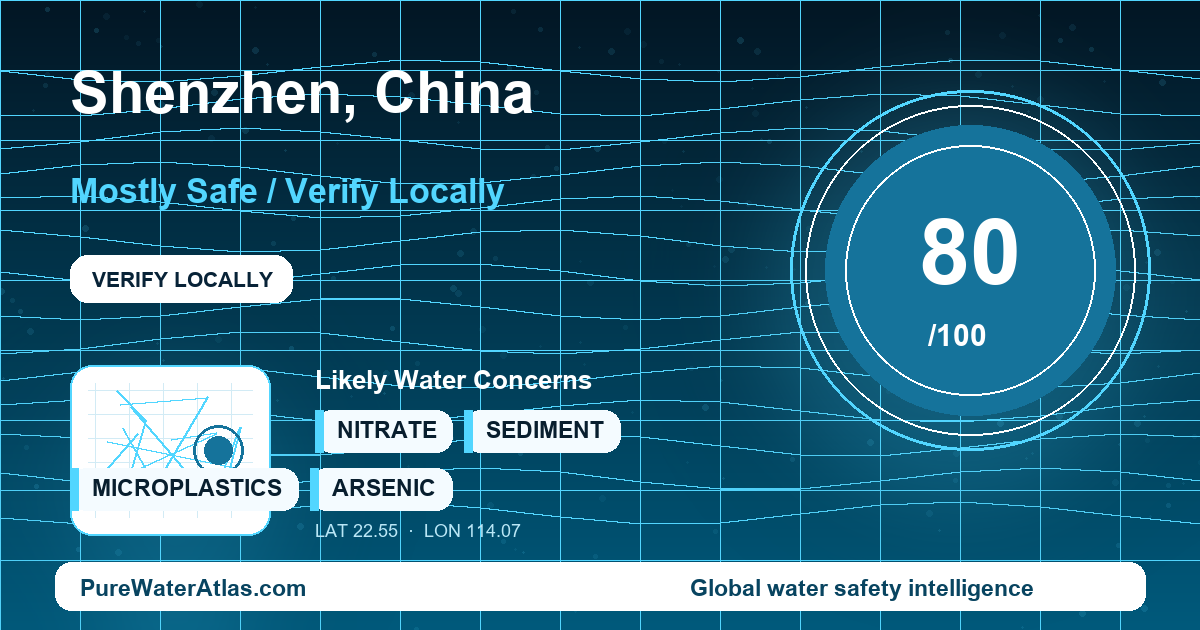
Shenzhen’s municipal water is treated through a modern urban system and is generally in the mostly safe category, but direct tap-water drinking is not the default local practice because building plumbing, high-rise tanks, and last-mile conditions can change water quality at the faucet.
Quick Answer
| Water safety score | 80 / 100 |
|---|---|
| Risk level | Mostly Safe / Verify Locally |
| Can you drink the tap water? | Do not rely on direct tap-water drinking as the default in Shenzhen. Use sealed bottled water, boiled tap water, or water from a verified hotel filtration system for the lowest-risk choice. |
| Traveler advice | Tap water in reputable hotels is usually reasonable for brushing teeth, but drinking it unboiled is not recommended as a default traveler practice. |
| Resident advice | Municipal tap water is generally suitable for cooking and boiling. For daily drinking, many residents use boiling, point-of-use filtration, or bottled water, especially in older or high-rise buildings. |
| Main raw-water system | Imported Dongjiang, or East River, water through Guangdong regional water-transfer infrastructure, supplemented by local reservoirs and regulating reservoirs in Shenzhen. |
| Main authorities | Shenzhen Water Affairs Bureau, Shenzhen Water Group Co., Ltd., and health authorities responsible for sanitary supervision and drinking-water monitoring. |
| Filter recommendation | A filter is not automatically required for every home, but it is practical for chlorine taste, sediment, older plumbing, high-rise storage tanks, and added protection when faucet-level conditions are uncertain. |
Why Shenzhen Is Different
Shenzhen is a coastal megacity next to Hong Kong with limited local freshwater relative to its population and economic scale. That geography makes imported water strategically important. Unlike cities that rely mainly on nearby rivers or abundant local groundwater, Shenzhen depends heavily on the Dongjiang, also called the East River, through regional Guangdong water-transfer infrastructure, while also using local reservoirs and regulating reservoirs inside the city.
The city’s water-safety picture is therefore split into two parts. At the system level, Shenzhen has a modern municipal supply and treated drinking water is subject to Chinese national drinking-water standards, including GB 5749-2022 Standards for Drinking Water Quality. At the tap level, however, the most important uncertainty is often the last mile: district distribution networks, construction-related pipe disturbances, high-rise booster systems, storage tanks, and private building plumbing. A well-operated treatment plant cannot fully control a poorly maintained rooftop or underground tank, corroded internal pipes, or stagnant apartment plumbing.
This is why the practical verdict for Shenzhen is “mostly safe / verify locally.” The citywide supply system is not the same as a guarantee that every apartment tap is suitable for direct drinking without boiling or filtration.
Where Does Shenzhen’s Tap Water Come From?
Shenzhen’s municipal water supply depends heavily on imported raw water from the Dongjiang, or East River, a major regional water source for Guangdong cities. This imported supply is supplemented by local reservoirs and regulating reservoirs within Shenzhen. The dependence on Dongjiang water reflects Shenzhen’s rapid urban growth and limited local freshwater resources.
Historically, Shenzhen relied more on local reservoirs and nearby surface-water resources. As the city grew into a major population and industrial center, imported Dongjiang water became central to the water-supply system. The Dongshen Water Supply Project is especially important in the regional context because it conveys Dongjiang water through the Shenzhen area and is associated with supply to Hong Kong via the Shenzhen Reservoir system.
Key water infrastructure connected to Shenzhen’s drinking-water identity includes the Dongjiang raw-water system, the Dongshen Water Supply Project, Shenzhen Reservoir, Xili Reservoir, the Tiegang-Shiyan Reservoir system, municipal treatment plants, and distribution networks operated by Shenzhen Water Group and other local service entities. For many residents, the final delivery stage also includes secondary water-supply facilities in high-rise residential and commercial buildings, including tanks, pumps, booster systems, and internal pipework.
This layered system matters because the quality of treated water leaving a plant can differ from the quality that arrives at a specific faucet after passing through building-level infrastructure.
Who Manages Drinking Water in Shenzhen?
The Shenzhen Water Affairs Bureau is the municipal water-administration authority for Shenzhen. Shenzhen Water Group Co., Ltd. is a major urban water utility and service operator. Public-health oversight also involves health authorities responsible for drinking-water sanitary supervision and monitoring, including the Shenzhen Municipal Health Commission and local public-health institutions.
Shenzhen’s urban drinking water is regulated under Chinese national drinking-water standards, including GB 5749-2022, as well as provincial and municipal rules for water supply, sanitation, and source protection. Guangdong-level agencies are relevant because the city’s water-supply identity is tied to regional water resources, reservoirs, drought management, and Dongjiang basin infrastructure.
For consumers, the important limitation is that compliance at the municipal or utility reporting level does not prove conditions at every individual tap. City-scale information does not show whether a specific building tank has been cleaned, whether internal pipes are corroded, or whether recent pipe work has caused temporary sediment or discoloration. Shenzhen residents who plan to drink tap water after boiling or filtration should verify building-level conditions when possible.
Main Local Water Concerns
The most commonly relevant Shenzhen concerns are not unusual for a large treated municipal system, but they are shaped by the city’s density, high-rise housing, construction activity, and regional source-water dependence.
- Chlorine taste or odor: Residual chlorine can be noticeable after disinfection, especially for people unused to Chinese municipal water.
- Turbidity and temporary cloudiness: Rainy-season runoff, pipe repairs, pressure changes, flushing, and urban construction can temporarily increase cloudiness or visible disturbance.
- Sediment: Particles or brownish water may appear after distribution work, building plumbing disturbances, or tank-related issues.
- Older internal plumbing: Old pipes, corrosion, brass fixtures, or long stagnation can create metallic taste, discoloration, or metals risk at the faucet even when treated municipal water is compliant.
- High-rise secondary supply: Shenzhen has many high-rise buildings where tanks, pumps, booster systems, and private pipework require regular cleaning, disinfection, sealing, and inspection.
- Source-water pressure: Shenzhen’s reliance on imported Dongjiang water and regional reservoirs makes source protection, drought management, and continuous monitoring important.
Seasonal conditions also matter. South China’s rainy season and typhoon events can increase raw-water turbidity and runoff, requiring treatment adjustments. Dry-season drought can place pressure on regional reservoirs and imported-water systems. Hot, humid weather can worsen taste, odor, and biological growth risks in poorly maintained private tanks or building plumbing.
For Travelers
For short visits to Shenzhen, the safest practical habit is to drink sealed bottled water, boiled tap water, or water from a verified hotel filtration system. The municipal supply is treated and generally suitable for domestic use, but direct tap-water drinking is not recommended as the default traveler practice.
Brushing teeth with tap water in modern hotels and serviced apartments is generally reasonable for most travelers. Use bottled water if you are immunocompromised, traveling with infants, have a sensitive stomach, or are staying in an older building where the tap water is brown, cloudy, particle-filled, or has an unusual odor.
Ice should be judged by the setting. Ice in higher-end hotels, international restaurants, and major chains is usually lower risk when made from treated or filtered water. Avoid ice from street stalls or places where the water source and hygiene are unclear.
Ask hotels whether room taps are considered potable, boiled, or filtered. Many hotels provide bottled water or kettles because local drinking habits in Shenzhen do not assume direct tap-water consumption. If tap water looks brown, cloudy, contains particles, or smells strongly unusual, do not drink it. Run the tap, notify the hotel or building manager, and use bottled water until the issue is resolved. For boiling guidance, see Boiling Water Purification: Complete Guide.
For Residents
For Shenzhen residents connected to the municipal network, tap water can generally be used for cooking and boiling. For daily drinking, many households use a kettle plus a point-of-use system, bottled water, activated carbon, ultrafiltration, or reverse osmosis depending on taste concerns, building conditions, and maintenance habits.
A home filter is not automatically required for every Shenzhen home, but it is practical for chlorine taste, sediment control, and added protection in older buildings or high-rises. Filter choice should be matched to the problem. Activated carbon can improve chlorine taste and odor. Sediment prefilters can help with visible particles. Reverse osmosis may be chosen by residents who want broader reduction capability, but cartridges and membranes must be replaced on schedule. UV treatment can be relevant for microbial control as part of a properly designed multi-stage setup; see UV Water Purification: Complete Guide.
If moving into an older apartment, consider testing both first-draw and flushed samples for lead and other metals if the building has old internal pipes, solder, brass fixtures, recurring discoloration, or metallic taste. For a deeper testing approach, see Lead in Drinking Water: Testing and Detection Methods.
High-rise residents should ask property management for the latest secondary water-supply tank cleaning and inspection records. Tanks should be sealed, cleaned, disinfected, and inspected regularly. If a building has recurring cloudy water, sediment, unusual odor, or pressure-related disturbances, verify whether nearby construction, pipe repairs, or tank maintenance is involved before using the water for drinking.
Relevant Contaminants and Water-Quality Issues
Several water-quality topics are especially relevant for Shenzhen because of disinfection, rainy-season conditions, construction activity, older plumbing, and high-rise secondary supply systems.
- Chlorine in Drinking Water: relevant to disinfected municipal water taste and odor in Shenzhen.
- Turbidity in Drinking Water: relevant when heavy rain, typhoons, runoff, pipe repairs, or flushing cause temporary cloudiness.
- Sediment in Drinking Water: relevant to construction, distribution-pipe disturbances, and high-rise tank issues.
- Lead in Drinking Water: relevant to older building plumbing and premise-level exposure uncertainty.
- E. coli in Drinking Water: relevant if secondary storage tanks or private plumbing are poorly maintained.
These issues do not mean all Shenzhen tap water is unsafe. They identify the points where treated municipal water can change before reaching a faucet, particularly in older apartments and high-rise buildings with secondary storage.
How to Verify Your Water Quality
The most reliable way to evaluate Shenzhen tap water is to combine official city or utility information with building-level verification. Check current notices from local authorities and the utility, then assess your own apartment or building conditions. This is especially important after construction, pipe repairs, pressure changes, visible sediment, recurring odor, or tank-maintenance uncertainty.
Residents can use the PureWaterAtlas Water Testing guide to decide when to test for turbidity, sediment, metals, or microbial indicators. For a broader safety framework, see Drinking Water Safety. If you are choosing a home system, see Water Treatment Systems. For storage-tank and microbial concerns, see Water Microbiology.
Travelers comparing Shenzhen with other destinations can use the Global Water Quality Checker. To look up specific terms such as chlorine, turbidity, lead, sediment, or E. coli, use the Contaminants Search Engine.
Official and Technical Sources
- Shenzhen Water Affairs Bureau — municipal authority for Shenzhen water resources, water supply, and water-management notices.
- Shenzhen Water Group Co., Ltd. — major Shenzhen water utility and service operator.
- Hong Kong Water Supplies Department: Dongjiang Water — official regional source explaining Dongjiang water and conveyance through the Shenzhen Reservoir system.
- Guangdong Provincial Department of Water Resources — provincial authority relevant to Dongjiang basin context, reservoirs, drought management, and water-transfer projects.
- Shenzhen Municipal Health Commission — public-health authority relevant to sanitary supervision and drinking-water quality information.
- Shenzhen Center for Disease Control and Prevention — local public-health institution relevant to disease prevention and environmental health advisories.
- Ministry of Housing and Urban-Rural Development of China — national authority relevant to urban water supply and building infrastructure.
- National Health Commission of China — national health authority relevant to drinking-water health standards and sanitary supervision policy.
Bottom Line
Shenzhen’s tap water comes from a modern treated municipal system supported heavily by imported Dongjiang water, local reservoirs, and major regional infrastructure. It is generally in the mostly safe category for domestic use, cooking, and boiling, but direct drinking from the tap is not the best default choice for visitors or for residents in buildings with uncertain plumbing. The main Shenzhen-specific uncertainty is the last mile: high-rise storage tanks, booster systems, old internal pipes, construction disturbances, sediment, and temporary turbidity can affect faucet-level quality. Travelers should use bottled or boiled water for drinking. Residents should verify tank maintenance, flush stagnant water, test older apartments when needed, and use well-maintained filtration if drinking tap water regularly.
Read the full guide: Global Water Quality Guide
Explore more in this category: Global Water Quality Articles