Shanghai’s tap water is produced by large modern surface-water systems, but the safety of water at an individual tap depends heavily on building plumbing, secondary storage tanks, and local maintenance.
Quick Answer
| City | Shanghai, China |
|---|---|
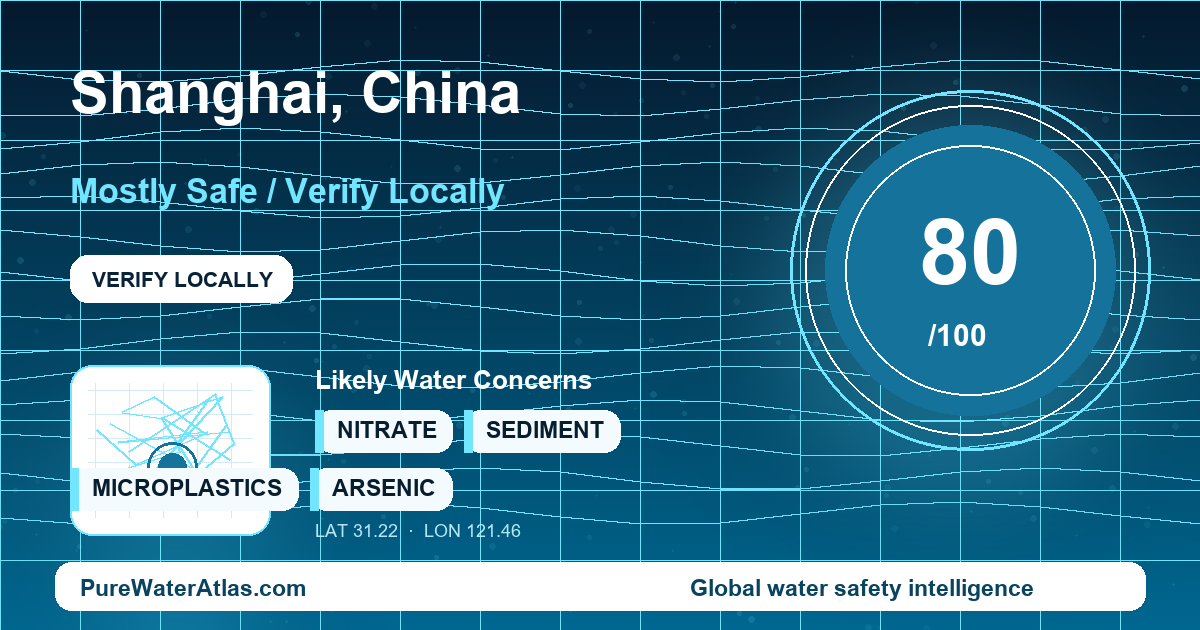
| Water safety score | 80 / 100 |
| Risk level | Mostly Safe / Verify Locally |
| Can you drink the tap water? | Shanghai’s municipally treated tap water is generally produced by modern, large-scale treatment systems. However, drinking straight from the tap is not the best default advice because building pipes, rooftop or basement tanks, and booster systems can affect final tap quality. |
| Traveler advice | Use bottled water, sealed hotel-provided water, or boiled and cooled tap water for routine drinking. Tap water is generally acceptable for brushing teeth in established hotels if it is clear and has no abnormal odor. |
| Resident advice | Check the building’s plumbing age and secondary water-supply maintenance records. Consider a certified point-of-use filter or reverse-osmosis system for drinking water, especially in older apartments or sensitive households. |
| Main raw-water sources | Surface-water systems linked to the Yangtze River estuary and upper Huangpu River system, including Qingcaosha Reservoir, Chenhang Reservoir, Dongfeng Xisha Reservoir, and upper Huangpu source works. |
| Water authority | Shanghai Municipal Water Authority; major urban utility operations are associated with Shanghai Chengtou Water Group and related municipal water-supply companies. |
| Filter recommendation | An activated-carbon filter may help with taste, odor, and residual disinfectant in newer well-managed buildings. Reverse osmosis is a stronger option where old plumbing, sediment, metals, or broader contaminant reduction are concerns. |
Why Shanghai Is Different
Shanghai is not a simple “safe” or “unsafe” tap-water city. It is a megacity at the Yangtze River estuary and along the Huangpu River, so its drinking-water security is tied to estuarine hydraulics, upstream river quality, tidal influence, and saltwater intrusion during low-flow periods. The city has invested in major engineered water-supply systems, including large reservoirs, long-distance raw-water conveyance, municipal treatment plants, and extensive distribution networks.
The most important Shanghai-specific distinction is between water leaving a municipal treatment plant and water arriving at a particular apartment, hotel room, or office tap. Utility-treated water may be compliant at the plant or distribution system level, while final tap quality can still be changed by old internal pipes, building-level storage tanks, booster pumps, and maintenance practices. This is especially relevant in high-rise residential and commercial buildings that use secondary water-supply systems.
Shanghai residents commonly boil water before drinking. That practice does not mean every municipal supply is untreated or unsafe. It reflects local habits, taste preferences, concern about disinfectant odor, and caution about the distribution “last mile.” Boiling can reduce microbial risk, but it does not remove dissolved metals, salts, PFAS, nitrate, or many chemical contaminants. For a broader safety framework, see PureWaterAtlas’s guide to how to know if tap water is safe to drink.
Where Does Shanghai’s Tap Water Come From?
Shanghai’s drinking water is supplied primarily from large surface-water sources connected to the Yangtze River estuary and the upper Huangpu River system. The Qingcaosha Reservoir, located in the Yangtze estuary area near Changxing Island, is the city’s dominant modern raw-water source for much of central Shanghai. It represents a major local water-security upgrade compared with Shanghai’s older reliance on the lower Huangpu River.
Other important Shanghai source-water facilities include Chenhang Reservoir and associated Yangtze-side raw-water works, Dongfeng Xisha Reservoir on Chongming Island, and upper Huangpu River source works, including Jinze-area infrastructure serving southwestern and connected supply zones. These systems provide both water-quality improvement and resilience for a large urban population.
Historically, Shanghai relied heavily on the Huangpu River for municipal raw water. That created vulnerability to upstream urban, industrial, agricultural, wastewater, and shipping-related pressures. The shift toward Yangtze-estuary reservoir sources such as Qingcaosha was intended to improve raw-water quality, reduce dependence on the more polluted lower Huangpu reaches, and manage the risk of estuary salinity. Even with this upgraded source-water structure, Shanghai remains a surface-water city, and surface-water systems require active treatment and monitoring because storms, runoff, organic matter, and salinity can change raw-water conditions.
Who Manages Drinking Water in Shanghai?
The city-level water administration authority is the Shanghai Municipal Water Authority. Major municipal water-supply and wastewater assets in the urban system are operated by Shanghai Chengtou Water Group and related municipal water-supply companies. Local policies and public-service notices may also be published through the Shanghai Municipal People’s Government.
Drinking-water quality in Shanghai is governed under China’s national drinking-water quality framework, including Standards for Drinking Water Quality GB 5749-2022. Local implementation involves municipal water, health, market-supervision, ecological-environment, and housing authorities. Environmental context for water resources and pollution control is connected to the Shanghai Municipal Bureau of Ecology and Environment.
Data limitations matter. Shanghai has identifiable official authorities, major source-water projects, and national drinking-water standards, but publicly accessible English-language and address-level water-quality datasets are limited. Available public information does not prove that every neighborhood, hotel, apartment tower, or household tap has identical water quality. The largest uncertainty is the last-mile system inside buildings.
Main Local Water Concerns
Shanghai’s key water concerns are not the same as in cities without modern treatment. The main issue is variability: raw-water conditions can shift at the estuary scale, while final tap quality can vary at the building scale.
- Saltwater intrusion: During winter or dry-season low-flow periods, saltwater intrusion in the Yangtze River estuary can affect raw-water intake management and reservoir operations.
- Turbidity and organic matter: Storms, typhoon-season rainfall, upstream runoff, or river disturbance can increase turbidity and treatment demand. Learn more about turbidity in drinking water.
- Old internal plumbing: Older Shanghai buildings may have aging galvanized steel, iron, copper, brass fixtures, solder, or internal pipes that add rust, sediment, metals, taste, or discoloration after water leaves the public main.
- Secondary storage tanks: High-rise buildings often rely on rooftop or basement tanks and booster systems. Poorly sealed, infrequently cleaned, or badly maintained tanks can create localized microbial, odor, turbidity, and sediment problems.
- Residual disinfectant taste: Chlorine or chloramine residual taste and odor can be noticeable, especially in warm weather or after treatment changes. See chlorine in drinking water.
- Emerging contaminants: PFAS and microplastics are research concerns in large industrialized river basins, but public neighborhood-level Shanghai drinking-water results are limited. Read more about PFAS in drinking water.
For Travelers
For short-term visitors, the conservative choice in Shanghai is bottled water, sealed hotel-provided water, or boiled and cooled tap water for routine drinking. A healthy traveler is unlikely to face the same level of risk as in cities without modern treatment, but drinking straight from the tap is not the best default recommendation because hotel and apartment plumbing systems vary.
Brushing teeth with tap water is generally acceptable for most travelers in established hotels and central districts, as long as the water is clear and has no unusual odor, particles, yellow color, brown color, or metallic taste. Use bottled water for young children, people with sensitive stomachs, and anyone who is immunocompromised.
Ice is more variable. Ice in higher-end hotels, international restaurants, and major chains is usually made from treated or commercial water, but ice from street stalls or small shops is harder to verify. If you are trying to minimize stomach illness risk during a short trip, skip uncertain ice and choose sealed beverages, bottled drinks, hot tea, or boiled water.
Many Shanghai hotels provide bottled water or in-room kettles because both visitors and residents commonly boil drinking water. If staying in an apartment rental, let stagnant tap water run briefly in the morning, avoid drinking discolored or particle-laden water, and use boiled, bottled, or filtered water for drinking. For practical boiling limits and methods, see Boiling Water Purification: Complete Guide.
For Residents
Residents should focus on the specific building, not just the citywide supply. In a newer building with well-managed secondary water supply, an activated-carbon filter may be enough to improve taste, reduce residual disinfectant odor, and capture some sediment. In an older building, a home with infants, or a household seeking broader contaminant reduction, a certified reverse-osmosis system with scheduled maintenance is a stronger option.
Ask property management for the most recent cleaning and inspection records for secondary water-supply tanks and booster systems. This is particularly important in high-rise residential compounds and multi-building complexes. Poorly maintained tanks can create local problems even when the municipal water entering the building is acceptable.
Testing is reasonable if you notice rust, recurring discoloration, particles, cloudy water, a metallic taste, or odor changes. For older buildings, test both first-draw and flushed samples. Prioritize lead, iron, manganese, turbidity, total dissolved solids, residual disinfectant, and microbial indicators where tanks or old pipes are involved. Use an accredited local laboratory or recognized testing service rather than relying only on inexpensive color-strip kits for metals or microbiological decisions.
After plumbing repairs, tank cleaning, neighborhood pipe work, or building maintenance, flush taps until water runs clear and consider temporary bottled or boiled water for drinking. If using reverse osmosis, periodically test product-water TDS and replace cartridges and membranes on schedule to avoid bacterial growth or performance decline. For system selection, see PureWaterAtlas’s guide to choosing the right water treatment system.
Relevant Contaminants and Water-Quality Issues
The most relevant Shanghai tap-water issues are tied to treated surface water, estuary conditions, and building-level plumbing. Chlorine is relevant because disinfectant taste and odor are common concerns in municipal surface-water systems. Turbidity and sediment matter after storms, pipe work, tank disturbance, or in older buildings with rust and particles.
Lead is primarily a last-mile concern rather than a source-water conclusion. Older internal pipes, fixtures, solder, or brass components can affect water after it leaves the municipal main. Residents concerned about plumbing-related metals can also review lead testing and detection methods and lead filter and treatment options.
E. coli is relevant when assessing microbial risk from poorly maintained secondary storage tanks or building systems. PFAS is an emerging contaminant category of interest in industrialized river basins, though public Shanghai tap-level data are limited. Readers concerned about emerging contaminants can review PFAS testing and detection methods.
How to Verify Your Water Quality
The best way to verify water quality in Shanghai is to combine citywide awareness with tap-level evidence. Check official municipal information from the Shanghai Municipal Water Authority, ask your building manager for secondary tank cleaning records, and test your own tap if you live in an older building or see recurring discoloration, sediment, metallic taste, or odor.
For household testing strategy, use PureWaterAtlas’s complete guide to water testing and analysis. To research contaminants mentioned in this Shanghai profile, use the Contaminants Search Engine. Travelers comparing Shanghai with other destinations can use the Global Water Quality Checker.
If you are deciding whether to boil, filter, or install reverse osmosis, match the method to the problem. Boiling helps with microbial risk but not dissolved metals or many chemical contaminants. Activated carbon is useful for taste and disinfectant odor. Reverse osmosis provides broader reduction when maintained correctly. For broader context, see PureWaterAtlas resources on water contamination pathways, global water quality, drinking water safety, and water testing.
Official and Technical Sources
- Shanghai Municipal Water Authority — primary municipal authority for water administration, water resources, and public water-related information in Shanghai.
- Shanghai Chengtou Water Group — major municipal water-supply and wastewater utility group associated with Shanghai’s urban water services.
- Shanghai Municipal People’s Government — official city government portal for local policies, notices, and public-service information.
- Standards for Drinking Water Quality GB 5749-2022 — national drinking-water quality standard used as China’s regulatory baseline.
- Shanghai Municipal Bureau of Ecology and Environment — official source for environmental quality and pollution-control information relevant to source-water context.
- Shanghai Qingcaosha Reservoir information — municipal information channel for Shanghai’s strategic raw-water supply system.
- World Bank project information — international source documenting Shanghai’s urban environmental and water-sector improvement context.
- World Health Organization water, sanitation and health guidance — public-health reference for safe drinking water and treatment principles.
Bottom Line
Shanghai’s tap water is best classified as mostly safe at the municipal utility level, but not automatically verified at every tap. The city relies on major engineered surface-water systems, especially Yangtze-estuary and upper Huangpu-related sources such as Qingcaosha, Chenhang, Dongfeng Xisha, and Jinze-area infrastructure. The main uncertainty is the last mile: old apartment plumbing, high-rise secondary storage tanks, booster systems, and maintenance events. Travelers should use bottled, hotel-provided, boiled, or properly filtered water for drinking while generally treating clear tap water as acceptable for brushing teeth. Residents should verify building tank records, test problem taps, and consider activated carbon or reverse osmosis depending on building age, household vulnerability, and water-quality symptoms.
Read the full guide: Global Water Quality Guide
Explore more in this category: Global Water Quality Articles