
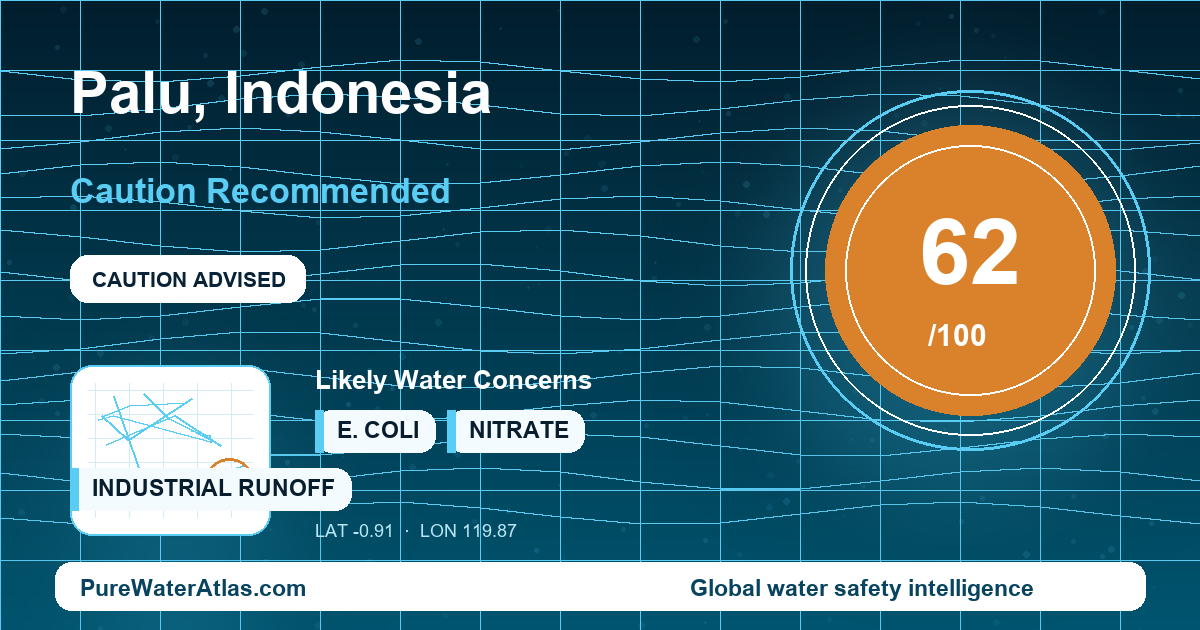
Palu, Central Sulawesi: municipal piped water exists, but earthquake legacy, intermittent pressure, storage tanks, storm turbidity, and private-well variability mean caution is recommended for drinking.
Quick Answer
| Overall safety status | Caution recommended. Palu has a formal municipal utility and treated piped-water infrastructure, but recent, public, citywide drinking-water quality reporting is limited. |
|---|---|
| Water safety score | 62 / 100 |
| Risk level | Caution Recommended |
| For travelers | Do not drink untreated tap water unless your hotel can confirm safe treated water and properly maintained storage. Use sealed bottled water, reputable refill water, or water that has been boiled or disinfected. |
| For residents | PDAM-connected households should manage risk at home: clean tanks, maintain filters, and use a validated disinfection step when pressure is intermittent or water becomes cloudy. |
| Main water identity | Palu is served by a small-source urban water system using a mix of upland spring and surface-water sources in the Palu valley and surrounding catchments, rather than one large citywide reservoir. |
| Local authority | Perumda Air Minum Avo Kota Palu, commonly referred to as PDAM Kota Palu, is the municipal drinking-water operator. |
| Filter recommendation | For drinking water, use sediment prefiltration plus activated carbon where needed for taste, followed by boiling, UV, or another validated disinfection step. Private wells require testing before treatment is selected. |
Why Palu Is Different
Palu’s tap-water risk profile is shaped by its geography and disaster history as much as by normal municipal treatment. The city sits in a narrow valley at the head of Palu Bay in Central Sulawesi, with steep surrounding catchments and the Palu River system draining toward the bay. This creates a mixed water environment: upland catchments can support spring and surface-water supply, while coastal and low-lying groundwater can face salinity or high TDS concerns.
Palu also has a major infrastructure legacy from the 2018 Central Sulawesi earthquake, tsunami, and liquefaction disaster. Areas such as Balaroa and Petobo experienced severe ground movement and liquefaction. Even after repairs and reconstruction, buried pipes, service connections, private wells, drainage proximity, and household plumbing can remain relevant to water safety. In practical terms, the risk is not defined by one confirmed contaminant across the whole city. It is defined by intermittency, pressure loss, turbidity after storms, storage-tank hygiene, possible private-well salinity, and local catchment pressures.
This is why PureWaterAtlas classifies Palu as Caution Recommended rather than “generally safe untreated.” There is enough public information to identify the operator, infrastructure context, and plausible risk pathways, but not enough recent, easily accessible, citywide finished-water compliance data to say that tap water is consistently safe at every consumer tap.
Where Does Palu’s Tap Water Come From?
Palu’s municipal supply is best understood as a small-source urban water system, not as a single large reservoir system. Public descriptions and local infrastructure references point to a mix of upland spring and surface-water sources in the Palu valley and surrounding catchments. Areas associated with Kawatuna and Poboya have been publicly referenced in relation to water-supply assets, although exact current operating status, source-by-source production, and plant-by-plant water quality should be verified directly with the utility.
The city’s water infrastructure includes raw-water intakes, treatment assets, and distribution networks that serve different zones of Palu. This means water quality can vary by neighborhood, pressure zone, pipe condition, and building plumbing. A household on a maintained Perumda Air Minum Avo Kota Palu connection may have a different risk profile from a home relying on a shallow well near the coast or a building using a roof tank that has not been cleaned.
Historically, households in and around Palu have used a combination of PDAM piped supply, shallow wells, boreholes, refill-water depots, bottled water, and local springs. After the 2018 disaster, water access and distribution infrastructure were disrupted, reinforcing the importance of continuity of supply and safe storage practices. Post-disaster reconstruction programs in Central Sulawesi included water supply, sanitation, drainage, and settlement infrastructure, but reconstruction context is not the same as routine tap-water quality reporting at every household.
Who Manages Drinking Water in Palu?
The municipal drinking-water operator is Perumda Air Minum Avo Kota Palu, commonly referred to as PDAM Kota Palu. It is the most direct local point of contact for service areas, operational notices, customer complaints, and current utility information.
Drinking-water health oversight in Indonesia is set nationally by the Ministry of Health and implemented through local health offices, including Dinas Kesehatan Kota Palu and provincial health authorities. Indonesia’s current environmental-health and drinking-water-related framework is reflected in Permenkes No. 2 Tahun 2023. Utility infrastructure is also influenced by local government ownership, national public-works programs, and post-disaster reconstruction support.
The key limitation for consumers is transparency of routine public reporting. Palu does not have the same easily accessible annual consumer water-quality report format common in some countries. National standards establish requirements, but they do not prove that water at every Palu tap meets those requirements at all times. For household decisions, this makes local verification, tank hygiene, and point-of-use treatment important.
Main Local Water Concerns
- Microbial contamination: The most practical concern is contamination when supply is intermittent, pipes lose pressure, or water is stored in tanks without routine cleaning. Learn more about E. coli in drinking water and why it is used as a key indicator of fecal contamination.
- Turbidity and sediment: Short intense rain events, runoff, pipe repairs, and catchment disturbance can increase cloudiness or visible particles. Turbid water can interfere with disinfection and should not be ignored. See turbidity in drinking water and sediment in drinking water.
- Low-pressure intrusion: During outages or low-pressure periods, contamination can enter damaged or leaky distribution pipes, especially where drains, septic systems, or surface water are nearby.
- Private-well salinity: Coastal or low-lying wells near Palu Bay may have brackish taste or elevated TDS due to coastal aquifer conditions. This should be confirmed by testing, not assumed from taste alone.
- Iron and manganese: These are plausible private-well concerns in groundwater-influenced supplies, especially where staining, metallic taste, or dark particles occur. See iron in drinking water and manganese in drinking water.
- Catchment pressure near Poboya: Poboya and surrounding upland areas have been associated in published research and public discussion with artisanal gold-mining activity and mercury-related environmental concerns. This is a catchment-pressure issue; it is not proof that treated municipal tap water contains mercury.
- Building-level plumbing: Older plumbing, repaired post-disaster pipework, unprotected storage tanks, and informal cross-connections can create risk after water leaves a treatment facility. In older buildings, lead in drinking water may be worth investigating where old solder, fixtures, or fittings are possible.
For Travelers
Short-stay visitors should not drink untreated tap water in Palu unless their hotel can clearly confirm that drinking water is treated and storage is properly maintained. Use sealed bottled water, reputable refill water, or water that has been boiled or passed through a validated purifier. This advice is especially important for travelers who have limited immunity to local waterborne microbes.
Use bottled or treated water for brushing teeth if you are a short-term visitor, pregnant, immunocompromised, traveling with young children, or staying in accommodation where tank maintenance is uncertain. Many long-term residents may use tap water for brushing, but visitors should be more conservative.
Be careful with ice. Accept ice from hotels, restaurants, or cafes only when they can confirm it is made from treated water. Avoid ice from informal street sources unless it is clearly commercial packaged ice. Better hotels and restaurants may use bottled, dispenser, filtered, or boiled water, but do not assume that all juices, ice, or rinsed raw foods are prepared with treated water.
Carry sealed water during hot weather. After heavy rain, local flooding, pipe works, or any outage, avoid untreated tap water. If water is cloudy, allow sediment to settle and filter before boiling; boiling alone improves microbial safety but does not remove sediment, salinity, or chemical contaminants.
For Residents
Residents connected to Perumda Air Minum Avo Kota Palu should treat tap water as potentially usable only after household risk control. A practical setup for drinking water is sediment prefiltration, activated carbon where taste or chlorine is an issue, and a final disinfection step such as boiling, UV, or a properly maintained membrane system. For microbial risk, review PureWaterAtlas guides to boiling water purification and UV water purification.
Storage tanks deserve special attention in Palu. Roof tanks and ground tanks are useful during intermittent service, but they can become secondary contamination points if uncovered, unscreened, or rarely cleaned. Tanks should be covered, screened, cleaned, and disinfected regularly. If water sits for long periods, drinking water should be treated or disinfected again after storage.
Private-well users should test before buying treatment equipment. At minimum, test for E. coli, total coliform, nitrate, TDS or electrical conductivity, chloride or salinity, iron, manganese, hardness, pH, and turbidity. Wells near workshops, fuel storage, mining-influenced areas, riverbanks, septic systems, or flood-prone land should add targeted metals and chemical testing based on local exposure history.
Do not assume the city plant is the only point of risk. Older buildings, corroded fixtures, long internal pipe runs, and post-disaster repairs can alter water quality before it reaches the glass. If there is unexplained metallic taste, old metal pipework, or possible old solder and fittings, consider first-draw and flushed samples, including lead testing. See lead testing and detection methods for a more detailed testing approach.
Relevant Contaminants and Water-Quality Issues
For Palu, the most relevant water-quality issues are those linked to pressure instability, storage, catchment runoff, and private wells. E. coli is the key microbial indicator to test after outages, tank contamination, flooding, or well damage. Turbidity and sediment matter after storms, repairs, and disturbed source water. Chlorine residual is important because it indicates whether piped water still has disinfectant protection in the distribution system.
For private wells, iron and manganese may explain staining, taste, or dark particles, while salinity/TDS testing is important in coastal or low-lying settings. For households near septic systems or flood-prone land, nitrate testing is also important; PureWaterAtlas has a guide to nitrate contamination testing.
How to Verify Your Water Quality
Because recent Palu-specific finished-water laboratory data are not consistently published in an easy consumer format, the safest approach is to verify water at the point where you actually drink it. For PDAM-connected homes, test tap water for E. coli or thermotolerant coliforms, turbidity, residual chlorine, pH, and TDS if there is odor, color, sediment, or intermittent pressure. If your home uses a roof tank or ground tank, test after the tank, not only at the incoming pipe.
After earthquakes, floods, landslides, major pipe repairs, or long outages, inspect wellheads, tanks, and internal plumbing, then retest microbial quality. Use the PureWaterAtlas complete guide to water testing to plan samples and parameters. For broader decision-making, see how to know if your tap water is safe, water microbiology risks, and choosing a water treatment system.
You can also compare Palu with other cities using the Global Water Quality Checker, search issues in the Contaminants Search Engine, or browse related categories such as Drinking Water Safety, Global Water Quality, Water Testing, and Water Purification.
Official and Technical Sources
- Perumda Air Minum Avo Kota Palu official website — local utility source for Palu’s municipal water operator, service information, and customer contact.
- Pemerintah Kota Palu official website — local government source for municipal context, public services, and city administration.
- BPS Kota Palu — official statistics source for city context, geography, population, and infrastructure indicators.
- World Bank Central Sulawesi Rehabilitation and Reconstruction Project — documents post-2018 reconstruction relevant to Palu’s urban infrastructure.
- Asian Development Bank Emergency Assistance for Rehabilitation and Reconstruction — high-authority post-disaster rehabilitation context for Central Sulawesi.
- Permenkes No. 2 Tahun 2023 — Indonesia’s national environmental-health and drinking-water-related regulatory framework.
- WHO Guidelines for Drinking-water Quality — international benchmark for risk-based drinking-water safety principles.
- BMKG official website — national authority for Indonesian weather, rainfall, earthquake, and geophysical context.
- Directorate General of Human Settlements, Ministry of Public Works and Housing — national infrastructure authority relevant to SPAM and settlement infrastructure programs.
These sources support the utility, regulatory, infrastructure, and disaster-context assessment. They do not provide a complete, current, neighborhood-by-neighborhood laboratory record of finished tap water at every Palu household.
Bottom Line
Palu has a formal municipal drinking-water operator and treated piped-water infrastructure, but caution is still appropriate. The main practical risks are not a single confirmed citywide contaminant; they are intermittent pressure, pipe disturbance, earthquake legacy, household tanks, storm-related turbidity, and variable private wells, especially in coastal or low-lying areas. Travelers should use sealed bottled water or properly treated water and be careful with ice. Residents should clean tanks, verify microbial safety, maintain filters, and disinfect drinking water when service is unstable or water is cloudy. Private-well users should test for microbes, salinity/TDS, nitrate, iron, manganese, pH, hardness, and turbidity before choosing treatment.
Read the full guide: Global Water Quality Guide
Explore more in this category: Global Water Quality Articles