
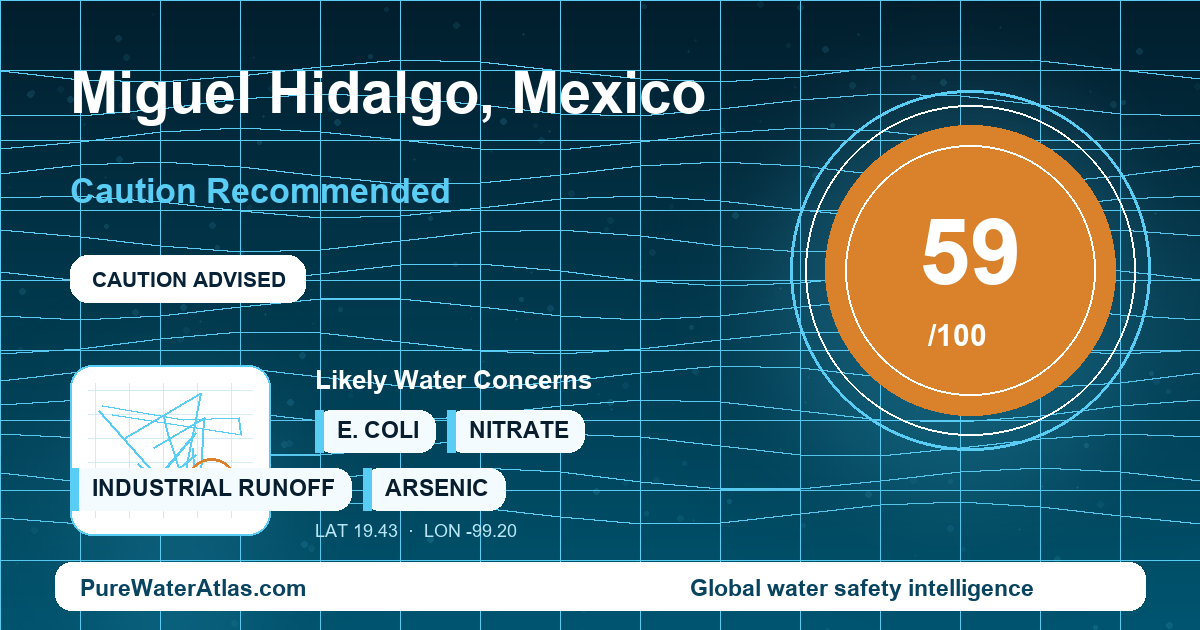
Miguel Hidalgo, Mexico: treated Mexico City network water with caution recommended because tap-level quality can change inside building cisterns, rooftop tanks, pumps, and older internal plumbing.
Quick Answer
| Water safety score | 59 / 100 |
|---|---|
| Risk level | Caution Recommended |
| Can tourists drink the tap water? | Most short-term visitors should not drink Miguel Hidalgo tap water straight from the tap unless they have reliable confirmation that the building uses maintained drinking-water treatment and clean storage. Use sealed bottled water, garrafon water, or boiled and properly treated water. |
| Resident recommendation | Residents can often make tap water suitable for routine use with clean cisterns or tinacos, maintained internal plumbing, and a certified point-of-use filter matched to tested risks. |
| Main water identity | Miguel Hidalgo is supplied through Mexico City’s metropolitan water network, which blends imported Cutzamala surface water, Lerma System groundwater, and Valley of Mexico groundwater wells. The blend can vary by zone, season, operations, and maintenance. |
| Water authority | Mexico City water service is managed by the city government through its water authority, historically SACMEX and in the current institutional transition by the Secretaría de Gestión Integral del Agua. Federal bulk-water infrastructure such as Cutzamala is associated with CONAGUA. |
| Filter recommendation | For drinking and cooking, use a sediment prefilter plus activated carbon for particles, chlorine taste, and odor. If testing shows metals, high dissolved solids, or other chemical concerns, use a certified reverse-osmosis or other contaminant-specific system. UV may help with microbes only when water is clear and the unit is properly maintained. |
Why Miguel Hidalgo Is Different
Miguel Hidalgo is a west-central borough of Mexico City that includes Polanco, Anzures, Chapultepec, Tacuba, Escandón, and dense residential, commercial, hotel, office, and high-rise zones. Its drinking-water question is not the same as asking about a small independent municipal utility. Miguel Hidalgo does not have a separate local water source or a standalone borough water system. It receives water through the wider Mexico City metropolitan network.
The safest interpretation is therefore nuanced: the public supply is treated, but the water that reaches a specific faucet may be affected by pressure changes, aging distribution lines, private cisterns, pumps, rooftop tinacos, and internal plumbing. In many Miguel Hidalgo buildings, especially apartment blocks, hotels, restaurants, offices, and older homes, water commonly passes through private storage after leaving the public network. That building-level infrastructure can dominate endpoint water quality.
This is why the PureWaterAtlas rating is Caution Recommended, not a claim that every tap is unsafe. Available information identifies the city-level supply and regulatory context, but recent, public, borough-specific laboratory results by colonia, hotel, building, and faucet are limited. For Miguel Hidalgo, the most practical risk is variability at the tap.
Where Does Miguel Hidalgo’s Tap Water Come From?
Miguel Hidalgo receives water through Mexico City’s regional water supply. The system blends several sources: imported treated surface water from the Cutzamala System, imported groundwater from the Lerma System, and groundwater from wells in the Valley of Mexico aquifer system. The exact mix can change with season, operating conditions, drought pressure, maintenance, and local distribution patterns.
The Cutzamala System is federal bulk-water infrastructure associated with CONAGUA and imports water from reservoirs and treatment works west of the Valley of Mexico. The Lerma System has historically been important for bringing groundwater into Mexico City. Valley of Mexico groundwater wells also contribute a large share of the overall city supply. Western Mexico City storage and regulating infrastructure, including facilities around Chapultepec and the Dolores area, is relevant to imported-water distribution in this side of the city.
Miguel Hidalgo’s local water path typically includes primary and secondary Mexico City distribution mains followed by private building infrastructure. In practice, a glass of water in Polanco, Tacuba, Anzures, Escandón, or near Chapultepec may have passed through public pipes, then a cistern, pump system, rooftop tank, and internal plumbing before reaching the tap. That final building segment is a major reason tourists and residents should evaluate the specific property, not just the citywide water source.
Historically, Mexico City moved from reliance on local springs, canals, and shallow groundwater to a heavily engineered regional network. Long-term aquifer overextraction, aging infrastructure, leakage, drought pressure on imported systems, and intermittent service in parts of the metropolitan area remain important context for Miguel Hidalgo’s water reliability and safety profile.
Who Manages Drinking Water in Miguel Hidalgo?
Water service in Miguel Hidalgo is part of Mexico City’s public system. The city water authority has historically been Sistema de Aguas de la Ciudad de México, commonly known as SACMEX. In the current institutional transition, the Secretaría de Gestión Integral del Agua provides the Mexico City water-management context. Federal water resources and major infrastructure are associated with CONAGUA.
Mexico’s drinking-water quality requirements are governed by federal health standards, especially NOM-127-SSA1-2021, Agua para uso y consumo humano. Oversight involves health authorities and water operators, while CONAGUA manages national water resources and major federal systems. For a Miguel Hidalgo resident or visitor, however, the practical challenge is that public compliance information is generally more accessible at the city or system level than at individual building taps.
This limitation matters. A public supply can be treated and still arrive at a faucet with altered quality if a private cistern is dirty, a rooftop tinaco is uncovered, pressure has recently dropped, sediment has been disturbed, or old internal plumbing is contributing metals or particles. PureWaterAtlas therefore treats the borough-level score as a guide for caution, not as a substitute for property-specific testing.
Main Local Water Concerns
- Building storage variability: Cisterns, pumps, rooftop tinacos, and internal plumbing can determine what comes out of the tap in many Miguel Hidalgo buildings.
- Sediment, color, or turbidity: Water may look cloudy, discolored, or particle-laden after pipe repairs, tank disturbance, pressure changes, or neighborhood service interruptions.
- Chlorine taste or odor: Chlorination can create a noticeable disinfectant smell or taste. This does not automatically mean the water is unsafe, but it affects palatability and may lead many households to use filtration or garrafon water.
- Microbial risk in storage: If a cistern or tinaco is cracked, uncovered, poorly cleaned, or affected by low-pressure events, microbial contamination becomes a practical concern.
- Building-specific metals: Lead or other metals are possible in older plumbing, solder, fixtures, or poorly maintained internal lines. There is not enough public evidence to claim a borough-wide lead problem, so testing is the correct approach.
- Drought and operational pressure: Low Cutzamala storage, dry-season stress, maintenance shutdowns, or repairs can contribute to supply reductions, lower pressure, and greater reliance on stored water.
Season also matters. Dry-season drought can increase pressure on the imported supply. Rainy-season runoff can increase turbidity challenges in source waters and complicate distribution if pressure is low or pipes are damaged. Warm periods can worsen taste, odor, and microbial regrowth risks in poorly maintained cisterns and rooftop tanks.
For Travelers
For tourists in Miguel Hidalgo, the practical answer is straightforward: do not drink tap water straight from the tap unless the hotel, apartment, or host can confirm that the building uses maintained drinking-water treatment and clean storage. Use sealed bottled water, garrafon water, or water that has been boiled or treated by a well-maintained point-of-use system.
Brushing teeth with tap water is generally lower risk than drinking it, especially in reputable hotels, but sensitive travelers should use bottled or treated water. That includes travelers with sensitive stomachs, children, pregnant travelers, and immunocompromised people. Use bottled water for infant formula.
Ice in established hotels and formal restaurants in Miguel Hidalgo is often made from purified water, but it is still worth asking. Avoid ice from street vendors, informal venues, or places where water handling is unclear. The same caution applies to juices, uncooked foods washed with water, and beverages mixed with ice.
Many hotels and restaurants in Polanco, Chapultepec-area districts, and other commercial parts of Miguel Hidalgo provide bottled water, garrafon water, or filtered water. Ask whether water served directly, used in juices, or used in uncooked food preparation is purified. If staying in an apartment, ask when the cistern or tinaco was last cleaned, whether a maintained filter is installed, and whether recent outages, repairs, low pressure, or discoloration have occurred.
For general traveler precautions, see the CDC’s Travelers’ Health guidance for Mexico and Food and Water Safety advice.
For Residents
Residents in Miguel Hidalgo should focus on the building, not only the public water source. A practical drinking-water setup is a sediment prefilter plus activated carbon for particles, chlorine taste, and odor. If testing identifies metals, elevated dissolved solids, or other chemical concerns, choose a certified reverse-osmosis system or another treatment method matched to the contaminant. UV can help manage microbes only if the water is already clear and the UV unit is properly maintained; it is not a substitute for dirty-tank maintenance.
Testing is advisable in old buildings, after water outages, after flooding, after major plumbing work, after pump replacement, after cistern cleaning, or whenever water becomes discolored, cloudy, or foul-smelling. Test for total coliform and E. coli when a building uses cisterns or rooftop tanks or if illness appears linked to drinking water. Test turbidity, color, odor, free residual chlorine, and basic chemistry when the water’s appearance or taste changes.
Older properties in areas such as Tacuba, Anzures, Escandón, and long-established apartment corridors may have aging internal plumbing, old galvanized lines, solder, fixtures, or sediment accumulation. Lead and other metals should be evaluated where plumbing age and materials are uncertain. There is not enough public evidence to assume a Miguel Hidalgo-wide lead problem, but there is also no reason to assume old internal plumbing leaves treated water unchanged.
Cisterns and rooftop tinacos should be covered, sealed against insects and debris, cleaned and disinfected regularly, and inspected after pressure loss or repairs. Poorly maintained storage tanks are one of the most important practical water risks for residents in Miguel Hidalgo.
Relevant Contaminants and Water-Quality Issues
The most relevant water-quality issues for Miguel Hidalgo are not a single confirmed borough-wide contaminant, but a set of endpoint risks linked to distribution, storage, and building plumbing. Chlorine is relevant because treated municipal water may have a noticeable disinfectant taste or odor. Turbidity and sediment are important after pressure changes, repairs, tank disturbance, or service interruptions.
Microbial indicators such as E. coli are important when cisterns or tinacos are poorly maintained, uncovered, or affected by low-pressure events. Lead is a building-specific concern in older plumbing, solder, fixtures, or internal lines, not a proven borough-wide condition from the available dataset. Residents concerned about metals can also review Lead in Drinking Water: Testing and Detection Methods and Lead in Drinking Water: Best Filters, Systems and Solutions.
For treatment context, PureWaterAtlas also provides guides to boiling water purification, UV water purification, and broader water treatment systems.
How to Verify Your Water Quality
The most reliable way to know whether a specific Miguel Hidalgo tap is suitable for drinking is to test that tap, especially after the water has passed through the building’s cistern, pump, rooftop tank, and internal plumbing. Use an accredited laboratory when results will guide health decisions. Home strips can be useful for screening chlorine or basic chemistry, but they are not definitive for microbial safety or metals.
Start with basic observations: sudden color, odor, sediment, or cloudiness should trigger caution. Then test for microbial indicators, residual chlorine, turbidity, and building-specific concerns such as lead or other metals. If a property uses any private well, has unusual taste, staining, or uncertain mixed sources, consider testing for arsenic, nitrate, hardness, total dissolved solids, iron, and manganese.
PureWaterAtlas resources that can help include the Complete Guide to Water Testing and Analysis, the Global Water Quality Checker, the Contaminants Search Engine, and the core guide to Drinking Water Safety. For microbial risk background, see Water Microbiology.
Official and Technical Sources
- Sistema de Aguas de la Ciudad de México — Government of Mexico City water authority information.
- Secretaría de Gestión Integral del Agua — current Mexico City institutional water-management context.
- Sistema Cutzamala — CONAGUA information on the imported surface-water system supplying part of the metropolitan area.
- Comisión Nacional del Agua — federal authority for national water resources and major hydraulic infrastructure.
- NOM-127-SSA1-2021 — Mexican federal drinking-water quality standard.
- CDC Travelers’ Health: Mexico — traveler health guidance relevant to food and water precautions.
- CDC Food and Water Safety — general guidance on safe water, ice, boiling, and treatment.
- WHO Guidelines for Drinking-water Quality — international reference for drinking-water risk management, disinfection, turbidity, microbiology, and household treatment.
Bottom Line
Miguel Hidalgo’s tap water comes from Mexico City’s treated metropolitan system, not a separate borough utility, but the safety question is decided at the faucet. Water may pass through public mains, private cisterns, pumps, rooftop tinacos, and old internal plumbing before use. For tourists, the safest choice is sealed bottled water, garrafon water, or confirmed purified water rather than drinking directly from the tap. Residents should maintain storage tanks, test after outages or changes in water appearance, and use a suitable point-of-use filter for drinking and cooking. The available public data supports caution, not a blanket claim that every tap is unsafe or safe.
Read the full guide: Global Water Quality Guide
Explore more in this category: Global Water Quality Articles