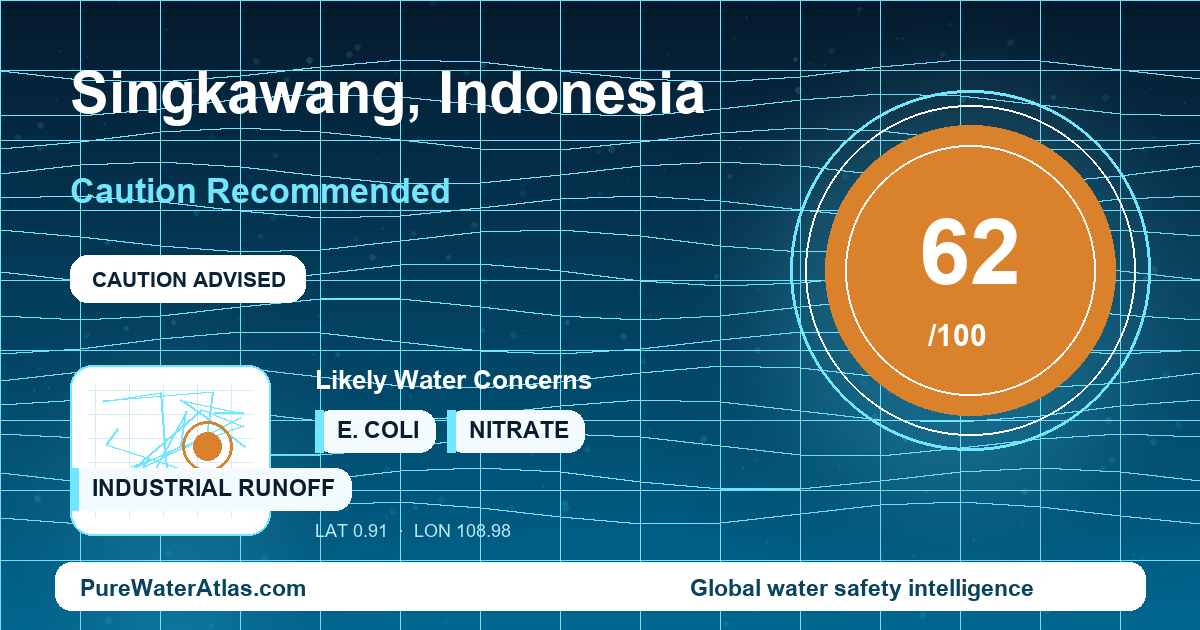
Singkawang, West Kalimantan: municipal surface-water supply exists, but direct tap-water drinking requires caution because public tap-level testing data are limited and household storage, wells, rain-driven turbidity, and distribution conditions can change water quality before it is consumed.
Quick Answer
| Water safety score | 62 / 100 |
|---|---|
| Risk level | Caution Recommended |
| Can tourists drink tap water? | No, not directly. Visitors should use sealed bottled water, reputable dispenser or refill-gallon water, boiled water, or water treated by a reliable purifier. |
| Resident advice | Municipal water from Perumda Air Minum Gunung Poteng is generally a better baseline than untreated shallow wells, but drinking water should still be boiled, disinfected, or properly filtered, especially after outages, heavy rain, or tank storage. |
| Main water source | Local surface-water intakes and catchments in the Singkawang area, associated with Gunung Poteng, Semelagi, Sedau, and related municipal systems. |
| Local water authority | Perumda Air Minum Gunung Poteng Kota Singkawang, with public-health and regulatory oversight involving the city government, Dinas Kesehatan Kota Singkawang, and Indonesian national drinking-water rules. |
| Filter recommendation | For drinking: sediment filtration where particles occur, activated carbon for taste and odor, and a reliable microbial barrier such as boiling, UV, or a well-maintained purifier. RO may be appropriate where salinity or dissolved contaminants are confirmed. |
Editorial verdict: Caution is recommended. Singkawang has a formal municipal water operator and treated piped supply, but recent citywide tap-water compliance reports are not easy to verify publicly. The main practical concern is not that every tap is unsafe; it is that turbidity, intermittent pressure, household tanks, private wells, and seasonal source-water changes can make untreated tap water unreliable for direct drinking.
Why Singkawang Is Different
Singkawang is a coastal city on the west side of Borneo in West Kalimantan. Its water-safety profile is shaped by two local realities at the same time: lowland coastal settlement and nearby hill or forested catchments such as the Gunung Poteng area. That combination means Singkawang households may encounter both surface-water runoff issues and coastal groundwater issues, depending on whether they rely on municipal piped water, a private well, stored rainwater, a refill depot, or a combination of sources.
The city’s formal piped supply is not described as a single large metropolitan reservoir system. Public utility and planning references point instead to a municipal SPAM supplied by local surface-water sources, with intakes and treatment installations connected to Singkawang-area rivers and catchments. Exact current allocation by neighborhood is not consistently published, so the safest city-specific description is a multi-intake municipal surface-water system supported by local catchments.
This matters because the water a resident actually drinks may be different from the water leaving a treatment plant. In Singkawang, as in many Indonesian secondary cities, household storage tanks, roof tanks, ground tanks, premise plumbing, refill-gallon systems, and boiling practices often determine the final water quality. A clean treated supply can become risky after low pressure, leaking pipes, dirty tanks, or long storage. For that reason, the practical advice for Singkawang is to treat municipal tap water as a useful baseline, but not as automatically safe to drink untreated.
Where Does Singkawang’s Tap Water Come From?
Singkawang’s formal piped drinking-water supply is operated through a municipal SPAM system using local surface-water sources. The local water identity is strongly connected to the Gunung Poteng context, and public references also point to Semelagi, Sedau, and related Singkawang-area systems feeding water-treatment installations. These systems draw from local rivers and catchments rather than from one large regional reservoir that is clearly documented for all neighborhoods.
The key infrastructure includes surface-water intakes, IPA or water-treatment installations, urban distribution pipes, household service connections, and domestic storage tanks. The treatment plant may reduce turbidity and disinfect water, but water quality can change during distribution if pressure is intermittent, if pipes are old or leaking, or if water is stored in an unclean household tank.
Before full piped coverage, and outside households connected to municipal supply, many families in coastal West Kalimantan cities have relied on shallow wells, rainwater collection, small vendors, or refill-water depots. In Singkawang, that history remains important because shallow lowland and coastal wells can be vulnerable to salty taste, higher dissolved solids, iron or manganese staining, septic influence, and seasonal changes. Hill-catchment surface water, meanwhile, can become more turbid after heavy tropical rain.
Who Manages Drinking Water in Singkawang?
The local municipal drinking-water company is Perumda Air Minum Gunung Poteng Kota Singkawang. This utility is the main institution associated with Singkawang’s piped municipal water service. The Official Portal of Kota Singkawang provides the broader city-government context, while local public-health monitoring involves city health authorities.
Nationally, Indonesian drinking-water quality requirements are set through Ministry of Health rules, including Ministry of Health Regulation No. 2 of 2023, which covers environmental health quality standards. The drinking-water supply system framework is governed through national SPAM regulations, including Government Regulation No. 122 of 2015 on Drinking Water Supply Systems. National public-works agencies, including the Direktorat Air Minum, Cipta Karya, provide broader SPAM policy and performance context.
Data limitation: PureWaterAtlas does not claim verified compliance for every Singkawang tap. Recent public neighborhood-level compliance data and consumer-style tap-sampling reports for Singkawang were not found in a consolidated, easy-to-verify public format. This is why this guide gives a “Caution Recommended” rating rather than a blanket “safe to drink untreated” conclusion.
Main Local Water Concerns
- Turbidity and color after heavy rain: Singkawang’s municipal system relies on local surface-water sources. During rainy periods, runoff can raise turbidity, organic matter, and microbial loading in raw water. If tap water becomes cloudy, muddy, or develops a changed odor after storms, it should not be consumed untreated. Learn more about turbidity in drinking water.
- Microbial risk from distribution and storage: Even treated water can become contaminated after leaving the treatment plant. Intermittent pressure, leaks, pipe repairs, unclean roof tanks, and dirty ground tanks can allow bacteria to enter. This is the main reason boiling, UV, or another reliable disinfection step is sensible for drinking water in Singkawang. See E. coli in drinking water and Water Microbiology.
- Salinity in shallow coastal wells: Singkawang’s coastal lowland setting makes private shallow wells more vulnerable to salty or brackish water, especially near the coast or during dry periods. Households with salty-tasting water should test conductivity, TDS, chloride, and sodium. Municipal piped water is usually a better baseline than untreated shallow well water.
- Iron, manganese, and sediment: Brown, black, metallic, stained, or particle-laden water can come from private wells, tank deposits, pipe sediment, or natural iron and manganese. These issues may be aesthetic, but they can also signal that a well, tank, or plumbing system needs maintenance or testing. Relevant profiles include iron, manganese, and sediment in drinking water.
- Old building plumbing and fixtures: Indonesia is not known for the same lead service-line pattern seen in some older countries, but lead can still enter water through old fittings, brass parts, solder, or premise plumbing. Older buildings, schools, clinics, and homes with infants should consider testing. See lead in drinking water.
For Travelers
Visitors to Singkawang should not drink untreated tap water. Use sealed bottled water, reputable refill-gallon or dispenser water, boiled water, or water treated through a reliable purifier. Tap water is usually acceptable for showering and washing, but it should not be treated as drinking water unless the accommodation specifically states that it is treated for drinking.
For brushing teeth, many healthy adults can use tap water if they avoid swallowing it. More cautious travelers, children, pregnant travelers, and anyone with a sensitive stomach should use bottled or boiled water. For ice, choose established hotels, cafes, and restaurants that use commercial ice or treated water. Avoid unknown street-vendor ice if the source cannot be confirmed.
Better hotels and restaurants commonly provide bottled water, sealed cups, or dispenser water. Still, do not assume that the bathroom tap is potable. Carry bottled water during day trips, check bottle seals, use boiled water for tea and coffee, and consider oral rehydration salts if diarrhea occurs. If staying longer than a few days, a kettle or compact purifier using carbon plus UV can be useful. For boiling details, see Boiling Water Purification: Complete Guide.
For Residents
Residents connected to Perumda Air Minum Gunung Poteng can generally treat municipal water as a better starting point than untreated shallow wells, but a drinking-water barrier is still recommended. A practical household setup is a sediment prefilter for visible particles, activated carbon for taste and chlorine-related issues, and either boiling, UV, or a well-maintained purification system for microbial protection. If salinity or dissolved contaminants are confirmed by testing, reverse osmosis may be appropriate.
Filters must be maintained. A neglected filter can become a microbial source, especially in a warm climate and when water is stored. If the water supply has been interrupted, pressure has dropped, or pipe repairs have occurred, flush taps and boil drinking water unless the utility provides clear instructions.
Private wells should be tested at least for E. coli or total coliform, turbidity, pH, TDS or conductivity, chloride, nitrate, iron, and manganese. Homes near the coast or with salty-tasting water should prioritize conductivity, TDS, chloride, and sodium testing. If water becomes cloudy after rain or pipe work, test turbidity and consider microbial testing before using it as drinking water.
Old buildings with unknown plumbing should be treated cautiously. Flush stagnant taps in the morning, avoid using hot tap water for cooking or infant formula, and test first-draw and flushed samples for lead and other metals if the plumbing history is uncertain. Household tanks should be covered, insect-proof, and cleaned regularly. A municipal supply that is acceptable at the incoming pipe can become unsafe after storage in a dirty or cracked roof or ground tank.
Relevant Contaminants and Water-Quality Issues
The most relevant Singkawang water-quality issues are linked to surface-water turbidity, microbial contamination pathways, household sediment, and private-well chemistry. Start with Turbidity in Drinking Water if water turns cloudy or muddy after rain. Review E. coli in Drinking Water if water is from a private well, stored tank, refill source, or has been affected by pressure loss.
For visible particles, pipe work, or disturbed tanks, see Sediment in Drinking Water. For taste and disinfection context, see Chlorine in Drinking Water; chlorine residual can protect water, but it may decline in long networks or household storage. For staining, metallic taste, or black deposits, compare Iron in Drinking Water and Manganese in Drinking Water. For older premises or infant-related concerns, review Lead in Drinking Water and Lead in Drinking Water: Testing and Detection Methods.
How to Verify Your Water Quality
Because public tap-level data for Singkawang are limited, household verification is important when water will be used for infants, elderly people, immunocompromised residents, clinics, food service, or long-term drinking. Use an accredited laboratory, a local health-office route, or a recognized water-quality lab when results will guide treatment decisions.
For a full testing framework, use the PureWaterAtlas guide How to Test Drinking Water: Complete Guide to Water Testing and Analysis. For choosing treatment after test results, see Water Purification Methods, UV Water Purification: Complete Guide, and the boiling guide linked above. Private-well users near septic systems, agriculture, or drainage-affected areas should also review Nitrate Contamination in Drinking Water: Testing and Detection Methods.
To compare Singkawang with other destinations, use the Global Water Quality Checker. If a lab report lists an unfamiliar contaminant, search the PureWaterAtlas Contaminants Search Engine. Broader category resources are available under Drinking Water Safety, Water Testing, Water Purification, and Global Water Quality.
Official and Technical Sources
- Perumda Air Minum Gunung Poteng Kota Singkawang — municipal water utility responsible for Singkawang’s piped drinking-water service.
- Official Portal of Kota Singkawang — city-government source for local institutions, public services, geography, and municipal context.
- BPS Kota Singkawang — Badan Pusat Statistik source for Singkawang geography, administrative areas, population, and local statistics.
- Direktorat Air Minum, Cipta Karya — national public-works source for Indonesian SPAM policy and water-utility performance context.
- Ministry of Health Regulation No. 2 of 2023 — official Indonesian legal reference for environmental health quality standards, including drinking-water quality requirements.
- Government Regulation No. 122 of 2015 on Drinking Water Supply Systems — official legal reference for Indonesia’s drinking-water supply system framework.
Bottom Line
Singkawang has a real municipal water system operated by Perumda Air Minum Gunung Poteng and supplied by local surface-water catchments, but untreated tap water should not be treated as reliably drinkable. The city’s coastal setting, hill-catchment runoff, rainy-season turbidity, possible low pressure, household tanks, and continued use of private wells all affect the water people actually consume. Tourists should use bottled, boiled, dispenser, or properly purified water. Residents should prefer municipal water over untreated shallow wells where available, but should boil or filter drinking water, clean tanks, and test wells or older buildings. Because recent public tap-level compliance data are limited, the appropriate rating for Singkawang is caution recommended, not automatic direct tap-water drinking.
Read the full guide: Global Water Quality Guide
Explore more in this category: Global Water Quality Articles