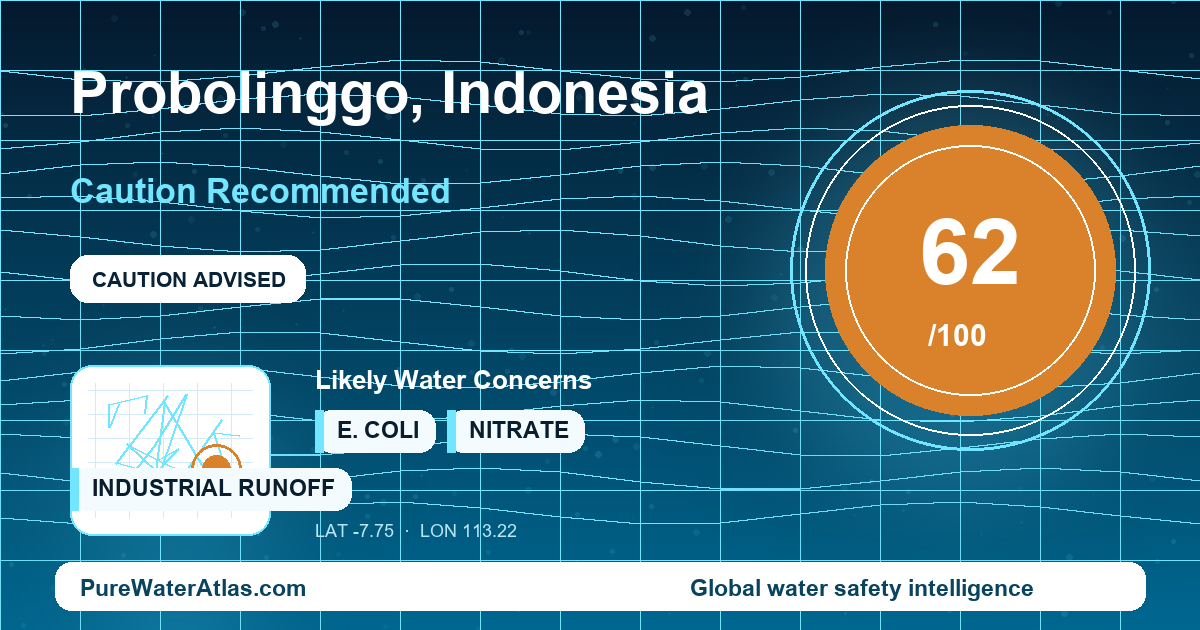
Probolinggo, East Java has an organized municipal water utility and important spring-fed raw-water resources, but untreated tap water should not be treated as reliably potable at the household tap without boiling, disinfection, or well-maintained point-of-use treatment.
Quick Answer
| Water safety score | 62 / 100 |
|---|---|
| Risk level | Caution Recommended |
| Can travelers drink the tap water? | No, not as a default. Short-term visitors should use sealed bottled water, boiled water, reputable dispenser water, or properly treated water. |
| Resident recommendation | Municipal piped water can generally be used for washing and household purposes, but drinking water should be boiled, UV-treated, or passed through a suitable point-of-use system. |
| Main local water identity | Perumda Air Minum Bayuangga Kota Probolinggo operates the municipal system. Local references identify inland spring resources, especially the Ronggojalu spring area in Tegalsiwalan, as an important raw-water source. |
| Water authority | Perumda Air Minum Bayuangga Kota Probolinggo, with oversight and health surveillance involving Pemerintah Kota Probolinggo, Dinas Kesehatan Kota Probolinggo, and national ministries. |
| Filter recommendation | A point-of-use barrier is recommended for drinking. For piped water, combine safe storage with boiling or UV; sediment and activated carbon can improve clarity and taste. For wells or salty water, test before selecting reverse osmosis or other treatment. |
Why Probolinggo Is Different
Probolinggo is not a single “tap water” situation. A visitor or resident may encounter municipal bathroom tap water, boiled water served for tea, gallon dispenser water in homes and guesthouses, refill-depot water, stored tank water, or private well water. The safety of each source can differ substantially, especially after water leaves the municipal system or is stored on the property.
The city’s geography is central to its water-risk profile. Probolinggo is a low-lying coastal city on the north coast of East Java facing the Java Sea, while its broader water context is connected to agricultural and volcanic upland catchments from the Probolinggo-Bromo interior. This means the raw-water picture is mixed: protected upland spring water may be relatively clear at its source, while shallow groundwater in the coastal urban plain is more exposed to septic leakage, urban drainage, seasonal runoff, and salinity.
Ronggojalu is widely known locally as both a spring-water resource and a public water site in Probolinggo Regency. Its relevance helps explain why a coastal city can still have important spring-fed municipal supply. However, spring-fed source water does not automatically mean every household tap is safe to drink untreated. The weaker part of the chain is often the final mile: distribution pressure, small leaks, old service lines, house plumbing, hotel tanks, roof tanks, refill handling, and storage hygiene.
Where Does Probolinggo’s Tap Water Come From?
The municipal drinking-water system is operated by Perumda Air Minum Bayuangga Kota Probolinggo, historically known as PDAM Kota Probolinggo. Public local references identify spring water from the Probolinggo Regency interior, especially the Ronggojalu spring area in Tegalsiwalan, as an important raw-water source for the city supply.
The core system includes spring intake and transmission infrastructure associated with inland raw-water sources, municipal distribution pipes, service connections, meters, reservoirs, pumps, and pressure zones within Kota Probolinggo. This managed source and trunk network is likely the safer portion of the water chain compared with shallow private sources and poorly maintained household storage.
At the property level, however, the water can change before it is consumed. Many homes, guesthouses, hotels, and small businesses use roof tanks, ground tanks, internal plumbing, gallon dispensers, refill-depot water, or private wells. These storage and handling steps matter because microbial contamination can be introduced after treatment. A clean municipal source does not protect water that later sits in a dirty tank, enters through a leaking service connection, or is handled in an unsafe container.
Historically, before wider piped-water service and the common use of refill-water depots, many households in and around Probolinggo relied on shallow wells, hand pumps, communal wells, and stored water. Those older patterns still matter because private wells and storage systems remain part of the city’s practical drinking-water landscape.
Who Manages Drinking Water in Probolinggo?
The local municipal water utility is Perumda Air Minum Bayuangga Kota Probolinggo. Local government context is provided by Pemerintah Kota Probolinggo, while health surveillance involves Dinas Kesehatan Kota Probolinggo. Broader infrastructure and national policy context are connected to Indonesian public-works and health authorities, including the Ministry of Public Works and Housing.
Indonesia regulates drinking-water and environmental health requirements through national Ministry of Health rules, including Permenkes No. 2 Tahun 2023. These rules provide the national regulatory basis for environmental health quality standards and requirements for water used for hygiene, sanitation, swimming pools, spas, and public bathing. Local health offices are responsible for surveillance and sanitation inspection, while utility operations and water-supply planning are handled through municipal and public-works channels.
Important limitation: this profile does not claim that every Probolinggo tap meets drinking-water standards at the point of consumption. City-level institutional and source-water context is available, but routine public reporting of finished-water laboratory results by neighborhood, residual chlorine at customer taps, pipe age, pressure continuity, and household tank conditions is limited. The safest interpretation is therefore cautious and practical.
Main Local Water Concerns
The main practical concern in Probolinggo is microbial risk at the household tap. Water can become contaminated after treatment through low pressure, leaks, unclean storage tanks, unsafe containers, or poor household plumbing. This is particularly relevant where water is stored before drinking or where travelers cannot verify tank cleaning and plumbing conditions.
Turbidity and sediment are also important warning signs. After pipe repairs, pressure changes, or heavy rain, water may carry visible particles or become cloudy. In Probolinggo, visible sediment should not be dismissed as only an aesthetic issue because turbidity can interfere with disinfection and can signal disturbance in pipes, tanks, or source conditions.
For private wells, especially in low-lying or coastal parts of the city, salinity, chloride, and high total dissolved solids are concerns when water tastes brackish or salty. Shallow groundwater in dense urban areas can also be vulnerable to septic contamination and nitrate, particularly where wells are near drains, latrines, soak pits, gardens, livestock, or agricultural land.
Iron and manganese are plausible groundwater-related concerns where boreholes or wells are used. They may cause staining, metallic taste, brown or orange water, black particles, or plumbing deposits. Lead is not documented in the available dataset as a citywide Probolinggo contaminant, but older building plumbing, brass fixtures, solder, and rarely used taps can create property-specific lead or metal exposure.
Seasonal conditions matter. Wet season rainfall can increase runoff, drain overflows, turbidity, and contamination around wells, tanks, and low-lying areas. Flooding or ponding after heavy rain can increase the chance that shallow wells and underground tanks are affected by surface water. During the dry season, local groundwater availability can decline and dissolved minerals, salinity, or taste problems may become more noticeable. Dust or ash episodes from the Bromo-Tengger region can also add sediment to roofs, gutters, rainwater tanks, and exposed storage if tanks are not sealed.
For Travelers
Travelers should not drink untreated tap water in Probolinggo as a default. Use sealed bottled water, boiled water, or water from a reputable dispenser or properly maintained treatment system. Hot tea and coffee are generally lower risk because they are boiled, but do not assume that bathroom tap water is potable in hotels, guesthouses, or restaurants.
For brushing teeth, the safer traveler recommendation is bottled, boiled, or dispenser water, especially if you have a sensitive stomach, are immunocompromised, are traveling with children, or are staying in budget accommodation where tank hygiene is uncertain. Many local residents may brush with tap water, but short-term visitors often have less tolerance for local microbial exposures and less information about the building’s water system.
For ice, accept it only from reputable hotels, restaurants, or cafes that use factory-made ice or treated water. Avoid irregular homemade ice from unknown street vendors if you are trying to minimize gastrointestinal risk. The issue is not only the original water source; handling and storage can also affect safety.
In hotels and restaurants, ask whether drinking water is filtered, boiled, bottled, or from a gallon dispenser. Better establishments commonly use dispenser or treated water for beverages, but the bathroom tap and kitchen washing water may be different sources. Carry sealed bottled water or use a purifier rated for bacteria and protozoa. For longer stays, a kettle plus a clean covered container is the simplest reliable approach. If water is cloudy, salty, smells of sewage, or has visible particles, do not drink it after simple carbon filtration alone; use another source or boil and filter as appropriate.
For Residents
Residents connected to Perumda Air Minum Bayuangga may use piped water for washing and general household use, but should use an additional barrier for drinking. At minimum, combine safe storage with boiling or UV treatment. A sediment filter and activated carbon can improve particles, taste, and odor, but carbon alone is not a complete microbial safety barrier. See the PureWaterAtlas guides to boiling water purification and UV water purification for household options.
For private wells, testing should come before treatment decisions. Test at least annually for total coliform and E. coli, and retest after flooding, pump repair, nearby construction, or any change in taste, odor, or color. If the property is coastal, low-lying, or the water tastes salty, measure turbidity, pH, conductivity, total dissolved solids, chloride, and salinity. Reverse osmosis may be appropriate for high TDS, salinity, nitrate, or certain dissolved contaminants, but it should not be selected blindly without testing.
Nitrate testing is especially important where infants, pregnant people, or immunocompromised residents use the water, and where shallow wells are near septic systems, drains, gardens, livestock, or agricultural land. Test iron and manganese if water stains fixtures, has a metallic taste, or produces brown, orange, or black particles.
Older houses, shop-houses, guesthouses, and public buildings may have aging internal plumbing, corroded fixtures, dead-end pipe sections, or rarely used taps. Flush stagnant taps before non-drinking use and test first-draw water for lead and copper if the water will be consumed by children or pregnant people. Storage tanks are a major final-mile risk: keep tanks sealed, screened from insects and animals, cleaned on a schedule, and protected from roof runoff, dust, and ash. After heavy rain, pipe work, ashfall, or a long vacancy, drain and clean tanks before using stored water for drinking.
Relevant Contaminants and Water-Quality Issues
The most important practical risk for untreated tap water, wells, and storage tanks in Probolinggo is microbial contamination, especially E. coli as an indicator of fecal contamination. Because the final-mile water chain may include household tanks, intermittent pressure, or private wells, microbial testing and treatment are central to safe drinking-water decisions.
Turbidity and sediment are relevant during wet season conditions, pipe repairs, pressure changes, and disturbed distribution lines. Visible particles, cloudiness, or tank deposits should be treated as warning signs that water quality may have changed.
Nitrate matters for shallow wells affected by septic systems, urban drainage, or agricultural influence. Residents using wells should also review PureWaterAtlas guidance on nitrate contamination testing and detection.
Chlorine is relevant because residual disinfectant can help protect municipal water in the distribution system, but customer-tap residual data for Probolinggo are not readily available in routine public sources. Lead is included as a property-specific issue for older plumbing, fixtures, or stagnant taps, not as a documented citywide contaminant. Older-building residents can also use the PureWaterAtlas guide to lead testing and detection.
How to Verify Your Water Quality
Because Probolinggo’s public city-level finished-water data are limited, the most reliable answer for a specific property is testing at the tap and, where relevant, at the source. Start by identifying whether your drinking water comes from the municipal utility, a private well, a refill depot, a gallon dispenser, a roof tank, a ground tank, or a combination of sources.
For a general framework, use the PureWaterAtlas guide to drinking water safety. For sampling plans and parameter selection, see the complete water testing guide. If the issue is biological risk, the water microbiology guide explains why E. coli and coliform results matter. For choosing treatment after testing, review water purification methods.
You can also compare Probolinggo with other locations using the Global Water Quality Checker, or research specific contaminants in the PureWaterAtlas Contaminants Search Engine. Relevant site categories include Global Water Quality, Drinking Water Safety, Water Testing, and Water Purification.
Official and Technical Sources
- Perumda Air Minum Bayuangga Kota Probolinggo — primary local utility identity for the municipal water-supply system.
- Pemerintah Kota Probolinggo official website — municipal government source for local institutional context and city information.
- BPS Kota Probolinggo — authoritative city statistics source that may include demographic, infrastructure, and drinking-water access indicators.
- Permenkes No. 2 Tahun 2023 — national regulatory basis for Indonesian environmental health quality standards and water-quality requirements.
- WHO and UNICEF Joint Monitoring Programme data for Indonesia — national context for drinking-water service levels and household water-safety interpretation.
- Kementerian Pekerjaan Umum dan Perumahan Rakyat Republik Indonesia — national authority for public water-supply infrastructure programs and SPAM policy context.
- Probolinggo Regency official portal — regional context for inland spring-water areas and Probolinggo Regency resources relevant to Kota Probolinggo source-water geography.
Bottom Line
Probolinggo’s tap-water picture deserves caution rather than alarm. The city has an organized municipal utility, Perumda Air Minum Bayuangga, and important inland spring-fed raw-water context, including the Ronggojalu area. That is a stronger starting point than relying only on shallow coastal groundwater. However, public neighborhood-level finished-water results, residual chlorine data, pipe condition details, and household tank hygiene information are limited. Travelers should not drink untreated tap water; use bottled, boiled, dispenser, or properly treated water. Residents should treat municipal water before drinking and test private wells for microbes, salinity, nitrate, iron, manganese, and basic chemistry where relevant. In Probolinggo, the final-mile system—pipes, tanks, wells, and storage—is often the decisive safety factor.
Read the full guide: Global Water Quality Guide
Explore more in this category: Global Water Quality Articles