
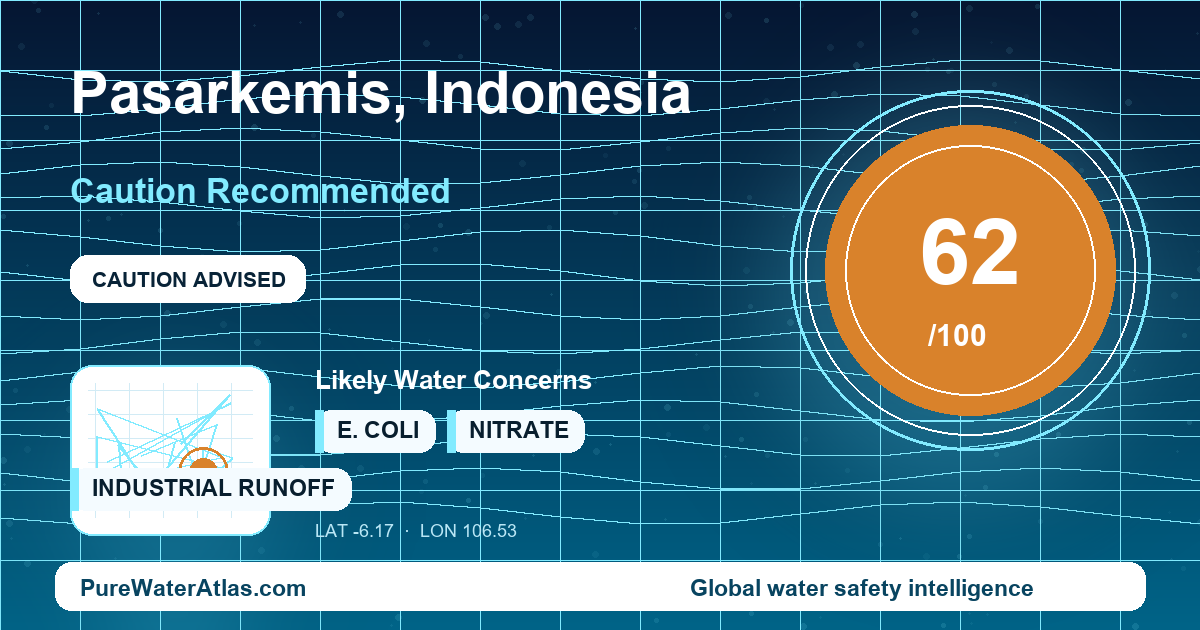
Pasarkemis, Tangerang Regency, Banten: surface-water based regional supply, mixed household water sources, and caution recommended for drinking untreated tap water.
Quick Answer
| Water safety score | 62 / 100 |
|---|---|
| Risk level | Caution Recommended |
| Can travelers drink the tap water? | No, not untreated. Use sealed bottled water, reputable refill water, boiled water, or water treated with a reliable purifier. |
| Resident guidance | Do not assume household tap water is potable unless the specific home connection, storage tank, and recent test results support it. |
| Main water context | Pasarkemis is within the Tangerang Regency water-supply area. Piped water is handled regionally by Perumdam Tirta Kerta Raharja Kabupaten Tangerang, with surface-water based Tangerang systems and broader raw-water infrastructure central to supply planning. |
| Water authority | Perumdam Tirta Kerta Raharja Kabupaten Tangerang, commonly abbreviated Perumdam TKR, not a separate Pasarkemis city utility. |
| Home filter recommendation | Recommended for drinking water unless recent household-level testing confirms safety. For uncertain microbial risk, boiling, UV with prefiltration, ultrafiltration, or reverse osmosis may be needed depending on source and test results. |
Editorial verdict: Caution recommended. Pasarkemis is a fast-urbanizing district in Tangerang Regency, where piped water is managed through the regional water company rather than a standalone city utility. Open public sources support a surface-water based regional supply context, but recent Pasarkemis-specific branch-level drinking-water compliance results were not found. Treat tap water as potentially acceptable for washing and bathing, but not as reliably potable without boiling, certified treatment, or verified local testing.
Why Pasarkemis Is Different
Pasarkemis is not a small rural settlement with a single predictable water source, and it is not a separate city water jurisdiction with its own public utility. It is a fast-urbanizing district in Tangerang Regency, Banten, within the Jakarta metropolitan influence zone. Local water safety depends heavily on the exact building, neighborhood, and source: a home may have a Perumdam TKR piped-water connection, use a private well, buy refill water, rely on tanker or vendor water, or combine more than one source.
This matters because the final water reaching a Pasarkemis tap may pass through building-level infrastructure before anyone drinks it. Rooftop tanks, ground storage tanks, booster pumps, internal pipes, corroded fixtures, and low-use taps can all affect water quality after water leaves the regional network. In rented rooms, shops, older housing, and multi-storey homes, the storage and plumbing system may be more important to day-to-day drinking-water risk than the regional source alone.
The available public record does not provide a recent, easily accessible Pasarkemis-specific drinking-water compliance table covering microbial results, turbidity, residual chlorine, nitrate, metals, or disinfection by-products. That limitation is central to the recommendation on this page: do not treat “served by a regulated utility” as the same as “safe at every tap.”
Where Does Pasarkemis’s Tap Water Come From?
Pasarkemis is served within the Tangerang Regency water-supply area. The piped-water context is surface-water based through Perumdam Tirta Kerta Raharja Kabupaten Tangerang systems and broader Tangerang raw-water infrastructure. The Cisadane River and regional bulk-water schemes are central to Tangerang-area water-supply planning. However, the presence of regional raw-water and treatment infrastructure does not prove the quality of water at every Pasarkemis household tap.
The relevant infrastructure includes raw-water intakes, water-treatment plants, reservoirs, transmission mains, and distribution pipes operated at the Tangerang Regency network level. Pasarkemis residents then often depend on local household or building systems: tanks, pumps, pipework, taps, filters, and storage practices. If supply pressure is intermittent, if repairs occur, or if water sits in an unclean tank, contamination risk can increase even where the incoming water was treated.
In homes without a reliable piped-water connection, drinking and domestic water may come from shallow or deeper groundwater wells, tanker water, or commercial refill depots. This historical pattern remains important in Pasarkemis because wider Tangerang Regency water supply has developed alongside rapid population growth, industrialization, and pressure on groundwater. Surface-water treatment and regional bulk-water development are intended to reduce reliance on groundwater, but many households still manage final water safety through boiling, filtration, and tank cleaning.
Who Manages Drinking Water in Pasarkemis?
The primary piped-water authority for Pasarkemis is Perumdam Tirta Kerta Raharja Kabupaten Tangerang, commonly abbreviated Perumdam TKR. This is the regional public water company for Tangerang Regency. Pasarkemis is therefore best understood as part of a regency-level utility service area, not as a separate municipal water system with its own independent utility.
Local public-health oversight is associated with Tangerang Regency institutions and Indonesia’s national drinking-water health framework. The Government of Tangerang Regency is the relevant local-government source for public services and local agencies. Nationally, drinking-water health parameters and sanitation-related environmental health standards are governed by Ministry of Health Regulation No. 2 of 2023.
Infrastructure planning is also influenced by Indonesian public-works programs and regional water-supply development. The Ministry of Public Works and Housing is a key national source for SPAM programs and bulk-water infrastructure affecting Banten and the Tangerang area. For population and district context, the BPS Kabupaten Tangerang publications portal is the official statistics source.
Main Local Water Concerns
- No recent open Pasarkemis branch-level test table: Public sources identify the utility and regulatory framework, but they do not provide recent Pasarkemis-specific tap-level compliance results for key microbial and chemical parameters.
- Private wells: Wells in dense urban or peri-urban settings can be vulnerable to E. coli, nitrate, and other contamination from septic systems, drains, floodwater intrusion, and poor wellhead protection.
- Rainy-season turbidity: Surface-water supplies in the Tangerang region can experience higher turbidity during heavy rainfall, increasing the importance of effective treatment and residual disinfection.
- Storage tanks: Tanks that are unsealed, rarely cleaned, exposed to insects or animals, or affected by floodwater can degrade water after it leaves the utility network.
- Intermittent pressure and repairs: Pipe breaks, long outages, low-pressure periods, and first flush after interruption can create cloudy, discolored, or highly chlorinated water. Residents should flush taps and avoid drinking until water clears and is boiled or treated.
- Industrial and mixed land use: Pasarkemis sits in the wider Tangerang corridor, where industrial and mixed land use make well testing important where contamination is suspected. This does not prove contamination at a specific tap, but it supports a cautious testing approach.
- Old internal plumbing: Older buildings may have corroded internal pipes, dead ends, low-use taps, and fittings that can affect taste, color, sediment, or metals.
For Travelers
Travelers should not drink untreated tap water in Pasarkemis. Use sealed bottled water, reputable refill water, water brought to a rolling boil, or water treated with a reliable purifier. This is especially important for short-stay visitors who cannot verify the building’s supply connection, tank maintenance, or plumbing condition.
Use bottled, boiled, or properly filtered water for brushing teeth if you have a sensitive stomach, are immunocompromised, are traveling with infants, or are staying in a rental, guesthouse, or hotel where the water-storage system is unknown. Avoid swallowing shower water, and use bottled or boiled water for infant formula.
Be cautious with ice. Avoid ice from street stalls or informal vendors unless you know it was made from factory ice or treated water. In reputable restaurants, ask whether ice is commercially produced from treated water. Better hotels and restaurants may provide bottled water, dispenser water, or treated water for guests, but that is a property-level practice, not a citywide guarantee.
Hot drinks are generally safer when made with water that has reached a rolling boil. For broader travel-health context, the CDC Travelers’ Health page for Indonesia supports conservative food and water precautions for visitors.
For Residents
Residents should first identify the household’s actual water source. A Perumdam TKR connection, private well, refill water, tanker supply, or combined system each carries different risks. If the home has piped water, confirm supply reliability, visible clarity, residual chlorine where possible, and the condition of any storage tank. If the home uses a well, do not rely on appearance or taste as proof of safety.
A home treatment step is recommended for drinking water unless recent testing confirms the household tap is safe. For piped water, a sediment prefilter plus activated carbon can improve clarity, taste, and chlorine-related issues, but it does not reliably disinfect water once chlorine has decayed in a tank. For uncertain tanks or wells, use boiling, UV with prefiltration, ultrafiltration, or reverse osmosis according to the water source and test results. See the PureWaterAtlas guides to boiling water purification and UV water purification for practical treatment choices.
Private wells should be tested at least annually for E. coli or thermotolerant coliforms, nitrate, pH, TDS or conductivity, turbidity, iron, manganese, and hardness. Test immediately after flooding, nearby septic failure, unusual odor, sudden illness, or suspected contamination. Homes near workshops, industrial drains, fuel storage, or heavily polluted canals should consider accredited laboratory testing for heavy metals and relevant volatile or semi-volatile organic compounds.
Storage tanks are a major Pasarkemis household risk point. Tanks should be sealed, screened against insects and animals, cleaned periodically, protected from floodwater, and disinfected after repairs. If treated piped water is stored for long periods, chlorine residual can decay and microbial regrowth can occur. For babies, pregnant people, older adults, and immunocompromised residents, boiled or properly treated water is advisable unless reliable recent microbial testing is available.
Relevant Contaminants and Water-Quality Issues
The most important issue for uncertain household drinking water in Pasarkemis is microbial safety. E. coli is a key indicator for fecal contamination in wells, tanks, flood-affected plumbing, and poorly protected water sources. Related risk increases when storage tanks are unclean or when shallow wells are close to septic systems and drainage channels.
Turbidity and sediment are practical indicators residents may notice after heavy rain, pipe repairs, or supply interruptions. Cloudy or discolored water is not automatically unsafe, but it can interfere with disinfection and should not be used untreated for drinking when the source is uncertain.
Chlorine matters because piped-water safety depends partly on maintaining residual disinfectant through distribution pipes and household storage. Low or absent residual chlorine at the tap, especially after storage, can allow microbial regrowth. For private wells, nitrate is important where septic influence is possible, particularly for infants. Groundwater users should also check iron and manganese, which can affect taste, staining, and household plumbing. Lead is not documented here as a confirmed Pasarkemis citywide problem, but older brass fixtures, solder, or imported plumbing components can still make building-level metals testing sensible.
How to Verify Your Water Quality
The safest approach in Pasarkemis is to verify the water at the point of use, not only at the utility or neighborhood level. For piped-water customers, check the tap after water has passed through the building’s tanks and pipes. For well users, test the well directly and retest after floods, repairs, septic problems, or sudden changes in odor, color, or illness patterns.
Start with the PureWaterAtlas pillar guide to Drinking Water Safety and the complete guide to Water Testing. For microbial hazards, see Water Microbiology. For treatment selection, use the Water Purification guide.
To compare Pasarkemis with other destinations, use the Global Water Quality Checker. If you receive laboratory results and need to understand individual parameters, search the PureWaterAtlas Contaminants Search Engine. For specific well concerns, see the guides to nitrate testing and detection and lead testing and detection.
Official and Technical Sources
- Perumdam Tirta Kerta Raharja Kabupaten Tangerang official website — local water utility context for Tangerang Regency, including the Pasarkemis service area.
- Government of Tangerang Regency official website — local-government source for administration, public services, and agencies relevant to water and health oversight.
- BPS Kabupaten Tangerang publications portal — official statistics source for Pasarkemis and Tangerang Regency demographic and district context.
- Ministry of Health Regulation No. 2 of 2023 — Indonesian national framework for environmental health quality standards, including drinking-water parameters.
- Ministry of Public Works and Housing, Republic of Indonesia — national infrastructure authority for Indonesian drinking-water infrastructure and regional bulk-water development.
- CDC Travelers’ Health: Indonesia — public-health travel guidance supporting conservative food and water precautions.
- WHO Guidelines for Drinking-water Quality — international reference for microbial risk, turbidity, disinfection, and household water-safety principles.
Bottom Line
Pasarkemis tap water should be approached with caution for drinking. The district is part of Tangerang Regency’s regional water-supply system, managed by Perumdam Tirta Kerta Raharja Kabupaten Tangerang, with surface-water based supply context and wider Tangerang raw-water infrastructure. However, no recent open Pasarkemis-specific compliance report was found for tap-level microbial and chemical quality. Travelers should use bottled, boiled, or reliably purified water and avoid untreated tap water for drinking or brushing teeth. Residents should verify their exact source, test private wells, maintain storage tanks, and use appropriate point-of-use treatment. Water may be suitable for washing and bathing, but it should not be considered reliably potable without boiling, certified filtration, or credible household-level testing.
Read the full guide: Global Water Quality Guide
Explore more in this category: Global Water Quality Articles