
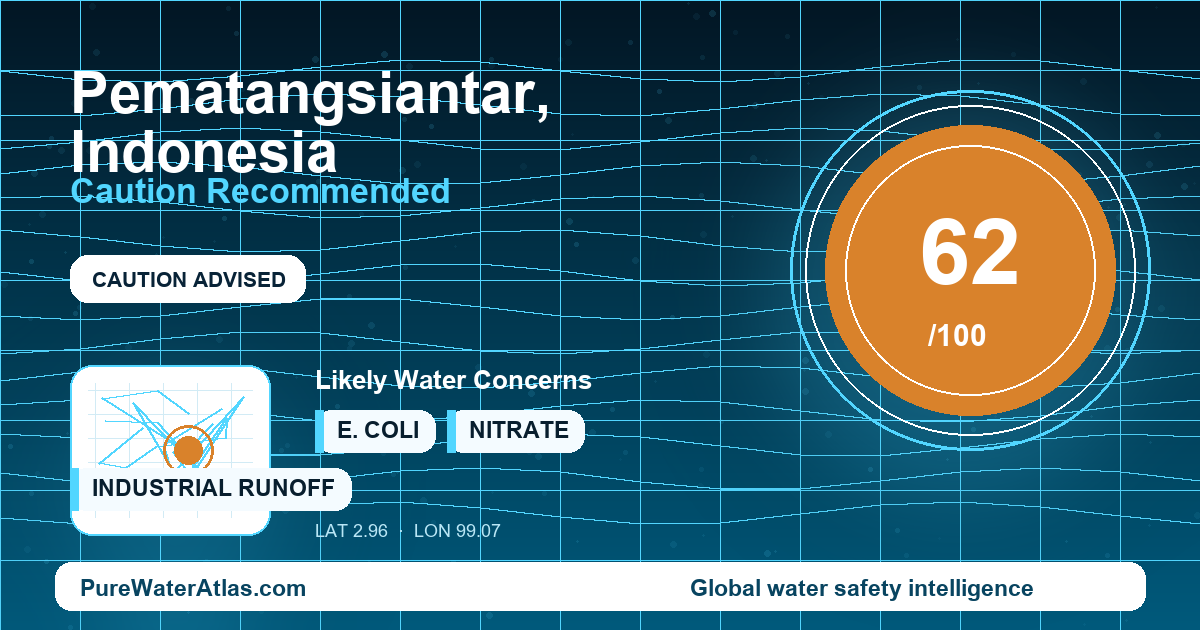
Pematangsiantar, North Sumatra: municipal water is available through Perumda Tirtauli, but untreated tap water is not recommended as a default drinking source without boiling, certified filtration, or recent tap-specific testing.
Quick Answer
| City | Pematangsiantar, Indonesia |
|---|---|
| Water safety score | 62 / 100 |
| Risk level | Caution Recommended |
| Can visitors drink the tap water? | No, not as a default recommendation. Short-term visitors should use sealed bottled water, boiled water, or water from a properly maintained dispenser or purifier. |
| Resident recommendation | Use point-of-use treatment for drinking water unless recent laboratory results from the actual household tap are satisfactory. Boiling is the most practical barrier for microbial risk. |
| Main water system | Perumda Tirtauli Kota Pematangsiantar municipal piped-water system, understood to rely on local highland spring and surface-water or intake sources in and around Pematangsiantar and neighboring Simalungun. |
| Water authority | Perumda Tirtauli Kota Pematangsiantar, with public-health oversight under Indonesian drinking-water health regulations. |
| Filter recommendation | For daily drinking water, consider a sediment prefilter plus activated carbon; add UV when microbial risk is the main concern and water is clear, or reverse osmosis if testing identifies dissolved contaminants of concern. |
Overall verdict: caution recommended. Pematangsiantar has an established municipal utility, but recent city-specific, parameter-by-parameter public drinking-water results by treatment plant, distribution zone, or customer tap were not found in the sources reviewed. Treat municipal tap water as generally suitable for washing and household use, but not as reliably drinkable without boiling, certified treatment, or verified recent testing.
Why Pematangsiantar Is Different
Pematangsiantar’s drinking-water question is different from that of coastal Indonesian cities. The city is inland in North Sumatra, surrounded by Simalungun Regency and located on the route toward Lake Toba. Its water context is highland river and spring catchment management, not seawater intrusion or desalination. The Bah Bolon river system is a major local drainage feature in and around the city, so rainy-season runoff, sediment, household wastewater pressure, and surface-water quality are more relevant concerns than salinity.
The practical drinking-water risk in Pematangsiantar is therefore ordinary but important: treated water can change quality after it leaves the utility system. Water may pass through distribution pipes, service connections, pressure changes, household storage tanks, shop tanks, guesthouse plumbing, hotel dispensers, or old building fixtures before reaching a glass. Even when water is acceptable for bathing or washing, it may not be safe enough for direct drinking if disinfectant residual is low, the tank is dirty, or the water has become turbid after rain or pipe work.
PureWaterAtlas rates Pematangsiantar at 62/100, with a Caution Recommended status. This does not mean every tap is unsafe. It means that the available public evidence is not strong enough to recommend untreated tap water for drinking across the city, especially for visitors, children, pregnant people, immunocompromised people, and households using private wells or stored water.
Where Does Pematangsiantar’s Tap Water Come From?
Pematangsiantar is served by the local municipally owned drinking-water company, Perumda Tirtauli Kota Pematangsiantar. The municipal system is understood to rely on local spring and surface-water or intake sources in and around Pematangsiantar and neighboring Simalungun, with raw-water collection, treatment, storage, and distribution through the city network. Exact current source shares by volume were not found in a recent public water-quality report, so this page does not claim a precise percentage split between springs, river intakes, or other local sources.
The important infrastructure for drinking-water safety includes the Perumda Tirtauli piped-water distribution network, raw-water collection and treatment infrastructure, service reservoirs, pressure-management infrastructure, and the private systems that sit after the utility connection. In Pematangsiantar, as in many Indonesian cities, household, shop, guesthouse, and hotel storage tanks can be a major end-user safety point. If tanks are uncovered, uncleaned, warm, or exposed to insects and debris, they can reintroduce sediment and microorganisms after municipal treatment.
Some households or businesses may also use private wells or boreholes as backup or alternative water supplies. These sources require their own testing. A well near septic influence, poor drainage, or shallow groundwater can have different risks from a municipal connection, including microbial contamination, nitrate, iron, manganese, turbidity, or total dissolved solids issues. A clear-looking well is not proof of microbiological safety.
Who Manages Drinking Water in Pematangsiantar?
The relevant local utility is Perumda Tirtauli Kota Pematangsiantar, not a provincial or national water company. Local public-health oversight is associated with the Pematangsiantar health office and Indonesian drinking-water health regulations. Broader urban water-supply policy and infrastructure oversight involves Indonesian public works and health authorities, including the public-works framework for urban water-supply infrastructure.
Indonesia’s drinking-water and water-for-hygiene standards are governed nationally through Ministry of Health environmental health standards, including Permenkes No. 2 Tahun 2023. These national standards provide the regulatory framework, but the public reporting environment is not the same as in places where utilities publish annual consumer confidence reports with full parameter tables by zone. For Pematangsiantar, basic city-level context and the utility identity are clear, but recent routine tap-water compliance data by parameter and neighborhood were not found in easily accessible public sources.
This limitation matters. A city can have a legitimate utility and national standards while still having variable end-tap water quality because of intermittent pressure, tank hygiene, building plumbing, or localized distribution issues. PureWaterAtlas therefore avoids claiming exact contaminant concentrations, exact compliance rates, or safe conditions in specific neighborhoods of Pematangsiantar.
Main Local Water Concerns
- Microbial contamination at the tap: The most important health concern is recontamination with organisms such as E. coli if treated water loses disinfectant residual, passes through low-pressure pipes, or sits in poorly maintained tanks. Specific recent Pematangsiantar zone-by-zone E. coli results were not found publicly, but this is a plausible and important risk for urban piped systems.
- Turbidity and sediment during wet periods: Heavy rain can increase sediment, color, and organic load in surface-water catchments. High turbidity can make disinfection less reliable if treatment and filtration are stressed. Residents may also notice sediment after outages, pressure changes, or pipe work.
- Aging distribution and household plumbing: Water quality can decline after treatment because of old pipes, service connections, stagnant premise plumbing, pipe repairs, or fixtures inside older buildings. Citywide lead service-line evidence was not found, but lead and other metals can still come from premise plumbing in individual buildings.
- Storage tank hygiene: Tanks in homes, shops, guesthouses, and hotels are site-specific risk points. Visible sediment, biofilm, insect access, mosquito access, or an unknown cleaning history are warning signs. Tank water should not be assumed drinkable.
- Private well variability: Wells and boreholes may face local risks depending on depth, lining, nearby septic systems, and drainage. Practical testing should include microbial indicators and nitrate, with additional metals testing where geology or plumbing is uncertain.
Season also matters. Rainy-season runoff can increase turbidity and microbial pressure in surface waters and shallow groundwater. Pipe repairs, outages, and pressure drops can temporarily raise contamination risk when water returns. During drier periods, lower source flows can reduce system resilience and concentrate some pollutants, although Pematangsiantar is not primarily a salinity-intrusion city.
For Travelers
Short-term visitors should not drink untreated tap water in Pematangsiantar as a default practice. Use sealed bottled water, boiled water, or water that has passed through a properly maintained purifier. If a hotel says the water is safe, ask what that means: is it boiled, filtered, UV-treated, or dispensed from a maintained gallon system? Do not assume bathroom tap water is treated to drinking standard.
For brushing teeth, bottled or boiled water is the cautious choice, especially for travelers with sensitive stomachs, young children, pregnant travelers, immunocompromised people, or anyone staying in budget accommodation with unknown plumbing or tank maintenance. Tap water is generally acceptable for showering and handwashing, but avoid swallowing it.
Be cautious with ice. Avoid ice from street stalls or small eateries unless you can verify that it was made from treated commercial ice or safe water. In better restaurants, ask whether ice is factory-made. Hot tea and coffee made with boiled water are generally more reliable than raw drinks, shaved ice, or beverages mixed with unverified tap water. Also be careful with uncooked foods washed in tap water if you are trying to minimize gastrointestinal risk.
For Residents
Residents connected to Perumda Tirtauli should treat household drinking water based on conditions at the actual tap, not only on the assumption that municipal water has been treated. If you do not have recent satisfactory laboratory results from your kitchen tap, a household barrier is advisable. At minimum, boil water used for drinking during outages, after pipe repairs, when pressure has been low, or whenever water is cloudy, colored, or unusual in taste or odor. See the PureWaterAtlas boiling water purification guide for practical limitations and correct use.
For daily use, a sediment prefilter plus activated carbon can improve particles, taste, odor, and some chemical concerns. If microbial risk is the main issue and the water is already clear, UV can be useful; see the UV water purification guide. Reverse osmosis may be appropriate if testing identifies dissolved contaminants that simpler filters do not address. Filter choice should follow test results, not marketing claims.
Test water at the kitchen point of use, especially if the building uses a storage tank. A practical first screen includes E. coli or total coliform, turbidity, pH, residual chlorine, iron, manganese, nitrate, hardness, and total dissolved solids. If the home uses a private well, microbial and nitrate testing should be priorities, with additional metals testing if plumbing or geology is uncertain. Retest after major plumbing work, flooding, long outages, a change in taste or odor, or visible sediment.
Older buildings, schools, shops, and converted houses may have corroded pipes, old brass fixtures, or stagnant plumbing. Flush stagnant water before using it for drinking or cooking, and consider metals testing where infants, pregnant people, or children regularly consume the water. Storage tanks should be cleaned and disinfected regularly, kept sealed, and protected from insects, debris, and mosquito access.
Relevant Contaminants and Water-Quality Issues
The most relevant Pematangsiantar issue is microbiological safety, especially where water is stored, pressure is intermittent, or tank maintenance is uncertain. Start with E. coli because it is a key indicator of fecal contamination and direct health risk. Turbidity and sediment matter because cloudy water can protect microbes and reduce disinfection reliability.
For piped water, chlorine residual is a useful operational indicator: too little residual can mean limited protection in the distribution system, while strong chlorine taste may cause residents to avoid treated water. For wells, tanks, and corroded plumbing, iron and manganese can cause staining, particles, and taste problems. For older premises, lead should be considered a premise-plumbing issue even without evidence of a citywide lead problem. For private wells and peri-urban groundwater, nitrate is important because it can be influenced by septic systems, drainage, and agricultural or household waste pressures.
How to Verify Your Water Quality
The most reliable way to know whether a Pematangsiantar tap is drinkable is to test the water at the point where it is consumed. Testing at a building inlet is useful, but it may miss contamination introduced by a roof tank, indoor plumbing, dispenser, or old fixtures. Use an accredited Indonesian laboratory or a local health-office testing route where available. Home strips can help screen pH, chlorine, hardness, or dissolved solids, but they are not enough to confirm microbiological safety.
For broader guidance, use PureWaterAtlas resources on water testing, drinking water safety, water microbiology, and water purification methods. You can also browse the Contaminants Search Engine or compare risk context with the Global Water Quality Checker. Related PureWaterAtlas categories include Drinking Water Safety, Global Water Quality, Water Testing, and Water Microbiology.
If lead or nitrate is a specific concern, see Lead in Drinking Water: Testing and Detection Methods and Nitrate Contamination in Drinking Water: Testing and Detection Methods.
Official and Technical Sources
- Perumda Tirtauli Kota Pematangsiantar — official local water utility identity and service context.
- Pemerintah Kota Pematangsiantar — official city-government source for municipal context.
- BPS Kota Pematangsiantar — official statistical source for city geography, population, and administrative context.
- Permenkes No. 2 Tahun 2023 — Indonesian national health standard framework for drinking water and water used for hygiene and sanitation.
- Kementerian PUPR Directorate General of Human Settlements — national public-works authority relevant to urban water-supply systems and SPAM infrastructure.
- Balai Wilayah Sungai Sumatera II — regional water-resources authority for North Sumatra river-basin management context.
- WHO Guidelines for Drinking-water Quality — technical guidance on microbial risk, turbidity, disinfection, and household drinking-water safety.
Bottom Line
Pematangsiantar has an established municipal water utility, Perumda Tirtauli, and an inland highland water context shaped by local springs, surface-water intakes, the Bah Bolon catchment, distribution infrastructure, and household storage. However, recent public tap-water compliance data by parameter and distribution zone are limited. Visitors should not drink untreated tap water by default; sealed bottled water, boiled water, or properly maintained dispensers are safer. Residents should verify water at the kitchen tap, keep storage tanks clean, and use boiling or point-of-use treatment for drinking water unless recent lab results show the tap is safe. The main practical concerns are microbial contamination, turbidity after rain or outages, tank hygiene, premise plumbing, and private well variability.
Read the full guide: Global Water Quality Guide
Explore more in this category: Global Water Quality Articles