
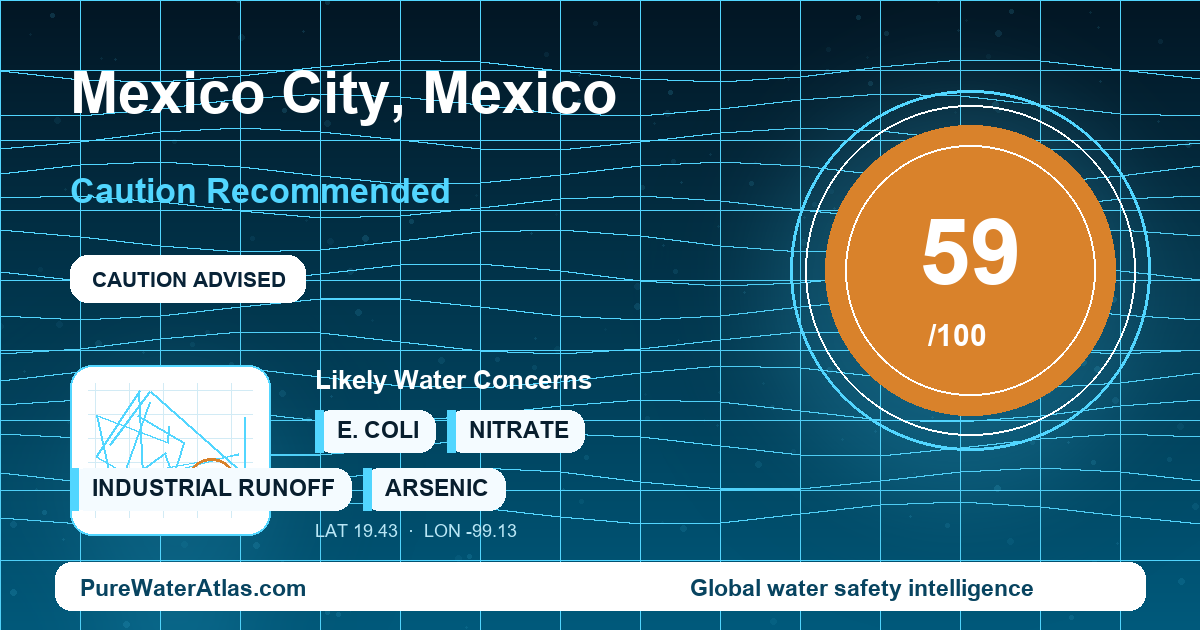
Mexico City has a large treated-water system, but drinking safety at the faucet depends heavily on distribution pressure, aging pipes, building cisterns, rooftop tinacos, and local storage conditions.
Quick Answer
| Overall safety status | Caution recommended. Mexico City’s water safety score is 59, with a risk level of Caution Recommended. The city has formal treated-water infrastructure, but tap quality is not uniform at the point of use. |
|---|---|
| Can visitors drink the tap water? | Not recommended for most visitors. Short-term travelers should use sealed bottled water, reputable garrafón water, hotel-provided purified water, or water that has been properly filtered and disinfected. |
| Resident guidance | Residents should treat tap safety as a building-specific question. Many households use garrafón water or point-of-use treatment for drinking and cooking. |
| Main water sources | A blended metropolitan supply: local groundwater from the Valley of Mexico aquifer system, imported Cutzamala surface water treated at Los Berros, and Lerma System water. |
| Water authority | Local service has traditionally been operated by SACMEX, with national water-resource roles under CONAGUA and sanitary regulation under Mexican health authorities. |
| Filter recommendation | A practical household setup may include sediment prefiltration, activated carbon, and a validated microbiological barrier such as UV, ultrafiltration, or reverse osmosis where testing supports it. |
Why Mexico City Is Different
Mexico City is not a simple “treated municipal water equals safe at every tap” case. The city sits in the high-altitude closed Basin of Mexico on former lakebed and volcanic terrain. Its geography creates a difficult water balance: very large demand, limited local renewable supply, heavy pumping from aquifers, and the need to import water uphill from outside basins.
The practical drinking-water issue is not only the quality of water leaving a treatment plant. Mexico City depends on long-distance conveyance, pumping, pressure zones, aging mains, household cisterns, rooftop tinacos, and local storage. These features mean that water at a kitchen faucet can differ from water in the main system, especially after low-pressure periods, repairs, tank contamination, or long residence time in private storage.
Historically, Mexico City grew on a lake basin and used springs, canals, aqueducts, and shallow groundwater. Modern urbanization drained much of that lacustrine environment and shifted the city toward deep groundwater extraction and interbasin transfers. Over-extraction of groundwater has contributed to land subsidence, a long-term stress that can damage water and sewer infrastructure, increase leakage, complicate pressure control, and raise intrusion risk during depressurization events.
Where Does Mexico City’s Tap Water Come From?
Mexico City’s drinking-water supply is a blended metropolitan system. Major inputs include local groundwater pumped from the Valley of Mexico aquifer system, imported surface water from the Cutzamala System, and water from the Lerma System. The exact mix can vary by zone, operating conditions, drought, maintenance work, and distribution constraints.
The Cutzamala System is one of the best-known imported supplies serving Mexico City and the metropolitan area. It includes reservoirs such as Valle de Bravo, Villa Victoria, and El Bosque, plus major pumping and conveyance infrastructure. Cutzamala water is treated at the Los Berros water treatment plant before being conveyed toward the Valley of Mexico. CONAGUA publishes official information on the Sistema Cutzamala and updates on Cutzamala reservoir storage, which are important because drought and low reservoir levels can affect operating pressure and supply reductions.
The Lerma System also imports water from the Toluca-Lerma basin area, while local and regional groundwater wells supply a large share of the city’s needs. Once water enters Mexico City’s distribution network, it may pass through pressure zones, storage tanks, pumping stations, building cisterns, and rooftop tinacos before reaching a tap. In some areas or during shortages, repairs, or low-pressure periods, pipas, or tanker trucks, may also be used. These multiple transfer and storage steps are central to understanding why point-of-use quality can vary.
Who Manages Drinking Water in Mexico City?
Local water service in Mexico City has traditionally been operated by the Sistema de Aguas de la Ciudad de México, SACMEX. SACMEX has been the city-level institution associated with water supply, distribution, drainage, and customer information. National water infrastructure, water concessions, and major basin-level matters fall under CONAGUA, the Comisión Nacional del Agua.
Drinking-water quality in Mexico is governed nationally by health regulations, including NOM-127-SSA1-2021, the Mexican standard for water for human use and consumption. Sanitary surveillance involves Mexican health authorities, with federal context available from COFEPRIS.
Mexico City’s water institutional structure has also been undergoing changes toward a broader Secretaría de Gestión Integral del Agua. Residents should check current CDMX government channels for the latest customer-service responsibilities and local advisories. Importantly, the existence of regulation and treatment does not prove that every borough, pressure zone, building cistern, rooftop tank, or tap has identical water quality at all times.
Main Local Water Concerns
Microbiological risk after distribution or storage is the central practical concern in Mexico City. Water may be chlorinated in the formal system, but intermittent pressure, pipe breaks, old plumbing, cisterns, rooftop tanks, and tanker delivery can create opportunities for contamination after the water leaves the treatment and main distribution system. Testing for indicators such as E. coli is the relevant way to verify microbial safety at a specific tap.
Turbidity and sediment are also important. Aging pipes, hydraulic changes, repairs, tank sediment, and source-water events can produce cloudy water or visible particles. Turbidity matters because it can interfere with disinfection and with UV treatment if water is not filtered first. Sediment can also indicate storage-tank buildup or distribution disturbance.
Chlorine residual variability is another local issue. Chlorine is essential for microbial control, but taste and odor complaints can occur, and chlorine residual can decline during long residence time in cisterns or rooftop tinacos. Very low residual in stored water is a warning sign for residents relying on building storage for drinking water.
Metals from building plumbing, including possible lead risk in older buildings, should be considered building-specific. Lead risk is usually driven by service lines, solder, fixtures, or internal plumbing rather than the raw water source alone. Older buildings, schools, childcare settings, homes with infants, and homes with pregnant residents should consider first-draw and flushed testing before making any safety claim.
Groundwater quality stress can include dissolved minerals, salinity indicators, iron, manganese, or localized contaminants. Because Mexico City uses heavily pumped aquifers along with imported supplies, source-water data cannot be treated as equivalent to a household tap result. During shortages, pressure reductions, maintenance shutdowns, or tanker use, practical risk can increase because water may sit longer in storage or pass through less predictable handling routes.
For Travelers
Most short-term visitors should not routinely drink Mexico City tap water. This guidance is conservative but practical: traveler risk is driven by variable distribution, building storage, local handling, and individual sensitivity. Use sealed bottled water, reputable garrafón water, a trusted hotel purified-water supply, or water that has been properly filtered and disinfected.
For brushing teeth, cautious travelers should use bottled or purified water. This is especially important for children, pregnant travelers, immunocompromised people, and anyone with a sensitive stomach. Healthy adults may tolerate small incidental exposure, but avoiding ordinary tap water is the lower-risk choice.
Use ice only where it is clearly made from purified water. Higher-end hotels and established restaurants commonly use purified ice, but street vendors and uncertain venues are higher-risk choices. If unsure, ask for hielo de agua purificada. Do not assume that a bathroom tap in a hotel or guesthouse is drinking water.
Be cautious with aguas frescas, raw produce washed in tap water, and blended drinks from informal vendors. Boiling can reduce microbial risk, but it does not remove metals, salts, or many chemical contaminants. The CDC’s Mexico Traveler View supports conservative traveler precautions for drinking water, ice, and food and beverage safety.
For Residents
Residents should treat tap-water safety as a site-specific question. Many Mexico City households use garrafón purified water or point-of-use treatment for drinking and cooking. If a household wants to drink tap water regularly, a treatment barrier is advisable, but the best system should be based on testing rather than assumptions.
A practical setup may begin with sediment prefiltration, followed by activated carbon for taste, chlorine, and many organic compounds. If microbiological risk is a concern, use a validated barrier such as UV after prefiltration, ultrafiltration, or reverse osmosis where dissolved contaminants or uncertain tanker sources are concerns. PureWaterAtlas has additional guidance on UV water purification, boiling water, and choosing water treatment systems.
Test for total coliform and E. coli at the kitchen tap, especially after cistern or tinaco contamination, flooding, pressure loss, pipe repair, or illness clusters in the household. Measure free chlorine residual at the tap and after storage. Check turbidity and visible sediment if water becomes cloudy, has particles, or changes after service interruptions.
Older apartment buildings, historic properties, and buildings with unknown renovations deserve special attention. Letting water run may reduce stagnation, but it does not prove safety. First-draw and flushed samples for lead and copper are appropriate in older buildings, schools, childcare settings, or homes with infants or pregnant residents. See PureWaterAtlas guidance on lead testing and detection.
Cisterns and rooftop tinacos are a major Mexico City point-of-use risk. They should be sealed, protected from insects and dust, inspected for sediment, and cleaned and disinfected regularly. If a building cannot document tank cleaning, residents should not assume tap water is potable without treatment and testing.
Relevant Contaminants and Water-Quality Issues
The most relevant Mexico City drinking-water issues are not a single contaminant profile that applies everywhere, but a set of risks linked to distribution, storage, plumbing, and supply interruptions. Key PureWaterAtlas reference pages include E. coli for microbial verification, turbidity for cloudy water and disinfection interference, sediment for particles and tank buildup, and chlorine for residual protection and taste concerns.
Residents in older buildings should review lead, while households using tanker-truck water, private wells, or uncertain building supplies may need broader testing that includes arsenic and nitrate. These should not be assumed present at every Mexico City tap; they are listed because the dataset recommends additional testing where municipal-distribution assumptions may not apply.
How to Verify Your Water Quality
The only reliable way to know whether a specific Mexico City tap is safe is to verify the actual water at that point of use. City-level facts describe the supply system, but they do not prove uniform safety in every borough, pressure zone, building, cistern, rooftop tinaco, or faucet.
Start with microbiological testing at the kitchen tap, especially after pressure loss, repairs, tank cleaning issues, flooding, or household illness. Add chlorine residual, turbidity, and visible sediment checks if water appearance or odor changes. In older buildings, test both first-draw and flushed samples for lead and copper. If water comes from tanker trucks, private wells, or an uncertain building source, consider nitrate, arsenic, broader metals, TDS, hardness, iron, manganese, and general chemistry.
For broader background, use the PureWaterAtlas Water Testing guide, Drinking Water Safety guide, Water Microbiology guide, Contaminants Search Engine, and Global Water Quality Checker. Mexico City residents may also monitor official information through the CDMX Datos Abiertos portal, recognizing that public data coverage and usability can vary.
Official and Technical Sources
- Sistema de Aguas de la Ciudad de México official site — local water-service institution historically responsible for Mexico City supply, distribution, drainage, and customer information.
- CONAGUA: Sistema Cutzamala — official national-water source describing the Cutzamala System.
- CONAGUA: Almacenamiento en presas del Sistema Cutzamala — reservoir-storage updates relevant to drought pressure and supply reductions.
- NOM-127-SSA1-2021 — Mexican national standard for water for human use and consumption.
- COFEPRIS: Agua de uso y consumo humano — federal health-authority context for sanitary surveillance.
- CDC Mexico Traveler View — traveler-health guidance for water, ice, and food and beverage precautions.
- NASA Earth Observatory: Mexico City Is Sinking Fast — geophysical context linking subsidence to groundwater extraction.
- Datos Abiertos CDMX — official Mexico City open-data portal.
Bottom Line
Mexico City tap water should be approached with caution. The city has formal treated-water systems, including groundwater, Cutzamala water treated at Los Berros, and Lerma System supplies, but water quality at the faucet can be affected by long conveyance, pressure changes, aging infrastructure, cisterns, rooftop tinacos, and building plumbing. Visitors should generally avoid routine tap-water drinking and use bottled, garrafón, or verified purified water. Residents should verify their own building conditions, maintain tanks, use appropriate filtration or disinfection, and test for microbial indicators, chlorine residual, turbidity, and metals where risk factors exist. Public data support the main risk drivers, but not a single safety claim for every tap in the city.
Read the full guide: Global Water Quality Guide
Explore more in this category: Global Water Quality Articles