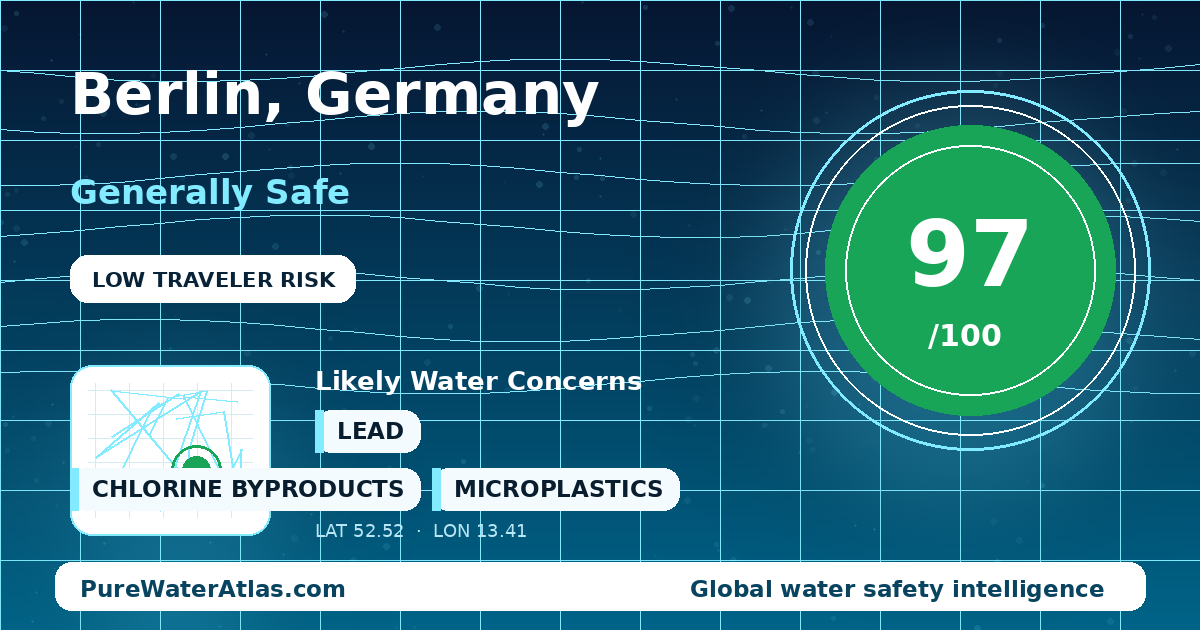
Berlin’s centrally supplied tap water is generally suitable for drinking without home treatment. The city relies on regional groundwater and normally treats it through aeration and sand filtration rather than routine chlorination. Berliner Wasserbetriebe’s published 2025 results show that all nine waterworks met the listed requirements of Germany’s Drinking Water Ordinance.
That citywide conclusion has an important boundary: waterworks data describe the public supply, not necessarily the water at every kitchen faucet. Once water enters a property, old pipes, fittings, stagnation and the operation of warm-water systems can affect its quality. Residents of older or partly renovated buildings should therefore distinguish between the quality delivered by Berliner Wasserbetriebe and conditions created by the building’s own installation.
Quick Answer
| Overall safety status | Generally safe from the central public supply. Berlin’s published 2025 waterworks medians meet the listed requirements of Germany’s Drinking Water Ordinance, but plumbing conditions inside individual properties can differ. |
|---|---|
| Can visitors drink the tap water? | Yes, normally. Use cold water from the public supply. If it has been standing in the pipes for a long period, let the tap run until the water becomes cool. Follow any building-specific notice or official incident advisory. |
| Resident advice | Check the utility’s postcode-specific analysis. In an older or partly renovated property, ask whether all lead pipes and components were removed. Arrange faucet-level testing if the plumbing history remains uncertain. |
| Main water source | Regional groundwater formed from approximately 60% bank filtrate, 30% infiltrated precipitation and 10% artificial groundwater recharge using infiltrated, treated surface water. |
| Responsible authority | Berliner Wasserbetriebe supplies and monitors the central system. LAGeSo supervises the central waterworks and protection zones, while district health offices oversee relevant building installations and private supplies. Building owners are responsible for water quality within their properties. |
| Filter recommendation | No routine filter is needed for compliant central-supply water. Treatment should address a verified faucet-level problem. For lead plumbing, replacement rather than filtration is the permanent remedy. |
Where Does Berlin’s Tap Water Come From?
Berlin’s drinking water comes entirely from regional groundwater. According to Berliner Wasserbetriebe’s 2025 environmental statement, the groundwater entering the system is formed by about 60% bank filtrate from nearby surface waters, 30% infiltrated precipitation and 10% artificial groundwater recharge using infiltrated, treated surface water. These proportions explain why “groundwater” in Berlin includes water influenced by both precipitation and nearby surface-water systems.
Approximately 650 wells feed nine waterworks. At the waterworks, the water is aerated and passed through sand filters. Routine chemical addition and routine chlorination are not part of the normal treatment description. Emergency disinfection remains part of the system’s contingency capability, so the absence of routine chlorination should not be interpreted as a rule that disinfection could never be used when circumstances require it.
This relatively straightforward treatment approach depends on source protection, operation of the well fields, filtration and extensive monitoring. Berliner Wasserbetriebe publishes both citywide waterworks data and a postcode-based water analysis. The postcode tool is more useful for a resident trying to understand the water supplied to a particular area, while the annual waterworks document is useful for comparing results across the nine facilities.
Who Manages Drinking Water?
Berliner Wasserbetriebe operates Berlin’s central drinking-water supply and carries out monitoring through its laboratory program. LAGeSo, the State Office for Health and Social Affairs, supervises the central waterworks and water-protection zones. District health offices have responsibilities for relevant premises, building installations and private supplies.
The practical dividing line is between the public network and the property’s plumbing. Berliner Wasserbetriebe describes the public network as lead-free, but that does not establish that every private building installation is free of lead. Building owners are responsible for conditions within their properties. Consequently, a compliant result at a waterworks cannot resolve a question about an old pipe, fitting or faucet inside a particular apartment.
For most consumers, the first step is not to commission a broad investigation of Berlin’s entire supply. It is to identify whether the concern belongs to the public system, the building or a private source. The appropriate contact and sampling point depend on that distinction.
Main Local Water Concerns
Lead and Other Building-Installation Metals
The principal property-specific concern is old premise plumbing, especially any remaining lead pipes or components. Lead can enter water after it has left the lead-free public network. A building described as renovated may still need closer examination if only part of its plumbing was replaced or if the scope of the work is unclear.
Official Berlin guidance also identifies copper as a metal that can be associated with building installations. The relevant question is therefore not simply whether Berlin’s source water complies, but whether the water has contacted problematic materials between the service connection and the faucet. Germany’s drinking-water regulatory framework contains chemical requirements and a lead-pipe removal requirement, but a resident should still verify what has actually been removed in the specific property.
If plumbing records are unavailable, faucet-level testing is more informative than relying only on a citywide report. Sampling must be designed for the question being asked, because a sample intended to examine water after stagnation is not equivalent to a sample taken after flushing.
PFAS
PFAS is monitored in Berlin’s supply and has been actively managed near the former Tegel Airport. The published 2025 waterworks medians remained below the German PFAS limits listed for the system. This supports the overall conclusion that the central supply met the reported requirements, while continued monitoring remains relevant because PFAS is a source- and system-level issue rather than something a resident can identify by appearance or taste.
A general PFAS concern should first be checked against current official utility results. A household treatment decision should not be based solely on the existence of PFAS monitoring or management activity elsewhere in the city.
Hardness and Scale
Berlin’s water is hard. Hardness can produce visible mineral scale on kettles, faucets and other surfaces, but hardness itself is not treated here as a health hazard or evidence that the water is unsafe. Scale should not be confused with contamination from lead, PFAS or microorganisms.
Residents may choose to manage hardness for practical reasons, but that is different from needing treatment to make centrally supplied water drinkable. A device selected for scale control also should not be assumed to solve a separate contaminant problem unless its purpose and performance match that verified issue.
Stagnation and Warm-Water Systems
Water that has remained in internal pipes can reflect the building installation more strongly than freshly drawn water. After a long period without use, run the cold tap until the water becomes cool before using it for drinking. This is particularly relevant after an apartment has been vacant or a specific faucet has not been used for some time.
Warm-water-system hygiene is a separate building-management matter. The favorable microbiological results from the waterworks do not automatically describe every warm-water installation within a large property. Property-specific instructions and health-office guidance should take priority if a building has an identified issue.
For Travelers
Visitors can normally drink Berlin’s cold tap water. In a hotel, apartment or other accommodation, use the cold-water tap and let it run until cool if the room or faucet has been unused for a long period. There is no general need to buy bottled water or install a filter merely because Berlin’s water is hard or not routinely chlorinated.
Pay attention to local context. A notice posted by the property, instructions from accommodation staff or an official incident advisory is more specific than the normal citywide assessment. If the building identifies a plumbing or warm-water problem, follow that guidance even though the central supply is generally compliant.
For Residents
Start with Berliner Wasserbetriebe’s postcode-specific analysis to identify the water supplied to your area. Then consider the building separately. In an older property, ask the owner or manager whether the drinking-water installation has been fully renewed and whether all lead pipes and components were removed. “Renovated” alone does not explain which pipes or fittings were changed.
If the answer is uncertain, arrange an appropriate faucet test through a LAGeSo-approved laboratory. Tell the laboratory whether the concern involves lead, another installation-related metal, stagnation, microbiology or a private supply so that the sample can be collected and interpreted correctly.
Private wells, small waterworks and tanks should not be judged from Berliner Wasserbetriebe’s central-system results. They require separate oversight and testing. Berlin’s district-level responsibilities and approved-laboratory requirements apply according to the type and location of the private supply.
Relevant Contaminants and Water-Quality Issues
- Lead: Primarily a premise-plumbing concern in buildings with remaining lead pipes or components. The public network is described as lead-free, but individual properties must be assessed separately.
- Copper: Can be associated with building installations, making faucet-level conditions relevant when a property-specific metal concern exists.
- PFAS: Monitored within the central system and managed near the former Tegel Airport. Published 2025 waterworks medians remained below the applicable German limits.
- Microorganisms: The 2025 waterworks medians reported zero E. coli, enterococci and coliform bacteria. These results characterize the reported waterworks data, not every private or warm-water installation.
- Hardness: Causes scale and practical maintenance issues but is not itself evidence of a health hazard.
- Stagnation: Can increase the influence of internal plumbing on faucet water. Flush the cold tap until the water is cool after long periods without use.
- Warm-water-system hygiene: Managed at the building level and distinct from the quality reported at the central waterworks.
How to Verify Your Water Quality
- Confirm the supply. Determine whether the property uses Berliner Wasserbetriebe’s central system or a private well, tank or small waterworks.
- Check official results. Use the postcode-specific utility analysis for local supply information and the annual waterworks document for the published system-wide medians.
- Investigate the building. Ask the owner or manager about the age and renovation history of drinking-water pipes, fittings and warm-water systems.
- Define the question before sampling. Lead after stagnation, general supplied-water chemistry and a microbiological concern are different questions and may require different sampling procedures.
- Use an approved laboratory. LAGeSo provides the relevant framework for laboratory approval. Berliner Wasserbetriebe also describes an accredited laboratory and household lead-testing context.
- Interpret the result at the right level. A faucet result may identify a building problem even when waterworks data comply. Conversely, citywide monitoring should not be replaced by an improperly collected household sample.
Testing and Treatment Decisions
Routine filtration is unnecessary for Berlin’s compliant central-supply water. Test first when there is a credible property-specific concern, and select treatment only after identifying the problem. A filter should not be chosen simply because the water is hard, because PFAS is monitored citywide or because an older building has an undocumented plumbing history.
For lead plumbing, replacement is the permanent remedy. Flushing after stagnation is useful practical guidance, but it does not prove that lead components are absent and does not substitute for removal. Where a problem involves a private supply or building system, work with the responsible owner, district health office and approved laboratory rather than relying only on a general-purpose household device.
Official and Technical Sources
- Analysendaten der Wasserwerke — Jahresmedianwerte 2025 — Berliner Wasserbetriebe
- Wasserqualität — Berliner Wasserbetriebe
- Umwelterklärung Wasserversorgung und Abwasserentsorgung 2025 — Berliner Wasserbetriebe
- Trinkwasserüberwachung — Landesamt für Gesundheit und Soziales Berlin
- Trinkwasserhygiene — Landesamt für Gesundheit und Soziales Berlin
- Trinkwasserqualität — Berlin.de
- Wasseranalyse — Berliner Wasserbetriebe
- Verordnung über die Qualität von Wasser für den menschlichen Gebrauch — German Federal Ministry of Justice and Federal Office of Justice
- Anlage 2 TrinkwV — Chemische Parameter — German Federal Ministry of Justice and Federal Office of Justice
- Hausbrunnen und kleine Wasserwerke — Überwachung — Berlin Service Portal
Related Contaminant Profiles
Bottom Line
Berlin’s central tap water is generally safe to drink, and the utility’s published 2025 waterworks medians show compliance with the listed German drinking-water requirements. For most visitors and residents, cold tap water can be used without routine home filtration.
The main uncertainty is not the central supply but the final section of the journey through a property. Older pipes, fittings, stagnation and warm-water installations can create building-specific concerns. Check the postcode analysis, verify the plumbing history and use an approved laboratory when uncertainty remains. Private wells, tanks and small supplies must be assessed separately from Berlin’s central-system results.
Read the full guide: Global Water Quality Guide
Explore more in this category: Global Water Quality Articles