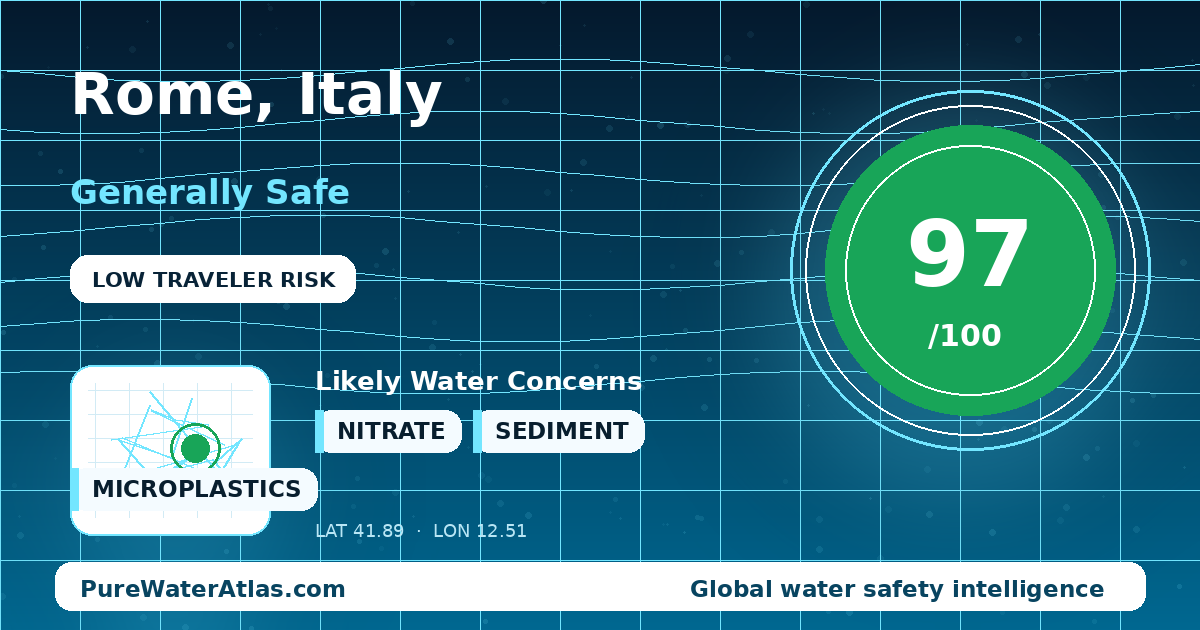
Rome’s municipal tap water is generally suitable for drinking. The capital is supplied mainly by major spring-fed aqueducts, and Acea Ato 2 monitors water from its sources through the distribution network. Rome’s famous nasoni are also designated drinking-water outlets connected to the public supply. For most residents and visitors, cold tap water is therefore a practical alternative to bottled water.
That favorable citywide picture does not certify every individual faucet at every moment. Water quality can change after it enters a property because of old premise plumbing, prolonged stagnation, shared storage tanks, pumps, private treatment equipment or poorly maintained fittings. Pressure loss, repairs and localized outages can also create temporary problems. The right question is usually not simply whether “Rome water” is safe, but whether the public supply is operating normally and whether a particular building preserves that quality up to the tap.
Quick Answer
| Overall safety status | Generally safe within Rome’s regulated municipal system, subject to current advisories and building-level plumbing conditions. |
|---|---|
| Can visitors drink the tap water? | Usually yes. Cold municipal tap water and designated nasoni are generally appropriate for drinking. |
| Resident advice | Check Acea notices, use cold water for drinking, and investigate old plumbing, tanks or persistent discoloration. |
| Main water source | Predominantly groundwater and spring water carried by the Peschiera–Le Capore, Marcio and other aqueduct systems. |
| Responsible authority | Acea Ato 2 operates the service; local health authorities and ARPA Lazio provide external health monitoring. |
| Filter recommendation | No routine filter is required for compliant municipal water. Match treatment to a measured problem. |
Where Does Rome’s Tap Water Come From?
Rome relies chiefly on groundwater and spring water transported through large aqueducts. The most important named system is Peschiera–Le Capore, which carries spring water from the Province of Rieti. The utility describes Peschiera as one of Europe’s major spring aqueducts and says that the water’s chemical and physical characteristics are continuously monitored.
The Marcio aqueduct is another major part of the supply. Acea reports that it provides about one-quarter of Rome’s water demand, particularly in eastern and southeastern districts. Other springs and wells feed the interconnected system. As a result, the precise blend delivered to an address can vary according to its location and the way the network is being operated. A result describing one source should not automatically be assumed to represent every neighborhood tap.
This spring-and-groundwater foundation helps explain Rome’s long association with aqueduct water, but the modern service is more than an aqueduct alone. It includes collection works, operational controls, distribution infrastructure, monitoring points and contingency arrangements. Acea’s reporting also describes network monitoring, aqueduct-resilience work and Water Safety Plans intended to manage risks across the supply system rather than relying only on testing finished water.
Lake Bracciano and the Tiber are documented as emergency reserves requiring treatment. Their presence in the supply plan does not mean that untreated river or lake water routinely reaches Roman taps. Emergency surface-water resources should be understood as resilience measures within the wider system, not as evidence that Rome’s normal supply is untreated surface water.
Who Manages and Checks Drinking Water?
Acea Ato 2 operates Rome’s integrated water service. The ATO 2 Conference of Mayors and its technical secretariat plan and oversee the local service, while ARERA regulates technical and contractual performance nationally. Acea’s role includes operating infrastructure, monitoring the supply and communicating service information, including information relevant to customers in Rome.
Health oversight is separate from the operator’s own internal monitoring. ARPA Lazio explains that local health authorities select drinking-water sampling points and parameters, ARPA laboratories perform the analyses, and the health authority issues the suitability judgment. This division matters: utility monitoring supports day-to-day operational control, while external sampling and health-authority review provide an additional public-health function.
Official results also need to be read at the correct geographic scale. An ATO 2 average or territory-wide interruption count describes a large service area and is not necessarily a Rome-only figure. Conversely, a problem at one apartment faucet may reflect that building rather than the water distributed across the city. Both system-level and tap-level evidence can be valid while answering different questions.
Main Local Water Concerns
Old Plumbing and Lead
The most relevant uncertainty for many Roman households is not the quality of spring water at its source but what happens in the final building. Italy’s Ministry of Health identifies old pipes, solder, taps and fittings as possible sources of lead at the consumer’s tap. Water that met requirements in the public network can therefore pick up lead while standing in contact with lead-bearing premise plumbing.
Rome has a substantial stock of historic buildings, but no reliable current source found in this review quantified how many properties still contain lead-bearing plumbing. Age alone does not prove that a building has a lead problem, and an attractive historic-center address is not enough to predict the materials behind its walls. Lead should be treated as a building-specific testing question, not as a claim that Rome’s municipal water is broadly contaminated.
Minerals, Hardness and Scale
Rome’s water is mineral-rich. Acea’s 2024 ATO 2 averages reported 88.2 mg/L calcium, 17.5 mg/L magnesium and 360.8 mg/L bicarbonate. These are territory-wide averages rather than a guaranteed analysis for every Roman address, but they are consistent with water that can leave scale in kettles, coffee equipment, showerheads and other appliances.
Visible scale is primarily an aesthetic and maintenance issue, not proof that the water is unsafe. It may affect taste preferences and increase cleaning needs, but it should not be confused with sediment from a pipe disturbance or with a health-related contaminant. A household considering a softener should distinguish appliance-scale management from drinking-water treatment and should also maintain any installed equipment properly.
Interruptions, Discoloration and Building Storage
Repairs, pressure changes and interruptions can temporarily produce cloudy or discolored water. Acea’s latest statistics confirm that interruptions occur, although the published counts cover the entire ATO 2 territory rather than Rome alone. A brief localized event should not be generalized into a conclusion about the permanent quality of the city supply.
Persistent discoloration, particles or an unusual odor should be reported and investigated rather than merely masked with a filter. Check whether neighbors in the same building or street have the same issue and whether Acea has announced work. If only one faucet is affected, the fixture or internal pipework becomes a more likely place to investigate. If the whole building is affected, shared tanks, pumps or incoming service conditions may be relevant.
Regional Concerns That Require Local Evidence
Arsenic associated with volcanic geology is a documented concern in parts of Lazio, but regional evidence must not be transferred automatically to Rome. Likewise, ARPA Lazio has monitored PFAS since 2023, but the accessible official material reviewed here did not provide a Rome-specific result establishing a citywide problem. Neither arsenic nor PFAS is presented here as a demonstrated Rome-wide exceedance. Residents should base testing or treatment decisions on results applicable to their supply zone, private source or individual tap.
For Travelers
Visitors can generally drink Rome’s cold municipal tap water unless a hotel, property manager or public authority posts a specific warning. Acea states that water from the city’s drinking fountains is the same drinking water supplied to households. Its official nasoni guide lists more than 3,000 drinking fountains across Rome, including more than 200 nasoni in the historic center.
Use designated nasoni and Water Houses, not water from decorative basins or monumental fountains. A fountain’s historic appearance does not by itself identify it as a drinking-water point. Roma Capitale also recommends the Acquea service for finding public drinking-water locations. Carrying a refillable bottle is therefore normally practical during sightseeing, especially when moving through central areas with many nasoni.
In a hotel or short-term rental, use the cold tap for drinking and cooking. If the property has been unoccupied and the water has stood for a long period, allow the cold water to run until its temperature stabilizes. Ask the host or reception staff about any posted building notice, recent interruption or private storage system if the water is visibly rusty, has a strong unusual odor or comes from an uncertain rooftop or basement tank.
A concern limited to one rental should be handled as a property-specific issue. It does not establish that public water across Rome is unsafe. When in doubt, avoid the visibly affected outlet until the host, building manager or utility has clarified the cause.
For Residents
Use cold water for drinking and cooking rather than drawing hot water from the plumbing system. If an older building may contain lead-bearing materials and water has been stagnant overnight or during an absence, let the cold tap run until the temperature stabilizes before using it for food or drink. The initial water can be collected for cleaning or other non-consumption uses to reduce waste.
Ask the condominium administrator whether the building has shared storage tanks, booster pumps, softeners or filters, and when they were last inspected or serviced. Private equipment can alter water after it leaves the public main, so its condition matters. A neglected filter or poorly maintained tank should not be assumed to improve water quality simply because it is labeled as treatment.
Clean faucet aerators after plumbing work and investigate persistent sediment, staining or metallic taste. Comparing faucets can help narrow the issue: a problem at one outlet may point to the fixture, while the same condition throughout an apartment or building may justify a broader plumbing or supply investigation. Sensory observations are useful warning signs, but they cannot determine the concentration of lead, PFAS, arsenic or other contaminants that require laboratory analysis.
A filter is not automatically necessary for compliant municipal water. If testing confirms lead, replacement of lead-bearing plumbing is the permanent solution; a properly certified lead-reduction filter may provide interim protection when it is selected, installed and maintained for that purpose. See the lead home safety checklist and lead treatment options. Boiling does not remove lead, so it is not a substitute for plumbing correction or appropriate treatment.
Relevant Contaminants and Water-Quality Issues
Lead: This is mainly a premise-plumbing concern where old pipes, solder, taps or fittings remain. Stagnation can increase contact time with those materials. Testing is the only way to establish the concentration at a particular tap; appearance and taste cannot provide a reliable answer. Read the lead in drinking water guide.
Microbial indicators: Routine municipal water is monitored for microbiological safety, but conditions after the public network can matter. A private tank, private well, prolonged outage or loss of pressure may justify testing for E. coli, enterococci and related indicators. The appropriate response depends on the event and the type of private system involved.
Hardness and scale: Mineral deposits are likely in parts of the system and are consistent with the reported calcium, magnesium and bicarbonate averages. Hardness can affect appliances, cleaning and taste, but it is not itself evidence of a health violation. Treatment intended only to reduce scale should not be marketed or interpreted as proof that untreated Rome water was unsafe.
Arsenic: Arsenic is a regional concern in some volcanic areas of Lazio, not a demonstrated Rome-wide problem in the evidence reviewed here. A private well or another source influenced by local geology requires more source-specific assessment than a residence supplied solely by the regulated municipal network.
PFAS: PFAS are included in regional monitoring, and official Acea reporting also provides monitoring context. The reviewed evidence does not establish a Rome-wide exceedance. Do not purchase treatment based only on a general regional concern; obtain a result relevant to the address or source first. If PFAS is confirmed, review PFAS removal and treatment options.
Cloudiness, color and odor: These conditions can follow network work, pressure changes or internal plumbing disturbances, but their cause cannot be diagnosed from appearance alone. Check current notices, compare outlets and report a condition that persists. A filter that hides color or odor without identifying the cause is not an adequate investigation.
How to Verify Your Water Quality
Start with current utility and health-authority information. Network or supply-zone results describe water within the regulated system, while a sample taken from the kitchen tap captures the additional influence of the building’s pipes, fixtures, storage and private equipment. Choose the type of evidence that matches the question you are trying to answer.
- Check current notices. Review Acea information for planned work, failures, interruptions or temporary restrictions affecting the address.
- Request relevant results. Ask for the latest information applicable to the address or supply zone rather than relying only on an ATO-wide average.
- Review the building. Establish the approximate age and known materials of internal plumbing and whether the property uses a shared tank, pump, softener or filter.
- Define the suspected problem. Record whether discoloration affects one faucet, the whole apartment, the entire building or nearby properties, and whether it followed plumbing work or an interruption.
- Use suitable lead sampling. For suspected lead, arrange laboratory-defined first-draw and flushed samples. The contrast can help assess the influence of stagnation and internal plumbing.
- Test private sources appropriately. For a private well or tank, include microbiological indicators and a chemistry panel appropriate to local geology and land use.
- Select treatment after results. Match any device to the confirmed contaminant or maintenance objective, and follow its replacement and servicing requirements.
Home observations can identify when further investigation is sensible, but they do not replace laboratory analysis. Conversely, a system-wide average does not rule out a plumbing-specific issue at one faucet. For the clearest interpretation, keep the sampling location, water-use conditions and purpose of the test documented.
PureWaterAtlas readers can use the contaminants search engine, the global water quality checker and the complete water-testing guide. Additional resources are available in the water-testing category.
Official and Technical Sources
- Acea Ato 2 2024 report: drinking-water quality, monitoring and interruptions
- Acea Ato 2 2024 report: governance, utility responsibility and water-safety planning
- Acea Ato 2 2024 report: aqueduct resilience, network monitoring and emergency reserves
- ARPA Lazio: official drinking-water control responsibilities
- ARPA Lazio: arsenic, public-fountain, radioactivity and PFAS monitoring
- Italian Ministry of Health: lead in drinking water and premise-plumbing guidance
- Roma Capitale: nasoni and public drinking water
- Acea 2023: water-quality monitoring and treatment context
Bottom Line
Rome’s regulated municipal tap water is generally suitable for drinking, and visitors can normally refill bottles from designated nasoni. The city is supplied predominantly by major spring and groundwater systems, supported by monitoring from the sources through the distribution network and by separate public-health controls.
The strongest recent evidence documents extensive monitoring across Acea Ato 2, although a complete 2024 Rome-only compliance table was not available in the accessed sources. At an individual address, the main practical uncertainties are old plumbing, stagnation, private storage or treatment equipment, and temporary distribution incidents. Check current notices, use cold water for consumption, investigate persistent changes and test the tap when a building-specific risk is suspected. Treatment should follow evidence rather than replace it.
Read the full guide: Global Water Quality Guide
Explore more in this category: Global Water Quality Articles