Hyderabad, Telangana receives treated municipal water from a large regional system drawing mainly on the Krishna and Godavari river systems, with additional reservoir sources. Municipal supply is treated and monitored, but reliability at an individual tap can still be affected by intermittent service, local distribution conditions, building plumbing, storage tanks, or the use of private borewell water.
Quick Answer
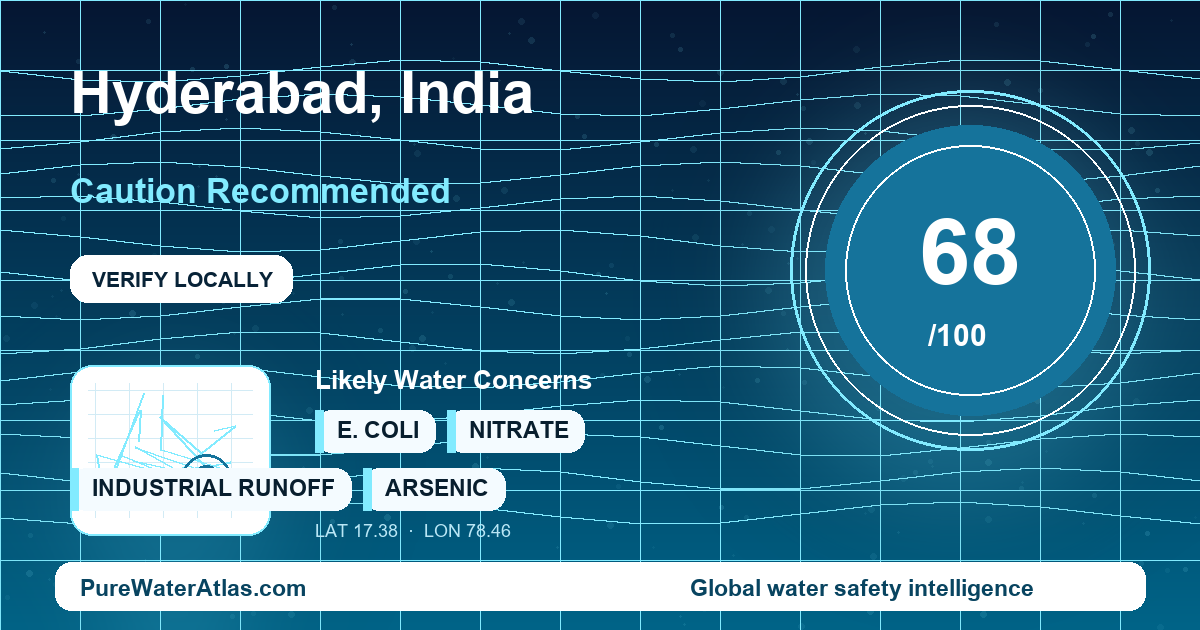
| Overall safety status | Caution recommended — PureWaterAtlas water safety score: 68/100. Hyderabad receives treated municipal water, but safety at an individual tap can still be affected by distribution conditions, building plumbing, household storage tanks, and the use of private borewell water. |
|---|---|
| Can visitors drink the tap water? | Caution is recommended. Travelers who cannot verify the building’s water source, plumbing, and storage conditions should use sealed packaged water from a reliable source or appropriately treated water. |
| Resident advice | Residents should identify whether their supply is HMWSSB municipal water, private borewell water, tanker water, or a mixture. Keep household storage tanks clean and test private groundwater rather than judging safety by taste or clarity alone. |
| Main water source | Primarily treated surface water supplied through Hyderabad’s regional system, with the Krishna and Godavari river systems providing major sources alongside Manjira, Singur, Osmansagar, Himayatsagar, and other components of the wider supply portfolio. |
| Responsible authority | Hyderabad Metropolitan Water Supply & Sewerage Board (HMWSSB), under Telangana’s urban water-administration framework. |
| Filter recommendation | Treatment should match the measured problem. For microbial concerns, reliable filtration and disinfection may be appropriate. For borewell water with excessive dissolved contaminants such as fluoride, nitrate, or high mineral content, laboratory testing should guide whether reverse osmosis or another targeted treatment is necessary. |
Is Tap Water Safe to Drink in Hyderabad, India?
Hyderabad’s municipal drinking water is supplied by the Hyderabad Metropolitan Water Supply & Sewerage Board, the statutory utility responsible for potable-water supply and sewerage services in the metropolitan area. The system is very different from Hyderabad in Sindh, Pakistan: this page refers exclusively to Hyderabad in Telangana, India.
At the utility level, Hyderabad has substantial treated surface-water infrastructure. Government and HMWSSB records identify the Krishna and Godavari systems as major sources, alongside Manjira, Singur, Osmansagar and Himayatsagar in the broader historical and operational supply portfolio. The precise contribution of individual sources can change with reservoir storage, season, infrastructure operation and demand.
That does not mean every household tap has identical water quality. Water can leave a treatment plant in acceptable condition and still be affected later by leakage, pressure changes, local pipe conditions, illegal connections, building plumbing or poorly maintained underground and rooftop storage tanks. For that reason, a city-level safety assessment should distinguish the quality of treated municipal supply from the quality of water actually consumed at a particular property.
Who Manages Drinking Water in Hyderabad?
The Hyderabad Metropolitan Water Supply & Sewerage Board (HMWSSB) is the principal agency responsible for planning, operating and maintaining Hyderabad’s metropolitan potable-water supply and sewerage systems. Telangana’s Municipal Administration & Urban Development Department lists HMWSSB within the state’s urban administration structure.
Water-quality monitoring is not purely theoretical. India’s Ministry of Housing and Urban Affairs lists a Telangana water-quality monitoring system operated through Hyderabad Water, and the national Jal Jeevan Mission Water Quality Management Information System identifies a recognized state-level laboratory in Hyderabad capable of testing parameters including E. coli, total coliform, residual chlorine, fluoride, nitrate, iron, TDS, hardness and other chemical indicators.
Independent monitoring has also existed in Hyderabad. The Institute of Health Systems reports a long-running collaboration with HMWSSB in which consumer-end water was checked for residual chlorine, bacteriological quality and physicochemical characteristics. This is useful evidence that Hyderabad’s water-safety challenge is understood as a treatment-and-distribution issue rather than simply a question of raw-water source quality.
Where Does Hyderabad’s Tap Water Come From?
Hyderabad has progressively expanded beyond its older local reservoirs. Official and government-linked records document supply infrastructure associated with Osmansagar, Himayatsagar, the Manjira and Singur systems, the Krishna Drinking Water Supply Project and the Godavari Drinking Water Supply Project. A government environmental filing based on HMWSSB source data records the major expansion toward Krishna and Godavari water as the metropolitan area grew.
This diversification matters for water security. Hyderabad is a large inland metropolis with high and growing demand, so the city depends on long-distance conveyance, pumping, treatment plants, service reservoirs and a very large distribution network. Source availability can therefore vary with monsoon inflows and reservoir storage, while the water reaching a neighborhood also depends on operational conditions within the network.
Mission Bhagiratha, Telangana’s statewide drinking-water program, also relies heavily on Krishna and Godavari basin sources and describes a treatment chain based on raw-water abstraction, water-treatment plants, pumping, balancing reservoirs and distribution networks. Hyderabad’s core metropolitan system is operated by HMWSSB, but the statewide program provides useful context for Telangana’s broader shift toward treated surface-water supply.
How Is Hyderabad’s Municipal Water Treated and Monitored?
Municipal surface water is treated before distribution. Conventional treatment normally includes clarification and filtration followed by disinfection, with operational monitoring intended to control microbial risk and maintain acceptable physical and chemical characteristics. Residual chlorine is particularly important because it provides continuing protection after water leaves the treatment plant.
The presence of a water-quality monitoring system does not eliminate the need for household awareness. A compliant sample from a treatment plant or monitoring point cannot guarantee the condition of every building’s plumbing or storage tank. Consumers in apartment buildings should therefore consider the entire chain from municipal inlet to sump, pump, rooftop tank and kitchen tap.
Main Water-Quality Concerns in Hyderabad
1. Microbial contamination after treatment
For consumers using treated municipal water, one of the most practical risks is contamination introduced after treatment. Low-pressure events, damaged pipes, sewer proximity, cross-connections and contaminated storage tanks can create opportunities for bacteria to enter water that was originally disinfected.
Warning signs such as unusual turbidity, odor, visible particles or a sudden change after a supply interruption deserve attention, but microbial contamination can also occur without obvious sensory changes. When contamination is suspected, boiling is a useful emergency measure for microbial hazards while the source of the problem is investigated.
2. Household and apartment storage tanks
Many Hyderabad properties use sumps or overhead tanks to manage intermittent or scheduled supply. Storage improves availability but adds another potential contamination point. Tanks that are uncovered, rarely cleaned, exposed to sediment or connected to poorly maintained plumbing can reduce water quality before it reaches the drinking tap.
Residents should keep tanks covered, inspect them periodically and arrange appropriate cleaning. Telangana’s own rainwater-harvesting guidance emphasizes cleaning storage tanks and protecting inlets from insects and debris; the same hygiene principle is relevant to domestic drinking-water storage.
3. Groundwater and borewell water
Private borewell water should not be assumed to have the same quality as treated HMWSSB water. The Central Ground Water Board’s Telangana groundwater monitoring shows that groundwater quality varies substantially by location. Recent state monitoring identifies nitrate and fluoride as important groundwater concerns in Telangana and also reports localized uranium occurrence.
These findings do not mean that every Hyderabad borewell is contaminated. They do mean that groundwater should be tested rather than judged by taste or clarity alone. A useful laboratory panel includes microbiology, TDS or conductivity, hardness, nitrate, fluoride and locally relevant metals or trace elements.
4. TDS, hardness and mineral content
Consumers sometimes interpret high TDS or hardness as proof that water is unsafe. That is too simplistic. TDS and hardness primarily describe dissolved mineral content and can affect taste, scaling and appliance performance. They are useful diagnostic parameters, but a safety assessment should also include microbiological indicators and specific contaminants such as nitrate or fluoride where groundwater is involved.
5. Source-water pollution and the Musi River
The Musi is heavily affected by urban wastewater in parts of and downstream from Hyderabad. Central Pollution Control Board monitoring has documented degraded water quality and elevated organic and microbial pollution in several Musi stretches. This is an important environmental issue, but consumers should not confuse polluted urban river water with the treated municipal water delivered by HMWSSB from its drinking-water source and treatment system.
Should Travelers Drink Tap Water in Hyderabad?
Travelers have less information about the plumbing, storage-tank maintenance and recent supply history of a hotel, rental or private residence. A cautious approach is therefore reasonable. Use sealed packaged water from a reliable source or water that has been appropriately treated when you cannot verify the condition of the building’s water system.
Ice, refill dispensers and reusable bottles are only as safe as the water and handling practices used to prepare them. Travelers with higher vulnerability to gastrointestinal illness should be especially conservative when the source or storage conditions are uncertain.
Advice for Hyderabad Residents
If your home receives HMWSSB water directly and has well-maintained plumbing and storage, the risk profile is different from a property relying partly or entirely on a private borewell or tanker. Start by identifying your actual source. In apartment buildings, ask how often the sump and overhead tanks are cleaned and whether municipal and borewell supplies are mixed.
If you use a borewell, test it periodically rather than selecting a purifier based only on TDS. Reverse osmosis can be appropriate for certain dissolved contaminants or high mineral loads, but it is not automatically necessary for every municipal-water household. For primarily microbial risk, properly maintained disinfection or certified filtration may be more appropriate. Treatment should follow the measured problem.
After a major pipe repair, unusual discoloration, prolonged interruption, flooding or suspected sewage intrusion, avoid assuming that clear-looking water is safe. Seek utility guidance and consider temporary boiling or another validated treatment method until normal conditions are restored.
How to Test Drinking Water in Hyderabad
For a household safety check, prioritize tests that answer a real exposure question. Municipal-water users concerned about storage or distribution should consider E. coli or total coliform, turbidity and residual chlorine. Borewell users should add TDS/conductivity, hardness, nitrate and fluoride, with metals or other parameters selected according to local geology and previous results.
Telangana is represented in India’s Jal Jeevan Mission water-quality laboratory system, and the state-level laboratory listed in Hyderabad can test a broad range of microbiological and chemical parameters. Consumers can also use a competent accredited laboratory. Sampling technique matters: a poorly collected sample can produce misleading results, especially for microbiology.
For more detail, see the PureWaterAtlas complete guide to drinking-water testing and the Water Contaminant Search Engine.
What Treatment Makes Sense?
There is no single purifier that is ideal for every Hyderabad household. If testing shows microbiological contamination but dissolved minerals are acceptable, a treatment train focused on particle removal and reliable disinfection may be sufficient. If a borewell has excessive fluoride, nitrate or other dissolved contaminants, treatment may require reverse osmosis or another technology specifically validated for the contaminant.
Activated carbon can improve taste and reduce some organic chemicals but does not reliably remove all dissolved salts, nitrate, fluoride or microorganisms. UV can disinfect clear water when correctly sized and maintained, but it does not remove dissolved chemicals. Boiling is effective against many pathogens but does not remove salts, fluoride, nitrate or metals and can concentrate nonvolatile dissolved substances as water evaporates.
For broader treatment guidance, see choosing a drinking-water treatment system and water purification methods.
Official and Technical Sources
- Government of Telangana — Municipal Administration & Urban Development — state department listing HMWSSB and Hyderabad’s urban water-administration structure.
- Ministry of Housing and Urban Affairs — Water Quality Assessment — national portal identifying Telangana’s Hyderabad Water quality-monitoring system.
- Jal Jeevan Mission — Water Quality Management Information System — national drinking-water laboratory and water-quality monitoring platform.
- Central Ground Water Board — Telangana Groundwater Quality Bulletin, Pre-monsoon 2024 — state groundwater evidence for nitrate, fluoride and other parameters.
- Mission Bhagiratha, Government of Telangana — official statewide treated piped-water program and Krishna/Godavari source context.
- Institute of Health Systems Laboratory — independent Hyderabad consumer-end water-quality monitoring work undertaken with HMWSSB.
- Central Pollution Control Board — national environmental regulator and surface-water monitoring authority, including Musi River monitoring.
- World Health Organization Guidelines for Drinking-water Quality — international reference for microbial, chemical and operational drinking-water risk management.
Bottom Line
Hyderabad, Telangana has a large treated municipal water system operated by HMWSSB and supported by major surface-water sources, particularly the Krishna and Godavari systems. The municipal supply should not be equated with untreated local surface water or private groundwater.
For an individual household, however, safety depends on more than the treatment plant. Distribution integrity, intermittent supply, building plumbing, sump and rooftop-tank hygiene, and the use of borewell water can materially change the water that reaches the glass. Residents should identify their actual source, maintain storage systems, test private groundwater and choose treatment based on measured contaminants rather than assumptions.
Read the full guide: Global Water Quality Guide
Explore more in this category: Global Water Quality Articles