
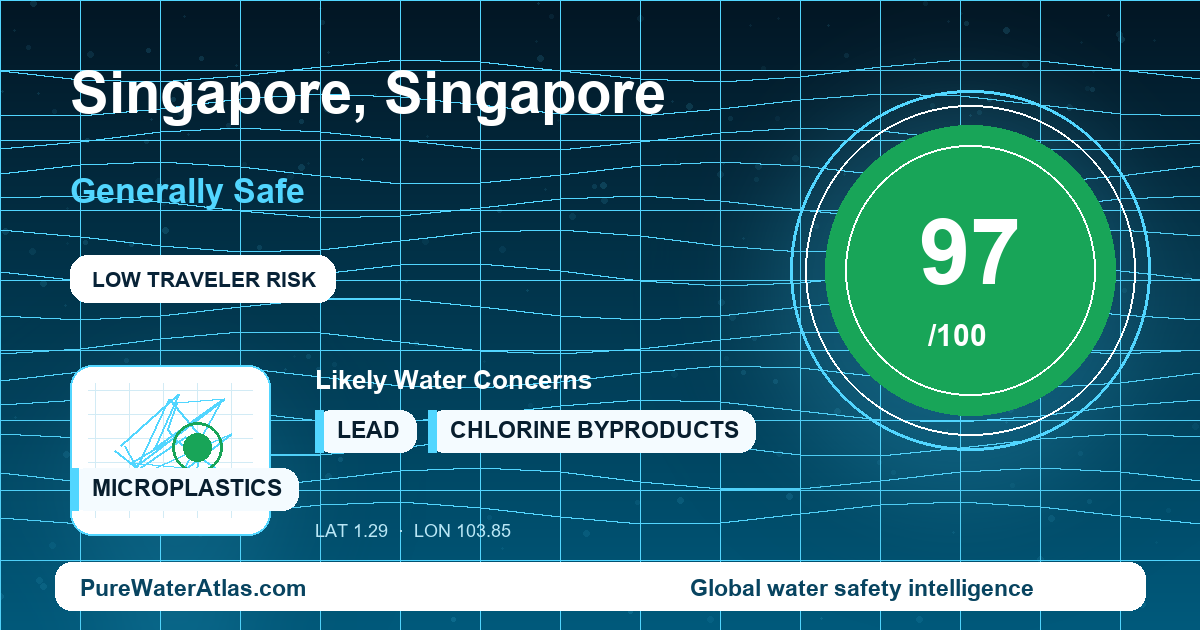
Singapore tap water is generally safe to drink directly from the tap, supported by PUB’s integrated national system, the Four National Taps strategy, and routine drinking-water monitoring from source to tap.
Quick Answer
| Safety status | Generally Safe — PureWaterAtlas water safety score: 97/100. |
|---|---|
| Can tourists drink it? | Yes. Most travelers can drink Singapore tap water, brush teeth with it, and use ice from regulated hotels, restaurants, cafes, and convenience stores. |
| Resident advice | Residents connected to PUB mains water generally do not need a safety filter for microbiological protection. Focus on private plumbing, stagnant taps, storage tanks, and filter maintenance. |
| Main water supply identity | Singapore uses the Four National Taps: local catchment water, imported water from Johor, NEWater, and desalinated seawater. |
| Water authority | PUB, Singapore’s National Water Agency, manages water supply, catchments, drainage, used water, NEWater, desalination, and drinking-water quality monitoring. |
| Filter recommendation | A filter is usually optional for taste or chlorine reduction, not normally required for basic safety. Poorly maintained filters can make water quality worse. |
In normal circumstances, Singapore tap water is safe to drink without boiling. The main practical exceptions are not citywide supply failures but building-specific issues: old or stagnant private plumbing, poorly maintained storage tanks, recently disturbed pipes, or neglected point-of-use filters.
Why Singapore Is Different
Singapore is not a typical city that depends on one large river, lake, or groundwater basin. It is a small, densely urbanized tropical island city-state with limited natural freshwater storage. Its drinking-water safety and reliability come from engineered diversification, centralized treatment, and national-scale management rather than from a single abundant natural source.
The defining feature of Singapore’s water system is the Four National Taps strategy. PUB describes these as local catchment water, imported water, NEWater, and desalinated water. This approach developed because Singapore has limited land area, no large natural rivers, relatively small catchments, high population density, and historic dependence on imported water from Johor in Malaysia. Since the 2000s, Singapore has expanded NEWater and desalination while increasing the capture of urban stormwater into reservoirs.
This means a glass of tap water in Singapore may contain a blend of reservoir water, imported water, desalinated seawater, and advanced-treated reclaimed water branded as NEWater, depending on supply operations. That blend is normal for Singapore. It is not a warning sign and does not mean the water is unsafe.
Singapore’s water safety profile is therefore high-confidence at the public-system level. The main uncertainty is local: official public information cannot prove the condition of every hotel pipe, apartment tap, private fixture, storage tank, dispenser, or under-sink filter. In Singapore, as in any city, the final few meters between the public mains and the drinking glass can matter.
Where Does Singapore’s Tap Water Come From?
Singapore’s drinking water is supplied through a national network managed by PUB. The raw-water and treated-water system includes local reservoirs and urban stormwater catchments, imported water infrastructure linked to Johor, NEWater factories, desalination plants, waterworks, service reservoirs, transmission mains, and internal water service installations in high-rise buildings.
The first national tap is local catchment water. Because Singapore is highly urbanized, rainwater is collected through an extensive system of drains, canals, rivers, and reservoirs. Heavy rainfall and monsoon periods can increase raw-water turbidity and urban runoff into catchments, but Singapore’s treatment barriers are designed to manage raw-water variation before water enters the potable distribution system.
The second national tap is imported water from Johor, Malaysia. Historically, this was a major pillar of Singapore’s water supply because the island’s natural storage is limited. Singapore’s modern water strategy reduces vulnerability by pairing imported supply with reclaimed and desalinated sources.
The third national tap is NEWater, Singapore’s high-grade reclaimed water. NEWater is produced using advanced treatment processes including microfiltration, reverse osmosis, and ultraviolet disinfection. In Singapore’s water identity, NEWater is not a fringe supply; it is a major part of national water resilience.
The fourth national tap is desalinated seawater, treated through membrane-based desalination plants. Desalination strengthens drought resilience and reduces dependence on rainfall and imported water, although Singapore still manages the energy demands and strategic pressures associated with desalination.
Before water reaches homes, hotels, restaurants, and public buildings, PUB blends and treats these supplies for distribution through the public mains network. Once water leaves PUB’s mains, however, building plumbing, tanks, pumps, fittings, and filters can affect what comes out of an individual tap.
Who Manages Drinking Water in Singapore?
Singapore’s drinking-water authority is PUB, Singapore’s National Water Agency. PUB is responsible for the national water supply and distribution network, water catchment management, drainage, used water management, NEWater, desalination, and drinking-water quality monitoring.
Singapore’s piped drinking water is governed under the Environmental Public Health (Quality of Piped Drinking Water) Regulations. PUB also states that Singapore’s drinking water is benchmarked against the World Health Organization Guidelines for Drinking-water Quality and monitored from source to tap.
This centralized structure is one reason Singapore’s tap-water safety profile is unusually strong. The city and country share one integrated public water system, so national-level drinking-water documentation is directly relevant to the city. At the same time, citywide monitoring does not provide real-time confirmation for every private premise, apartment tower, hotel room, storage tank, or individual tap. For residents and long-stay visitors, that distinction is important: PUB mains water may be compliant while a building’s internal system still needs attention.
Main Local Water Concerns
Singapore’s main tap-water concerns are typically practical and local rather than signs of a contaminated citywide supply.
- Chlorine taste or disinfectant odor: Sensitive drinkers may notice a chlorine-like taste or smell, especially in some buildings or after water has been standing in pipes. This is usually a taste issue in a treated system, not proof that the water is unsafe.
- Temporary discoloration or sediment: Brown, cloudy, particle-filled, or turbid water can occur after plumbing works, fire hydrant activity, building tank disturbance, or stagnation in internal pipes. If this happens, avoid drinking it until it clears and report persistent issues.
- Private plumbing and fixtures: Non-approved fittings, old fixtures, stagnant pipe sections, flexible hoses, or recent renovation debris can affect taste, clarity, or metals at an individual tap. Lead is not identified as a well-documented citywide Singapore problem, but it can be relevant in private plumbing anywhere.
- High-rise storage tanks and pumps: Many multi-storey buildings use internal storage tanks, rooftop or intermediate tanks, and pumping systems. If these are not properly maintained by the owner, MCST, landlord, or managing agent, they can affect taste, odor, clarity, or microbial quality within that building.
- Climate and stagnation: Singapore’s hot, humid climate can make water left standing in bottles, kettles, dispensers, and seldom-used taps taste stale faster. Clean containers and routine flushing are sensible.
During local plumbing works or water-service interruptions, follow PUB or building-management notices and flush taps until water runs clear before using the water for drinking or cooking.
For Travelers
Can you drink tap water in Singapore? Yes. In normal circumstances, travelers can drink Singapore tap water without boiling. Bottled water is usually unnecessary for safety, although some visitors may prefer it for taste, convenience, or carrying around in hot weather.
Brushing teeth: Tap water is safe for brushing teeth in hotels, apartments, airport facilities, restaurants, and homes connected to the public supply.
Ice: Ice from regulated hotels, restaurants, cafes, and convenience stores is generally considered safe. Avoid ice only if it comes from an obviously unhygienic or informal source, which is uncommon in Singapore.
Hotels and restaurants: Hotels and restaurants normally use PUB mains water. If a hotel room tap appears unused for a long time, run the cold tap briefly before drinking, especially in an older building or a room that may have been vacant.
Practical travel advice: Carry a refillable bottle. Singapore is warm and humid, and there are many safe refill opportunities. If water is brown, cloudy, has visible particles, or has an unusual odor, do not drink it until it clears. Report the issue to hotel staff, the building manager, or PUB rather than assuming it reflects Singapore’s whole water system.
For Residents
For most Singapore residents connected to PUB mains water, a home filter is not needed for basic safety. Filters can be reasonable for taste, chlorine reduction, or personal assurance, but they must be maintained according to the manufacturer’s schedule. A neglected cartridge, stagnant filter housing, or poorly maintained dispenser can create a water-quality problem that was not present in the mains supply.
Residents should consider testing or further investigation if water remains brown, yellow, black, cloudy, oily, metallic-tasting, or particle-filled after flushing. If only one tap has a problem, start with the fixture, aerator, flexible hose, under-sink filter, or local pipework before assuming the public supply is affected.
Testing for lead and other metals may be prudent in older properties, recently renovated homes, premises with imported or non-approved fixtures, or households with infants, pregnant residents, or medically vulnerable people. This should be treated as a private-plumbing question, not as evidence of a known citywide lead issue.
Older buildings are not automatically unsafe, but internal plumbing can be the weak point in an otherwise high-quality public supply. Watch for stagnant water, corroded fittings, old pipes, metallic taste, and renovation-related debris. If concerns persist, request checks from building management and use accredited laboratory testing rather than relying only on taste or appearance.
In multi-storey buildings, storage tanks, pumps, and internal water service installations are typically managed by the owner, MCST, landlord, or managing agent. Poor maintenance can cause sediment, odor, discoloration, or microbial concerns inside the building even when PUB mains water is compliant.
Relevant Contaminants and Water-Quality Issues
The most relevant Singapore tap-water issues are not exotic contaminants but common treated-water and building-plumbing topics.
- Chlorine in Drinking Water is relevant because disinfectant taste or odor is one of the most likely complaints in a safe, treated public system.
- Turbidity in Drinking Water helps explain temporary cloudiness after plumbing works, tank disturbance, or raw-water variation managed by treatment barriers.
- Sediment in Drinking Water is useful for residents seeing particles, discoloration, or debris from internal plumbing or storage tanks.
- Lead in Drinking Water is not identified here as a citywide Singapore problem, but it is relevant for old fittings, private plumbing, and household testing decisions.
- E. coli in Drinking Water explains why storage tank hygiene, microbial barriers, and filter maintenance matter even in a high-performing public water system.
For broader context, see PureWaterAtlas guides to Drinking Water Safety, Global Water Quality, and Water Treatment Systems.
How to Verify Your Water Quality
Singapore has strong city-level and national-level drinking-water documentation, but no public dataset can verify every tap in real time. Verification should match the problem you are seeing.
- If you are comparing destinations, use the Global Water Quality Checker.
- If you want to understand a specific substance or symptom, use the Contaminants Search Engine.
- If you have persistent discoloration, particles, metallic taste, or concerns after renovation, consult the PureWaterAtlas Water Testing guide.
- If lead is a concern because of private plumbing or older fixtures, see Lead in Drinking Water: Testing and Detection Methods.
- If an unusual advisory or localized contamination event occurs, boiling guidance may be relevant; see Boiling Water Purification: Complete Guide. Boiling is not normally needed for Singapore tap water.
- For microbial treatment concepts, see UV Water Purification: Complete Guide, especially if evaluating private devices.
Official and Technical Sources
- PUB Singapore: Four National Taps — official explanation of local catchment water, imported water, NEWater, and desalinated water.
- PUB Singapore: Drinking Water Quality — official PUB information on potable water quality, monitoring, and safety from source to tap.
- PUB Singapore: Water Supply — overview of Singapore’s national water supply system and PUB’s role.
- Singapore Statutes Online: Environmental Public Health (Quality of Piped Drinking Water) Regulations — legal framework for piped drinking-water quality.
- World Health Organization: Guidelines for Drinking-water Quality — international benchmark referenced for drinking-water safety.
- Meteorological Service Singapore: Climate of Singapore — climate and rainfall context relevant to tropical catchments and runoff.
- CDC Travelers’ Health: Singapore — traveler health context for Singapore.
Bottom Line
Singapore tap water is generally safe to drink directly from the tap, with a high PureWaterAtlas safety score of 97/100. The city-state’s water system is unusual because it is built around the Four National Taps: local catchment water, imported water from Johor, NEWater, and desalinated seawater. PUB centrally manages treatment, supply, and monitoring under Singapore’s piped drinking-water regulations and WHO-benchmarked guidance. Travelers can normally drink tap water, brush teeth, and use ice from regulated venues without concern. Residents usually do not need a safety filter, but should pay attention to private plumbing, stagnant taps, old fittings, storage tanks, and neglected filters. The key limitation is local: every individual building and tap cannot be assumed identical without inspection or testing.
Read the full guide: Global Water Quality Guide
Explore more in this category: Global Water Quality Articles