
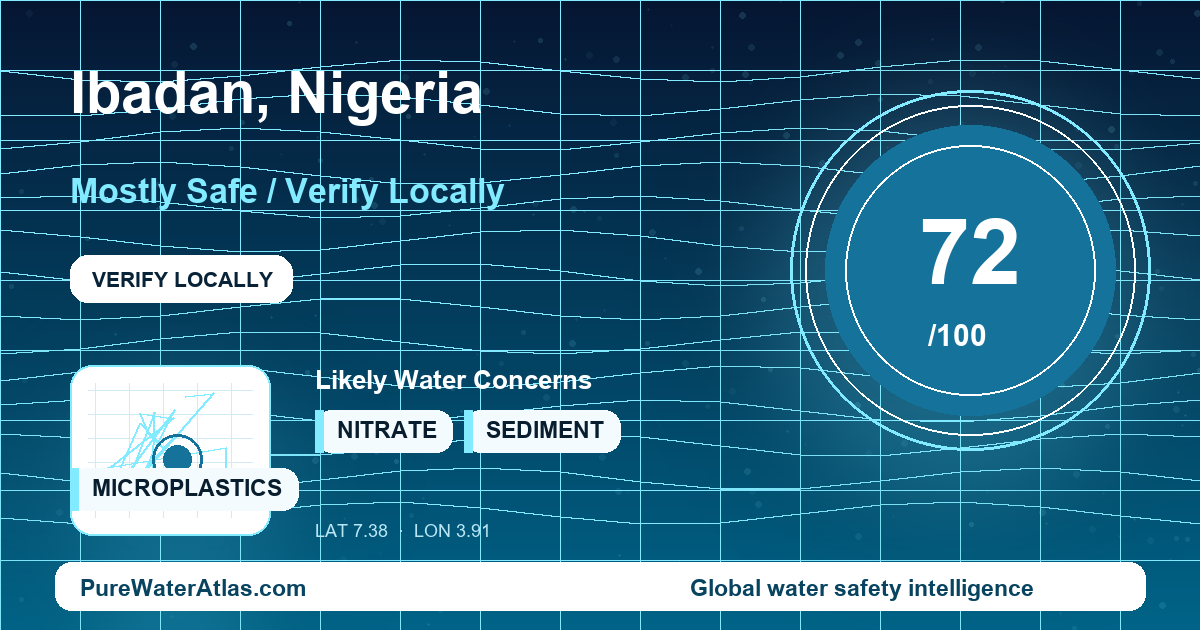
Ibadan tap water can be acceptable when it comes from the treated municipal system and remains protected through the distribution network, building plumbing, and storage tanks, but many homes and visitors rely on mixed sources that need local verification.
Quick Answer
| Overall safety status | Mostly Safe / Verify Locally. PureWaterAtlas score: 72/100. Treated municipal water is the lower-risk option, but safety depends on local service reliability, disinfectant residual, pipe condition, and storage hygiene. |
|---|---|
| Can travelers drink it? | Short-term visitors should not assume every tap in Ibadan is potable. Use sealed bottled water, boiled water, or properly filtered and disinfected water unless a reputable hotel or host can confirm treated supply and maintained treatment. |
| Resident guidance | Residents connected to Oyo State Water Corporation supply can use tap water more confidently after checking local service conditions. Homes using boreholes, wells, tankers, or stored water should test and treat according to results. |
| Main public source identity | Ibadan’s public supply is historically based on surface-water sources, especially the Asejire Reservoir/Dam system on the Osun River catchment, supported by local waterworks and reservoirs such as Eleyele. |
| Water authority | Oyo State Water Corporation is the principal public water-supply utility for Ibadan and wider Oyo State. |
| Filter recommendation | Not automatically required for every municipal connection, but point-of-use treatment is prudent where supply is intermittent, water is stored, or the household uses boreholes, wells, tankers, or mixed sources. |
Why Ibadan Is Different
Ibadan is not a city where one simple answer covers every tap. The practical safety question is not only whether the city has treated public water infrastructure; it is whether the water reaching a specific household, hotel, school, or compound has remained protected after treatment. Ibadan’s water pattern often includes a mix of public tap water, borehole water, shallow wells, tanker-supplied storage, sachet or bottled water, and water held in tanks. A household may use several of these in the same week, especially where municipal supply is intermittent.
The city is inland in southwestern Nigeria, so coastal salinity intrusion is not the defining drinking-water risk. Ibadan’s concerns are more closely tied to surface-water catchment quality, rainfall-driven turbidity, sanitation, urban runoff, groundwater vulnerability, old or repaired distribution lines, and the condition of private storage. This makes Ibadan different from cities where a single, continuously pressurized central system supplies most consumers.
The most useful classification is therefore cautious: Ibadan tap water is mostly safe only when it comes from the treated municipal system, has a detectable disinfectant residual, and passes through well-maintained building plumbing and storage. Without those conditions, residents and visitors should verify locally rather than relying on appearance, taste, or the fact that the address is inside the city.
Where Does Ibadan’s Tap Water Come From?
Ibadan’s public drinking-water supply is historically associated with surface-water sources. The major system identified for the city is the Asejire Dam and Reservoir, on the Osun River catchment, together with the Asejire Waterworks and related treatment and transmission infrastructure. The city also has older and locally significant water infrastructure, including Eleyele Reservoir and Eleyele Waterworks.
Eleyele is important not only as part of Ibadan’s water-resource history, but also in the city’s wider water and flood-management geography. World Bank-supported Ibadan flood-management work highlights how drainage, catchment conditions, and urbanization around water bodies matter for the city. Those same pressures can affect raw-water quality by increasing runoff, sediment, and contamination risks during heavy rain or flooding.
After treatment, municipal water is distributed through Oyo State water-supply infrastructure, including urban distribution mains and service reservoirs. However, the city’s growth has outpaced parts of the older network. In practice, many residents supplement or replace piped supply with private boreholes, shallow wells, vendors, tankers, and packaged water. This mixed-source reality is central to Ibadan drinking-water safety: water from a treated surface-water works, a private borehole, a shallow well, and a tanker-fed roof tank may have very different risk profiles.
Who Manages Drinking Water in Ibadan?
The principal public water-supply utility for Ibadan is Oyo State Water Corporation, which serves Ibadan and the wider state water-supply system. State-level water resources and environmental agencies also influence source-water protection, infrastructure planning, and urban water management.
Nigeria’s drinking-water quality framework is guided by the Nigerian Standard for Drinking Water Quality, with national water-sector oversight through the Federal Ministry of Water Resources and Sanitation. Packaged water is regulated separately through Nigerian food and drug control systems.
A key limitation for consumers is that recent, routine, neighborhood-level tap-water compliance data for Ibadan are not readily available in a public consumer-report format. The city has identifiable infrastructure and authority records, but available public information does not prove that every tap, borehole, storage tank, hotel, vendor supply, or building plumbing system is safe on a given day. PureWaterAtlas therefore avoids claiming exact pass rates or neighborhood safety rankings without current laboratory or utility data.
Main Local Water Concerns
Microbial contamination is the main practical risk where water is stored, collected from shallow wells, handled by vendors, delivered by tankers, or supplied after pipe breaks and pressure loss. Intermittent supply can create periods of low or negative pressure, increasing the chance that leaks, cross-connections, or contaminated surroundings affect distribution water, especially where pipes are old or repairs are frequent.
Rainy-season turbidity is another Ibadan-specific concern because much of the public source identity is surface-water based. Heavy rainfall can increase sediment loading, urban runoff, latrine overflow risk, and contamination of shallow wells or poorly sealed boreholes. Turbid water is harder to disinfect reliably because particles can interfere with treatment and shield microorganisms.
Groundwater variability matters for households using private boreholes or wells. Safety can vary with depth, construction quality, nearby septic systems, drainage, waste disposal, and local geology. Clear borehole water is not automatically safe. Iron and manganese may occur in some groundwater supplies and can cause staining, taste, or color problems. Nitrate is plausible in shallow groundwater near septic tanks, pit latrines, waste dumps, or agricultural runoff, and is especially important for infants and pregnant people.
Building-level plumbing and storage are also major control points. Lead is not confirmed as a citywide Ibadan problem from public data, but older internal plumbing, brass fixtures, solder, or storage fittings can create building-specific exposure. Storage tanks can lose disinfectant residual over time and become contaminated if they are uncovered, poorly cleaned, exposed to dust, insects, rodents, or floodwater, or filled from mixed sources.
For Travelers
Visitors should use a conservative approach in Ibadan. Do not treat every tap as automatically safe for drinking. In reputable hotels, treated or filtered water may be acceptable if the property can confirm its water source, tank maintenance, and additional treatment such as filtration, UV, or chlorination. If that information is unclear, sealed bottled water, boiled water, or properly filtered and disinfected water is the safer default.
For brushing teeth, short-stay visitors, people with sensitive stomachs, children, immunocompromised travelers, and anyone unsure about the building’s storage tank should use bottled, boiled, or filtered water. This is especially sensible after outages, flooding, or visible discoloration.
Avoid ice from street vendors or informal outlets. In higher-standard hotels and restaurants, ask whether ice is made from treated or bottled water. If staff cannot answer clearly, skip the ice. Prefer sealed bottled drinks with intact seals, avoid refilled bottles, and choose hot drinks prepared with freshly boiled water. Travelers staying longer should combine sediment filtration with a reliable disinfection step such as boiling or UV for water of uncertain microbial quality. See the PureWaterAtlas boiling water purification guide and UV water purification guide for practical treatment options.
For Residents
For Ibadan residents, the best approach is source-specific. If your home receives regular treated supply from Oyo State Water Corporation and the water is clear, chlorinated, and not stored for long periods, the risk is lower. Even then, intermittent pressure, household tanks, old internal plumbing, and local repairs can change water quality before it reaches your glass.
A home filter is not automatically required for every municipal connection, but point-of-use treatment is prudent in many Ibadan homes because of intermittent supply, storage tanks, mixed sources, and limited tap-by-tap public data. For municipal water with sediment, color, or taste issues, a sediment pre-filter plus activated carbon may help, provided cartridges are replaced on schedule. For borehole or well water, test first and choose treatment based on results. UV or chlorination is important for microbial control in clear water, while reverse osmosis or targeted media may be needed for nitrate, metals, or specific chemistry problems.
Test any private borehole, shallow well, tanker-fed storage, or newly occupied home before using it as drinking water. At minimum, include E. coli or thermotolerant coliforms, total coliforms, turbidity, pH, electrical conductivity or total dissolved solids, nitrate, iron, manganese, and residual chlorine where chlorinated water is supplied. After flooding, pipe repairs, long outages, or tank cleaning, retest or disinfect before returning the water to drinking use.
Storage tanks deserve special attention in Ibadan. Tanks should be covered, screened, cleaned, and disinfected on a schedule. Vents and overflow pipes should be protected from insects, dust, rodents, and floodwater. If stored water has lost disinfectant residual or has been exposed to contamination, boil, UV-treat, or otherwise disinfect it before drinking.
Relevant Contaminants and Water-Quality Issues
The most urgent contaminant group for Ibadan households using stored water, wells, or post-outage supply is microbial contamination, especially E. coli. A positive result indicates fecal contamination and the need for immediate disinfection and source investigation.
Turbidity and sediment are especially relevant during the rainy season, after bursts or repairs, and where tanks accumulate deposits. Turbidity matters because it can make disinfection less reliable. Chlorine is relevant both as a taste or odor issue and as an indicator of remaining disinfectant protection in treated water.
For private groundwater sources, test for nitrate, especially near septic systems, latrines, waste dumps, or runoff influence. Iron and manganese may affect color, staining, and taste in some borehole supplies. Lead should be treated as a building-plumbing risk rather than a confirmed citywide Ibadan finding; older or unknown plumbing should be tested using first-draw and flushed samples.
How to Verify Your Water Quality
The most reliable way to answer “is my Ibadan tap water safe?” is to test the exact water you drink, from the exact tap or storage point you use. Start with the PureWaterAtlas complete guide to water testing and the broader drinking water safety guide. For households relying on wells, boreholes, or tankers, microbial testing and nitrate testing should be prioritized.
If your test shows a contaminant you do not recognize, use the PureWaterAtlas Contaminants Search Engine. To compare Ibadan with other city-level water safety profiles, use the Global Water Quality Checker and the Global Water Quality guide. For treatment selection, consult the Water Treatment Systems guide and the Water Microbiology resource.
Residents with older buildings should also consider lead testing methods. Households near sanitation or runoff risks should review nitrate testing and the PureWaterAtlas guide to agricultural runoff in drinking water.
Official and Technical Sources
- Oyo State Government official portal — official state portal for public-service context and state water institutions.
- Federal Ministry of Water Resources and Sanitation — Nigerian national water-sector authority for water resources, supply, and sanitation context.
- Nigerian Standard for Drinking Water Quality — national drinking-water benchmark for Nigeria.
- World Bank: Ibadan Urban Flood Management Project — Ibadan-specific record documenting drainage, flooding, and urban infrastructure pressures relevant to water risk.
- WHO and UNICEF Joint Monitoring Programme data for Nigeria — national household water and sanitation access context.
- CDC Travelers’ Health: Nigeria — traveler-focused food and water hygiene guidance.
- WHO Guidelines for Drinking-water Quality — global framework for microbial safety, turbidity, disinfection, and risk-based management.
- JICA: Review and Update of Nigeria National Water Resources Master Plan — broader Nigerian water-resources planning context.
Bottom Line
Ibadan tap water is best treated as mostly safe only when verified locally. The lower-risk scenario is treated municipal water from the Oyo State system, with clear appearance, maintained disinfectant residual, sound building plumbing, and clean storage. The higher-risk scenarios are shallow wells, uncertain boreholes, tanker-fed tanks, vendor water, long-stored water, and taps affected by outages, pipe repairs, flooding, or old internal plumbing. Travelers should default to sealed bottled, boiled, or properly filtered and disinfected water unless a reputable hotel can confirm treatment. Residents should manage storage tanks carefully, test private sources, and choose treatment based on microbial and chemistry results rather than taste alone.
Read the full guide: Global Water Quality Guide
Explore more in this category: Global Water Quality Articles