
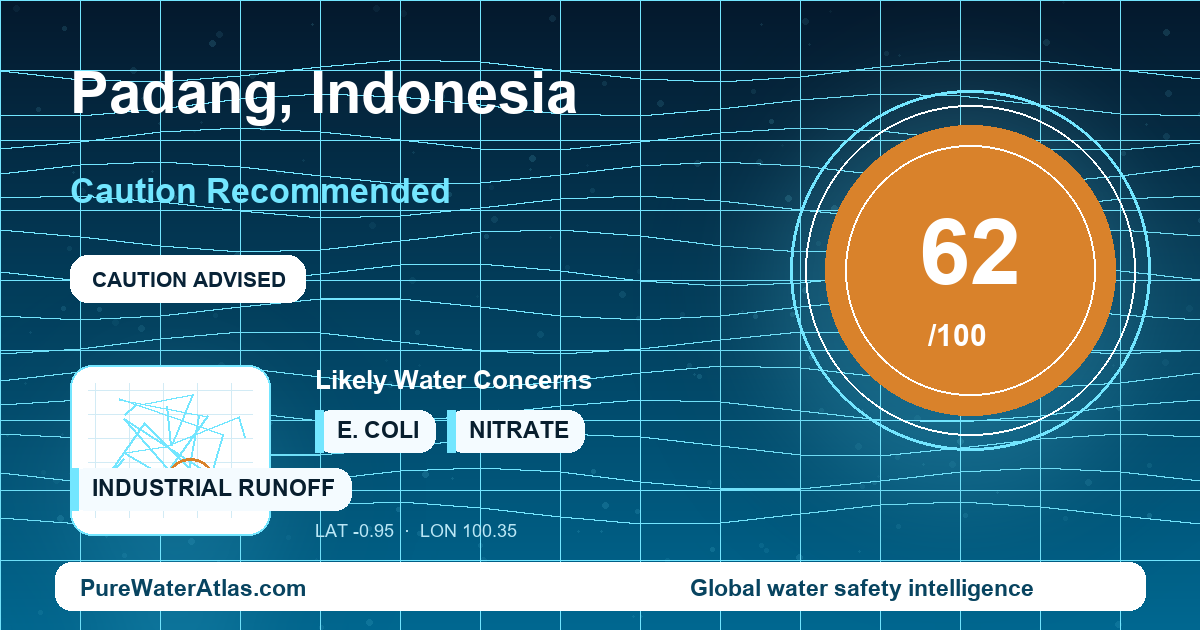
Padang, Indonesia: municipal piped water exists, but untreated tap water should be approached with caution because citywide tap-level compliance data are limited and local rainfall, storage, plumbing, and coastal groundwater conditions can change household risk.
Quick Answer
| Overall safety status | Caution recommended. PureWaterAtlas water safety score: 62/100. Padang has an organized municipal supply, but recent public, tap-level evidence is not sufficient to say untreated tap water is reliably safe at every household or hotel tap. |
|---|---|
| Can travelers drink the tap water? | Not recommended untreated. Short-term visitors should use sealed bottled water, properly boiled water, or water treated with a reliable purifier. |
| Resident guidance | Residents connected to Perumda Air Minum Kota Padang have a better starting point than households using shallow wells, but point-of-use treatment is still prudent for drinking. |
| Main water identity | Padang’s municipal supply is understood to rely mainly on local surface-water and upland catchment sources from rivers and springs around the city, treated before distribution. |
| Water authority | Perumda Air Minum Kota Padang, under local public authority supervision by the City of Padang. |
| Filter recommendation | For drinking: sediment prefiltration plus boiling, UV, or a maintained purifier. Private well users should test before choosing treatment, especially for microbes, salinity, nitrate, iron, manganese, turbidity, and pH. |
Why Padang Is Different
Padang is not a city where a simple “safe” or “unsafe” label captures the real household situation. It is a coastal city on the west coast of Sumatra facing the Indian Ocean, with a low-lying urban plain backed by steep upland catchments. That geography matters for drinking water. The municipal system depends on short, rain-responsive river and spring-fed catchments rather than a large imported water source. During heavy rainfall, flooding, or upstream slope disturbance, raw surface water can become more turbid and harder to treat consistently.
Padang also has a separate coastal groundwater risk profile. Municipal piped water and private shallow wells should not be treated as the same thing. A household connected to the Perumda Air Minum Kota Padang network starts from treated water, while a coastal household using a shallow well may face additional concerns such as brackish taste, salinity, sewage influence, iron, or manganese. The practical risk for visitors is usually not one unusual contaminant; it is the combination of rainfall-driven turbidity, possible microbial recontamination after treatment, intermittent pressure or repairs, and building-level storage tanks.
Padang’s environmental setting also makes emergency preparedness important. The city is exposed to earthquakes, intense rainfall, flooding, and landslide-related watershed disturbances. The 2009 West Sumatra earthquake is an example of a regional event that caused major urban infrastructure disruption, illustrating why residents should be ready to treat or store drinking water safely during outages, pipe damage, floods, or post-disaster recovery.
Where Does Padang’s Tap Water Come From?
Padang’s municipal drinking-water supply is operated by Perumda Air Minum Kota Padang. Publicly available utility and city materials indicate that the system relies mainly on local surface-water and upland catchment sources from rivers and springs around the city, with water treated through water-treatment installations before being distributed across the urban network. A recent official source-by-source production breakdown was not found in open sources, so this profile does not assign exact percentages to individual intakes.
The city’s water infrastructure includes raw-water intakes on local river and spring-fed catchments, water-treatment installations, distribution reservoirs, transmission mains, neighborhood service pipes, and building-level storage such as roof tanks, ground tanks, and local containers. Those final storage points are especially important in Padang and many other Indonesian cities because household or building tanks can become the last contamination point even when the utility water was treated upstream.
Older descriptions of Padang’s water system commonly point to mountain-fed water from foothills behind the coastal city, including river and spring systems flowing from the Barisan mountain side toward the urban plain. That historical context is consistent with Padang’s geography, but current public materials are not detailed enough to verify historical source shares by intake. The most accurate summary is that Padang depends heavily on local catchments and treated municipal distribution, with household conditions playing a major role in final tap safety.
Who Manages Drinking Water in Padang?
The municipal drinking-water utility is Perumda Air Minum Kota Padang. The Pemerintah Kota Padang is the local government authority associated with city public services and oversight of the regional drinking-water company. City-level administrative and environmental context is also available through BPS Kota Padang.
Indonesia’s drinking-water quality framework is governed nationally by Ministry of Health sanitary and drinking-water requirements, including Permenkes No. 2 Tahun 2023. Local implementation involves the water utility and local health authorities. This profile does not claim full compliance at every Padang tap because recent public distribution-zone results, residual chlorine data, E. coli results, household tank data, and neighborhood-specific tap tests were not located in open sources. That limitation is important: a treated municipal system improves baseline safety, but it does not prove that every building outlet is safe to drink untreated.
Main Local Water Concerns
- Rainfall-driven turbidity: Heavy rain, flooding, or upstream landslide and slope disturbance can increase turbidity in raw surface water. Higher turbidity can strain treatment and can also make household disinfection less reliable if the water is visibly cloudy.
- Microbial recontamination: The main health concern for untreated drinking water is microbial contamination after treatment, especially where pressure drops, pipes leak, repairs occur, or household tanks are unclean. The World Health Organization emphasizes microbial safety as a central drinking-water issue; see the WHO drinking-water fact sheet.
- Storage tanks and local containers: Roof tanks, ground tanks, dispensers, and storage containers can introduce contamination if they are not sealed, cleaned, screened from insects and rodents, and protected from floodwater.
- Sediment, color, and taste events: Residents may notice sediment, color, or taste changes after pipe repairs, flushing, rain events, or tank disturbance. These events do not automatically prove dangerous contamination, but they are a reason to avoid untreated drinking and to flush, filter, boil, or test.
- Coastal shallow well issues: Private wells in low-lying coastal areas can have a different risk profile from the municipal network, including salinity or brackish taste, sewage influence, iron, manganese, and possible nitrate concerns.
- Building-level metals: Even if municipal source water is treated, older internal plumbing, corroded galvanized pipe, brass fittings, solder, or rarely used taps can contribute metals such as lead.
- Public data gaps: Recent tap-by-tap public results for Padang are limited, so household testing and treatment are more important than relying on citywide assumptions.
For Travelers
Do not routinely drink untreated tap water in Padang. The conservative and practical advice for short-term visitors is to use sealed bottled water, properly boiled water, or water treated by a reliable purifier. If a hotel says the water is filtered, ask whether it is filtered at the point of use or whether the building is simply connected to the municipal system.
For brushing teeth, bottled or boiled water is the safer choice, especially for children, pregnant travelers, older adults, people with compromised immunity, and anyone with a sensitive stomach. Tap water is generally acceptable for showering and handwashing, but avoid swallowing it if you are trying to minimize traveler stomach risk.
Be cautious with ice. Ice in higher-end hotels and established restaurants may be commercially produced, but ice from street stalls or small venues may be made from local water or handled under uncertain conditions. Hot tea, coffee, and cooked foods are usually lower risk because water has been heated. Do not assume table water, juice with ice, or rinsed raw garnishes are safe unless the venue uses purified water.
During or after heavy rain, flooding, service interruptions, pipe repairs, or visible discoloration, avoid untreated tap water even more strictly. Travelers should carry bottled water during city travel and trips to beach or hill areas. For general traveler health precautions, consult the CDC Travelers’ Health guidance for Indonesia.
For Residents
For Padang residents, the most practical drinking-water strategy is a layered approach. If you are connected to Perumda Air Minum Kota Padang, municipal treatment gives you a better starting point than an untreated shallow well, but a household treatment barrier is still prudent for drinking. A sediment filter can reduce visible particles and protect downstream devices when water is cloudy. Boiling or UV can address microbes when water is visually clear. Where testing confirms salinity, nitrate, or other dissolved contaminants, a certified system such as reverse osmosis may be considered. Filters must be maintained; a neglected filter can become a contamination source.
Residents using private wells should not assume that clear water is safe. At minimum, test for E. coli, turbidity, pH, electrical conductivity or salinity, nitrate, iron, manganese, and hardness. After flooding, do not rely on smell or appearance. Wells and tanks should be disinfected and flushed, then tested for microbial indicators before the water is used for drinking.
Older buildings need additional attention. Municipal source-water safety does not rule out building-level metal exposure. If the building has old plumbing, unknown service lines, brass fixtures, corrosion problems, or rarely used taps, consider first-draw and flushed testing for lead. Flush stagnant water before drinking, especially where infants, children, or pregnant people use the tap.
Storage tanks should be sealed, screened from insects and rodents, cleaned periodically, and protected from floodwater. If the hygiene of a roof tank, ground tank, dispenser, or storage container is uncertain, apply boiling or UV after storage before drinking.
Relevant Contaminants and Water-Quality Issues
The most relevant Padang water-quality issues are linked to surface-water treatment, distribution integrity, storage hygiene, and coastal well conditions. Learn more about turbidity in drinking water, which is especially relevant after heavy rain and watershed disturbance, and sediment in drinking water, which may appear after repairs, flushing, or tank disturbance.
For health risk, microbial contamination is the key concern. Review E. coli in drinking water for why fecal indicator bacteria matter and why clear water can still be unsafe. Chlorination is an important treatment concept, but residual protection can be affected by distribution conditions; see chlorine in drinking water. For older buildings, internal plumbing can be the source of exposure even when the utility supply is treated; see lead in drinking water and lead testing and detection methods.
How to Verify Your Water Quality
Because open public data for recent Padang tap-level compliance are limited, the best way to know your household risk is to test the water actually used for drinking. For municipal tap water, test at the kitchen tap if you notice recurring stomach illness, low pressure, repairs, unusual odor, color, sediment, or water stored in questionable tanks. Useful checks include E. coli or total coliform, turbidity, and residual chlorine where a field kit or laboratory is available.
Private well users should test more broadly, including E. coli, turbidity, pH, conductivity or salinity, nitrate, iron, manganese, and hardness. Add arsenic or other metals only where local geology, prior results, or a qualified laboratory recommends it. For nitrate-specific guidance, see nitrate contamination testing and detection methods.
PureWaterAtlas resources that may help include the complete guide to water testing, the Global Water Quality Checker, and the Contaminants Search Engine. For treatment choices, review boiling water purification, UV water purification, and the broader water purification methods guide. For background, see Drinking Water Safety and Water Microbiology.
Official and Technical Sources
- Perumda Air Minum Kota Padang — official municipal water company for service notices, utility identity, and local water-supply information.
- Pemerintah Kota Padang — official city government source for local public-service and geographic context.
- BPS Kota Padang — official city-level statistics and geography references.
- Kementerian Kesehatan Republik Indonesia, Permenkes No. 2 Tahun 2023 — national sanitary health and drinking-water quality framework.
- World Health Organization drinking-water fact sheet — public-health reference on safe drinking water and microbial risk.
- CDC Travelers’ Health Indonesia — traveler-oriented food and water precautions.
- BMKG Indonesia — official rainfall, weather warning, earthquake, and geophysical hazard information relevant to Padang water-system disruptions.
Bottom Line
Padang has a formal municipal drinking-water utility and treated piped-water system, but untreated tap water should still be treated with caution. The city’s local river and spring-fed catchments, heavy rainfall, flood exposure, possible pressure interruptions, household storage tanks, and older building plumbing can all affect final tap quality. Visitors should use bottled, boiled, or reliably purified water for drinking and preferably for brushing teeth. Residents connected to Perumda Air Minum Kota Padang should consider sediment filtration plus boiling, UV, or a maintained purifier for drinking water. Private well users need testing for microbes, salinity, nitrate, turbidity, iron, manganese, pH, and related indicators. Because public tap-level data are limited, household verification is the safest approach.
Read the full guide: Global Water Quality Guide
Explore more in this category: Global Water Quality Articles