
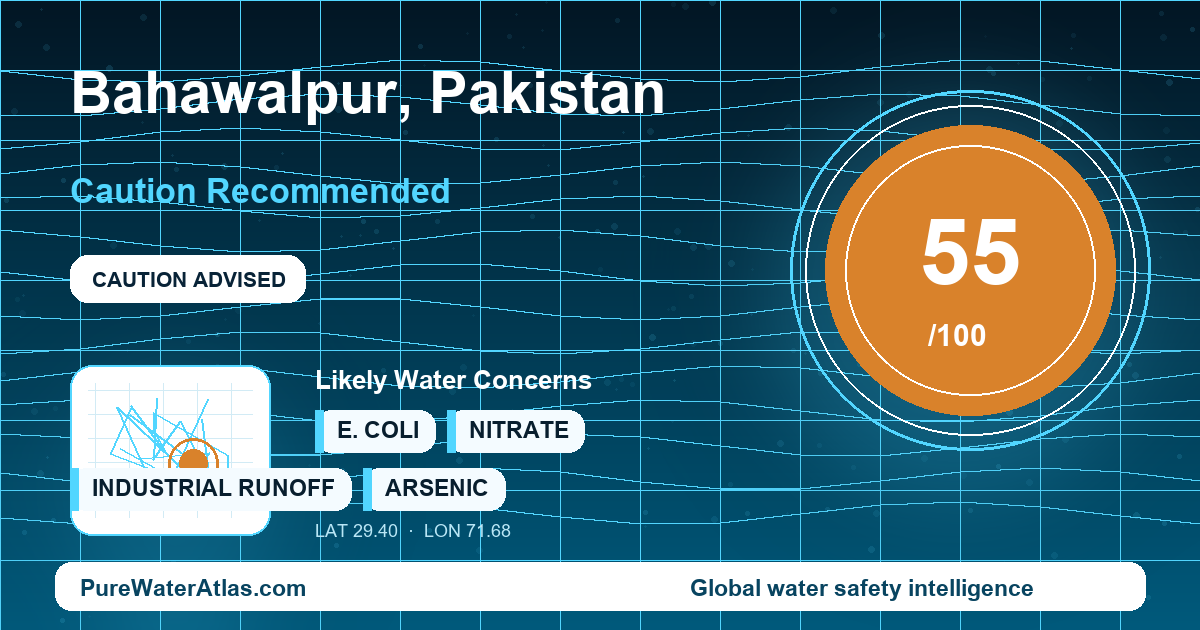
Bahawalpur, Pakistan: groundwater-based urban supply with salinity, hardness, storage-tank, and intermittent-pressure risks. Water safety score: 55/100. Risk level: Caution Recommended.
Quick Answer
| Overall status | Caution recommended. Bahawalpur is not a city where visitors should assume untreated tap water is reliably safe to drink. Safety can vary by tube well, neighborhood distribution line, building plumbing, storage tank condition, and season. |
|---|---|
| Traveler advice | Use sealed bottled water from reputable brands, hotel-provided filtered water, or water that has been boiled or otherwise disinfected. Avoid untreated tap water unless a trusted local source confirms treatment and recent safety. |
| Resident advice | Treat tap water as location-specific. Test the household tap and storage tank, then choose treatment based on results. Boiling or UV can control microbes, but they do not remove salinity, arsenic, nitrate, or dissolved minerals. |
| Main water source | Primarily groundwater pumped through municipal tube wells, with quality influenced by the Indus alluvial plain, Sutlej River floodplain, canal-irrigated landscape, and the Cholistan desert margin. |
| Water authority context | Urban water supply and sanitation responsibilities are linked to local government bodies such as the Municipal Corporation or Metropolitan Corporation Bahawalpur, with Punjab Public Health Engineering Department involved in schemes and infrastructure. |
| Filter recommendation | Often advisable. Use disinfection for microbial risk, and consider reverse osmosis or contaminant-specific treatment only after testing for TDS, hardness, nitrate, arsenic, and other local parameters. |
Why Bahawalpur Is Different
Bahawalpur’s drinking-water profile is shaped by its position in southern Punjab, near the Sutlej River floodplain and on the edge of the Cholistan desert. This arid to semi-arid setting makes groundwater quality a central issue. Unlike cities that depend mainly on a large treated surface-water intake, Bahawalpur’s practical urban supply is understood to rely largely on groundwater abstraction through tube wells. That makes the safety and taste of water more dependent on local aquifer chemistry, depth, pumping patterns, and distribution conditions.
The most important city-specific point is variability. A household in one part of Bahawalpur may receive water with different salinity, hardness, taste, or microbial risk than a household in another area. A hotel, university, hospital, or newer building may operate its own filtration system, while nearby homes may rely on direct municipal supply, underground storage, rooftop tanks, or private pumping. Even if water is chlorinated at the source, protection can be reduced by long distribution runs, low residual chlorine, intermittent pressure, and storage in hot weather.
Historically, Bahawalpur’s settlement and irrigation economy were connected to the Sutlej River and canal systems developed in the former Bahawalpur State and the wider Punjab irrigation network. Today, canals and the Sutlej system remain important to the regional water environment, agriculture, and recharge pressures, but routine drinking supply in the city is mainly associated with tube-well groundwater. Reduced river flows and heavy dependence on groundwater in southern Punjab make aquifer quality and recharge important long-term concerns.
Where Does Bahawalpur’s Tap Water Come From?
Bahawalpur’s tap water is primarily associated with groundwater pumped from municipal tube wells and pumping stations into the urban distribution network. The city sits within the Indus alluvial plain near the Sutlej River and the Cholistan desert margin, where groundwater quality can vary sharply. In this setting, mineralization, hardness, salinity, and high total dissolved solids can be practical drinking-water problems even when water looks clear.
The key infrastructure elements are municipal tube wells, pumping stations, distribution mains, local service lines, and, where present, overhead or ground storage reservoirs. At the household level, many buildings use roof tanks, underground tanks, and small pumps to manage intermittent supply. These household systems are not just convenience features; they are part of the safety chain. A clean, covered, regularly disinfected tank can reduce risk, while a dirty or poorly sealed tank can introduce sediment, insects, dust, and microbial contamination.
Intermittent supply is especially important in Bahawalpur’s risk profile. When water pressure drops, leaking water pipes located near drains or sewers may be more vulnerable to intrusion. Pipe repairs, low-pressure events, power outages, or pumping interruptions can also disturb sediment and increase turbidity. During hot months, water may spend longer in household tanks, increasing the risk of bacterial regrowth if disinfectant residual has already declined.
Who Manages Drinking Water in Bahawalpur?
Urban water supply and sanitation responsibilities in Bahawalpur are linked to local government institutions such as the Municipal Corporation or Metropolitan Corporation Bahawalpur. The Public Health Engineering Department, Government of the Punjab, is also relevant because it is involved in water supply and sanitation schemes and infrastructure projects, particularly outside the large dedicated WASA-style utility cities.
Pakistan’s drinking-water quality framework includes the National Standards for Drinking Water Quality and the work of provincial environmental and public-health institutions. The Pakistan Council of Research in Water Resources has conducted national and city water-quality monitoring, including reports that identify common drinking-water concerns in Pakistani cities. In Punjab, the Public Health Engineering Department, the Local Government and Community Development Department, and the Punjab Environmental Protection Department are relevant to service delivery, municipal oversight, and environmental regulation.
A major limitation for consumers is public reporting. Bahawalpur does not appear to have the same widely visible, dedicated WASA-style public reporting found in some larger Punjab cities, and routine neighborhood-level consumer water-quality reports are not consistently public. This means residents should not assume that a general city assessment proves their own tap is safe or unsafe. Testing at the building or tap level remains the most reliable way to verify household risk.
Main Local Water Concerns
- Microbial contamination: Intermittent supply, leaking distribution lines, proximity to drains or sewers, private suction pumps, and poorly cleaned storage tanks can increase the risk of fecal contamination. Learn more about E. coli in drinking water.
- High TDS, salinity, and hardness: Southern Punjab groundwater can have elevated dissolved minerals, salty taste, and hardness. Boiling does not remove these dissolved substances.
- Turbidity and sediment: Cloudy water or particles may appear after pipe repairs, low-pressure events, disturbed storage tanks, or monsoon-related intrusion. See PureWaterAtlas guides to turbidity and sediment.
- Nitrate risk: Shallow groundwater may be affected by agriculture, septic systems, sewage leakage, drains, or animal keeping. Nitrate requires testing because it cannot be reliably judged by taste or appearance. See nitrate in drinking water.
- Arsenic risk: Punjab alluvial aquifers can contain geogenic arsenic in some locations. Bahawalpur households should not assume arsenic is absent without local testing. See arsenic in drinking water.
- Variable chlorine residual: Chlorination at the source may not guarantee protection at the tap after long distribution, low pressure, or hot storage. Learn more about chlorine in drinking water.
Season also matters. Hot months increase demand, storage time, and bacterial regrowth risk in roof and underground tanks. Monsoon rains can increase drain overflow, sewer intrusion risk, and turbidity where distribution systems are compromised. Dry periods and heavy groundwater pumping can worsen salinity or concentrate dissolved minerals in vulnerable aquifer zones.
For Travelers
Most short-term visitors to Bahawalpur should not drink untreated tap water. The safer default is sealed bottled water from reputable brands, verified hotel-filtered water, or water that has been boiled or disinfected. Check bottle seals and avoid bottles that appear refilled. In hot weather, carrying oral rehydration salts is sensible because dehydration can become a practical travel issue.
For brushing teeth, use bottled, boiled, or reliably filtered water if you have a sensitive stomach, are immunocompromised, are traveling with children, or are staying only briefly. Avoid ice unless you know it was made from purified water. Ice from street vendors or small shops should be treated as higher risk because the source water and handling conditions may be uncertain.
In hotels and restaurants, ask specifically whether the drinking water is bottled, reverse osmosis, UV-treated, or otherwise filtered. Better hotels and restaurants may provide filtered water, but “filtered” can mean different things. If staff cannot clearly explain the treatment system, choose sealed bottled drinks and be cautious with uncooked foods washed in tap water.
Boiling water is useful for bacteria, viruses, and protozoa, especially when microbial safety is the main concern. However, boiling does not remove salinity, arsenic, nitrate, hardness, or other dissolved chemicals. For practical instructions, see the PureWaterAtlas Boiling Water Purification Complete Guide.
For Residents
Residents should treat Bahawalpur tap water as a local, building-specific question. A practical household plan begins with laboratory testing of both tap water and stored tank water. At minimum, test for total coliform and E. coli if anyone in the home has recurrent gastrointestinal illness or if the property has older plumbing, intermittent pressure, or poorly maintained tanks.
Because salinity and hardness are common concerns in southern Punjab groundwater, residents should also test TDS, electrical conductivity, hardness, chloride, sulfate, and taste-related minerals. If the home uses shallow groundwater, a private boring, or is near drains, septic leakage, animal keeping, or agricultural land, nitrate testing is important. Arsenic should be tested through a certified laboratory because it cannot be detected by smell, color, or taste. For more detail, see PureWaterAtlas guides to arsenic testing and nitrate testing.
Filter choice should follow test results. For microbial risk, options include boiling, UV, chlorination, or certified microbiological filtration. UV systems need clear water and usually require sediment pre-filtration. For high TDS, salinity, nitrate, or arsenic, activated carbon alone is not sufficient; a properly maintained reverse osmosis system or other contaminant-specific treatment may be needed. See the PureWaterAtlas UV Water Purification Guide and Water Treatment Systems guide.
Older buildings may have corroded galvanized lines, unknown plumbing materials, rooftop tanks, and low-pressure plumbing that can introduce sediment and metals. There is not enough public evidence to claim citywide lead contamination in Bahawalpur, but testing is prudent in older properties and schools. See Lead in Drinking Water: Testing and Detection Methods.
Storage tanks are a major control point. Keep rooftop and underground tanks covered, clean and disinfect them regularly, prevent insects and dust entry, and do not assume municipal chlorination remains effective after long storage in hot weather. Retest after installing a filter, after major pipe repairs, after flooding or sewer overflow, and whenever taste, color, odor, or sediment changes suddenly.
Relevant Contaminants and Water-Quality Issues
The most relevant PureWaterAtlas contaminant profiles for Bahawalpur are E. coli, because intermittent supply and storage tanks can create microbial risk; turbidity and sediment, because pipe disturbance and tank conditions can affect clarity; arsenic, because Punjab alluvial aquifers require local verification; nitrate, because shallow groundwater may be influenced by sewage, septic, or agriculture; and chlorine, because residual disinfectant can decline before water reaches the consumer tap.
These issues should be understood together. Clear water is not automatically safe, and bad taste is not the only warning sign. Microbes, nitrate, and arsenic may be present without obvious taste or odor. Conversely, salty or hard water may be unpleasant and may require treatment even if microbial tests are acceptable.
How to Verify Your Water Quality
For Bahawalpur households, the strongest verification step is direct testing of the actual water you drink. Test the kitchen tap, the rooftop or underground tank, and any private boring separately if they are used. Include microbiology, TDS, electrical conductivity, hardness, chloride, sulfate, nitrate, arsenic, and basic metals when relevant to the building.
PureWaterAtlas resources can help you plan the process: start with How to Test Drinking Water, review the broader Drinking Water Safety guide, and use the Water Microbiology guide to understand bacteria, viruses, and microbial risks. You can also search specific risks in the Contaminants Search Engine or compare city-level guidance with the Global Water Quality Checker.
Because Bahawalpur lacks consistently public, address-level water-quality reporting, local testing is not a luxury; it is the most practical way to avoid guessing. This is especially important for infants, elderly residents, immunocompromised people, and homes relying on storage tanks or private groundwater.
Official and Technical Sources
- Pakistan Council of Research in Water Resources, Water Quality Reports — national drinking-water monitoring and identification of common microbial and chemical contamination issues.
- Pakistan Council of Research in Water Resources, National Water Quality Monitoring Programme — official research institution for Pakistan water resources and drinking-water quality assessments.
- Public Health Engineering Department, Government of the Punjab — provincial authority involved in water supply and sanitation schemes.
- Local Government and Community Development Department, Government of the Punjab — provincial department overseeing local government institutions responsible for municipal services.
- Punjab Environmental Protection Department — provincial environmental regulator relevant to water pollution control and standards.
- World Bank, Punjab Cities Program — municipal infrastructure and service delivery context for intermediate Punjab cities including Bahawalpur.
- FAO AQUASTAT Pakistan Country Profile — background on Pakistan’s Indus Basin water resources, irrigation dependence, and water-stress context.
- WHO Drinking-water fact sheet — health guidance on microbial contamination, safe drinking water, and disease risk.
Bottom Line
Bahawalpur’s tap water should be approached with caution. The city’s supply is mainly groundwater-based, and quality can vary with tube wells, salinity, hardness, distribution condition, household storage, and seasonal pressure changes. Visitors should use sealed bottled water or verified filtered, boiled, or disinfected water, including for brushing teeth when risk tolerance is low. Residents should not rely on appearance or taste alone. Test tap and stored water for microbes, TDS, hardness, nitrate, arsenic, and relevant metals, then choose treatment based on results. Boiling or UV can help with microbes, but they do not remove salts, arsenic, nitrate, or dissolved minerals. Because routine neighborhood-level public reporting is limited, household verification is the safest practical approach.
Read the full guide: Global Water Quality Guide
Explore more in this category: Global Water Quality Articles