
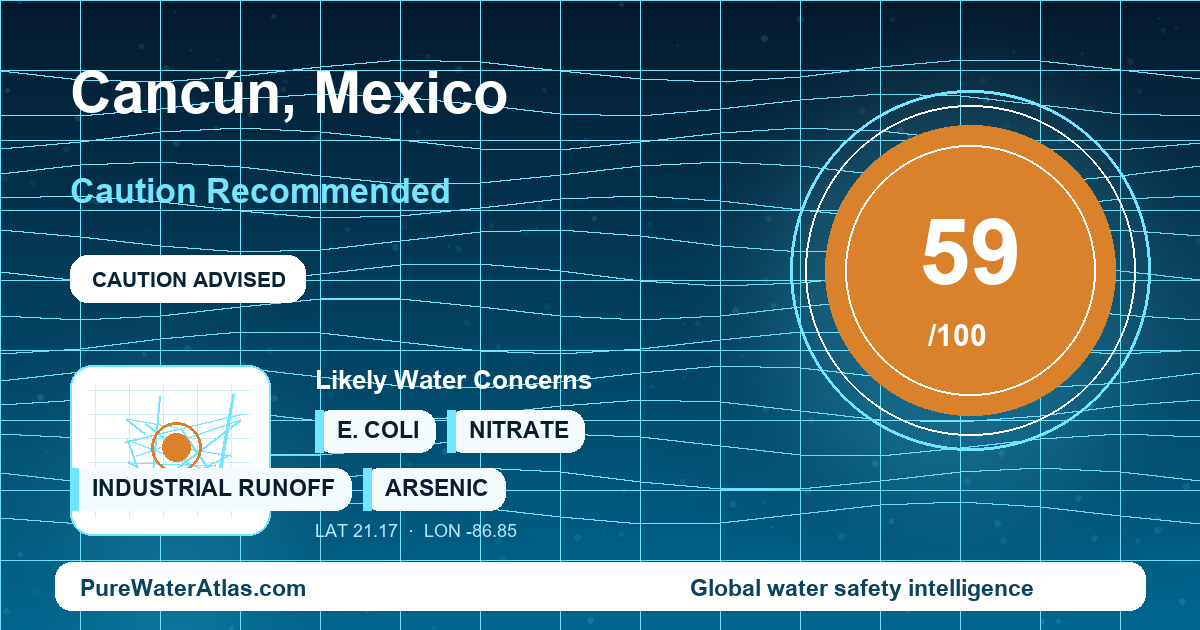
Cancún, Mexico: groundwater-based municipal supply, karst aquifer vulnerability, and practical tap-water guidance for visitors, hotels, rentals, and residents.
Quick Answer
| Water safety score | 59 / 100 |
|---|---|
| Risk level | Caution Recommended |
| Can visitors drink the tap water? | Not recommended for most travelers unless the property confirms the faucet is supplied by a maintained purification system. Use sealed bottled water, hotel-provided purified water, or reliably treated water. |
| Resident guidance | Municipal water can generally be used for washing and bathing, but residents who drink tap water should verify building tanks and plumbing, maintain cisterns and tinacos, and use appropriate point-of-use treatment. |
| Main water source | Groundwater wells drawing from the Yucatán Peninsula karst limestone aquifer. |
| Water authority and operator | Aguakan operates water and wastewater services in Cancún under the local concession model; CAPA Quintana Roo is the state water commission; CONAGUA oversees national water resources. |
| Filter recommendation | For home drinking water, consider sediment prefiltration, activated carbon, and UV disinfection or reverse osmosis depending on microbial uncertainty, salinity, nitrate, or dissolved-solids concerns. |
Editorial verdict: Caution is recommended. Cancún’s municipal supply is based mainly on treated groundwater, but the practical risk at the faucet often depends on building plumbing, cisterns, rooftop tanks, intermittent pressure, and limited public access to recent neighborhood-level tap-water results. The safest default for short-term visitors is sealed bottled water or water confirmed by the property to be purified.
Why Cancún Is Different
Cancún is not a city supplied by a large river or a conventional surface reservoir system. It sits on the northeastern Yucatán Peninsula, a flat coastal karst region where rainwater can infiltrate rapidly through fractured limestone. In this setting, groundwater commonly moves through underground conduits, caves, and connected voids rather than through slow, protected surface drainage networks.
That geology matters for drinking-water safety. Karst aquifers can provide large volumes of groundwater, but they are intrinsically vulnerable because contaminants may move quickly through fractures and conduits with less natural filtration than in some deeper confined aquifers. Urban growth, wastewater control, pumping, coastal conditions, and well-field protection are therefore especially important in Cancún.
The other city-specific issue is what happens after water enters a property. Many homes, condominiums, smaller hotels, and rentals use cisterns and rooftop storage tanks, locally known as cisternas and tinacos. Even if water entering a building has been disinfected, poor tank cleaning, open lids, insects, animals, dust, biofilm, low residual chlorine, cross-connections, or internal plumbing problems can change water quality before it reaches the faucet.
Where Does Cancún’s Tap Water Come From?
Cancún’s tap water comes primarily from groundwater wells and well fields serving Cancún and the municipality of Benito Juárez. The source is the Yucatán Peninsula’s karst limestone aquifer, not a major local surface-water river system. Cancún was developed as a planned tourism city in a low-lying barrier-island and lagoon-coast setting, which increased reliance on inland groundwater production, pumping, storage, distribution networks, and disinfection.
Key infrastructure includes groundwater production wells, pumping stations, pressurized distribution networks, disinfection infrastructure, and building-level storage systems. Hotels and resorts often add their own water-management systems, which may include additional filtration, softening, ultraviolet treatment, reverse osmosis, bottled water, purified dispensers, or commercially supplied drinking water.
Wastewater infrastructure is also directly relevant to drinking-water risk in Cancún. In a karst aquifer, sewage leaks and wastewater pressure can be more consequential because subsurface transport may be rapid. This does not mean every tap is contaminated, but it does mean that aquifer protection, sewage control, pressure management, and building maintenance are central to water safety.
Who Manages Drinking Water in Cancún?
Drinking-water and wastewater services in Cancún are operated by Aguakan, a private concessionaire serving Benito Juárez, Isla Mujeres, Puerto Morelos, and Solidaridad under Quintana Roo’s water-service framework. At the state level, the relevant water commission is CAPA Quintana Roo, Comisión de Agua Potable y Alcantarillado. At the federal level, CONAGUA, Comisión Nacional del Agua, is responsible for national water resources, concessions, aquifer management, and water information.
Mexico’s drinking-water quality framework includes NOM-127-SSA1-2021, the sanitary standard for water for human use and consumption. Health oversight involves the Secretaría de Salud and COFEPRIS. These standards are important, but travelers and residents should understand a key local limitation: compliance for supplied water does not guarantee the same quality at every building faucet after water passes through cisterns, rooftop tanks, internal pipes, valves, fixtures, and filters.
PureWaterAtlas rates confidence for Cancún as moderate. The source-water system and responsible institutions are identifiable, but recent, independently compiled, faucet-level and neighborhood-level results are not consistently public in a format that allows exact claims for every hotel, vacation rental, colonia, or apartment building.
Main Local Water Concerns
- Post-distribution microbial risk: A major concern in Cancún is not only the municipal source, but the final segment of the system. Cisterns, tinacos, low pressure, plumbing, sewage leaks, and poor tank maintenance can create microbial risk at the tap.
- Karst aquifer vulnerability: The Yucatán limestone aquifer is highly permeable. Contaminants can move through fractures, caves, and conduits with limited natural filtration compared with some other aquifer types.
- Storm and hurricane effects: Hurricane season and intense tropical rains can increase flooding, turbidity, sewer overflows, power interruptions, and pressure disruptions. After storms, outages, or low-pressure events, untreated tap water should be avoided until safety is verified.
- Storage tank contamination: Open, dirty, or poorly sealed cisterns and rooftop tanks can allow insects, animals, dust, biofilm, and fecal contamination to enter stored water.
- Salinity and dissolved minerals: Coastal groundwater systems can face salinity or chloride pressure where pumping, sea-level influence, or coastal intrusion affects water quality. Household-level salinity should not be generalized without testing.
- Nitrate and sewage-related indicators: Nitrate is a relevant regional concern in urbanizing karst areas with wastewater pressure, but public neighborhood-level nitrate results for Cancún drinking taps are limited.
- Building-specific metals: Lead risk is more likely to come from old fixtures, solder, valves, or internal plumbing than from the groundwater source. It should be assessed by building age and testing rather than assumed citywide.
For Travelers
Most visitors should not drink untreated tap water in Cancún. The safer default is sealed bottled water, hotel-provided purified water, or water treated by a reliable purifier. Check that bottle caps are intact, carry bottled water when arriving, and use bottled or purified water for medications, infant formula, and situations where a stomach illness would be especially disruptive.
For brushing teeth, conservative guidance is to use bottled or purified water, especially for short-term visitors, people with sensitive stomachs, immunocompromised travelers, pregnant travelers, and families with young children. Some travelers brush with tap water without obvious problems, but Cancún’s risk depends heavily on the specific building, storage tanks, and plumbing.
Ice in reputable hotels, resorts, established restaurants, and bars is usually made from purified water or supplied commercially. However, ask if unsure, and avoid ice from informal vendors or places that cannot confirm purified-water use. Large hotels and resorts commonly manage guest drinking water separately from general tap water through bottled water, purified dispensers, commercial ice, and kitchen treatment systems. In small hotels, independent rentals, older apartments, and budget lodgings, the faucet may depend heavily on the property’s cistern, rooftop tank, filters, and plumbing condition.
If bottled water is unavailable, boiling can reduce microbial risk when done correctly. For more detail, see Boiling Water Purification: Complete Guide. Boiling is useful for microbes but does not remove salts, metals, nitrate, or many chemical contaminants.
For Residents
Residents can generally use municipal water for washing and bathing, but drinking tap water regularly requires more caution. A practical Cancún household setup may include sediment prefiltration, activated carbon for taste and chlorine-related issues, and either UV disinfection or reverse osmosis where microbial uncertainty, salinity, nitrate, or dissolved solids are concerns. Choose certified systems and maintain cartridges, lamps, membranes, and storage tanks on schedule. For system selection, see Water Treatment Systems and UV Water Purification: Complete Guide.
Testing is especially important after moving into a property, after tank cleaning, after plumbing work, after flooding, after long vacancies, or after low-pressure events. At minimum, residents intending to drink tap water should test for total coliform and E. coli. Basic chemistry testing should include pH, conductivity or total dissolved solids, chloride, hardness, alkalinity, and turbidity to understand salinity, scaling, and sediment conditions.
Nitrate testing is also reasonable because karst aquifers in urbanizing and wastewater-impacted areas can be vulnerable to nitrogen contamination. Older buildings and remodeled properties should consider lead and copper testing at the kitchen tap, using first-draw and flushed samples if a laboratory recommends that protocol. Do not assume a municipal or nearby hotel-zone result represents your own kitchen faucet.
Cisterns and rooftop tanks are one of the most important household controls in Cancún. They should be sealed, screened, periodically cleaned, and disinfected. If water has sulfur odor, sediment, discoloration, oily sheen, unusual taste, or if household members report repeated gastrointestinal complaints, use bottled or treated water and request laboratory testing rather than relying on appearance alone.
Relevant Contaminants and Water-Quality Issues
The most relevant Cancún issues are microbial safety, turbidity, tank hygiene, chlorine residual, nitrate screening, sediment, and building-specific metals. Learn more through these PureWaterAtlas contaminant profiles:
- E. coli in Drinking Water — important for evaluating fecal contamination and post-distribution microbial risk.
- Turbidity in Drinking Water — relevant after storms, maintenance, pressure changes, or disturbed tanks.
- Chlorine in Drinking Water — useful for understanding disinfection residuals, taste, and treatment context.
- Nitrate in Drinking Water — relevant in karst areas where wastewater and urban growth may affect groundwater.
- Lead in Drinking Water — most likely a building-specific concern from fixtures, solder, or internal plumbing.
- Sediment in Drinking Water — relevant when water is discolored, gritty, or disturbed after pressure events.
For deeper reading, see Water Microbiology, Nitrate Contamination: Testing and Detection Methods, and Lead in Drinking Water: Testing and Detection Methods.
How to Verify Your Water Quality
Because building-level conditions are the main uncertainty in Cancún, the most reliable answer comes from testing the water actually used for drinking. Residents should test at the kitchen tap and consider separate samples before and after household treatment. Vacation-rental owners and small lodging operators should maintain documented tank-cleaning schedules, filter changes, UV lamp replacement records, and microbial test results if they tell guests the water is purified.
Use the PureWaterAtlas Water Testing guide to plan a test panel, and compare possible issues using the Contaminants Search Engine. Travelers comparing destinations can also use the Global Water Quality Checker. For general interpretation of risk, see Drinking Water Safety.
Official and Technical Sources
- Aguakan — local water and wastewater concessionaire for Cancún and other northern Quintana Roo municipalities.
- CAPA Quintana Roo — state water authority for Quintana Roo.
- CONAGUA — Mexican federal water authority.
- Sistema Nacional de Información del Agua — CONAGUA national water-information portal.
- NOM-127-SSA1-2021 — Mexico’s drinking-water standard for water for human use and consumption.
- COFEPRIS — federal health-protection authority.
- CDC Travelers’ Health: Mexico — traveler food and water precautions.
- CDC Yellow Book: Food and Water Precautions — safer beverage, ice, boiling, and traveler-risk guidance.
- WHO Guidelines for Drinking-water Quality — international drinking-water risk-management reference.
- UNESCO World Water Assessment Programme — groundwater and karst-resource context.
Bottom Line
Cancún’s tap water should be treated with caution, especially by short-term visitors. The city relies mainly on treated groundwater from the Yucatán Peninsula’s highly permeable karst aquifer, and official institutions and regulations are identifiable. However, the key uncertainty is often at the property level: cisterns, rooftop tanks, pressure changes, plumbing, and maintenance can alter water quality before it reaches the faucet. Visitors should default to sealed bottled water, hotel-provided purified water, or confirmed purified systems, including for brushing teeth when being conservative. Residents should maintain tanks, test for microbes and key chemistry, and use certified treatment such as carbon plus UV or reverse osmosis when drinking tap water regularly.
Read the full guide: Global Water Quality Guide
Explore more in this category: Global Water Quality Articles