Introduction
Access to safe drinking water is often discussed as a national achievement, but the reality is more nuanced. Even in countries known for strong public utilities, water quality can vary by region, building age, source water, seasonal conditions, and local treatment practices. That is why many readers searching for countries with safe drinking water best filters are not only asking which countries have good tap water, but also which household filtration systems make sense within those environments.
In broad terms, countries with highly developed water infrastructure generally provide drinking water that meets national safety standards most of the time. However, “safe” does not always mean identical. One country may disinfect heavily to control microbial risk, creating noticeable taste and odor. Another may have hard but microbiologically safe water. A third may have old plumbing in some neighborhoods, raising concern about lead, copper, or sediment. As a result, the best filter depends less on a country’s reputation and more on the actual contaminants, treatment goals, and household conditions involved.
This article explains how to think about water safety in countries with established public systems and how to choose among common filtration options, including carbon filters, reverse osmosis systems, ultraviolet disinfection, sediment prefiltration, and whole-house treatment. It also covers health implications, testing methods, maintenance needs, and the standards that shape drinking water quality. For broader context, readers may also explore global water quality resources and the complete guide to countries with safe drinking water.
What It Is
When people refer to “countries with safe drinking water,” they usually mean nations where public drinking water systems are regulated, routinely monitored, and generally reliable. Examples often include many parts of North America, Western Europe, Oceania, and selected high-income regions in Asia. Yet the concept is not just about national identity; it is about the performance of a drinking water system from source to tap.
Safe drinking water is water that does not present unacceptable short-term or long-term health risk when consumed as intended. To meet that expectation, water utilities and regulators work to control several categories of hazards:
- Microbiological contaminants, such as bacteria, viruses, and protozoa
- Chemical contaminants, including nitrates, pesticides, industrial compounds, disinfection byproducts, and metals
- Physical issues, such as sediment, turbidity, and particulate matter
- Aesthetic concerns, including taste, odor, hardness, and discoloration
These categories matter because they affect filter selection. A carbon pitcher may improve taste and reduce chlorine, but it will not reliably remove dissolved salts or every heavy metal. A reverse osmosis system can reduce many dissolved contaminants, but it may be unnecessary if the main issue is odor from chlorination. In other words, the phrase countries with safe drinking water best filters should be understood as a question of optimization, not panic.
In countries with well-managed municipal treatment, most household filters are chosen to address one or more of the following goals:
- Improve taste and odor
- Reduce chlorine or chloramine
- Lower lead exposure from older plumbing
- Reduce sediment or rust particles
- Address hard water scale
- Reduce specific contaminants of local concern, such as PFAS, arsenic, nitrates, or pesticides
There is also an important distinction between point-of-use and point-of-entry systems. Point-of-use systems treat water at a single tap, typically in the kitchen. Point-of-entry systems treat all water entering a home. The best choice depends on whether the concern is drinking water alone or broader household water quality.
Main Causes or Sources
Even in countries recognized for safe public water, contamination or undesirable water characteristics can arise from multiple sources. Understanding those sources is essential to selecting a suitable filter and avoiding over-treatment or ineffective treatment. For further reading, see causes and sources of drinking water issues.
Source Water Conditions
Water utilities draw from rivers, lakes, reservoirs, and groundwater aquifers. Each source has different vulnerabilities. Surface water can be influenced by agricultural runoff, algal blooms, urban stormwater, and microbial contamination. Groundwater may be less exposed to pathogens but can contain naturally occurring minerals and dissolved chemicals such as arsenic, fluoride, manganese, or uranium depending on local geology.
A country may have excellent treatment standards overall, but local source conditions still shape what reaches households and what treatment steps are required. This is one reason there is no single universal answer to countries with safe drinking water treatment comparison.
Municipal Treatment Choices
Utilities use combinations of coagulation, sedimentation, filtration, activated carbon, membrane treatment, and disinfection to make water safe. Different utilities also choose different disinfectants. Chlorine is common because it leaves a residual that helps protect water in distribution systems. Chloramine is used in some areas because it can be more stable in long pipe networks. Ozone and ultraviolet light may be used at treatment plants as additional barriers.
These treatment decisions affect household preferences. For example:
- Water with chlorine often leads households to choose activated carbon filters for better taste
- Water with chloramine may require catalytic carbon for more effective reduction
- Utilities facing high dissolved solids or specific chemical contamination may produce water that some consumers choose to polish further with reverse osmosis
Distribution System and Plumbing
Water can leave the treatment plant in excellent condition and still be affected by infrastructure before reaching the tap. Aging distribution pipes may contribute sediment, rust, or intermittent turbidity. Household plumbing may introduce lead, copper, nickel, or other metals, especially where corrosion control is inadequate or building plumbing is old.
This distinction is especially important in developed countries. National water quality may be strong, while a specific building still has plumbing-related risks. In such situations, point-of-use certified filters can offer an added safety margin.
Private Wells and Small Systems
Not all households in countries with safe water rely on municipal treatment. Rural homes may use private wells, and some communities are served by small systems with different oversight capacity. Wells can be affected by bacteria, nitrates, agricultural chemicals, iron, sulfur, hardness, and naturally occurring metals. These conditions often require more tailored treatment than city water does.
Emerging Contaminants
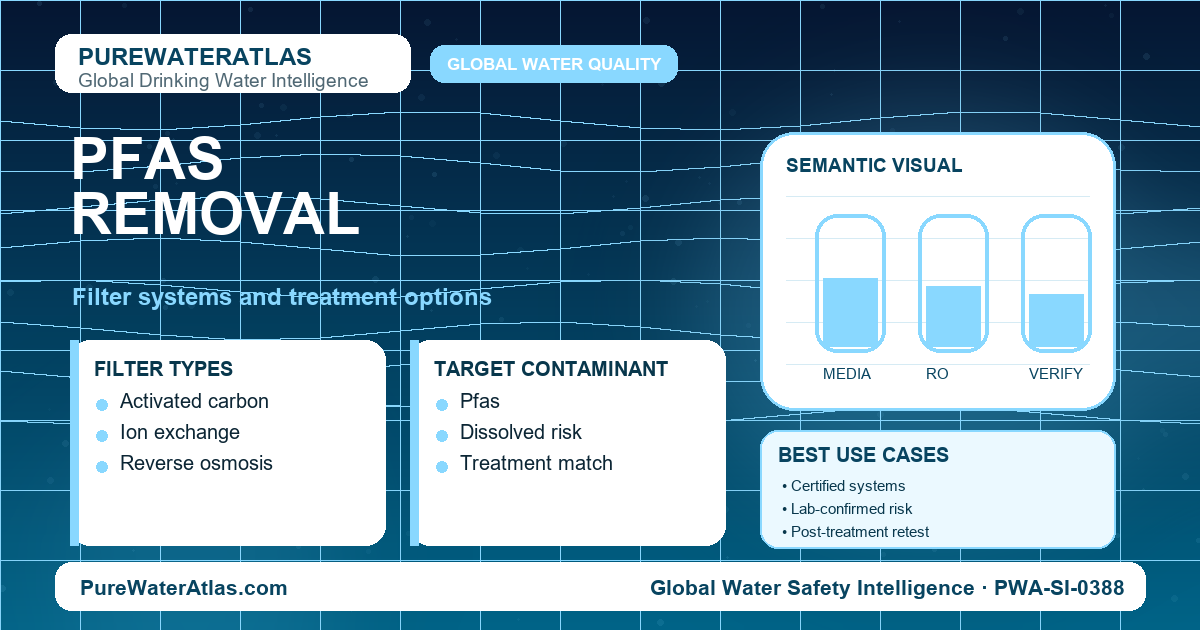
Many consumers are increasingly concerned about PFAS, pharmaceutical residues, microplastics, and industrial chemicals. Regulatory science is evolving in this area. While not every emerging contaminant is present at harmful levels, awareness of these compounds has changed the filter market significantly. High-quality activated carbon and reverse osmosis are often discussed in relation to PFAS reduction, though performance depends on system design and certification.
Health and Safety Implications
The health significance of water quality issues depends heavily on the type of contaminant, concentration, duration of exposure, and user vulnerability. Infants, pregnant people, older adults, and immunocompromised individuals may be at increased risk from certain hazards. More detailed discussion is available in health effects and risks and related material in water microbiology.
Microbial Risks
Pathogens in drinking water can cause acute illness, often affecting the gastrointestinal tract. Bacteria, viruses, and protozoa may lead to diarrhea, vomiting, fever, dehydration, and in severe cases hospitalization. In countries with advanced municipal systems, these events are relatively uncommon compared with poorly treated water settings, but they remain important during outbreaks, boil-water notices, and failures in small systems.
Chemical Risks
Chemical contaminants are often associated with long-term exposure. Some examples include:
- Lead: linked to neurological and developmental harm, especially in children
- Nitrate: dangerous for infants at high levels due to risk of methemoglobinemia
- Arsenic: associated with cancer and other chronic health effects over time
- Disinfection byproducts: regulated because long-term exposure above standards may increase health risks
- PFAS: under increasing scrutiny for persistence and possible links to multiple health outcomes
Aesthetic Problems and Quality of Life
Not every water issue is a direct toxicological emergency. Chlorine taste, sulfur odor, cloudiness, and hardness are often aesthetic concerns, but they still matter. Poor taste can reduce trust in tap water and encourage greater reliance on bottled water. Hard water can damage appliances and reduce soap efficiency. Sediment can stain fixtures and make water appear unsafe even when microbial standards are met.
Why Filtration Still Matters in Safe Countries
Because “safe” is a regulatory baseline rather than a guarantee of ideal consumer experience, household treatment can still be worthwhile. The key is choosing a system that matches the problem. A filter should complement municipal treatment, not replace evidence-based understanding. This is why educational comparison is more useful than marketing claims.
Testing and Detection
The smartest way to choose a household filter is to begin with evidence. Water testing helps distinguish between actual contamination and perceived issues such as odor or mineral taste. It also prevents buying expensive systems that do not address the real problem.
Review Utility Reports
If a home is connected to a public water supply, start by reviewing the local water quality report, often called a consumer confidence report or annual drinking water report. These documents typically include:
- Source water information
- Detected contaminants and compliance status
- Disinfectant used
- Hardness or mineral-related information in some cases
- Contact details for the utility
This information is a useful baseline, but it does not always reflect conditions inside a specific building. For that reason, additional household testing may be warranted.
Use Targeted Household Testing
Testing should be based on context. In homes with older plumbing, lead and copper testing are often priorities. In rural well systems, bacteria, nitrates, hardness, iron, manganese, and arsenic may be relevant. If there are taste and odor complaints, testing for chlorine, chloramine, sulfur-related compounds, or total dissolved solids may be useful.
Common testing options include:
- Certified laboratory analysis: best for metals, nitrates, PFAS, pesticides, and microbiological confirmation
- Home test kits: useful for screening pH, hardness, chlorine, nitrate, and some metals
- Digital meters: often used for total dissolved solids, conductivity, or temperature
For health-protective decisions, laboratory testing is generally preferable to basic strip tests.
Interpretation Matters
A test result has meaning only when compared with a health-based or operational benchmark. A water sample may show measurable chlorine, calcium, iron, or copper, but that does not automatically indicate danger. Likewise, water can taste fine while containing contaminants of concern. Good interpretation uses local regulations, certified lab ranges, and household circumstances.
When to Re-Test
Water should be re-tested when:
- You move into a new home
- A boil-water advisory or contamination event occurs
- Water changes in taste, odor, color, or clarity
- You install a new filtration system and want baseline and follow-up data
- You use a private well and follow periodic testing schedules
Prevention and Treatment
This section is the practical core of any guide to countries with safe drinking water best filters. The best system depends on whether the goal is taste improvement, contaminant reduction, scale control, microbial protection, or broad-spectrum purification. Readers interested in broader scientific context may also explore water science resources.
Activated Carbon Filters
Countries with safe drinking water carbon filters are often the best match when the primary issue is taste, odor, chlorine, or some organic compounds. Activated carbon is available in pitchers, faucet units, countertop systems, under-sink cartridges, refrigerator filters, and whole-house systems.
Carbon filters are commonly chosen because they are relatively affordable, easy to install, and effective for aesthetic improvement. Depending on design and certification, they may also reduce lead, volatile organic compounds, and some PFAS.
Best use cases for carbon:
- Chlorine taste and odor
- Some chloramine reduction with appropriate media
- Lead reduction with certified products
- Improvement of overall palatability of municipal water
Limitations:
- Not ideal for high total dissolved solids
- Does not soften hard water
- Does not reliably remove all microbes unless part of a specialized system
- Performance varies widely by product certification and cartridge condition
Reverse Osmosis Systems
Countries with safe drinking water reverse osmosis systems are often selected when dissolved contaminants are a major concern. Reverse osmosis, or RO, uses a semi-permeable membrane to reduce many dissolved salts, metals, nitrates, and other substances. Under-sink RO units are among the most common point-of-use systems for drinking and cooking water.
Best use cases for reverse osmosis:
- Elevated total dissolved solids
- Nitrate reduction
- Arsenic reduction, depending on speciation and system design
- Broad reduction of many dissolved contaminants
- Households seeking a higher level of treatment than basic carbon filtration
Limitations:
- Higher upfront cost than simple carbon filters
- Slower water production and storage tank dependence in many systems
- Wastewater generation
- Possible need for remineralization depending on user preference and system design
- Requires regular membrane and prefilter replacement
RO is powerful, but not always necessary. In many municipal systems with already compliant water, a high-quality carbon filter may be sufficient for the user’s actual concerns.
Sediment Filters
Sediment filters remove particulate matter such as sand, silt, rust, and debris. They are often used as prefilters in homes with visible turbidity, older plumbing, or private wells. They do not remove dissolved chemicals, but they protect downstream treatment equipment and improve clarity.
Water Softeners
Hard water is common even in countries with safe drinking water. Water softeners exchange calcium and magnesium for sodium or potassium, reducing scale buildup. They improve appliance efficiency and cleaning performance but are not contaminant removal devices in the same sense as carbon or RO filters.
Ultraviolet Disinfection
UV systems inactivate many microorganisms and are useful where microbial contamination is a concern, especially in private wells or small systems. UV does not remove chemicals, sediment, or hardness, so it is often paired with prefiltration and other treatment steps.
Whole-House vs Point-of-Use Systems
A practical countries with safe drinking water buying guide should distinguish between treating all water and treating only drinking water.
- Point-of-use systems are usually best for lead, nitrate, PFAS, taste, and drinking-water-focused concerns
- Whole-house systems are often best for sediment, chlorine for bathing, hard water, or protecting plumbing and appliances
Many homes benefit from a layered approach: sediment prefiltration plus softening for the whole house, and a certified carbon or RO unit at the kitchen sink.
Treatment Comparison
For readers researching countries with safe drinking water treatment comparison, the following general framework can help:
- Activated carbon: best for taste, odor, chlorine, and selected chemicals
- Reverse osmosis: best for broad dissolved contaminant reduction
- Sediment filtration: best for particles and equipment protection
- Softening: best for hardness and scale control
- UV: best for microbial inactivation when water is already clear enough for proper UV transmission
Filter Maintenance
Countries with safe drinking water filter maintenance is one of the most overlooked parts of successful household treatment. A good filter can become ineffective if cartridges are not replaced on schedule, housings are not sanitized, or prefilters are neglected. In some cases, poorly maintained filters can even worsen water quality by reducing flow, harboring microbial growth, or allowing breakthrough of contaminants.
Core maintenance principles include:
- Follow manufacturer replacement intervals and adjust for actual water use
- Use certified replacement cartridges, not just physically compatible ones
- Sanitize systems when changing filters if recommended
- Replace RO membranes and prefilters according to performance and schedule
- Monitor pressure, flow rate, and taste changes as practical warning signs
- Retest water periodically when treating a serious contaminant concern
Maintenance is not a minor detail; it is part of the treatment process itself.
Common Misconceptions
There are several recurring myths about drinking water safety and household filters, especially in higher-income countries.
“If a Country Has Safe Water, Filters Are Unnecessary”
This is too simplistic. Filters may not be medically necessary for every household, but they can still address lead from premise plumbing, local taste and odor issues, hardness, or emerging contaminants. The question is not whether filters are always necessary, but whether they are appropriate for the specific water profile and household goals.
“All Filters Remove the Same Things”
Filter categories differ substantially. Carbon, reverse osmosis, UV, softening, and sediment filtration solve different problems. Even within one category, performance depends on media type, contact time, certification, flow rate, and maintenance.
“Bottled Water Is Always Safer”
Bottled water is not automatically safer than municipal water in well-regulated countries. It may be convenient, but it is often less transparent in day-to-day monitoring than public supplies. It also adds cost and plastic waste. For many households, tested tap water plus an appropriate filter is a more sustainable solution.
“Reverse Osmosis Is Always the Best Choice”
RO is highly effective for many contaminants, but it is not universally the best option. It costs more, wastes some water, and may be excessive for households only seeking chlorine taste reduction. Treatment should be matched to the problem, not chosen by prestige alone.
“Taste Predicts Safety”
Good-tasting water can still contain contaminants, and bad-tasting water is not always dangerous. Taste and odor are useful clues, but they are not substitutes for testing and standards-based interpretation.
Regulations and Standards
Understanding water safety in developed countries requires some awareness of the regulatory systems behind it. These frameworks set limits, monitoring rules, reporting obligations, and treatment expectations. They do not eliminate all risk, but they provide the foundation that distinguishes countries with reliable tap water from those with weaker oversight.
Health-Based Standards
Most national drinking water laws establish maximum allowable concentrations for specific contaminants or treatment technique requirements for pathogens. These standards may draw on risk assessment, toxicology, epidemiology, engineering feasibility, and analytical capability. In some regions, standards are guided by the World Health Organization and then adapted into national law.
Operational Monitoring and Compliance
Utilities must usually monitor source water, treatment performance, disinfectant residuals, microbiological indicators, and regulated contaminants. Reporting requirements vary, but regular compliance monitoring is central to maintaining trust and accountability.
Certification of Household Filters
For consumers, one of the most important practical standards relates to product certification. Filters should ideally be certified by recognized independent organizations to verify claims for contaminant reduction, material safety, and structural integrity. A product advertised for lead, PFAS, or cyst reduction should have certification relevant to that claim rather than relying only on generic marketing language.
Why Standards Still Need Consumer Awareness
Regulation is essential, but it does not replace household responsibility. Consumers still need to:
- Understand their local source and utility conditions
- Account for plumbing inside the home
- Choose filters based on verified performance
- Maintain treatment systems correctly
Countries may have safe water by law and by infrastructure, yet real-world water quality at the tap can still differ enough to justify targeted treatment.
Conclusion
Choosing the right filtration method in countries with strong drinking water systems is not about assuming danger everywhere. It is about understanding that “safe” public water can still vary in taste, mineral content, plumbing-related metal exposure, and local contaminant profile. The best approach begins with source awareness and testing, then matches treatment to the actual issue.
For many households, activated carbon is the most practical answer because it improves taste and reduces chlorine and selected contaminants. For homes dealing with dissolved pollutants such as nitrates, arsenic, elevated total dissolved solids, or broader chemical concerns, reverse osmosis may be the better point-of-use solution. Sediment filters, water softeners, and UV systems also play important roles when the water problem involves particles, hardness, or microbial risk.
The most important takeaway is that no single filter is universally best. The right system depends on local water chemistry, plumbing, health priorities, and maintenance commitment. A careful, evidence-based approach will always outperform a one-size-fits-all purchase. In that sense, the true answer to countries with safe drinking water best filters is not a brand name or a trend, but a method: test first, compare treatment options carefully, choose certified products, and maintain them consistently.
Read the full guide: Global Water Quality Guide
Explore more in this category: Global Water Quality Articles