
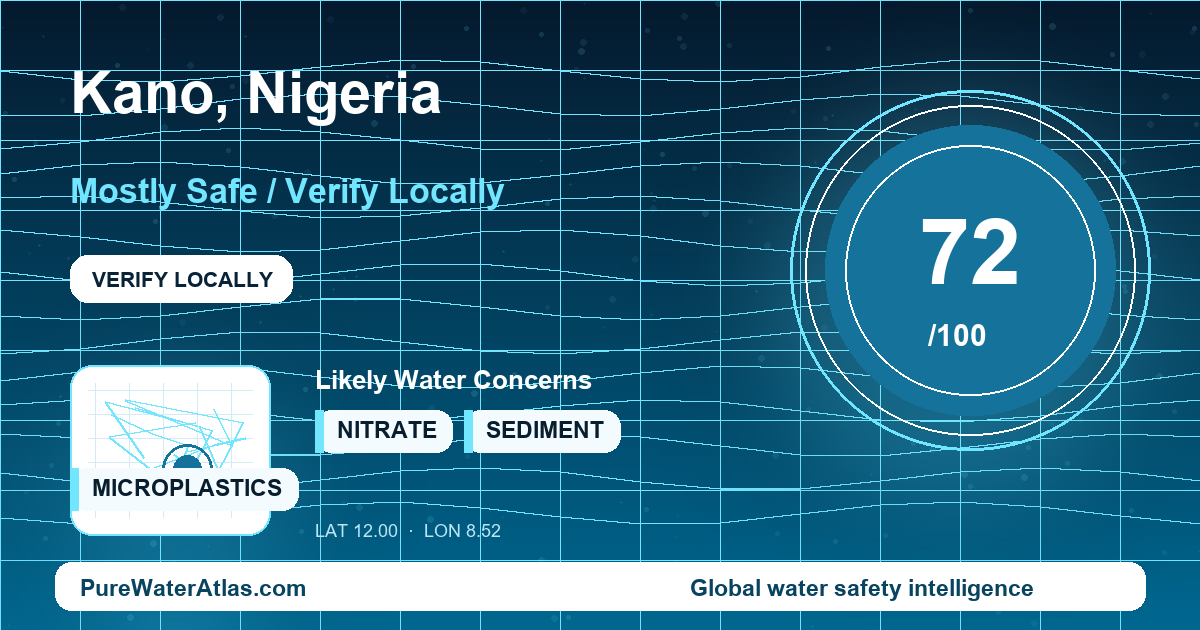
Kano, Nigeria: municipal tap water is conditionally usable in some settings, but travelers and households should verify building-level storage, disinfection, and local water quality before drinking it untreated.
Quick Answer
| City | Kano, Nigeria |
|---|---|
| Water safety score | 72 / 100 |
| Risk level | Mostly Safe / Verify Locally |
| Is tap water safe to drink? | Conditionally. Kano has a treated municipal surface-water supply, but safety at the tap depends heavily on distribution pressure, pipe condition, household storage tanks, and whether the building has recent water-quality verification. |
| Traveler advice | Short-stay visitors should not use ordinary tap water as their main drinking water unless a reputable hotel or host confirms safe treatment, safe storage, and recent testing. Use sealed bottled water, boiled water, or properly filtered and disinfected water. |
| Resident advice | Residents can use municipal water more confidently when it is clear, reliably supplied, and has a detectable disinfectant residual, but should test both tap and stored tank water where supply is intermittent or plumbing is old. |
| Main water source | Treated surface water from the Kano-Challawa river and dam system, including infrastructure associated with Challawa Gorge Dam, Tiga Dam, Watari Dam, and metropolitan treatment plants. |
| Main authority | Kano State Water Board, within Kano State water-sector governance. |
| Filter recommendation | Often practical, not automatically mandatory. Sediment prefiltration plus activated carbon and UV or chlorination is commonly more relevant than reverse osmosis unless testing shows dissolved contaminants such as high salinity, nitrate, fluoride, arsenic, or other dissolved pollutants. |
Why Kano Is Different
Kano is not a city where the tap-water question can be answered simply by saying “groundwater is safe” or “municipal water is unsafe.” Kano’s urban public supply is primarily a treated surface-water system serving a large inland, semi-arid northern Nigerian metropolis. The city sits within the wider Kano-Challawa-Hadejia river basin, where water availability, raw-water turbidity, and seasonal pressure on supply can change sharply between the rainy season and the hot dry season.
The central issue in Kano is often what happens after water leaves the treatment plant. Intermittent supply, pressure drops, pipe leakage, old or stressed distribution infrastructure, illegal or poor-quality connections, and building-level storage can all change water quality before it reaches a kitchen tap. Many homes and businesses store water in overhead or underground tanks because supply may not be continuous. That storage practice is practical, but it means a building with a good municipal connection can still have unsafe tap water if tanks are dirty, uncovered, poorly plumbed, or fed from mixed sources.
This guide treats Kano’s tap water as conditionally usable rather than automatically safe everywhere. The confidence level is medium: the main supply identity and local risk pathways are reasonably documented, but recent publicly accessible tap-water results by distribution zone, neighborhood, season, and building type are limited. Conditions may differ substantially between treated utility water, private boreholes, shallow wells, tanker water, sachet water, and stored water inside individual buildings.
Where Does Kano’s Tap Water Come From?
Kano’s urban piped water supply is mainly based on treated surface water, not a simple groundwater-only city system. The raw-water context includes the Kano-Challawa river and dam system, with water associated with Challawa Gorge Dam, Tiga Dam, Watari Dam, and related reservoirs. Water is treated at metropolitan water-treatment facilities before being distributed through transmission mains, service reservoirs, public standpipes, household tanks, and building plumbing.
Important infrastructure in the Kano urban supply context includes the Kano State Water Board metropolitan distribution network, the Tamburawa Water Treatment Plant, Challawa dam-linked and treatment infrastructure, and Watari Dam and Watari Water Treatment Plant. These facilities and networks form the formal public-supply backbone for Kano metropolis and surrounding urban areas.
However, Kano’s practical water reality is mixed. Historically and today, many households also rely on shallow wells, boreholes, vendors, sachet water, tanker water, and household storage. Rapid urban growth has increased demand on the formal system and has kept non-network sources important, especially during supply interruptions. That means “Kano water” can refer to very different sources depending on the neighborhood, building, season, and household practice.
Who Manages Drinking Water in Kano?
The principal public water utility for urban piped water in Kano is the Kano State Water Board. Kano’s broader water-sector governance also includes state-level institutions such as the Kano State Ministry of Water Resources. Regional water-resources context is influenced by basin and dam infrastructure, including institutions such as the Hadejia-Jama’are River Basin Development Authority.
Drinking-water quality in Nigeria is guided by the Nigerian Standard for Drinking Water Quality and public-health guidance from federal and state institutions. The Standards Organisation of Nigeria is relevant to national standards, while packaged water, bottled water, and sachet water are separately regulated through the National Agency for Food and Drug Administration and Control. This distinction matters in Kano because many residents and visitors use packaged water in addition to, or instead of, piped municipal water.
In practice, Kano users should not assume that every tap across the city has the same quality at the same time. Current utility notices, water-board information, state updates, and laboratory testing are more useful than a citywide assumption. International guidance from the WHO Guidelines for Drinking-water Quality also emphasizes that microbial safety, turbidity control, effective disinfection, and protection during distribution are central to drinking-water safety.
Main Local Water Concerns
The most important Kano-specific concerns are linked to intermittency, storage, and mixed sources. When piped supply is not continuous, pressure drops can increase the risk that contaminated water intrudes through damaged pipes or poor connections. Pipe disturbances can also produce visible sediment, color, or turbidity at the tap. High turbidity is especially relevant around rainy-season runoff events or after network repairs and disturbances.
Rainy-season runoff can increase raw-water turbidity, color, sediment, and microbial loading before treatment. During the dry season, heat and lower flows can concentrate taste, odor, salinity, and organic-matter issues in some sources. Water scarcity periods can increase reliance on boreholes, vendors, tanker water, sachet water, and stored water, shifting the household risk profile away from the municipal network and toward source handling and storage hygiene.
Private groundwater sources add another layer. Boreholes and shallow wells may have variable microbial quality and may also show hardness, iron, manganese, salinity, or taste issues depending on local conditions. Nitrate is a concern to test for in wells and boreholes where sanitation leakage, flooding, or agricultural influence may be relevant. Industrial and urban runoff pressure in the Challawa and Kano urban river corridors is also a documented environmental concern, although that does not prove that treated municipal tap water at every Kano tap is contaminated.
Older building plumbing can create local risks that are not visible at the treatment plant. Metal fittings, pumps, solder, corroded internal pipes, and old service connections can affect water quality after it enters a property. Possible lead or metal exposure should not be assumed citywide without testing, but older or unknown plumbing is a valid reason to test first-draw and flushed samples.
For Travelers
For travelers, the cautious answer is no: do not drink untreated ordinary tap water in Kano unless you have verified the building’s treatment, storage, and recent testing. Use sealed bottled water from reputable shops, boiled water, or water treated with a credible filter plus disinfection. Check that bottled-water caps are intact and avoid bottles that appear refilled.
Use bottled or treated water for brushing teeth if you are a short-term visitor, pregnant, immunocompromised, traveling with young children, or staying in budget accommodation where tank hygiene is unknown. This is especially important because a hotel, guesthouse, or rented apartment may receive water from the municipal system but store it in tanks that have not been cleaned or disinfected recently.
Avoid ice unless you are confident it was made from treated water in a reputable hotel, restaurant, or packaged-water facility. Freezing does not reliably make contaminated water safe. Higher-end hotels may use storage tanks, filtration, chlorination, UV treatment, or bottled-water service, but ask specifically whether drinking water and ice are made from treated or bottled water, not simply from tap water.
For hot drinks, boiled water is safer only if it has reached a rolling boil. Travelers using portable filters should remember that filtration alone may not control all microbial risk; pairing filtration with disinfection is a more cautious approach. The CDC Travelers’ Health guidance for Nigeria supports careful food and water precautions for visitors.
For Residents
For Kano residents, the decision is more nuanced than for short-stay visitors. If your home is connected to the Kano municipal system, water is clear, supply is reliable, and a disinfectant residual is detectable, the risk may be lower than in homes using stored, mixed, or private sources. But building-level verification is essential, especially where water is stored in overhead or underground tanks.
A home filter is not automatically required for every Kano household, but it is often practical where supply is intermittent, plumbing is old, tanks are used, or boreholes and tanker water are part of the household supply. A sensible setup for many homes is a sediment prefilter followed by activated carbon and a microbial barrier such as UV or chlorination. UV is most effective when water is already low in turbidity, so sediment control and tank hygiene matter. See the PureWaterAtlas UV Water Purification Guide and Boiling Water Purification Guide for practical treatment context.
Reverse osmosis should be chosen based on testing, not guesswork. It may be justified if laboratory results show high dissolved solids, salinity, nitrate, arsenic, fluoride, or other dissolved contaminants that ordinary carbon filters do not remove. For boreholes or shallow wells, residents should test for microbial contamination, nitrate, hardness, iron, manganese, salinity indicators, pH, and electrical conductivity or TDS, particularly after flooding or nearby sanitation failures.
Storage tanks deserve special attention in Kano. Overhead and underground tanks should be covered, screened, cleaned, disinfected, and inspected routinely. Open lids, animal access, dirty tank bottoms, biofilm, cross-connections with borehole or tanker water, and poor plumbing can turn otherwise acceptable water into unsafe water before it reaches the tap.
Relevant Contaminants and Water-Quality Issues
The most important Kano risk to rule out at the household level is microbial contamination, especially E. coli. E. coli indicates fecal contamination and is particularly relevant where water is stored, pressure is intermittent, wells are poorly protected, or containers are unsafe.
Turbidity and sediment are also important in Kano because rainy-season runoff, pipe disturbances, and tank deposits can affect clarity and treatment performance. High turbidity can interfere with disinfection and may signal that water should be settled, filtered, or avoided until properly treated.
Chlorine residual is a practical indicator for disinfected piped supply. If chlorinated municipal water reaches the building but no residual remains after storage, the tank or internal plumbing may be consuming disinfectant or allowing contamination. For older buildings, lead and other metals should be tested rather than judged by taste or appearance. Residents using wells or boreholes should also understand nitrate and iron, both of which can be relevant to non-network sources.
How to Verify Your Water Quality
The most reliable way to assess your Kano water is to test the actual water you use. Test tap water and stored tank water separately. A clean municipal supply can become contaminated inside a building, and a clean-looking tank can still have microbial risk. At minimum, test for E. coli or thermotolerant coliforms, total coliforms, turbidity, pH, electrical conductivity or TDS, and free chlorine residual where chlorinated supply is expected.
If the building is old or has unknown plumbing, test first-draw and flushed samples for lead and other metals. PureWaterAtlas has a detailed guide to lead testing and detection methods. If your property uses a borehole or shallow well, add nitrate testing; the nitrate testing guide explains why this matters for private sources and sanitation-influenced water.
If your property is near industrial drains, workshops, tanneries, dyeing activity, fuel storage, or waste sites, consider laboratory testing for heavy metals and site-specific contaminants. For broader learning, use the PureWaterAtlas Water Testing Guide, the Contaminants Search Engine, and the Global Water Quality Checker. Related background pages include Drinking Water Safety, Water Microbiology, Water Treatment Systems, and Agricultural Runoff in Drinking Water.
Official and Technical Sources
- Kano State Water Board — local utility context for Kano urban water services.
- Kano State Ministry of Water Resources — Kano State water-sector governance context.
- World Bank: Nigeria Sustainable Urban and Rural Water Supply, Sanitation and Hygiene Program — national service-delivery and WASH context.
- WHO Guidelines for Drinking-water Quality — microbial safety, turbidity, disinfection, and household water-safety principles.
- CDC Travelers’ Health: Nigeria — travel food and water precautions.
- WHO/UNICEF Joint Monitoring Programme: Nigeria household drinking-water data — national WASH monitoring context.
- Standards Organisation of Nigeria — Nigerian standards context.
- NAFDAC — packaged, bottled, and sachet water regulatory context.
- Hadejia-Jama’are River Basin Development Authority — regional basin and dam infrastructure context.
Bottom Line
Kano’s tap water should be treated as conditionally usable, not automatically safe at every tap. The city has a real treated municipal surface-water system linked to the Kano-Challawa river and dam network, but household safety depends on local distribution pressure, pipe condition, tank hygiene, and whether the building uses mixed sources such as boreholes, tankers, or stored water. Travelers should use sealed bottled water, boiled water, or properly filtered and disinfected water unless a reputable hotel can verify safe treatment and storage. Residents should test tap and tank water separately, maintain tanks, and choose filtration based on actual results. Because recent zone-by-zone public water-quality data are limited, local verification is essential in Kano.
Read the full guide: Global Water Quality Guide
Explore more in this category: Global Water Quality Articles