
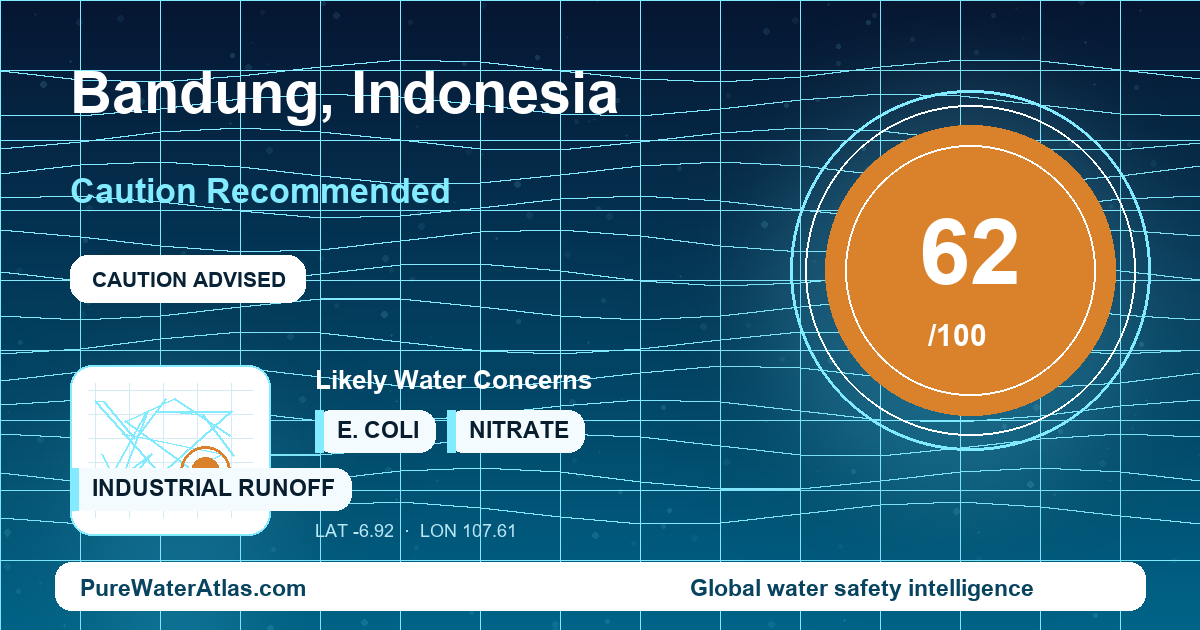
Bandung, Indonesia: treated municipal water exists, but drinking straight from the tap is not recommended without point-of-use treatment because risk varies by source, distribution conditions, building tanks, plumbing, and private wells.
Quick Answer
| City | Bandung, West Java, Indonesia |
|---|---|
| Water safety score | 62 / 100 |
| Risk level | Caution Recommended |
| Can you drink the tap water? | Not recommended without treatment. Use sealed bottled water, reputable gallon water, boiled water, or water treated by a maintained filter, UV system, or other appropriate purifier. |
| Traveler advice | Do not assume bathroom tap water is drinkable. Use bottled or boiled water for drinking; be cautious with ice from informal vendors. |
| Resident advice | Municipal supply from Perumda Tirtawening is more controlled than untreated wells, but drinking water should still be filtered and disinfected at the point of use, especially after storage tanks. |
| Main water source context | Treated surface water tied to the Citarum basin, especially the Cisangkuy and Cikapundung river systems, supplemented by springs and groundwater or deep wells. |
| Water authority | Perumda Tirtawening Kota Bandung, historically known as PDAM Tirtawening. |
| Filter recommendation | For drinking: sediment filtration plus activated carbon, followed by boiling, UV, ultrafiltration, or reverse osmosis depending on source and test results. Private wells require testing before choosing treatment. |
Bandung has a real municipal treated-water system, but a blanket claim that all taps are safe to drink directly would not be evidence-based. Current public, neighborhood-level tap-water compliance data are limited, and final water quality can change between the treatment plant and the kitchen tap.
Why Bandung Is Different
Bandung is an inland highland city in West Java, located in the Bandung Basin and surrounded by volcanic uplands. Its drinking-water profile is shaped by steep catchments, dense urban development, wet-season runoff, and dependence on tributaries of the Citarum basin rather than coastal or desalinated water. This makes Bandung different from cities where a single reservoir, desalination plant, or uniformly pressurized distribution network dominates the drinking-water picture.
The practical question in Bandung is often not simply “is the municipal treatment plant operating?” but “what happened to the water after treatment?” A hotel, boarding house, cafe, apartment, or home may receive treated municipal water, but the final tap can be affected by rooftop tanks, ground tanks, booster pumps, old internal pipes, intermittent pressure, dispenser hygiene, or the handling of refill gallons. Those customer-side systems are especially important because they sit close to the point of consumption and may not be reflected in utility-level descriptions.
Bandung also has a strong local river identity. The Cikapundung River runs through North and central Bandung before joining the wider Citarum system. At the same time, urbanization, domestic wastewater, runoff, and solid-waste pressure in the Citarum basin make source-water protection a continuing challenge. Treated municipal water should therefore not be equated with raw river water, untreated well water, or refill water of unknown handling quality.
Where Does Bandung’s Tap Water Come From?
Bandung does not have a single simple source-to-tap profile. The municipal drinking-water supply is tied to the Citarum River basin and its tributaries. Perumda Tirtawening uses treated surface water, notably from the Cisangkuy and Cikapundung river systems, with supplementary springs and groundwater or deep wells in parts of the supply portfolio. The Cisangkuy system is especially important because it feeds major municipal treatment infrastructure serving Bandung.
Key infrastructure includes Perumda Tirtawening Kota Bandung’s municipal production and distribution system, the Badaksinga drinking-water treatment installation commonly associated with Bandung’s larger treated surface-water supply, and Dago Pakar and other Bandung-area intake and treatment facilities linked to upland river sources such as the Cikapundung system. Historically, Bandung benefited from upland springs and groundwater in its volcanic highland setting, but as the city expanded, supply increasingly depended on engineered intakes, transmission, treatment, and distribution from the wider Citarum basin.
From a household perspective, the official source is only part of the story. Many residents and businesses depend on customer-side roof tanks, ground tanks, pumps, and premise plumbing. These systems can improve continuity of supply, but they can also introduce microbial risk if tanks are open, unclean, poorly sealed, or connected through plumbing that allows contamination during pressure changes.
Who Manages Drinking Water in Bandung?
Bandung’s piped municipal water service is managed by Perumda Tirtawening Kota Bandung, also known historically as PDAM Tirtawening. The utility is the primary local institutional reference for Bandung’s municipal drinking-water production and distribution service.
Indonesia’s drinking-water quality framework is set nationally by the Ministry of Health, including Minister of Health Regulation No. 2 of 2023. Local implementation involves the municipal utility, health authorities, and water-resource agencies. Bandung’s raw-water context also sits within Citarum basin governance, involving West Java and national public works and water-resources institutions, including the Balai Besar Wilayah Sungai Citarum.
The important limitation is that utility identity and basin context do not prove that every consumer tap is safe at all times. Publicly accessible, current, neighborhood-level tap-by-tap data for Bandung are limited. Treatment-plant water, distribution-main water, building-tank water, private well water, and refill-depot water are different exposure points and should not be treated as identical.
Main Local Water Concerns
The main Bandung concern is practical microbial risk, especially where tap water is stored before use, pressure is intermittent, pipes leak, tanks are unclean, or a building relies on private wells. Clear water is not proof of microbiological safety, and absence of chlorine smell is not proof that water is either unsafe or safe. For drinking, untreated tap water should be handled cautiously.
- Wet-season turbidity: During the wet season, roughly November to March, heavier runoff can increase suspended sediment in upland surface-water sources. Intense rain, landslides, or catchment disturbance can raise sediment loads in rivers feeding treatment systems.
- Citarum and Cikapundung source pressure: Urban runoff, domestic wastewater, and solid-waste pressure in the wider basin make treatment essential before drinking.
- Storage tanks and building plumbing: Roof tanks, ground tanks, pumps, old pipes, and internal fittings can strongly affect water at the final tap.
- Private wells: Wells in dense urban or peri-urban areas may be vulnerable to septic leakage, nitrate, bacteria, iron, manganese, or local contamination depending on construction and depth.
- Discoloration and sediment: Brown, black, metallic-tasting, or sediment-heavy water can indicate turbidity, iron, manganese, disturbed deposits, or plumbing-related issues.
- Old buildings: There is not enough public evidence to claim a citywide lead problem in Bandung, but older premise plumbing is a legitimate reason to test for metals if water is consumed.
- Refill gallons and dispensers: Refill-water depots are common, but safety depends on source water, treatment maintenance, container cleaning, and handling.
After service interruptions, pipe repairs, flooding, long outages, or low-pressure events, Bandung residents should flush taps and avoid drinking discolored water until it clears and has been boiled or otherwise treated.
For Travelers
Short-stay visitors to Bandung should not rely on untreated tap water for drinking. Use sealed bottled water, reputable sealed gallon water, boiled water, or water treated by a well-maintained purifier. In hotels, ask whether drinking water is bottled, boiled, or filtered; do not assume bathroom tap water is intended for drinking.
For brushing teeth, most healthy adults may use tap water in better hotels or modern buildings, but cautious travelers, young children, pregnant travelers, and immunocompromised people should use bottled or boiled water. For ice, use judgment: ice in established hotels, malls, and higher-end restaurants is more likely to be made from treated water, while ice from street stalls and informal vendors may have less reliable handling. Avoid ice if the source is unclear.
For food and drink, choose sealed water when possible, prefer hot drinks that have been boiled, and carry water during sightseeing. Avoid swallowing shower water if you are sensitive. If stomach illness occurs, oral rehydration salts can be useful. The conservative traveler guidance is consistent with the CDC Travelers’ Health advice for Indonesia, which emphasizes food and water precautions.
For Residents
Residents connected to Perumda Tirtawening generally have a more controlled source than untreated private wells, but point-of-use treatment is advisable for drinking water. A practical Bandung setup is sediment prefiltration for visible particles, activated carbon for taste and chlorine-related issues, and a validated microbial barrier such as boiling, UV, ultrafiltration, or reverse osmosis depending on source and test results. For method selection, see PureWaterAtlas guides to boiling water purification, UV water purification, and broader water purification methods.
If you use a private well, test before selecting treatment. At minimum, test for E. coli or thermotolerant coliforms, total coliforms, nitrate, pH, electrical conductivity or TDS, iron, manganese, turbidity, and basic hardness. If your home receives municipal water but stores it in a tank, sample after the tank or at the kitchen tap, not only at the incoming service line.
Old houses, boarding houses, schools, and commercial buildings may have internal pipes, fittings, solder, or storage systems that differ from the municipal main. Bandung-specific public evidence is not sufficient to claim widespread lead contamination, but old plumbing justifies first-draw and flushed-sample testing for metals when the water is used for drinking. Storage tanks should be cleaned and disinfected regularly, kept sealed, protected from insects and dust, and inspected at float valves, pump connections, and lids. Stored water should not be consumed without boiling, UV, or another validated disinfection step.
Relevant Contaminants and Water-Quality Issues
For Bandung, the most relevant issues are not limited to one contaminant. Turbidity and sediment matter because wet-season runoff and disturbed pipes or tanks can make particles visible at the tap. Microbial safety is central, so residents and travelers should understand E. coli as an indicator of fecal contamination and unsafe disinfection conditions.
Chlorine taste or odor may occur in treated supply, but sensory clues alone are not a reliable safety test. Private wells may require attention to nitrate, especially where septic leakage is possible, and to naturally or locally elevated iron and manganese. In older buildings, lead is not confirmed as a citywide Bandung issue, but plumbing-related metal testing is reasonable when water is consumed daily.
How to Verify Your Water Quality
The safest Bandung decision is to test the water you actually drink. If your home uses a roof tank, sample at the kitchen tap after the tank. If you use a private well, test the well water and retest after treatment. If you rely on refill gallons or dispensers, hygiene and handling matter as much as the source claim.
Start with the PureWaterAtlas Water Testing guide, then use the Contaminants Search Engine to match symptoms such as color, sediment, odor, or metallic taste with possible causes. For broader country and city comparisons, use the Global Water Quality Checker. If you are new to risk assessment, the Drinking Water Safety guide and Water Microbiology guide explain why clear water can still require disinfection.
For specific testing decisions, see PureWaterAtlas resources on nitrate testing and lead testing.
Official and Technical Sources
- Perumda Tirtawening Kota Bandung — local water utility reference for Bandung’s municipal water service.
- Kota Bandung official government website — official municipal context.
- BPS Kota Bandung — official statistics context for Bandung’s administrative and urban setting.
- Balai Besar Wilayah Sungai Citarum — official Citarum basin water-resources authority.
- Citarum Harum, West Java Provincial Government — provincial reference for recognized Citarum watershed restoration and pollution challenges.
- Minister of Health Regulation No. 2 of 2023 — Indonesia’s national health-based drinking-water and environmental health quality framework.
- World Health Organization drinking-water fact sheet — public health reference for safe drinking water, microbial risk, and safe storage.
- CDC Travelers’ Health: Indonesia — travel health guidance supporting conservative food and water precautions.
- Asian Development Bank: Integrated Citarum Water Resources Management Investment Program — technical background on basin-scale Citarum water-resource management needs.
Bottom Line
Bandung has treated municipal water managed by Perumda Tirtawening, with raw-water connections to the Cisangkuy, Cikapundung, and wider Citarum basin, plus supplementary springs and groundwater. That does not mean every tap is safe to drink directly. Wet-season turbidity, urban source-water pressure, intermittent distribution conditions, customer storage tanks, private wells, refill-water handling, and old building plumbing can all affect final water quality. Travelers should use bottled, boiled, or properly treated water. Residents should maintain tanks, test wells and suspect taps, and use point-of-use treatment for drinking. Because current public tap-by-tap data are limited, the most evidence-based Bandung verdict is: use caution, verify locally, and disinfect drinking water before consumption.
Read the full guide: Global Water Quality Guide
Explore more in this category: Global Water Quality Articles