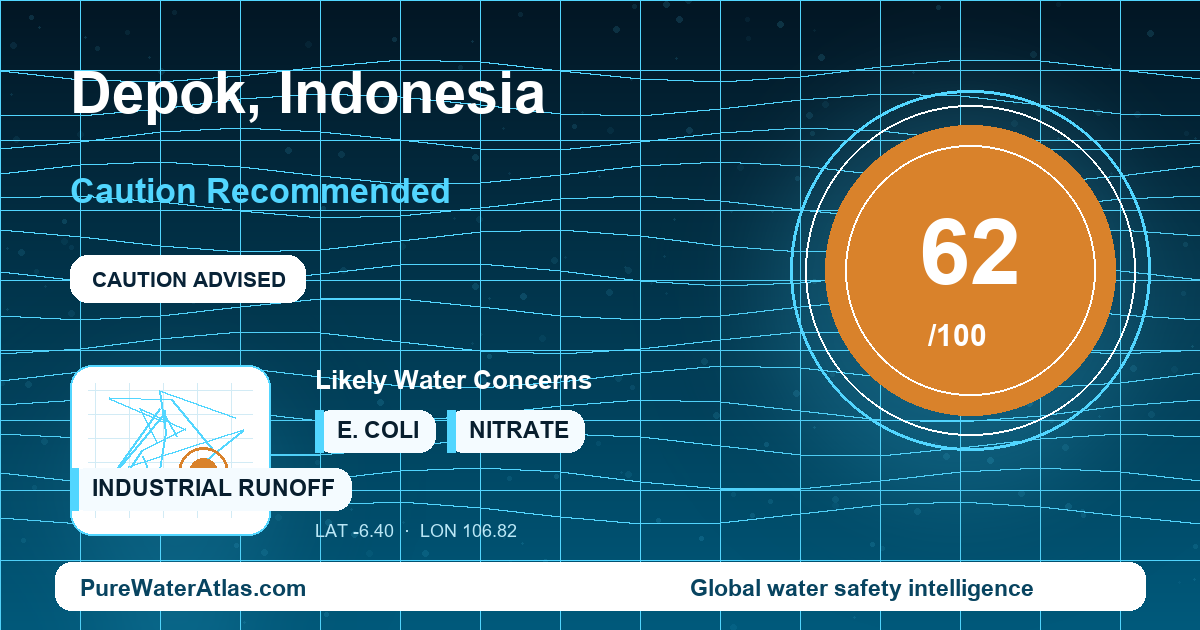
Depok, Indonesia: municipal treated water exists, but point-of-use caution is recommended because river-source pressure, rainy-season turbidity, household storage, and private wells can all affect drinking-water safety.
Quick Answer
| Overall safety status | Caution Recommended — PureWaterAtlas score: 62/100. |
|---|---|
| Can you drink Depok tap water directly? | Not as a default practice. Depok has treated municipal piped water, but visitors and many households should boil, reliably filter, or otherwise verify treatment before drinking. |
| Traveler advice | Use sealed bottled water, properly boiled water, or water from a verified hotel or restaurant treatment system. Hot tea and coffee made with fully boiled water are generally lower risk. |
| Resident advice | Perumda Air Minum Tirta Asasta customers can treat the supply as utility-treated water, but drinking water should often still be boiled or filtered, especially after roof tanks, ground tanks, pumps, or old internal plumbing. |
| Main water source context | Treated surface water associated with the Ciliwung and Pesanggrahan river systems, plus private wells, refill-water depots, and bottled water in areas or households not relying fully on piped service. |
| Local authority | Perumda Air Minum Tirta Asasta Kota Depok, with public-health oversight through Depok and Indonesian health authorities. |
| Filter recommendation | For utility water: sediment prefiltration, activated carbon, and final disinfection such as boiling or UV where needed. For wells: test first, then select treatment based on results. |
Why Depok Is Different
Depok’s water-safety profile is shaped by its position as an inland West Java city immediately south of Jakarta and north of Bogor. It sits in the heavily urbanized Ciliwung-Cisadane basin corridor, so the relevant risks are not mainly coastal seawater intrusion. Instead, Depok’s drinking-water question is tied to dense settlement, urban rivers, drainage channels, sanitation pressure, household storage, and heavy seasonal rainfall.
The city has a formal municipal utility and treated piped-water infrastructure, but household experience can vary sharply. A home connected to the Perumda Air Minum Tirta Asasta network is not the same as a home using a private shallow well, a deep borehole, refill water, or bottled water. Even within the piped network, water quality at the kitchen tap can differ from water quality leaving a treatment plant because many buildings use pumps, roof tanks, ground tanks, and internal plumbing before water reaches the point of use.
The most practical Depok-specific question is therefore not simply “does the city treat water?” It is: is this particular home on the Tirta Asasta network, is pressure continuous, is the storage tank clean and sealed, is the plumbing old, and is any private well close to septic tanks, flood-prone drainage, or other contamination sources?
Where Does Depok’s Tap Water Come From?
Depok’s municipal supply is associated with treated surface water from the Ciliwung and Pesanggrahan river systems. Public local references identify water treatment installations serving Depok, including Legong, Citayam, and Cinangka. These assets form part of the city’s piped-water identity through Perumda Air Minum Tirta Asasta Kota Depok.
That source-water context matters. Urban rivers in the Jakarta-Bogor corridor can be affected by domestic wastewater, septic systems, storm runoff, drainage channels, solid-waste impacts, and seasonal flow changes. During heavy rain, storm runoff can raise turbidity and microbial loading in raw water. During dry periods, lower flows can concentrate pollutants and contribute to taste, odor, or treatment challenges.
Depok also has a legacy of household groundwater use. Rapid suburban growth occurred before and during expansion of the municipal network, and many households historically depended on private wells, neighborhood boreholes, refill water, and household storage tanks. In areas outside reliable piped service, those alternatives remain relevant. This is why a citywide statement about “tap water” can be misleading unless it distinguishes between treated utility water, private well water, and water that has been stored in a building tank.
Who Manages Drinking Water in Depok?
The local drinking-water utility is Perumda Air Minum Tirta Asasta Kota Depok, formerly commonly referred to as PDAM Tirta Asasta. The utility is the primary local reference for Depok’s piped-water services, customer information, and institutional water-supply identity.
City-level public-service context is available through the Kota Depok official government portal, while geographic, population, and urban-growth context is supported by BPS Kota Depok. The broader river-basin context is framed by the Balai Besar Wilayah Sungai Ciliwung Cisadane, the official Ciliwung-Cisadane basin authority.
Indonesia’s national framework also matters. Drinking-water and environmental health standards are set nationally, including Ministry of Health Regulation No. 2 of 2023, which establishes environmental health quality standards and drinking-water parameters. Public drinking-water supply systems are governed under Indonesia’s SPAM framework, including Government Regulation No. 122 of 2015. These rules create the regulatory framework, but they do not prove that every household tap, tank, or private well in Depok is safe without local testing.
Main Local Water Concerns
The main Depok concern is not a single confirmed citywide toxic contaminant. It is the combined risk created by polluted urban river raw water, rainy-season turbidity, variable household infrastructure, private wells, and storage tanks.
- Urban river raw water: The Ciliwung and Pesanggrahan catchment context means raw water can face high turbidity, organic pollution, and microbial loading, especially during storm runoff.
- Rainy-season stress: Heavy rainfall can increase sediment, color, microbial contamination, and short-term treatment difficulty. Flooding or drainage backups can also affect shallow wells and poorly sealed tanks.
- Private wells: Wells may be vulnerable to E. coli, total coliform, nitrate, turbidity, iron, manganese, pH imbalance, and nearby septic or drainage influence. Taste and appearance alone are not reliable safety tests.
- Household storage: Chlorine residual may be present in treated piped water, but disinfection at the plant does not guarantee safety after long storage in roof tanks or ground tanks.
- Building plumbing: Lead is not documented from public data as a citywide Depok problem, but older fixtures, brass fittings, solder, galvanized components, or imported plumbing materials can create building-level metal risk.
- Salinity: Salinity is not a leading Depok risk because the city is inland, unlike some coastal Jakarta Bay and north-coast groundwater settings.
Public information is sufficient to identify the utility, regulatory setting, and broad source-water context. However, comprehensive current laboratory results by treatment plant, distribution zone, household tap, and private well are not available in one public dataset. This profile should not be read as a claim that every Depok tap either passes or fails every Indonesian drinking-water parameter.
For Travelers
Travelers should not drink Depok tap water straight from the tap as a default practice. Use sealed bottled water, properly boiled water, or water from a verified hotel or restaurant treatment system. If you are staying in Depok while visiting Jakarta, Bogor, campuses, hospitals, family homes, or business areas, do not assume that bathroom tap water is potable.
For brushing teeth, most healthy travelers can use tap water in better hotels if they avoid swallowing it, but bottled or boiled water is safer for children, immunocompromised travelers, short-stay visitors, and anyone with a sensitive stomach. For ice, be cautious with street vendors and small shops unless the ice is clearly made from commercial purified water. Ice in reputable hotels, chain restaurants, and established cafes is usually lower risk, but it is still not independently verified at the point of service.
Ask hotels and restaurants whether drinking water is bottled, boiled, filtered, or supplied through a dispenser. Many establishments use commercial purified water rather than straight tap water. During heavy rain or local flooding, be more conservative with ice, raw foods washed in water, and drinks from small roadside vendors. A travel filter rated for bacteria and protozoa can reduce risk; for higher confidence, combine filtration with boiling, UV, or chemical disinfection.
For Residents
Depok residents connected to Perumda Air Minum Tirta Asasta can generally regard the supply as utility-treated water, but many households should still treat drinking water at the point of use. A practical setup for piped water is a sediment prefilter, activated carbon for taste and odor, and final disinfection such as boiling or UV if stored water, intermittent pressure, or household plumbing conditions raise concern. See the PureWaterAtlas guides to boiling water purification and UV water purification for treatment-method details.
For private wells, do not choose treatment only by taste, smell, or color. Test first. At minimum, private wells in Depok should be tested at least annually for E. coli, total coliform, nitrate, pH, conductivity or TDS, turbidity, iron, and manganese. Retest microbiology after flooding, septic failure nearby, pipe repairs, or a noticeable change in taste, color, or odor. Homes with infants, pregnant residents, elderly people, or immunocompromised people should prioritize E. coli, nitrate, and turbidity testing.
Storage tanks are a major control point in Depok homes and buildings. Keep roof tanks and ground tanks covered, screened, and sealed against insects, rodents, dust, and floodwater. Clean and disinfect tanks periodically, especially after construction work, flooding, or visible slime and sediment. If UV treatment is used, turbidity should be controlled first because cloudy water can reduce UV effectiveness.
Older buildings deserve extra attention. Depok is not identified in public data as a citywide lead-pipe hotspot, but internal plumbing can still affect a specific tap. Flush stagnant water and consider first-draw and flushed lead testing from the kitchen tap if the building is old, plumbing materials are unknown, or infants will consume the water.
Relevant Contaminants and Water-Quality Issues
For Depok, the most relevant PureWaterAtlas contaminant profiles are tied to the city’s river-source, well-water, storage, and plumbing context. Microbial contamination is central, especially for private wells and storage tanks, so start with E. coli in drinking water. Rainy-season raw-water changes and cloudy water make turbidity and sediment important practical indicators.
For piped utility water, chlorine is relevant because it relates to residual disinfection, taste, and what happens after water is stored. For private wells, nitrate is a reasonable screening parameter in dense settlement and septic-influenced environments; PureWaterAtlas also has a guide to nitrate testing and detection. Groundwater users should also understand iron and manganese, which can cause staining, color, sediment, or taste issues. For older internal plumbing, review lead in drinking water and the guide to lead testing methods.
How to Verify Your Water Quality
The only reliable way to know whether a specific Depok tap or well is safe is to test that water at the point of use. This is especially important for private wells, homes with infants, buildings using roof or ground tanks, older properties, and households affected by flooding, pipe repair, or changes in color, odor, or taste.
Use the PureWaterAtlas guide to water testing to plan sampling and decide which parameters matter. For a broader framework, see Drinking Water Safety, Water Microbiology, Water Purification, and Water Treatment Systems.
You can compare Depok with other locations using the Global Water Quality Checker. If you already have a local lab report, use the Contaminants Search Engine to look up individual parameters. Related PureWaterAtlas categories include Drinking Water Safety, Global Water Quality, Water Testing, and Water Microbiology.
Official and Technical Sources
- Perumda Air Minum Tirta Asasta Kota Depok official website — local utility source for Depok piped-water services and institutional identity.
- Kota Depok official government portal — city-government context for local administration and public services.
- BPS Kota Depok — official city statistics source for Depok geography, population, and urban context.
- Permenkes No. 2 Tahun 2023 — Indonesian Ministry of Health drinking-water and environmental health quality standards.
- Government Regulation No. 122 of 2015 on Drinking Water Supply Systems — national SPAM framework.
- Balai Besar Wilayah Sungai Ciliwung Cisadane — official Ciliwung-Cisadane river-basin authority.
- WHO/UNICEF Joint Monitoring Programme household water data for Indonesia — national drinking-water and sanitation service-level context.
Bottom Line
Depok has a recognized municipal water utility and treated piped-water infrastructure, but straight-from-the-tap drinking is not the safest default. The city’s water context is shaped by Ciliwung and Pesanggrahan river-source pressure, rainy-season turbidity, dense urban drainage and sanitation conditions, private wells, and household tanks. Tourists should use sealed bottled, boiled, or verified treated water. Residents on Perumda Air Minum Tirta Asasta should still pay attention to storage tanks, old plumbing, pressure interruptions, and point-of-use treatment. Private well users should test for microbiology, nitrate, turbidity, pH, iron, and manganese before choosing a filter. Because detailed neighborhood-level tap and well results are not publicly centralized, verification at the specific home or building remains essential.
Read the full guide: Global Water Quality Guide
Explore more in this category: Global Water Quality Articles