
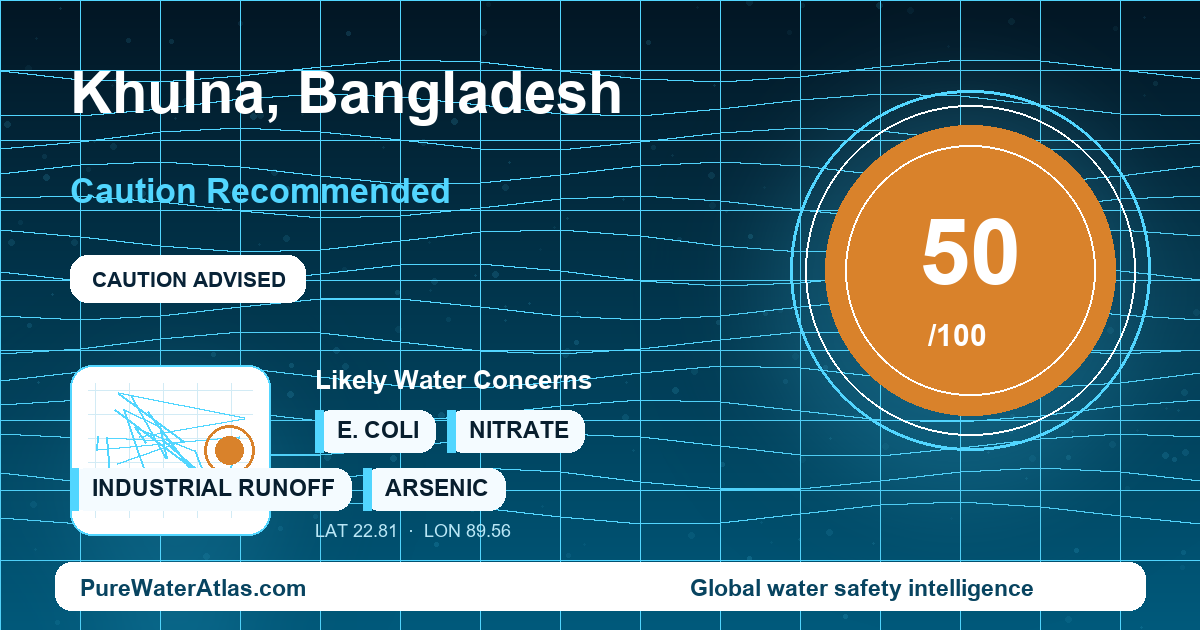
Khulna, Bangladesh: treated municipal supply exists, but coastal salinity pressure, household storage, intermittent distribution risks, and limited public tap-level data mean caution is recommended.
Quick Answer
| Overall safety status | Caution recommended. Khulna has a real municipal water authority and a major treated surface-water supply system, but tap safety should not be assumed at every household or building. |
|---|---|
| Water safety score | 50 / 100 |
| Risk level | Caution Recommended |
| Can travelers drink tap water? | Not recommended untreated. Short-stay visitors should use sealed bottled water or water that has been boiled, UV-treated, or filtered through a well-maintained purifier. |
| Resident advice | Khulna residents should pay close attention to storage tanks, building plumbing, turbidity, residual chlorine, salinity taste, and testing of private wells or boreholes. |
| Main municipal source | Khulna’s municipal system has been shifting from groundwater dependence to treated surface water drawn from the Madhumati River upstream of the saline coastal zone. |
| Water authority | Khulna Water Supply and Sewerage Authority, commonly referred to as Khulna WASA or KWASA. |
| Filter recommendation | A household treatment barrier is advisable for drinking and cooking water unless recent reliable testing confirms safety at the actual tap. Sediment filtration plus disinfection is often practical; reverse osmosis may be needed where salinity, arsenic, or high TDS are confirmed. |
Why Khulna Is Different
Khulna’s drinking-water situation is shaped by its location in southwest coastal Bangladesh. The city sits near the Rupsha-Bhairab river system in a low-lying delta environment affected by tidal rivers, cyclones, flooding, and salinity intrusion. This makes Khulna different from cities where the main water concern is only treatment-plant performance. In Khulna, the basic question is not simply whether a utility exists; it is whether the water source, treatment process, distribution network, household storage, and building plumbing all remain protective by the time water reaches the tap.
The city’s water-supply strategy reflects this local challenge. Nearby surface water around Khulna can become too saline for drinking-water use during the dry season, so the major municipal supply project was designed to bring raw water from farther upstream. Asian Development Bank project records describe a Khulna Water Supply Project built around a Madhumati River intake in the Mollahat area, raw-water transmission toward Khulna, treatment, storage, and distribution improvements. The purpose was to improve reliability and reduce dependence on groundwater in a salinity-stressed coastal zone.
This does not mean every tap in Khulna is automatically unsafe, and it also does not mean every tap is automatically safe. The most accurate verdict is caution. Khulna has important treated-water infrastructure, but publicly accessible, recent, citywide tap-by-tap compliance data for microbiology, turbidity, residual chlorine, salinity, and key chemicals are limited. A household’s actual risk can depend heavily on pipe pressure, intermittent supply, rooftop tanks, underground reservoirs, and maintenance inside the building.
Where Does Khulna’s Tap Water Come From?
Khulna’s municipal supply has historically relied heavily on groundwater production wells and local sources. That older pattern created problems because southwest coastal aquifers and nearby rivers are vulnerable to dry-season salinity intrusion. Groundwater in Bangladesh can also contain iron and manganese, and arsenic is a national groundwater concern that should be tested in private wells or boreholes rather than assumed absent.
The more recent municipal direction is a shift toward treated surface water. The key city-specific system is the Khulna Water Supply Project, which draws raw water from the Madhumati River upstream of the saline coastal zone and moves it through transmission, treatment, storage, and distribution infrastructure toward the city. This system was designed to reduce reliance on saline-prone groundwater and improve long-term reliability for urban supply.
For the consumer, however, the important distinction is between “water leaving the treatment system” and “water at the household tap.” In Khulna, those can be different risk situations. Treated water may pass through distribution pipes, experience periods of low pressure or intermittent service, and then sit in household or building storage tanks before use. If tanks are dirty, uncovered, flooded, or poorly maintained, water can become contaminated after treatment. This is why household-level testing and storage-tank hygiene are especially important in Khulna.
Who Manages Drinking Water in Khulna?
Urban piped water in Khulna is managed by Khulna Water Supply and Sewerage Authority, also known as Khulna WASA or KWASA. KWASA is the local utility responsible for the city’s urban water service information and municipal supply operations.
At the national level, urban water supply sits within Bangladesh’s local government and public-health water governance framework. Relevant institutions include the Local Government Division, Government of Bangladesh, and the Department of Public Health Engineering, which is relevant to water-supply engineering, water quality, and public-health water programs.
A key limitation for users is transparency at the final tap. Khulna has documented city-level infrastructure information, particularly through KWASA and ADB project records, but recent public datasets showing routine neighborhood-level consumer tap results are limited. For that reason, this guide does not claim that all Khulna tap water meets standards or that all Khulna tap water fails standards. It separates the existence of treated municipal infrastructure from the practical question of whether water is safe in a specific building, kitchen, restaurant, hotel, or private well.
Main Local Water Concerns
Salinity, chloride, and high dissolved solids are central Khulna concerns. The city is in a coastal region affected by dry-season salinity intrusion, and the municipal shift toward Madhumati River water is a direct response to that pressure. A salty taste, high electrical conductivity, or high total dissolved solids can indicate that additional treatment or source investigation is needed, especially for private groundwater sources.
Microbial contamination is also a practical concern. Even if water is treated, contamination can occur after treatment where distribution pipes are compromised, pressure is low, supply is intermittent, or household tanks allow intrusion. Total coliform and E. coli testing at the actual tap is important because microbial safety can change between the utility connection and the glass.
Turbidity and sediment can affect both safety and treatment performance. During monsoon or high-flow river periods, turbidity and runoff can increase treatment difficulty. Sediment in household tanks or old plumbing can also affect appearance, taste, and disinfection performance. PureWaterAtlas has separate guides to turbidity and sediment for understanding these issues.
Iron and manganese are common aesthetic and operational issues in groundwater-dependent supplies in Bangladesh. They may stain fixtures, darken water, or affect taste. Learn more in the PureWaterAtlas profiles for iron and manganese.
Arsenic should be treated carefully. Arsenic is a major Bangladesh groundwater concern, and private wells or boreholes in Khulna should be tested for it. However, a specific citywide piped-water arsenic exceedance should not be assumed without local test data. For health background, see the World Health Organization arsenic fact sheet and the PureWaterAtlas guide to arsenic.
For Travelers
Short-stay visitors should not drink untreated tap water in Khulna. The safer approach is to use sealed bottled water or water that has been reliably boiled, UV-treated, or filtered through a well-maintained purifier. This is especially important for travelers with sensitive stomachs, children, pregnant travelers, older adults, and immunocompromised people.
Use bottled, boiled, or otherwise treated water for brushing teeth if you are a short-stay visitor or if you are trying to avoid gastrointestinal illness. For oral rehydration salts, use treated water rather than untreated tap water. Carry sealed bottled water during heat and humidity, and inspect bottle seals before drinking.
Avoid ice unless you know it was made from purified water. In restaurants, choose sealed bottled drinks or hot drinks served steaming hot. Higher-end hotels may provide filtered water, but visitors should still ask what “filtered” means: bottled, boiled, reverse osmosis, UV-treated, or another maintained purification system. Do not assume pitcher water, hotel jug water, or ice cubes are safe unless the source and treatment are clear.
If you are being particularly cautious, avoid raw foods washed in untreated water. Khulna’s municipal infrastructure is real, but the traveler’s risk is determined by the final handling chain, including restaurant storage, hotel tanks, and kitchen hygiene.
For Residents
Khulna residents using KWASA piped water should treat household storage and building plumbing as part of the drinking-water system. Water quality at the treatment plant or utility connection may not be the same as water after an underground reservoir, rooftop tank, old internal pipes, or long stagnation. Tanks should be tightly covered, protected from insects and floodwater, cleaned on a schedule, and checked for sludge.
A household treatment barrier is advisable for drinking and cooking water unless the household has recent reliable test results from the actual tap and a well-maintained storage and plumbing system. A practical Khulna setup often includes sediment filtration, microbial disinfection such as UV or boiling, and reverse osmosis where salinity, arsenic, or high TDS are confirmed by testing. Filters must be maintained; expired cartridges and neglected purifiers can become contamination sources.
Private wells and boreholes should be tested rather than assumed safe. Recommended testing includes arsenic, electrical conductivity, TDS, chloride, iron, manganese, nitrate, pH, turbidity, total coliform, and E. coli. For piped water, test after the household tank and at the drinking tap, not only at the utility connection. Residual chlorine checks can be useful where possible, especially after long storage, taste or odor changes, pipe repairs, or service interruptions.
Retest after flooding, cyclone events, pipe repairs, new building plumbing work, or tank cleaning. Older buildings may have corroded galvanized iron pipes, poorly sealed tanks, dead-end plumbing, or sediment accumulation. Lead should not be claimed as a confirmed citywide Khulna issue based on the available dataset, but older fixtures, brass components, and solder can still justify testing when infants, pregnant people, or children drink the water.
Relevant Contaminants and Water-Quality Issues
The most relevant Khulna water-quality issues are linked to the city’s coastal setting, legacy groundwater dependence, and final household storage conditions. For source and treatment performance, residents should understand turbidity, sediment, and chlorine. For private wells and boreholes, the most important chemical concerns to verify include arsenic, iron, and manganese.
For microbial safety, the key indicator is E. coli, especially after storage tanks, flooding, pipe failures, or intermittent service. If E. coli is detected in drinking water, the water should be treated and the source of contamination investigated. PureWaterAtlas also provides background on water microbiology and practical treatment options such as boiling water purification and UV water purification.
How to Verify Your Water Quality
The best way to know whether your Khulna drinking water is safe is to test the water you actually drink. For piped supply, collect a sample from the household tap after the storage tank and building plumbing. For private wells, use a competent laboratory for arsenic and metals; field kits can be useful screening tools, but they should not be the only basis for health decisions involving infants, children, pregnant people, or long-term exposure.
Start with the PureWaterAtlas complete guide to water testing and the broader drinking water safety guide. To compare city-level safety context, use the Global Water Quality Checker. To research specific substances, use the Contaminants Search Engine.
If arsenic is detected or suspected in a private source, see Arsenic in Drinking Water: Testing and Detection Methods and Arsenic in Drinking Water: Best Filters, Systems and Solutions. For choosing household treatment, see Water Treatment Systems. For country and city comparisons, see Global Water Quality.
Official and Technical Sources
- Khulna Water Supply and Sewerage Authority — official local utility for Khulna’s urban water supply.
- Asian Development Bank, Khulna Water Supply Project — project record documenting the purpose of improving sustainable water supply and reducing groundwater dependence.
- Asian Development Bank project documents — technical and safeguards repository for intake, treatment, transmission, distribution, and environmental context.
- Local Government Division, Government of Bangladesh — national government context for urban water and sanitation institutions.
- Department of Public Health Engineering, Bangladesh — national public-health water institution relevant to water quality and engineering programs.
- World Health Organization arsenic fact sheet — health background for arsenic in drinking water.
- UNICEF Bangladesh: Water, sanitation and hygiene — Bangladesh-level WASH context.
- World Bank Bangladesh country context — climate vulnerability, flooding, and coastal risk context relevant to southwest Bangladesh.
Bottom Line
Khulna’s tap water deserves a cautious rating, not a simple yes or no. The city has a functioning municipal utility and a major treated surface-water system drawing from the Madhumati River to reduce dependence on saline-prone groundwater. That is an important improvement for a coastal delta city facing dry-season salinity intrusion, cyclones, flooding, and groundwater quality concerns. However, recent public tap-level compliance data are limited, and final safety can depend on distribution pressure, household tanks, old plumbing, and maintenance. Travelers should avoid untreated tap water and use bottled or properly treated water. Residents should test private wells, monitor salinity and microbial indicators, maintain storage tanks, and use appropriate household treatment for drinking and cooking water.
Read the full guide: Global Water Quality Guide
Explore more in this category: Global Water Quality Articles