Quick Answer
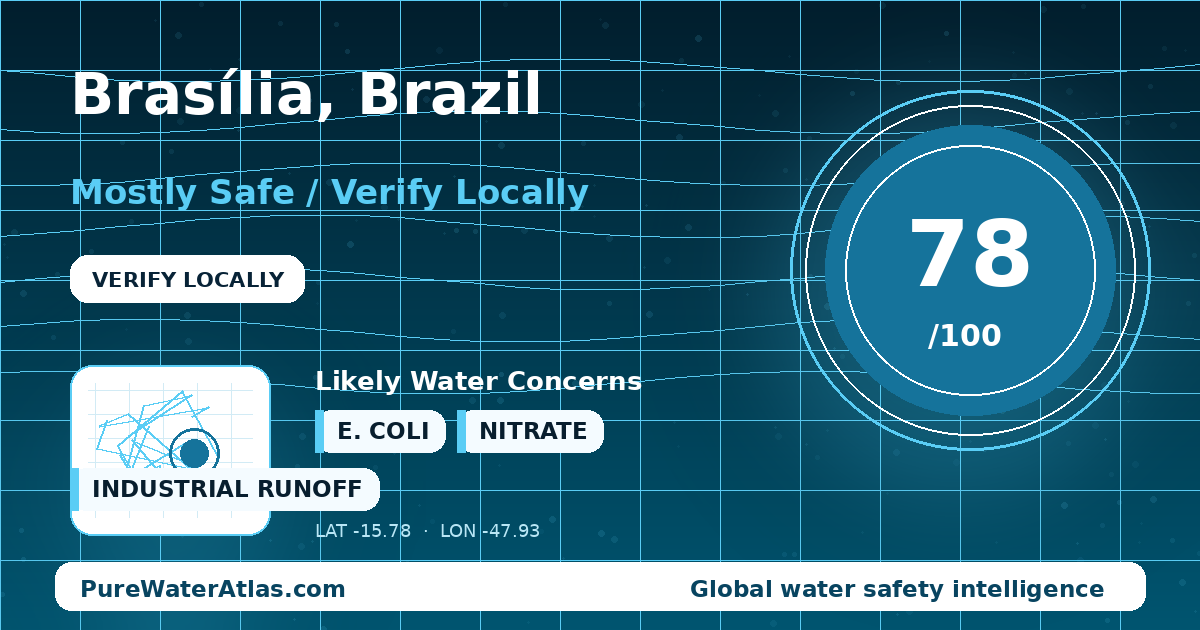
| Overall safety status | Caesb water is treated, monitored and officially intended to meet Brazil’s drinking-water requirements. Available evidence supports a generally potable assessment at the utility level, but safety at a particular tap also depends on the building’s water tank, internal plumbing and recent service conditions. |
|---|---|
| Can visitors drink the tap water? | At a well-maintained property connected to Caesb, the utility says the water can be consumed without a filter. Visitors who cannot verify the source, storage tank or plumbing should use factory-sealed bottled water or another reliably treated source. |
| Resident advice | Check the quality information on the Caesb bill or system report, maintain the property’s tank and plumbing, and investigate unusual color, odor, turbidity or changes following an outage. Test according to the suspected problem rather than choosing a generic filter. |
| Main water source | Surface water dominates the Federal District supply. Major sources include the Descoberto and Santa Maria reservoirs, with Torto and other district systems also contributing. The exact source can vary by administrative region and network configuration. |
| Responsible authority | Caesb operates the public supply; Adasa regulates the service; Federal District health authorities conduct public-health surveillance through the Vigiagua framework. |
| Filter recommendation | No blanket filter recommendation. Use certified carbon for a taste or chlorine issue, an appropriately certified lead-reduction filter for confirmed plumbing-related lead, and suitable disinfection for a demonstrated microbial risk or official advisory. |
Where Does Brasília’s Tap Water Come From?
Official Caesb information identifies the Descoberto and Santa Maria reservoirs among the Federal District’s principal water sources. Caesb says Descoberto historically represents about 60% of district-wide supply, while Santa Maria is a protected reservoir inside Brasília National Park. The Torto reservoir, Pipiripau and several smaller captures also form part of the district system. The Corumbá system has been integrated to strengthen regional supply.
These descriptions apply across the Federal District and should not be read as a fixed blend delivered to every address in Brasília. Interconnected networks, operating decisions and local service arrangements can affect which system supplies a particular administrative region. Someone trying to understand water at a specific apartment, hotel or office should therefore identify the relevant Caesb system rather than assuming that all taps receive identical source water.
Caesb describes source-dependent treatment processes. Depending on raw-water conditions, treatment may involve conventional clarification and filtration or simpler processes appropriate to the source. The utility states that chlorine is used for disinfection and that public supplies are fluoridated. Its monitoring covers source water, treated water and water in distribution, but those controls do not eliminate the separate influence of private storage and plumbing after water reaches a property.
Who Manages Drinking Water?
Caesb captures, treats and distributes public drinking water across the Federal District. The company states that its water laboratory is accredited to NBR ISO/IEC 17025 and that treated-water control follows Ministry of Health Portaria GM/MS 888/2021. Consumers can consult utility reports and the quality summary provided with their water account.
Adasa regulates the service and performs technical oversight of Caesb. Its 2024 inspection plan included review of potability data, semiannual parameters, interruptions, operational incidents and treatment-system performance. Environmental-health surveillance is performed by the Federal District health authority through Brazil’s Vigiagua framework, which addresses drinking-water surveillance and information management.
These responsibilities have an important boundary. Caesb delivers treated water through the public system, but the utility says internal pipes, fixtures and private water tanks are the responsibility of the property owner or user. A compliant utility sample therefore cannot establish that every final tap in a large building has the same quality.
Main Local Water Concerns
The clearest Brasília-specific concern is the possible difference between water in the Caesb network and water after it enters a building. Brasília has many apartment buildings, hotels, offices and homes that use internal storage. A poorly sealed, infrequently cleaned or hydraulically defective tank can allow sediment or microbes to affect water after compliant supply has passed the utility meter. Caesb recommends cleaning and disinfecting a property water tank about every six months.
Internal plumbing can also matter. Stagnation, corrosion or unsuitable fixtures may alter taste, color or metal concentrations. A problem limited to one faucet is more suggestive of that fixture or a nearby plumbing section, while similar changes throughout a building may point toward the shared tank, internal network or incoming supply. This is a practical diagnostic distinction, not proof of the cause.
Repairs, interruptions and pressure loss can temporarily disturb sediment or create conditions requiring additional caution. Users should check Caesb notices and follow any utility or health-authority instruction. Boiling visibly discolored water should not be treated as a complete solution because boiling does not remove sediment or dissolved metals.
Alternative supplies require separate verification. Private wells and boreholes are not equivalent to monitored Caesb water. Tanker water must come from a registered provider and certified vehicle. Federal District rules require potable-water tankers to carry identification, maintain treatment and test records, and provide information on the source, treatment, turbidity, pH, chlorine and coliform results.
No current evidence reviewed here establishes a Brasília-wide emergency involving lead, arsenic, PFAS or another specific chemical. These substances should not be described as confirmed citywide problems without address-specific or system-specific evidence.
For Travelers
A visitor staying at a well-maintained property connected to Caesb can reasonably rely on the utility’s statement that its supplied water is potable. In practice, the unresolved variable is often the hotel or building rather than the treatment plant. Ask whether drinking water comes from Caesb, whether the building uses a storage tank, whether that tank is regularly maintained, and whether a recent outage or advisory applies.
If staff cannot confirm the source or storage condition, use factory-sealed bottled water for drinking, brushing teeth, making ice and taking medication. Check that the seal is intact. CDC travel guidance recommends avoiding tap water whenever a traveler is not reasonably certain that it is safe. Ordinary tap water should not be used for contact lenses or nasal rinsing.
A chlorine taste by itself does not establish that the water is unsafe; chlorine provides residual microbial protection. Conversely, clear appearance does not prove that an uncertain well, tanker or neglected tank is microbiologically safe. Travelers comparing destinations can consult the PureWaterAtlas guides for São Paulo and Rio de Janeiro, but conditions in those cities do not establish conditions in Brasília.
For Residents
Start with the information already available for the property. Read the monthly quality summary on the Caesb bill, consult annual and system-level results, and identify which supply system serves the address. Utility reports describe the public supply; they should be interpreted alongside the condition of the building’s tank and plumbing.
Keep private tanks covered, structurally sound and separated from possible contamination sources. Arrange cleaning and disinfection at roughly six-month intervals as advised by Caesb, and retain maintenance records where several residents or tenants share the system. Building managers should investigate damaged covers, sediment, hydraulic defects or unexplained changes rather than relying only on a countertop filter.
After prolonged stagnation, use cold water and flush until the temperature stabilizes before collecting water for drinking or cooking. If water becomes cloudy, colored or unusually odorous, compare hot and cold taps and test more than one fixture. Ask neighbors whether the issue is limited to the unit or present throughout the building, then check for a Caesb repair or interruption notice. A problem only in hot water may involve the property’s hot-water system rather than the incoming cold supply.
Do not drink visibly discolored water until the cause is resolved. After an outage, follow instructions from Caesb or the health authority instead of assuming that any household filter makes the water safe. Properties using a private well, shared borehole or tanker should retain current laboratory records and verify that the source, vehicle and supplier are properly authorized.
Relevant Contaminants and Water Quality Issues
Microbiological indicators such as total coliforms and E. coli are central when evaluating a storage tank, private well, tanker delivery or water affected by loss of pressure. Their relevance is a testing priority, not evidence that E. coli is currently present throughout Brasília. See the PureWaterAtlas guide to E. coli removal and treatment.
Turbidity and disinfectant residual help assess whether treatment and distribution barriers are functioning. Unusual turbidity after repairs should be investigated, especially if it persists after utility instructions have been followed. Chlorine may produce a noticeable taste or odor while serving as residual protection against microbial contamination. Removing that taste with carbon is a preference decision, not automatically a safety requirement.
Metals such as lead or copper are primarily premise-plumbing concerns when old or unsuitable fixtures are present. Iron and manganese may also be relevant when investigating staining, color or metallic taste. No evidence reviewed here establishes a Brasília-wide lead problem. Residents with a confirmed lead result can consult the lead in drinking water guide and certified lead-filter comparison.
Source-water studies, national datasets or reports from other Brazilian cities must not be treated as proof of contamination at a treated Brasília tap. A useful conclusion requires evidence matched to the correct supply system, property and sampling point.
How to Verify Your Water Quality
First identify the supply: Caesb network, private well, shared borehole, tanker or another arrangement. For Caesb water, obtain the system name and compare the utility’s monthly or annual results with the quality information on the bill. Note whether the concern began after an interruption, is shared by neighboring properties or appears only inside one building.
If the issue is limited to a property, inspect the building tank and plumbing before assuming that the treatment plant is responsible. For suspected storage contamination or pressure problems, request laboratory analysis for E. coli, total coliforms, turbidity and disinfectant residual. Sampling should distinguish incoming water, stored water and a final tap when that is necessary to locate the problem.
For metallic taste, staining or older fixtures, collect samples under laboratory instructions for lead, copper, iron and manganese. First-draw and flushed samples can help distinguish a premise-plumbing contribution from incoming water, but collection details should come from the laboratory so the results remain interpretable.
Private groundwater needs a broader risk-based panel that normally includes E. coli, coliforms, nitrate, turbidity, pH, conductivity and locally plausible metals or pesticides. Tanker users should request the supplier’s sanitary registration, vehicle certificate and current laboratory record, as well as the required source and treatment information.
Use an accredited laboratory and preserve the sampling chain correctly. Do not rinse sample bottles or change preservation and holding instructions. PureWaterAtlas readers can review the water-testing guide, use the contaminants search engine, and check broader destination context with the global water-quality checker.
Treatment Guidance
No extra treatment is automatically necessary for clean Caesb water delivered through well-maintained storage and plumbing. Treatment should respond to a verified contaminant, a documented building problem or an official advisory. Selecting equipment only because water tastes unfamiliar can add maintenance obligations without addressing the actual risk.
For chlorine taste or odor, a properly certified activated-carbon filter can help. Carbon does not reliably disinfect contaminated water, and a neglected cartridge can support microbial growth. Replace cartridges according to their capacity and maintenance requirements.
If laboratory testing confirms lead from premise plumbing, use a filter specifically certified for lead reduction, observe cartridge-capacity limits and address the plumbing source. Boiling does not remove lead. The same principle applies to other dissolved chemicals: treatment performance must match the substance demonstrated by testing.
For a confirmed microbial problem or official boil-water advisory, boiling is an emergency barrier against pathogens. CDC guidance advises bringing water to a rolling boil for one minute at elevations below 6,500 feet. Follow any more specific local instruction if issued. Boiling does not remove metals, pesticides, PFAS, nitrate or sediment and can concentrate nonvolatile dissolved chemicals.
UV can address microbes only when correctly sized, maintained and supplied with sufficiently clear water; it does not remove chemicals. Reverse osmosis should be selected only for a measured dissolved contaminant that the specific certified unit is designed to reduce. For more detail, see choosing a water-treatment system and the drinking-water safety library.
Official and Technical Sources
- Caesb: Relatório Anual da Qualidade da Água, including reports through 2024.
- Caesb: Relatório da Qualidade da Água Distribuída pela Caesb em 2024.
- Caesb: water information, analyses, treatment and monitoring.
- Caesb: user questions and answers and the utility’s responsibility boundaries.
- Caesb: 2024 management report and reservoir information.
- Adasa: 2024 annual inspection plan.
- Federal District Health Secretariat: sanitary requirements for potable-water tankers.
- Ministry of Health: Vigiagua drinking-water surveillance program.
- CDC: Brazil traveler guidance and food and water precautions for travelers.
Bottom Line
Brasília’s Caesb supply is treated, chlorinated, monitored and intended to meet Brazil’s drinking-water standard. The official 2024 distributed-water quality report supports a generally potable assessment at the utility level. It does not prove that every final tap is safe, particularly where a building tank is neglected, plumbing is defective, pressure has recently been lost, or water comes from a private well or tanker.
Visitors should confirm the property’s source and storage conditions and use sealed bottled water when they cannot do so. Residents should maintain tanks, investigate changes promptly and test according to the suspected pathway. The most useful response is not a generic filter, but a source-specific decision based on utility information, building conditions and appropriately collected laboratory evidence.
Read the full guide: Global Water Quality Guide
Explore more in this category: Global Water Quality Articles