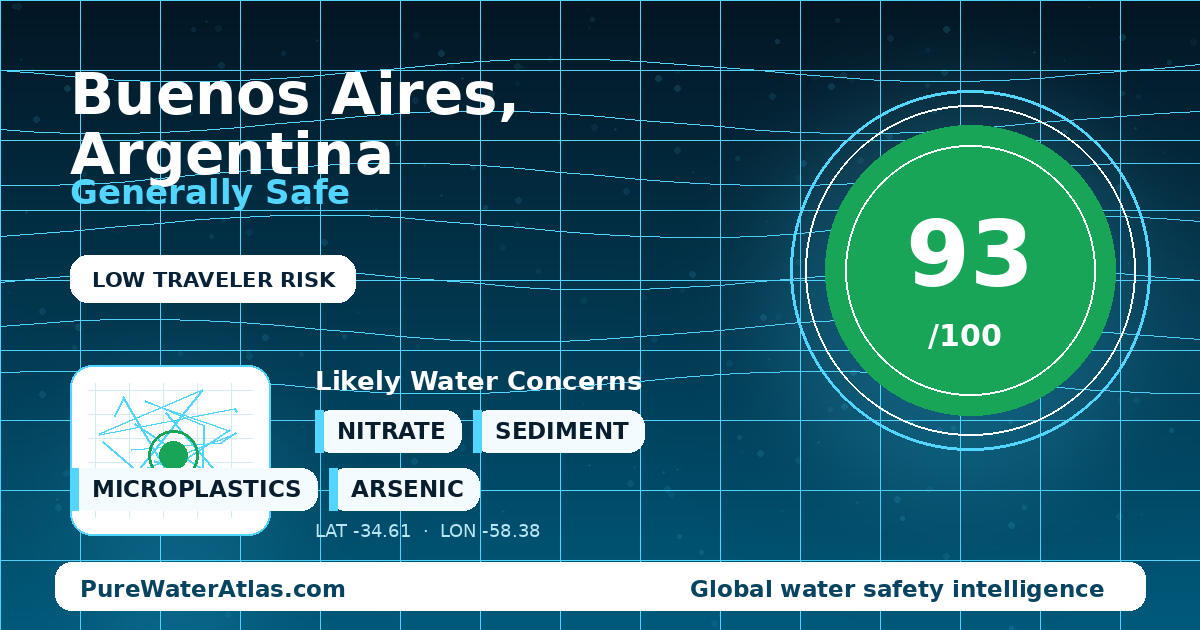
Buenos Aires tap water is generally considered drinkable when it comes from the normal AySA public network. The city’s official tourism service explicitly says that tap water is drinkable, while AySA treats and monitors water serving the capital under ERAS oversight. This citywide conclusion does not guarantee the condition of every individual faucet. Apartment storage tanks, internal pipes, stagnation and temporary service interruptions can affect water after it enters a property.
Quick Answer
| Overall safety status | Generally drinkable under normal AySA network conditions, subject to building-level and interruption-related caveats. |
|---|---|
| Can visitors drink the tap water? | Usually yes. Confirm that the building has no current tank, plumbing or outage problem if the water looks, tastes or smells abnormal. |
| Resident advice | Review AySA service notices and ask the administrator for the building’s most recent annual tank-water analysis. |
| Main water source | Primarily treated surface water from the Río de la Plata. |
| Responsible authority | AySA operates the public supply; ERAS regulates water-service quality. |
| Primary local caveat | Water can change inside a building because of storage tanks, internal plumbing, stagnation or a pressure interruption. |
| Filter recommendation | No universal filter is necessary. Select treatment only after identifying the specific problem it is intended to address. |
What “Generally Drinkable” Means in Buenos Aires
The official position is straightforward: public-network tap water in the City of Buenos Aires is potable. This is supported by the city’s tourism guidance, the utility’s treatment and monitoring information, and ERAS regulatory oversight. It is therefore not accurate to characterize all Buenos Aires tap water as unsafe or to assume that bottled water is automatically required.
Potability at the public-system level and water quality at a particular kitchen faucet are nevertheless different questions. AySA is responsible for producing and distributing treated water through its network. Once that water passes through a property’s storage and plumbing, its condition may also depend on the building. This distinction is especially relevant in apartment buildings that use tanks or have older common pipes.
A temporary change in color, odor or taste does not by itself identify a contaminant or its source. It may be limited to one fixture, shared by an entire building, or present in the surrounding area. The practical response is to establish the scale of the problem, check for service information and investigate the building system rather than immediately drawing a citywide conclusion.
Where Does Buenos Aires’s Tap Water Come From?
Buenos Aires is supplied primarily with treated surface water from the Río de la Plata. AySA identifies river water as the dominant source across its concession and monitors conditions in the Río de la Plata so that treatment can respond when source-water conditions change. The public network is the normal source for city households; Buenos Aires government data also provides historical evidence that public-network water was overwhelmingly dominant.
The General San Martín treatment plant, located in Palermo, explicitly supplies the City of Buenos Aires as well as several surrounding districts. AySA lists the plant’s treatment capacity as 3.1 million cubic metres per day. Its role helps explain why discussion of the city’s ordinary tap water should focus primarily on treated Río de la Plata water rather than on private groundwater.
AySA also produces groundwater elsewhere in its much larger metropolitan concession and reports that groundwater accounts for about 13% of concession-wide production. That figure must not be assigned specifically to CABA: the utility’s public information does not provide a city-only groundwater share. A percentage covering the full concession cannot establish what reaches a particular address in the capital.
Private wells and tanker deliveries are not representative of normal Buenos Aires household supply. Water from those sources falls outside the simple conclusion that ordinary AySA network water is generally drinkable and requires source-specific assessment or testing.
Treatment, Monitoring and Regulatory Oversight
AySA reports continuous controls, daily sampling, laboratory monitoring and surveillance of the Río de la Plata. These functions cover several stages of the supply process: observing the source, controlling treated water and checking water within the distribution system. Monitoring at multiple stages matters because source conditions, treatment performance and network conditions are not interchangeable.
ERAS provides regulatory oversight and describes a framework covering 39 regulated parameters, with approximately 750 monitoring points and independent verification. These numbers refer to the broader regulated system; they should not be interpreted as a test result for every building or every faucet. They do, however, show that the public safety assessment is based on an organized monitoring framework rather than on appearance alone.
AySA’s transparency materials also list 2024 audits covering produced water and distribution-network water. The Argentine Food Code provides chemical, physical and microbiological criteria for potable water, including the absence of E. coli and a disinfectant residual. Together, these utility, regulatory and national criteria support the conclusion that normal public supply is intended and monitored as drinking water.
Consumers should still distinguish system-level compliance from a complaint at one address. A regulator or utility can assess the public network, but neither a general report nor a citywide monitoring result proves that a privately maintained tank, internal pipe or individual faucet is in good condition.
Building Tanks and Internal Plumbing
Building storage is one of the most important local qualifications to the overall safety conclusion. CABA Law 6040 addresses water-storage tanks, including annual water testing, maintenance responsibilities and corrective-action requirements. For a resident, the useful document is the building’s own recent tank-water record, not merely a general statement that AySA water is monitored.
Residents can ask the administrator for the most recent annual bacteriological and physicochemical analysis. The record should correspond to water in the building system and should be considered alongside any recent tank cleaning, maintenance issue or interruption. If the required analysis identified a problem, the relevant question is what corrective action followed.
Internal pipes create a separate boundary. Water can meet public-network requirements and later be affected by corroding components, a poorly maintained tank, stagnation or a fixture-specific problem. This is why two apartments in the same neighborhood—or even two taps in the same building—may not present exactly the same situation.
Potential Concerns and How to Interpret Them
Temporary Service Interruptions
Planned or unplanned interruptions deserve attention because pressure and flow conditions may be temporarily different from normal operation. AySA provides an address- or account-based service-interruption checker. If a noticeable change appears after an outage, residents should review current utility information and ask whether the building experienced its own pumping or tank problem.
An interruption does not prove that water is contaminated, but it supplies useful context. While an active advisory or unresolved abnormality is being investigated, use a known safe alternative rather than relying on guesswork.
Color, Odor or Taste Changes
Appearance and smell are useful warning signs but are not complete tests of safety. Clear water can still require investigation in some circumstances, while an aesthetic change does not identify a particular chemical or microorganism. First determine whether the issue affects hot and cold water, one tap, the whole apartment, the whole building or nearby properties.
If only hot water is affected, the observation does not necessarily describe the incoming cold-water supply. If only one cold tap is affected, inspect the issue as a fixture or internal-branch concern. If multiple apartments report the same change, building management should assess the common tank and plumbing. A neighborhood-wide change should be reported to AySA and compared with official service information.
Metals From Premise Plumbing
Old or corroding plumbing can justify testing metals at the tap even when utility water is compliant at the property boundary. Lead was not identified in this research as a demonstrated citywide AySA problem. It should therefore be treated as a conditional premise-plumbing concern, not presented as a Buenos Aires-wide contaminant claim.
The age or uncertain composition of a building’s plumbing, visible corrosion or a problem isolated to internal fixtures may support targeted investigation. Residents assessing older plumbing can use the lead home safety checklist to organize questions and next steps.
For Travelers
The official City of Buenos Aires tourism website says that tap water is drinkable. Most visitors staying in a hotel or apartment supplied by AySA can therefore drink normal-looking cold tap water and use it for brushing their teeth. There is no general need to buy bottled water solely because the destination is Buenos Aires.
- Ask the accommodation whether there has been a recent outage, tank-maintenance issue or building plumbing problem if water is discolored or has an unusual odor.
- Check whether the concern is limited to your room or apartment. A single affected fixture points to a different problem from complaints throughout the property.
- Use a known safe alternative while an active advisory or unresolved building problem is being investigated.
- Do not use ordinary tap water for contact lenses or sinus rinsing; those uses require appropriately sterile water even where tap water is potable.
- People with severe immune suppression should follow advice from their clinician, particularly when staying in a building with uncertain tank maintenance.
Travelers using accommodation supplied by a private well, tanker or another nonstandard source should not assume that the general AySA conclusion applies. Ask the host to identify the source and provide relevant building or water-quality information.
For Residents
Residents should begin with records and comparisons rather than purchasing treatment immediately. Ask the building administrator for the latest annual bacteriological and physicochemical tank analysis, whether any corrective action was required, and whether there has been a recent service interruption or tank-maintenance problem.
If a problem occurs, compare a cold-water sample taken near the building entry, where accessible and appropriate, with water from the affected apartment. Also compare multiple cold taps. A problem at only one fixture points more strongly toward the tap, flexible connector or internal branch. A building-wide problem may involve the tank or common plumbing, while a neighborhood-wide change should be reported to AySA.
AySA’s interruption page can help determine whether planned work applies to an address or account. This check is more useful than relying on a general assumption about service elsewhere in the city. Keep a simple record of when the change began, which fixtures are affected and whether neighbors observe the same condition; that information helps separate a fixture complaint from a wider event.
Testing and Treatment Decisions
Testing should answer a defined question. A building tank report is useful for assessing the stored water represented by that sample. A tap sample is more relevant when the concern is internal plumbing or a specific faucet. A general AySA report provides important system context but cannot replace sampling inside a property when the suspected issue arises there.
Choose the parameters according to the concern. Bacteriological and physicochemical analysis is already part of the annual building-tank framework. Metals testing may be appropriate where older or corroding plumbing is suspected. Private wells, tanker water and other nonstandard sources require separate evaluation rather than assumptions based on AySA’s network monitoring.
No single filter is automatically necessary for every Buenos Aires household. Treatment should follow identification of the problem, and the selected device must be intended for that problem. A product bought only because it is marketed as a “water filter” should not be assumed to address every microbiological, chemical or plumbing-related concern. Operation and replacement requirements also matter; treatment cannot substitute for correcting a neglected tank or damaged internal pipe.
For unexplained changes, a sensible sequence is to check AySA notices, ask building management about tanks and common plumbing, compare affected and unaffected taps, and then arrange targeted analysis if the issue remains unresolved. PureWaterAtlas’s water-testing guide provides broader context on planning an appropriate test.
Official and Technical Sources
- AySA — Agua potable — Agua y Saneamientos Argentinos S.A.
- AySA — Planta General San Martín — Agua y Saneamientos Argentinos S.A.
- AySA — Calidad del agua — Agua y Saneamientos Argentinos S.A.
- ERAS — Normas de calidad — Ente Regulador de Agua y Saneamiento
- AySA — Auditorías y evaluaciones — Agua y Saneamientos Argentinos S.A.
- CABA Law 6040 — Water storage tanks — Boletín Oficial del Gobierno de la Ciudad de Buenos Aires
- Buenos Aires official tourism — Health and security — Government of the City of Buenos Aires
- Argentine Food Code — Resolution 22/2021 — Government of Argentina
- AySA — Service interruptions — Agua y Saneamientos Argentinos S.A.
- Buenos Aires Data — Procedencia de agua por comuna — Government of the City of Buenos Aires
Related Contaminant Profiles
Explore PureWaterAtlas
- Contaminants Search Engine
- Global Water Quality Checker
- drinking-water safety guide
- water-testing guide
- Water Testing resources
Bottom Line
Normal AySA tap water in the City of Buenos Aires is officially treated as drinkable and is monitored under ERAS oversight. Visitors generally do not need bottled water or a safety filter solely because they are in Buenos Aires. The primary source is treated Río de la Plata water, with the General San Martín plant in Palermo explicitly serving the city.
The most important qualification is the building itself. Storage tanks, internal plumbing, stagnation and temporary pressure interruptions can affect water after it leaves the public network. If water changes unexpectedly, check official service notices, ask for the building’s tank records and determine whether the issue affects one fixture, the whole property or the surrounding area. Use targeted testing to define any problem before purchasing treatment.
Read the full guide: Global Water Quality Guide
Explore more in this category: Global Water Quality Articles