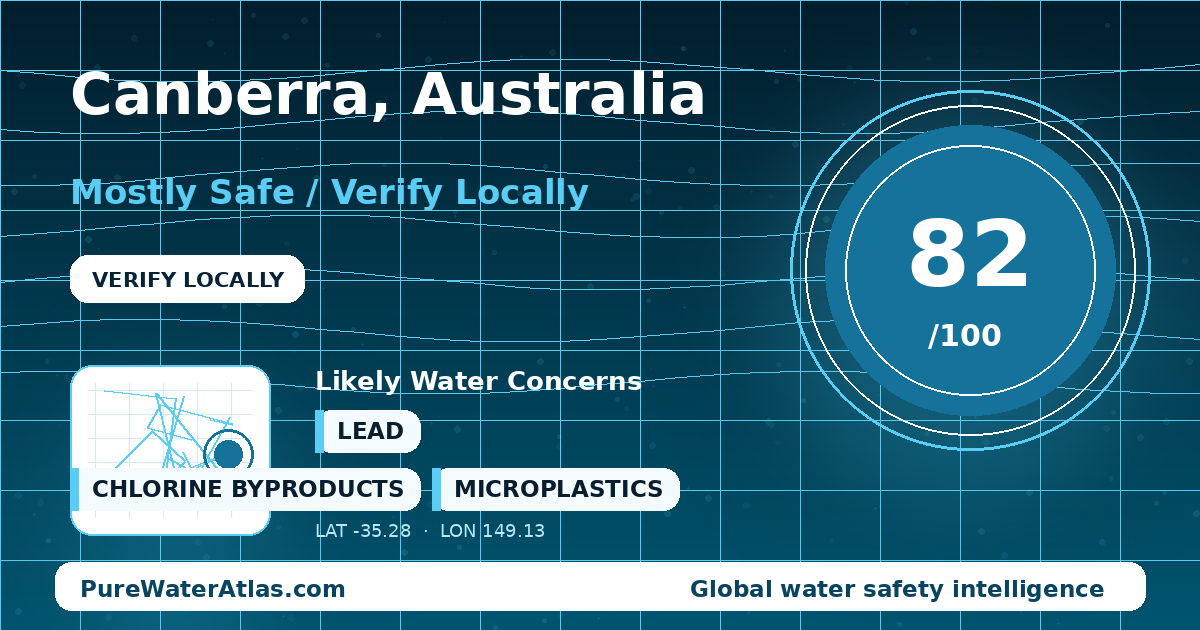
Canberra has a well-regulated surface-water supply operated by Icon Water. The strongest comprehensive report verified for this review found that all applicable health-related results met the Australian Drinking Water Guidelines in 2023–24. More recent official testing also reports no PFAS detections in final treated water. Together, that evidence supports a generally safe assessment for water reaching the customer connection, although it does not guarantee the condition of every tap inside every property.
The distinction matters because water quality can change after water passes from the public network into a building. Stagnation, ageing fittings, plumbing corrosion, private tanks and disturbances after an outage can all require property-specific judgment. Residents and visitors should therefore combine the reassuring system-wide results with current notices and what they observe at the tap.
Quick Answer
| Overall safety status | Generally safe at the utility connection based on verified official evidence. Icon Water reported 100% compliance with applicable health values in 2023–24. |
|---|---|
| Can visitors drink the tap water? | Usually yes in mains-connected accommodation unless a current notice says otherwise. Do not drink water that is visibly discoloured or has an objectionable smell or taste. |
| Resident advice | Use the cold tap for drinking and cooking, flush after stagnation, check outages after a sudden colour change and investigate plumbing when only internal taps are affected. |
| Main water source | Surface water from the Cotter River reservoirs and Googong Reservoir, with the Murrumbidgee River available as an additional source. |
| Responsible authority | Icon Water operates the system; ACT Health licenses and regulates drinking-water supply. |
| Filter recommendation | No routine safety filter is supported by the verified mains-water results. Choose treatment only after identifying a specific tap-level problem. |
Where Does Canberra’s Tap Water Come From?
Canberra’s drinking-water supply is built around three surface-water catchments. Corin, Bendora and Cotter reservoirs store Cotter River water, while Googong Reservoir impounds the Queanbeyan River. Icon Water can also abstract water from the Murrumbidgee River when operating conditions require it. These sources form a managed regional system rather than a set of fixed, suburb-by-suburb supplies.
The source mix can change with storage, catchment and operational conditions. During 2023–24, the three Cotter reservoirs supplied 86% of delivered water and Googong supplied the balance. Mount Stromlo Water Treatment Plant produced 44.2 gigalitres that year, compared with 7 gigalitres at Googong. A household should not use those annual percentages to determine the exact source of water coming from its tap on a particular day.
Source and treatment-plant figures also need careful interpretation. They describe the origin of raw water and the amount produced by each plant, not the safety of untreated water in a reservoir, river or stream. Canberra’s safety assessment applies to water that has moved through source protection, treatment, monitoring and the distribution system. It does not mean that untreated catchment water is suitable for direct consumption.
Who Manages Drinking Water?
Icon Water owns and operates the dams, treatment plants, service reservoirs, pump stations and mains serving the ACT. ACT Health regulates the drinking-water utility under the Public Health Act and the Public Health (Drinking Water) Code of Practice 2007. The code requires monitoring, health-incident notification and a public annual report assessed against the Australian Drinking Water Guidelines.
Icon Water describes its water-quality management in terms of the Australian Drinking Water Guidelines and a HACCP framework. Laboratory testing is part of that system, including NATA-accredited analysis where applicable. This preventive approach is important because drinking-water management is not based only on testing finished water after treatment; it also involves understanding risks from the catchment through to the distribution network.
At Mount Stromlo, treatment includes coagulation, flocculation, filtration, ultraviolet disinfection, chlorination, fluoridation and pH adjustment. Googong uses coagulation and flocculation, clarification or dissolved-air flotation, filtration, chlorination, fluoridation and pH adjustment. The processes differ in detail, but both plants use multiple treatment barriers rather than relying on a single step.
Chlorination also leaves a residual disinfectant that provides continuing microbiological protection as water travels through the network. That network protection is separate from any issue that may arise after water enters private plumbing, a storage tank or a building’s hot-water system.
Main Local Water Concerns
Water discoloration after outages
Canberra has about 3,400 kilometres of mains, including some pipes that are up to a century old. Bursts, maintenance or a reversal in flow can disturb iron and manganese deposits. The result may be temporary yellow, orange, brown or black water, sometimes accompanied by visible particles.
A sudden colour change affecting multiple cold taps may therefore be associated with a network disturbance rather than a change at the treatment plant. Icon Water advises checking for an outage and, after it is resolved, running the tap nearest the meter for about three minutes. Using the meter-adjacent tap helps draw disturbed water out without first pulling it through more of the building’s internal pipework.
Water that remains discoloured or has an objectionable taste or smell should not be used for drinking, cooking or bathing. Persistent colour, especially when nearby properties are unaffected or only one outlet has a problem, warrants further investigation rather than repeated indefinite flushing.
Plumbing beyond the meter
Utility compliance does not characterize every building. Once water crosses into premise plumbing, its condition may be affected by the materials, fittings, maintenance and pattern of use within that property. This is why a compliant utility result and an unusual result from one household tap are not necessarily contradictory.
Australian health guidance says lead service pipes are unusual nationally, but some brass fittings and older solder can release lead after water stagnates. Copper corrosion can create a metallic taste, blue-green water or staining. These effects may be more noticeable at outlets that are rarely used or after water has remained in contact with plumbing for an extended period.
Use cold water for drinking, cooking and infant formula, and flush an outlet after overnight or longer non-use. Hot water should not be treated as a shortcut for food or drink preparation. If a building has relevant age, fitting or stagnation concerns, see the lead in drinking water guide and home safety checklist.
PFAS requires geographic qualification
PFAS-contaminated land has been identified at some emergency-services sites in the ACT, but the existence of contaminated land does not establish contamination of Canberra’s mains supply. Site investigations, source-water findings and final treated-water results need to be kept separate.
Icon Water’s official tables report no PFHxS, PFOS, PFBS or PFOA detections in final treated-water samples, including Mount Stromlo samples through March 2026 and Googong samples through October 2025. Low source-water detections have either been followed by non-detects or attributed to sampling contamination. The utility also identifies reporting limits and NATA-accredited analysis in its PFAS information.
On the evidence reviewed, household PFAS treatment is not supported as a routine response for ordinary Canberra mains water. Residents should not infer a tap-water problem solely from the presence of a geographically separate contaminated site. If future accredited testing detects PFAS at a particular property, consult the PFAS treatment guide and interpret the result in its sampling and supply context.
Raw-water hazards are managed hazards
Bushfires, erosion, recreation and development can affect catchment water. The ACT’s catchment sanitary survey work considers these pressures because they can influence raw-water quality and treatment needs. Their presence is not, by itself, proof that finished tap water is unsafe.
Canberra’s supply is designed around source protection, selective abstraction, filtration and disinfection rather than reliance on raw-water purity alone. This multiple-barrier approach explains why discussion of catchment hazards should not be confused with a result from treated water at a customer connection.
For Travelers
Visitors can generally drink cold tap water in mains-connected hotels, rentals and homes. Canberra’s official travel guidance describes treated tap and fountain water as generally drinkable. A traveler normally does not need to buy bottled water merely because the accommodation is in Canberra.
There are still sensible checks. Ask the operator if a property uses tank water or if a temporary notice applies. After entering a room that may have stood unused, let the cold tap run briefly before filling a bottle. If the water is strongly discoloured or objectionable in smell or taste, do not use it and notify the accommodation operator.
Do not assume that water from lakes, streams, campground outlets or private rural tanks is potable simply because Canberra’s municipal supply is regulated. Those are separate supplies with different sanitary conditions and monitoring arrangements.
Travelers comparing destinations can use the Global Water Quality Checker. Separate guides cover Sydney and Melbourne; neither city’s utility evidence should be transferred to Canberra.
For Residents
- Use cold water for drinking, cooking and infant formula.
- Flush drinking outlets after overnight or extended stagnation, especially where a tap is rarely used.
- Replace filter cartridges on schedule; neglected filters can accumulate deposits or microbial growth.
- Check Icon Water’s outage information after sudden changes in colour, flow or pressure.
- Compare an affected internal tap with the cold tap nearest the meter. An internal-only problem points toward premise plumbing.
- Check whether the problem affects cold water, hot water or both. A hot-only issue directs attention toward the building’s hot-water system rather than the incoming cold supply.
- Ask whether neighbouring properties are experiencing the same change. A wider pattern can help distinguish a network event from a single-building issue.
- Treat rainwater, bore water and delivered water as separate supplies requiring their own sanitary assessment and tests.
Repeated flushing should not substitute for diagnosis when a problem persists. Network-level concerns belong with Icon Water, while a licensed plumber is the appropriate contact when the evidence points to internal plumbing. During a current incident, follow official instructions rather than relying on general household guidance.
Relevant Contaminants and Water-Quality Issues
E. coli and microbial indicators: these are priorities after a loss of supply integrity and for private water. Canberra’s municipal system uses filtration, ultraviolet treatment at Mount Stromlo, chlorine and a residual disinfectant. A household carbon filter alone does not disinfect water and should not be treated as a response to a suspected microbial incident.
Lead and copper: these are mainly tap- and building-specific concerns. First-draw and flushed samples can help distinguish stagnation and plumbing effects from incoming water. Sampling instructions matter because an uncontrolled sample may not answer the intended question. Boiling does not remove dissolved metals.
Iron and manganese: disturbed deposits can cause temporary colour or sediment after maintenance, bursts or changes in flow. Filtration may capture particles, but clearer-looking water after filtration does not establish that otherwise unexplained water is safe. Check the outage context and follow utility advice.
PFAS: contaminated land and low-level source-water findings should not be represented as detections in final drinking water. The official final-water results reviewed here were non-detects for the listed PFAS compounds.
Cloudiness: water that clears from the bottom upward after standing is commonly caused by harmless air. This can occur when tiny bubbles leave the water. Water that does not clear, contains persistent material or has another objectionable quality should be investigated. See the cloudy tap water profile.
Do Canberra Homes Need a Water Filter?
The verified municipal results do not support a blanket recommendation that Canberra households install a filter for safety. A device should be selected only after the user has identified the problem it is meant to address. Otherwise, a filter may add cost and maintenance without resolving the actual cause.
For example, temporary particles after a network disturbance, dissolved metals from premise plumbing and a suspected microbial problem are not the same issue. They require different investigation and should not be grouped under a vague desire to “improve” water. Boiling does not remove dissolved lead or copper, while a carbon filter alone does not provide disinfection.
Any installed filter must be maintained according to its replacement schedule. If testing is justified, obtain a reliable result first and match treatment to that result. A persistent internal-plumbing problem may require plumbing work rather than continued treatment at one outlet.
How to Verify Your Water Quality
- Confirm whether the property uses Icon Water mains water or a private source such as rainwater, bore water or delivered water.
- Check current utility outages, faults and notices before assuming the change is caused inside the property.
- Compare the cold tap nearest the meter with internal cold taps and hot-water taps.
- Record colour, smell, taste, pressure, affected outlets and the time since each outlet was last used.
- Ask whether the issue began after an interruption, maintenance event or period of non-use.
- Call Icon Water for a network-level concern or a licensed plumber for an internal-only problem.
- Use a NATA-accredited laboratory when testing is needed. Obtain sampling instructions before collecting water.
The choice of sample should reflect the question. A first-draw sample can help examine water that has been standing in premise plumbing, while comparison with a flushed sample can provide useful context. A meter-adjacent sample can also help separate incoming-water conditions from effects farther inside the building.
The PureWaterAtlas water-testing guide, Contaminants Search Engine and Drinking Water Safety resources can help organize testing, but official ACT instructions take priority during an incident.
Official and Technical Sources
- Icon Water 2023–24 Drinking Water Quality Report — Icon Water
- PFAS and drinking water — Icon Water
- Water quality — Icon Water
- Water Treatment — Icon Water
- Mount Stromlo Water Treatment Plant — Icon Water
- Googong Water Treatment Plant — Icon Water
- Public Health (Drinking Water) Code of Practice 2007 (No 1) — ACT Legislation Register
- Per- and poly-fluoroalkyl substances (PFAS) — ACT Government
- Water discolouration — Icon Water
- Emergencies, faults and outages — Icon Water
- Water resources — ACT Government
- ACT Water Strategy Report Card 2024–25 — ACT Government
- Lead in drinking water from some plumbing products — Australian Government Department of Health and Aged Care / enHealth
- Australian Drinking Water Guidelines — National Health and Medical Research Council
- Travel Tips — Drinking water — VisitCanberra
Related Contaminant Profiles
Related City Water Guides
- Is Tap Water Safe in Melbourne? Water Quality & Safety Guide
- Is Tap Water Safe in Sydney? Water Quality & Safety Guide
Explore PureWaterAtlas
Bottom Line
Canberra’s regulated mains water is generally suitable for drinking without a household filter. The verified comprehensive report recorded full compliance with applicable health values in 2023–24, and later official testing found no listed PFAS in final treated water. The conclusion applies to the managed utility supply up to the property connection, not every private tank, bore, hot-water system or internal tap. Check current notices, use cold water for consumption, avoid objectionable water and investigate persistent building-specific problems rather than assuming that a system-wide compliance result describes every outlet.
Read the full guide: Global Water Quality Guide
Explore more in this category: Global Water Quality Articles